This matters most for sectors where custom software is non-negotiable. Legal firms managing case workflows, finance companies building compliant reporting tools, and marketing teams needing bespoke analytics platforms all share a common problem: off-the-shelf solutions don't fit, and lengthy custom builds carry significant delivery risk.
This article covers what AI agents actually are (and how they differ from basic AI tools), the distinct types used in modern builds, the real-world benefits for delivery speed and quality, sector-specific applications, the Privacy Act considerations for Australian businesses, and what to look for in a development partner using them.
Key Takeaways
- AI agents are autonomous systems that handle multi-step tasks end-to-end, not simple code autocomplete
- Custom builds typically combine multiple agent types matched to different workflow stages
- Continuous automated testing shifts quality assurance from end-of-project to embedded throughout
- Regulated sectors require APP-compliant architecture and human review gates built into every agentic workflow
- Senior engineering oversight remains essential; AI agents accelerate output but do not replace engineering judgment
What Are AI Agents in Software Development?
An AI agent is an autonomous software system that perceives inputs, reasons about goals, plans multi-step actions, uses external tools (APIs, databases, CI/CD pipelines) and iterates based on feedback. As Anthropic's engineering documentation describes it, agents differ from standard workflows because the LLM dynamically directs its own processes and tool use, rather than following predefined code paths.
The Agent Loop
What makes an agent an agent is a specific control loop:
- Perception — reads the codebase, task brief, or error log
- Planning — breaks the goal into discrete subtasks
- Execution — writes code, runs tests, opens pull requests
- Evaluation — checks outcomes and self-corrects before stopping
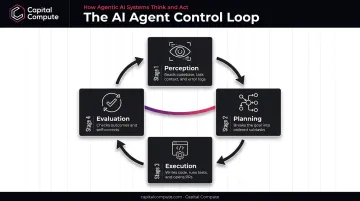
OpenAI's agent documentation defines exit conditions that include a final response, structured output, an error, or a turn limit — not just a single completed action. Simple chat interfaces and single-turn LLM calls don't qualify as agents because the model doesn't control workflow execution.
Agents vs. Assistants
The distinction matters directly for anyone commissioning a build. An AI assistant suggests a fix. An AI agent detects a failing test, identifies the root cause, implements the fix, reruns the tests, and marks the task complete — maintaining context across the entire sequence without a human directing each step.
Custom builds involve continuous cycles of specification, implementation, testing, and revision. That's precisely the multi-step, context-dependent workflow agents are built for, and where assistants consistently fall short.
Types of AI Agents Used in Custom Builds
Not all AI agents work the same way. Different types suit different stages of a custom development project, and production builds typically combine more than one.
Simple Reflex Agents
These act on the current state using predefined rules — no memory, no planning. In development contexts, they handle predictable rule-based tasks: linting checks, formatting enforcement, triggering a build when code is pushed. Useful for bounded, deterministic tasks; unable to handle ambiguity or complexity.
Model-Based and Goal-Based Agents
Model-based agents maintain an internal representation of the world — the state of the codebase, what's changed, which tests are passing — allowing them to reason across past actions and anticipate future states.
Goal-based agents extend this further. They work toward a defined objective ("implement this feature and ensure all tests pass") and make decisions that move toward that goal. These agents do the heavy lifting in custom builds:
- Writing and refactoring features across multiple files
- Managing multi-step implementation tasks
- Handling context that spans multiple sprints
Learning Agents
Learning agents improve over time by processing feedback from their environment. In an active project, they adapt to the codebase's conventions, catch recurring patterns, and produce better outputs as they accumulate context.
This is why context-setting at project start matters so much. Tools like Codex read an AGENTS.md file before starting work; Claude Code uses CLAUDE.md for persistent project instructions. What you put in determines what you get out:
- Architecture decisions and data models
- Coding conventions and naming standards
- Known constraints (regulatory requirements, performance boundaries)
Multi-Agent Systems
Modern custom builds increasingly use multi-agent systems: an orchestrator agent manages task flow and delegates to specialised sub-agents. Anthropic's documented architecture uses a lead agent to break down a query, spawn parallel subagents, and synthesise their findings.
Applied to software development, this mirrors a real team structure:
- A product manager agent grooms requirements
- A software engineer agent implements
- A QA agent verifies independently
- A documentation agent captures decisions as context for future sprints
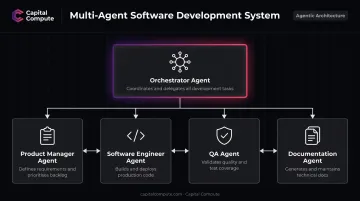
The separation of responsibilities matters for the same reason it does in human teams: the agent writing the code has no incentive to catch its own errors. Independent verification — whether by a QA agent or a human reviewer — is what makes the output trustworthy.
How AI Agents Accelerate Custom Software Development
For an Australian business commissioning a custom build, the relevant question isn't how agents work under the hood — it's what they mean for delivery speed, code quality, and cost of revision.
The evidence here is worth interpreting carefully. The 2024 DORA report found that a 25% increase in AI adoption was associated with better documentation quality, code quality, and review speed — but also with lower delivery throughput and stability. These findings concern AI-assisted development broadly, not autonomous agents specifically. They suggest that AI tooling adds real value in specific areas while requiring structured oversight to avoid introducing systemic risk.
Automated Code Generation and Refactoring
AI agents can analyse an existing codebase, identify outdated patterns, and apply consistent refactoring across multiple files simultaneously. Tasks that would take a developer several days can complete in hours. In new builds, agents implement feature specifications directly from well-defined task briefs, reducing back-and-forth between brief and implementation.
One important caveat: agents produce better output when given clear specifications. Vague prompts lead to vague code. The quality of what goes in determines the quality of what comes out.
Intelligent Testing and Quality Assurance
AI agents generate unit and integration tests, identify uncovered code paths, create edge-case scenarios, and execute tests within CI environments. The real benefit isn't just speed — it's timing.
Continuous automated testing shifts quality assurance from a sign-off phase at project end to an ongoing, embedded process. Bugs surface earlier, when they're cheaper to fix. For regulated sectors — healthcare, finance, legal — that difference translates directly into lower remediation costs and cleaner audit trails at go-live.
Incident Response, Debugging, and Documentation
Beyond testing, two functions consistently underdeliver when left to manual processes:
- Debugging: AI agents monitor logs, detect anomalies, correlate errors across services, and propose root-cause analysis — reducing the time engineers spend diagnosing production issues
- Documentation: Agents generate API docs, summarise pull requests, update README files, and produce onboarding guides automatically
Automated documentation is a significant benefit for Australian businesses who want to retain full ownership of their codebase post-handover. Documented, versioned APIs mean an internal team — or any future team — can maintain the system without depending on the original development partner.
Human Oversight and Milestone Gates
Effective use of AI agents in a custom build does not mean removing humans from the loop. The highest-performing teams use agents as productivity multipliers while preserving structured review points:
- Sprint reviews every two weeks
- Client approval gates at each milestone before the next phase begins
- Senior engineer review of all architecture decisions before planning closes
Without this structure, agent output can accumulate unchecked — generating code that passes tests in isolation but creates architectural debt at scale. Senior engineers remain the architects and decision-makers; agents handle implementation volume.
At Capital Compute, this model is built into the delivery structure by default: fortnightly sprint reviews, outcome-based billing tied to milestone sign-off, and named PM oversight across every engagement.
AI Agent Use Cases by Sector: Legal, Finance, and Marketing
The context files, compliance constraints, and definition of acceptable output vary significantly by industry. An AI agent system built for a legal document platform has fundamentally different requirements to one built for a marketing analytics dashboard. Capital Compute has shipped production AI agents across all three sectors below — in each case, compliance architecture was scoped at discovery, not bolted on before go-live.
Legal
Candidate applications for AI agents in legal workflows include:
- Document review and clause extraction from contracts
- Case research summarisation
- Compliance checking against defined rule sets
- Paralegal task assignment and docket file retrieval
LexisNexis research shows more than 50% of Australian legal practitioners have trialled generative AI tools, with document analysis and due diligence among the most common applications. Governance requirements remain front and centre as adoption grows.
In practice, this means two non-negotiables: any output affecting legal conclusions or client interests requires human review, and the underlying data architecture must be APP-compliant from the start, not retrofitted at go-live.
Finance
Finance sector applications include:
- Transaction monitoring and anomaly detection
- Reporting automation and audit trail generation
- Customer-facing advisory and decisioning tools
- Internal-process optimisation across back-office functions
The joint Reserve Bank of Australia and ASIC survey found that 75% of respondent firms already used AI, with fraud detection among the most common use cases.
Regulated financial software in Australia requires auditability. The ASIC's outcomes-focused framework — covering Senior Managers and Certification Regime, Consumer Duty, and operational resilience — applies directly to AI systems. Every decision or output an agent produces must be traceable. Architecture choices made in sprint one (logging, audit trails, model versioning) determine whether the final product is compliant under ASIC regulation.
Marketing
Marketing applications include content personalisation engines, campaign analytics, lead scoring, and data pipeline automation. The compliance constraints are somewhat lighter than legal or finance, but they still apply.
The Privacy Act governs how customer data is processed. The OAIC defines profiling as automated processing used to evaluate personal aspects — including direct-marketing predictions. Article 22 adds restrictions when decisions are solely automated and produce legal or similarly significant effects.
Custom-built marketing platforms need consent management, lawful basis mapping, and data residency considerations built in from the start — not added as an afterthought before launch.
The Privacy Act and Governance Considerations for Australian Businesses
AI agents are highly effective at processing data and generating outputs from it. For any Australian business, that creates a direct intersection with the Privacy Act — and the data architecture decisions made during development are foundational to the agent implementation, not separate from it.
The OAIC's Position on Automated Decisions
Under the Privacy Act 1988 and the Australian Privacy Principles, automated decisions that produce significant effects on individuals warrant particular scrutiny. The trigger isn't every use of AI — it's the effect of the decision, the level of automation, and the human authority over the outcome. For most custom builds, this means assessing each agent workflow individually.
Where human review is required, the OAIC's standard is specific: review must be genuinely meaningful, performed by someone with the competence and authority to understand, challenge, and change the outcome. Rubber-stamp approval from someone without that authority won't satisfy the OAIC's standard.
Key Governance Controls
When AI agents interact with personal or sensitive data, these controls must be in place:
- Human-in-the-loop review for agent decisions affecting data subjects
- Transparency about when AI-generated outputs are used
- Access controls limiting what data the agent can interact with
- Data minimisation — OAIC guidance under the Australian Privacy Principles specifically addresses feature selection and limiting inference data as AI-specific measures
- DPIA where processing is likely to create high risk, including qualifying systematic automated evaluation of individuals
Privacy Act compliance is an architectural decision, not a checklist. Australian businesses commissioning custom AI agent builds should ensure their development partner scopes data architecture at discovery, before a line of build code is written.
Capital Compute treats this as a standard discovery output: data-flow analysis, consent architecture, and data minimisation planning are completed in sprint one, not reviewed at go-live.
What to Look for in a Development Partner Building AI Agent Solutions
Not all development partners using "AI" are using it in ways that benefit the client. These are the questions worth asking before signing a scoping agreement:
- Are AI agents being used to accelerate senior engineering work, or to replace senior engineering judgement?
- Does the partner use structured oversight — milestone gates, QA verification, client sprint reviews — or is agent output generated and shipped with minimal human review?
- Who makes the final architecture decisions: a senior engineer, or the agent?
- Can the partner explain every architectural decision in the codebase they deliver?
Handover Readiness
A development partner using AI agents should still produce documented, versioned APIs and a codebase any capable team can maintain. AI-accelerated development should not create a black box. The same engineers who built the system should be able to explain it and remain available post-handover.
A partner that meets this standard will typically offer:
- A single internal engineering team — no subcontracting, no handover gaps
- Fortnightly sprint reviews with client approval gates at each milestone
- Senior engineers making architecture decisions from sprint one
- Documented, versioned APIs ready for your team to maintain post-handover
- Compliance architecture (the Privacy Act, ASIC, HIPAA) scoped at discovery, not reviewed at go-live
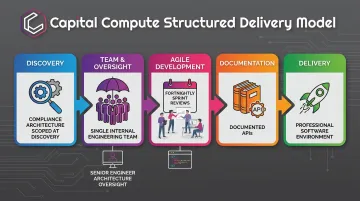
Capital Compute delivers production AI agent solutions against each of these criteria. Clients review and approve progress at every milestone rather than at a single go-live presentation. Architecture decisions are made by senior engineers in sprint one, and compliance is built into the architecture from discovery — not retrofitted before launch.
Frequently Asked Questions
What are AI agents in software development?
AI agents are autonomous software systems that plan, execute, and iterate across multi-step development tasks — writing code, running tests, reviewing pull requests, and managing CI/CD pipelines. Unlike traditional AI tools that respond to a single prompt, agents maintain context and act across extended workflows with minimal human intervention at each step.
What are the types of AI agents?
The main categories are: simple reflex agents (rule-based, no memory), model-based agents (maintain internal state), goal-based agents (work toward defined objectives), learning agents (improve from feedback), and multi-agent systems where specialised agents collaborate under an orchestrator. Custom software builds typically use a combination.
How do AI agents differ from traditional software development tools?
Traditional tools — IDEs, linters, autocomplete — respond to developer input and execute a single action. AI agents autonomously plan sequences of actions, interact with external systems, self-evaluate outputs, and iterate. They function more like a team member working toward a goal than a tool waiting to be used.
Can AI agents be used for regulated industries like legal and finance?
Yes, but data architecture must be designed for compliance from the start, not retrofitted. Human review gates must be built into agent workflows for decisions affecting data subjects, and the development partner must understand sector-specific regulatory requirements including the Privacy Act, ASIC frameworks, and SRA obligations.
How do I ensure quality control when AI agents are involved in my custom build?
Quality control requires structured oversight: clear specifications before agents begin, separation of roles so the agent writing code doesn't also declare it complete, and automated testing embedded throughout rather than run as a final phase. Regular sprint reviews with client approval gates keep human judgement in the loop at every milestone.
Do AI agents replace human developers in custom software projects?
No. Senior engineers still make architecture decisions, review all outputs, and own quality end-to-end. Agents handle implementation volume and repetitive tasks, which frees senior engineers to focus on design, security, and decisions that require genuine judgement.