Many Australian startups reach a point where generic platforms become a constraint rather than an enabler: rising subscription costs, integration workarounds, workflows bent to fit someone else's interface, and data architectures that weren't designed with your regulatory obligations in mind.
This guide gives Australian founders a clear framework for deciding whether custom software is the right move, what the development process actually looks like, what it costs, and what to demand from a development partner — without the vague reassurances.
Key Takeaways
- Custom software makes sense when off-the-shelf tools cannot serve your business model, even with configuration
- The Privacy Act requires data protection by design — built into architecture from day one, not reviewed at go-live
- A focused MVP typically takes 8–14 weeks from discovery to launch; scope discipline is the primary timeline driver
- The cheapest development partner rarely stays cheapest — rework costs typically exceed the savings from a low initial quote
- Secure IP ownership and documentation handover rights in the contract before any work starts
Custom Software vs Off-the-Shelf: Making the Right Call
Off-the-shelf software is pre-built for the common case — Salesforce assumes your sales process, Shopify assumes your eCommerce model. That works well for standard businesses. Custom software is built around your specific workflows, users, and growth trajectory. For startups with non-standard models, that difference determines whether the tool fits the business or the business bends to fit the tool.
When Custom Software Makes Sense
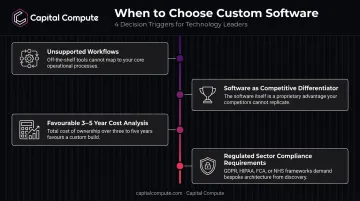
Custom development is the right call when at least one of these applies:
- Your business model has workflows that generic tools cannot support without expensive customisation
- The software itself is your competitive differentiator — particularly relevant for SaaS founders whose product is the platform
- You've mapped 3-5 years of SaaS subscription costs, integration overhead, and workaround effort, and the numbers favour a one-time build
- You're in a regulated sector where off-the-shelf platforms cannot meet compliance requirements (more on this below)
When Off-the-Shelf Is Still the Better Option
Generic tools remain the right choice for:
- Non-core functions like email, basic accounting, or HR administration
- Early concept validation where you need to test assumptions before committing to a build
- Needs that are genuinely standard with no differentiation required
The Hybrid Approach
Most successful Australian startups don't choose one or the other entirely. They use off-the-shelf tools for peripheral functions — accounting, email, scheduling — while investing in custom software for the one or two core workflows that determine their competitive edge. The build cost concentrates where it creates lasting commercial advantage.
The Australian Regulatory Dimension
For businesses in finance, legal, or healthcare, capital allocation is only part of the picture. Regulatory obligations often make the decision for you. ASIC guidance requires regulated firms to conduct due diligence on outsourced technology, understand the supply chain, maintain audit rights, and plan for exit. AAAPRA's Prudential Standard CPS 230 similarly requires regulated entities to manage operational and model risk from third-party arrangements, and legal practitioners are advised to verify where data is stored and processed, and confirm supplier terms are consistent with confidentiality obligations.
Off-the-shelf platforms built for the general market often cannot satisfy these requirements by configuration alone. In regulated sectors, custom architecture is frequently not a preference — it's a necessity.
Core Benefits of Custom Software Development
Full Ownership and No Vendor Dependency
With SaaS tools, the vendor controls pricing, features, roadmap, and continuity. A price increase, a product discontinuation, or a change in terms affects your business whether you like it or not.
Custom software belongs to you. The code, architecture, and documentation transfer to your organisation at project close. You can hand it to an internal team, bring in a different development partner, or maintain it independently — on your own terms, with no permission required.
Scalability Designed for Your Trajectory
Architecture decisions made in sprint one determine your product's technical ceiling. With custom software, senior engineers can design for your specific scaling requirements from the outset: multi-tenancy, data isolation, API-first design, and infrastructure choices that match your growth model.
SaaS platforms, by contrast, are designed for the average customer. Businesses that grow beyond that average often find the platform becomes either a constraint or prohibitively expensive to scale on.
Competitive Differentiation
Subscribing to the same tool your competitors use doesn't build competitive advantage. Custom software embeds capabilities that cannot be replicated by a competitor signing up for the same SaaS product. For SaaS founders, this is especially direct — your product is the software, and owning it outright determines your ability to differentiate, iterate, and protect your market position.
The Privacy Act and Data Security by Design
The Australian Privacy Principles under the Privacy Act 1988 require privacy to be built into systems from the design stage, not bolted on at go-live. The OAIC's maximum penalty for a serious interference with privacy is the greater of A$50 million, three times the benefit obtained, or 30% of adjusted turnover.
Custom development allows APP-compliant architecture to be scoped before a single line of code is written. Key elements are designed in from the start, not retrofitted after the fact:
- Data flows mapped and documented during discovery
- Access controls scoped to role and data classification
- Retention policies defined at the schema level
- Tenant isolation enforced at the architecture layer, not application logic
That design-first approach matters most in regulated sectors. For Capital Compute's Australian regulated sector clients, compliance architecture is documented during discovery — not reviewed at deployment.
The Custom Software Development Process: Discovery to Launch
Discovery and Scoping (Weeks 1–2)
A proper discovery phase defines requirements, surfaces technical risks, and produces documented scope. More importantly, it's where architecture decisions — data model, integrations, scalability plan, compliance requirements — should be made by senior engineers. Deferring these decisions to later sprints is how projects accumulate expensive technical debt.
At this stage, expect to receive:
- A requirements specification with scope boundaries clearly defined
- Compliance architecture decisions (the Privacy Act, sector-specific obligations) documented before development begins
- A fixed-price estimate tied to agreed scope
Design and Prototyping (Weeks 2–4)
Wireframes and interactive prototypes let you validate UX and user flows before any production code is written. This is the cheapest point to catch mistakes. A significant usability problem found during prototyping costs a discussion. The same problem found after three sprints of build costs a rebuild.
Agile Development in Sprints (Weeks 4–12+)
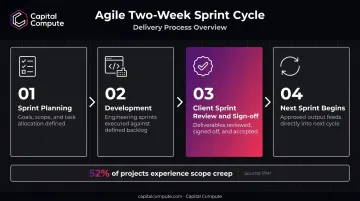
Software is built in two-week cycles, with working features delivered iteratively. What matters here is visibility:
- Fortnightly sprint reviews with client approval at every milestone
- No sprint proceeds without sign-off on the previous one
- Changes are surfaced and costed at the gate, not absorbed silently into billable hours
PMI research found that 52% of projects experienced scope creep — fortnightly approval gates are the practical defence against this.
Quality Assurance and Testing
QA runs throughout development, not only at the end. A NIST study illustrates why: fixing a defect during requirements costs roughly 1X; fixing it post-release costs around 30X.
Testing within each sprint covers:
- Functional and integration checks
- Security validation
- Performance benchmarking
Running these checks inside each sprint — rather than batching them at the end — is what keeps defect costs manageable throughout the project.
Launch and Post-Launch Support
Launch delivery covers:
- Soft launch with monitoring setup before full production deployment
- Documented, versioned APIs designed for the client's internal team to maintain independently
- A post-launch support window (typically 90 days as standard) for defect resolution
- A month-to-month retainer option for ongoing development — with no lock-in
How Much Does Custom Software Cost?
Realistic cost ranges vary significantly by project type. Using Clutch's verified global benchmark, the average custom software project costs approximately $132,000 (USD), though the most common reviewed band is $10,000–$49,999 (USD) — reflecting that focused MVPs represent the majority of engagements.
Approximate ranges by project type:
| Project Type | Indicative Range |
|---|---|
| MVP / focused web application | A$40,000–A$120,000 |
| Full SaaS platform or multi-platform build | A$120,000–A$350,000+ |
| Enterprise system with complex integrations | A$400,000+ |
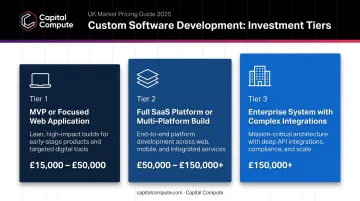
These are indicative ranges. Actual costs depend on scope, compliance requirements, and development location.
Key Cost Drivers
- Scope and feature count — the single largest variable
- Number of platforms — web-only vs. web plus iOS and Android
- Third-party integrations — each API integration adds complexity and testing overhead
- Compliance requirements — ASIC, SRA, Australia's public health system DSPT, and the Privacy Act architecture add scope to discovery and build
- Engagement structure — fixed-price scoped projects vs. time-and-materials
The Total Cost of Ownership Argument
Comparing day-one prices alone misses most of the real cost. The honest calculation is a 3-year view:
- Cumulative SaaS subscription costs across all tools
- Integration and workaround overhead (internal time and third-party connectors)
- Cost of rebuilding when you outgrow the platform — which often costs more than building right first time
That rebuild risk is where the offshore vs. Australian cost question becomes relevant. Australian-based development partners carry higher day rates, but the trade-offs are concrete: communication quality, privacy accountability, availability during Australian business hours, and consistency of code quality. For projects with regulatory exposure — ASIC, SRA, Australia's public health system DSPT — those factors directly affect delivery risk, not just day rate.
How to Choose the Right Development Partner
Internal Team vs. Subcontracting
Whether a development company uses its own engineers or subcontracts to third parties affects quality consistency, accountability, and knowledge transfer at project close. A partner that subcontracts cannot guarantee that the engineers who built your product are available to support it — or that those engineers meet the quality bar you assessed during the pitch.
The engineers who build the initial product should be the same engineers available on the ongoing retainer. That continuity matters when something breaks at 9pm before a board demo.
That's what to look for in practice. Capital Compute, for example, delivers all work through an internal engineering team with no subcontracting at any stage — the same senior engineers who make sprint one architecture decisions remain on the engagement through post-launch support.
Process Transparency
A trustworthy partner welcomes scrutiny. Look for:
- Fixed-price scoping with clearly documented milestones before any code is written
- Fortnightly sprint reviews with client approval gates at every milestone — not a demo at the end
- Proactive communication rather than status updates when you chase them
Capital Compute structures engagements with fixed-price scope, fortnightly reviews in Australian business hours, and a month-to-month retainer with no lock-in after launch. A certified delivery professional owns governance — sprint cadence, milestone coordination, client communication — rather than leaving it to a developer doubling as a project manager.
The Privacy Act and Compliance Readiness
For Australian regulated sector clients, verify before engaging:
- Does the partner scope data architecture and compliance requirements during discovery — or at go-live?
- Do they understand APP obligations specific to your sector (ASIC, SRA, Australia's public health system DSPT)?
- Are data isolation, access controls, and audit logging treated as first-class architecture requirements?
If these questions draw vague answers in a first meeting, treat that as a signal — compliance gaps discovered at go-live are significantly more expensive to fix than architecture decisions made on day one.
Common Mistakes Startups Make in Custom Software Projects
Over-Scoping the First Version
The most common and costly mistake is trying to build every planned feature before launch. The right approach: define the smallest version that delivers real value, launch it, gather feedback from real users, and iterate.
PMI reports that 47% of unsuccessful projects failed due to inaccurate requirements management. MVP scope creep is a leading cause of budget overrun and delayed go-live — not because development is slow, but because the scope was never disciplined in the first place.
Choosing a Partner on Price Alone
The cheapest development option produces poor code quality, missing documentation, and software that cannot be maintained or handed over cleanly. The cost of a rebuild almost always exceeds the savings from a low initial quote. A saving of a few thousand dollars on a build that requires a costly rebuild is not a saving.
When evaluating quotes, look at:
- Whether senior engineers are involved from sprint one (not just the pitch)
- Whether fixed-price scope is offered (or if pricing is open-ended)
- What documentation and IP handover looks like at project close
Price and contract terms are connected more closely than most founders expect — which makes the next mistake particularly costly.
Neglecting IP Ownership and Documentation
Many startups sign contracts without confirming that all code, architecture documentation, and API specifications will be handed over at project close. The result is ongoing dependency on the development partner for changes that should be straightforward — and a negotiating position that weakens with every passing month.
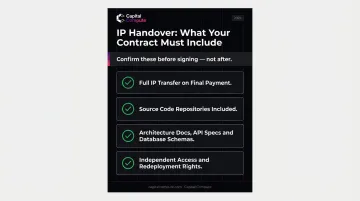
Before signing, confirm:
- All IP transfers to the client upon final payment — explicitly, in the contract
- The deliverable list includes source code repositories, architecture documentation, API specs, and database schemas
- Documented, versioned APIs are designed for the client's internal team to maintain independently
- You can access, modify, and redeploy your software independently after handover — no ongoing partner relationship required
Frequently Asked Questions
How much does custom software development for startups cost?
MVP builds typically fall in the A$40,000–A$120,000 range; mid-scale bespoke systems run A$120,000–A$350,000, with enterprise systems reaching A$400,000+. Key drivers include feature complexity, compliance requirements, and number of platforms. Over a 3-year view, custom development frequently costs less than cumulative SaaS subscriptions plus the overhead of platform limitations.
When should a startup choose custom software over off-the-shelf?
Two primary triggers: when your business model cannot be adequately served by existing tools, and when the software itself is a core competitive differentiator that must be owned and controlled. If you're building a SaaS product, or if generic tools require significant workarounds to support your workflows, custom development is the right direction.
How long does custom software development take for a startup?
A focused MVP typically takes 8–14 weeks from discovery to launch. Full SaaS platforms or multi-platform builds take longer — timeline is directly linked to scope discipline. Every feature added to the initial scope extends the timeline; every feature deferred to version two shortens it.
Does custom software need to be APP compliant from day one?
Yes. The Privacy Act Article 25 requires data protection by design — compliance must be built into the architecture from discovery, not reviewed at go-live. Retrofitting compliance after launch is considerably more expensive and exposes the business to regulatory risk, particularly for clients in finance, legal, or healthcare.
What is an MVP and should my startup build one first?
An MVP is the smallest functional version of a product that delivers value and enables real user feedback. For most startups, beginning with an MVP reduces risk and ensures subsequent development is guided by actual usage data rather than assumptions — then iterate based on what users do.
Who owns the code after development is complete?
Ownership must rest entirely with the client upon final payment. The contract must explicitly transfer all IP — including architecture documentation, API specifications, and source code repositories. Avoid any arrangement where your ongoing access to your own software depends on maintaining a commercial relationship with the development partner.