That gap forces a decision: hire in-house or outsource. And it matters more than most founders realise at the time they make it.
This guide covers when outsourcing makes sense, what a well-structured engagement looks like, how to evaluate a partner, and how to protect your IP and code quality from sprint one through to handover. One thing worth noting upfront: outsourcing has matured considerably beyond cheap freelance work. For Australian SaaS founders and regulated-sector businesses especially, the right model delivers senior engineering, APP-compliant architecture, and a codebase you fully own at close.
Key Takeaways
- Outsourcing fills the technical gap for non-technical founders without a long-term payroll commitment
- Fixed-price milestone scoping gives investors and founders cost predictability that open-ended hiring does not
- Privacy Act compliance must be scoped at discovery — retrofitting it after launch costs far more and introduces regulatory exposure
- Australian law defaults copyright of commissioned software to the creator, not the commissioner: your contract must explicitly assign IP ownership
- The right outsourcing partner uses internal engineers only, with no subcontracting
What Does It Mean to Outsource a Developer?
Outsourcing development means contracting an external team or firm to design, build, or maintain software rather than hiring employees to do it in-house. To outsource is to delegate technical work to a specialist outside your organisation.
Three models appear most often at the startup stage:
| Model | What It Is | Best For |
|---|---|---|
| Freelance hire | Individual contractor, typically unmanaged | Small, isolated tasks |
| Agency / project-based | Vendor owns delivery of a defined scope | MVP builds with clear requirements |
| Dedicated team / retainer | Engineers embedded in your sprints over time | Scaling SaaS with ongoing iteration |
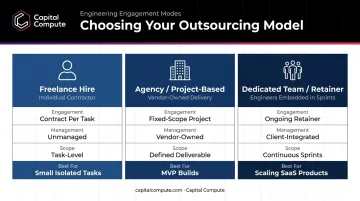
The right model follows your build stage. A founder validating an MVP in three sprints needs a defined scope and a fixed handover point. A SaaS business scaling after its first growth event needs engineers who already know the codebase and can move without ramp-up time.
When Should a Startup Outsource Instead of Hiring In-House?
The No Technical Co-Founder Problem
When a non-technical founder has validated demand but cannot yet justify the cost of a full-time senior engineer, outsourcing fills the gap without a permanent payroll commitment.
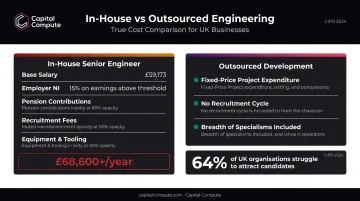
Levels.fyi data puts median total compensation for a senior software engineer in Australia at around A$178,428, with a base of roughly A$152,000 — but salary is only part of the picture. Add the Superannuation Guarantee at 12% of ordinary time earnings, recruitment costs, and equipment, and the recurring cost floor sits well above base salary before any benefits or workspace costs.
For a pre-Series A founder managing cash carefully, that recurring commitment is a significant bet on a hire who may not be the right fit.
Outsourcing converts that commitment into defined project expenditure. You pay for outcomes, not headcount.
The MVP Stage
At MVP stage, requirements are still being discovered sprint by sprint. An external team that works in short approval cycles lets founders course-correct without the sunk-cost pressure that comes with a permanent hire invested in their original interpretation of the spec.
The Skills Gap
SaaS products routinely need multiple disciplines running simultaneously. No single hire covers all of that, and running five separate hiring processes carries its own time and quality risk. An outsourced team brings immediate breadth across:
- Back-end and front-end engineering
- DevOps and cloud infrastructure
- AI and machine learning capabilities
- Mobile development (where needed)
Runway Economics
Fixed-price or milestone-gated engagements give investors and founders cost predictability that open-ended headcount does not. At the pre-Series A stage, controlling spend carries the same weight as controlling product risk.
When Outsourcing Is Not the Right Answer
Outsourcing is a build-phase strategy, not a permanent substitute for an internal team. Once your product is live, generating revenue, and requiring continuous feature velocity, the institutional product knowledge that accumulates in a permanent team becomes a genuine competitive asset. At that point, building in-house starts to make more economic and strategic sense.
Key Benefits of Outsourcing Development for SaaS Founders
Senior Engineering from Sprint One
Freelance hires often deliver capable mid-level execution, but the architecture decisions that shape your product's long-term stability require senior judgment. The choices made in sprint one around data model design, API structure, and scalability approach accumulate consequences — in either direction — faster than most founders expect.
A well-structured outsourcing engagement puts senior engineers on those early decisions specifically because changing them later is expensive.
Speed to a Working Build
Without a recruitment cycle — job advertising, interviews, references, notice periods — a structured outsourcing engagement can have working engineers in discovery within weeks. Australian founders continue to report difficulty attracting qualified candidates and rising competition for well-qualified talent, reflecting the hiring environment any Australian founder would be navigating.
Cost Control Through Fixed-Scope Delivery
Milestone-based approval gates mean you only pay for work you have reviewed and approved. This eliminates the open-ended burn that comes with time-and-materials billing and unmanaged freelancers, where budgets drift before any accountability mechanism kicks in.
The Privacy Act-Compliant Architecture by Design
For Australian SaaS founders — particularly those targeting legal, finance, HR, or healthcare — data architecture must be APP-compliant from the first database schema decision, not the week before launch.
The OAIC is explicit that privacy must be addressed at the design stage — when fixes are cheaper and easier to implement. Under the Privacy Act 1988, the maximum penalty for a serious interference with privacy is the greater of A$50 million, three times the benefit obtained, or 30% of adjusted turnover. That is a commercial risk. Scoping compliance at discovery is how you contain it.
Full Ownership at Handover
A properly structured engagement delivers documented, versioned code and APIs that your future internal team can maintain without needing to reverse-engineer or re-brief anyone. Undocumented code and proprietary platforms create a different outcome — one where the original builder remains essential long after the build concludes.
What to Look for in an Outsourced Development Partner
Internal Team, Not Subcontracting
When an agency subcontracts work to third-party developers the client never meets, three things break down: quality control, communication continuity, and IP chain-of-title. The engineers who scope the work should be the same engineers who build it. Accountability depends on it.
Capital Compute operates with an internal engineering team only, no subcontracting at any stage. The same engineers who conduct discovery carry the work through to delivery.
Fixed-Price Scoping with Milestone Approval Gates
A fixed-price contract that has no interim visibility is not really fixed-price — it is just a locked total with no mechanism for founders to course-correct before delivery. Look for:
- A defined deliverable for each sprint
- A client review point built in
- A go/no-go gate before the next sprint is authorised
Capital Compute's fortnightly sprint cadence is managed by a certified delivery lead, with approval gates at every milestone.
Transparent Discovery Before Development
A reputable partner will run a paid discovery phase before writing a line of code. A proper discovery phase produces:
- A technical specification the founder owns outright
- An architecture direction set before any code is written
- A sprint plan tied to real deliverables, not estimated hours
If a firm wants to skip discovery and go straight to billing, that is a warning sign.
The Privacy Act and Data Handling
For any Australia-regulated sector engagement, ask specifically:
- How is data architecture scoped for Privacy Act compliance?
- Where will data be processed and stored?
- Are Data Processing Agreements included in the contract as standard?
These questions determine whether your product can legally operate in the sectors you are targeting. They belong in the discovery conversation, not the go-live checklist.
Risks of Outsourcing Development and How to Manage Them
IP and Code Ownership
Australian law defaults copyright of commissioned work to the creator, not the commissioner. A freelancer or agency that builds your product retains copyright unless your contract explicitly assigns it in writing. Relying on implied ownership or a verbal agreement is a common and costly mistake.
Your engagement contract must assign all IP to you from the point of creation — without that clause in writing, ownership stays with the developer.
Capital Compute transfers full code ownership to the client as standard — confirmed in client testimony: "We own all of the IP and the codebase is extremely clean and well-documented."
Quality and Architectural Drift
Without fortnightly sprint reviews and milestone approval gates, code quality erodes without the founder noticing until final delivery. By then, fixing it means reopening work that was already paid for.
Structured governance gives you visibility before problems compound. That means sprint demos, written acceptance criteria, and documented decisions at every stage — not a single review at handover.
Scope Creep and Budget Overrun
Time-and-materials billing without a defined scope is how most outsourced builds go over budget. The engagement starts with a rough scope, requirements expand mid-build, and the invoice grows with them.
Fixed-price scoping with a formal change control process is the standard protection. If a request falls outside the agreed scope, the team prices it separately before work proceeds — nothing gets absorbed silently into the existing budget.
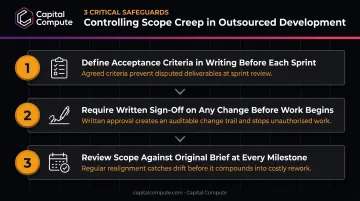
Key safeguards against scope creep:
- Define acceptance criteria in writing before each sprint begins
- Require written sign-off on any change before the team picks it up
- Review scope against the original brief at every milestone, not just at final delivery
How to Start: From First Conversation to First Sprint
Discovery Before Development
The first engagement milestone should always be a scoping or discovery session. This is where product requirements, technical architecture, compliance obligations, and sprint planning get defined before any development budget is committed. Skipping straight to code is how teams reach sprint six with architecture that cannot support the product they actually built.
What to Prepare Before the Conversation
Founders who arrive at a first scoping conversation with the following move faster and get more accurate estimates:
- A written summary of the product concept and the target user
- Any existing designs, prototypes, or requirements documentation
- Third-party integration dependencies (CRM, payment systems, APIs)
- Compliance context — particularly if you are in a regulated sector
- Budget range and timeline expectations
- Scale expectations — anticipated user volume and growth trajectory
Capital Compute's Process
Capital Compute's engagement follows a defined sequence:
- 30-minute scoping call in Australian business hours to align on requirements and constraints
- Architecture and sprint plan defined by the internal engineering team within two business days
- Fixed-price estimate issued for founder approval before any sprint begins
- Milestone gates — founder sign-off required at each stage before work continues
Retainer terms run month-to-month with no lock-in. For qualifying engagements, a one-week trial sprint is available at no cost, running against your actual backlog before any financial commitment is required.
Frequently Asked Questions
What does "to outsource" mean?
Outsourcing means delegating a task or function to an external provider rather than handling it in-house. For startups, this typically means contracting an agency or dedicated development team to build the product — rather than recruiting and employing engineers directly.
When should a startup outsource development instead of hiring in-house?
The clearest triggers are: no technical co-founder, limited runway, need for multiple specialisms simultaneously (back-end, front-end, DevOps), or an MVP stage where requirements are still being validated sprint by sprint. It works best as a build-phase strategy — before the product has the revenue or stability to justify permanent headcount.
How do I protect my IP when outsourcing my SaaS build?
Your contract must explicitly assign all IP to you from the point of creation — Australian law defaults copyright to the creator, not the commissioner. For the Privacy Act, ensure a Data Processing Agreement is included. At handover, documented and versioned code means your future internal team can maintain the codebase without dependency on the original developer.
What should an Australian startup look for in an outsourced development partner?
Four things: an internal engineering team with no subcontracting, fixed-price milestone scoping with approval gates at every sprint, APP-compliant architecture defined at discovery (not launch), and sprint reviews conducted in Australian business hours. If an agency cannot clearly confirm all four, keep looking.
How much does it cost to outsource a developer for a startup in Australia?
Australian agency rates vary widely, with structured engagements typically starting well into the tens of thousands of dollars for a proof of concept, rising toward A$400,000+ for enterprise systems. Compare that to an in-house senior engineer's total compensation of around A$178,428 per year — before superannuation at 12%, benefits, equipment, and recruitment costs. Fixed-price milestone billing gives you a defined spend ceiling that time-and-materials contracts cannot.
What happens to my codebase after the outsourced project is complete?
You should own all code from sprint one, with documented and versioned APIs your internal team can maintain without returning to the original partner. Reject any engagement where documentation is treated as a closing task — it should be an ongoing deliverable throughout the build.