Introduction
Picking a software development outsourcing partner in 2026 is harder than it should be. The market is crowded, vendor claims are difficult to verify independently, and a poor choice costs far more than the contract value — in delayed launches, compliance gaps, and codebases that need rebuilding.
Australian businesses face a specific set of pressures here. Senior engineering talent is expensive and hard to retain domestically, with demand for skilled software engineers consistently outstripping supply across the sector.
The compliance context compounds that further. The Privacy Act, OAIC obligations, ASIC resilience requirements, and SRA standards mean that architecture decisions made by an outsourcing partner carry genuine regulatory weight.
Those pressures shape how this list is assembled. The emphasis is on APP-compliant data handling, Australian business hours communication, engagement model transparency, and delivery accountability — not global headcount or marketing spend.
What follows: a working definition of software outsourcing, five companies worth evaluating in 2026, and the criteria used to assess each one.
Key Takeaways
- Software development outsourcing lets Australian businesses access senior engineering talent without permanent headcount overhead
- The broader IT services outsourcing market is valued at $744.6 billion in 2024, growing at 8.6% CAGR through 2030
- For Australian buyers, Privacy Act compliance, no-subcontracting guarantees, and Australia-aligned communication are non-negotiable selection criteria
- Hidden subcontracting creates direct liability under the Privacy Act — OAIC Article 28 requires written contracts governing every sub-processor your vendor uses
- The five companies here cover different buyer profiles, from regulated-sector specialists to vendors built for large-scale legacy modernisation
Software Development Outsourcing for Australian Businesses
Software development outsourcing is the practice of contracting an external team to design, build, test, or maintain software rather than hiring in-house. For Australian businesses in 2026, the cost case is clear: a senior software engineer earns a median total compensation of around A$178,428, with a base of about A$152,000 as a permanent hire — before recruitment fees, benefits, or the time lost finding the right person in a skills-short market.
But cost is only part of the decision. For regulated Australian organisations, the compliance framework around outsourcing contracts is equally determinative.
The Australian Compliance Context
The compliance dimension is what separates Australian outsourcing decisions from those in less regulated markets. Several frameworks create direct obligations:
- The Privacy Act / OAIC: Article 28 requires a written processor contract covering security, confidentiality, sub-processor authorisation, and audit rights — subcontracting without written authorisation is a direct contracting gap
- ASIC PS21/3: In-scope firms must map technology dependencies and stay within operational resilience impact tolerances; software supporting important business services falls within scope
- ASIC SYSC 8: Regulatory responsibility for critical or important outsourced functions remains with the authorised firm
- SRA guidance: Client confidentiality obligations apply in full when information is shared with a development supplier
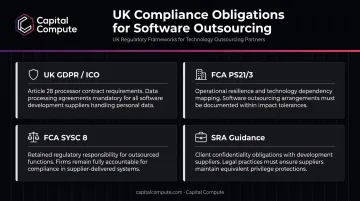
These obligations determine which vendors are viable for regulated Australian organisations — not as a secondary check, but as a starting filter.
Top Outsourcing Software Development Companies in 2026
These companies were selected on delivery model transparency, the Privacy Act and compliance posture, Australian business hours communication capability, and sector-specific experience — not on size or Clutch ratings alone.
Capital Compute
Capital Compute is an Australia-focused software development outsourcing company built for businesses that need senior engineering talent, APP-compliant architecture, and full delivery transparency — without subcontracting or long-term lock-in.
Key differentiators include:
- All-internal engineering team — the same senior engineers who scope the project remain through to post-handover retainer
- APP-compliant data architecture scoped at discovery, not reviewed at go-live
- Sprint reviews delivered in Australian business hours
- Milestone-based client approval gates at every stage
The no-subcontracting policy is publicly stated across service lines and matters specifically for Privacy Act compliance: undisclosed sub-processors conflict directly with OAIC requirements for prior written authorisation under Article 28.
| Attribute | Details |
|---|---|
| Key Services | Custom SaaS development, AI agent development (legal, finance, marketing sectors), legacy system modernisation, API and system integrations, cross-platform mobile development (React Native, Flutter) and native iOS/Android (Swift, Kotlin) |
| Engagement Model | Fixed-price scoping with milestone approval gates; month-to-month retainer with no lock-in; no subcontracting — all delivery through an internal engineering team |
| Best Suited For | Australian SaaS founders, regulated-sector businesses (fintech, legal, marketing), and organisations needing Privacy-First architecture and post-handover independence |
EPAM Systems
EPAM Systems is a global software engineering and digital transformation company with Australian offices in Sydney and Newcastle, operating across 55+ countries. At the end of 2025, the company employed approximately 62,850 people, including 56,600 delivery professionals.
Engineering depth at scale is EPAM's defining capability. Delivery experience spans complex, multi-year programmes in financial services, insurance, life sciences, and healthcare — sectors with stringent compliance requirements.
Compliance credentials include ISO 27001 and scoped SOC 1, SOC 2, and SOC 3 reports for certain services, though scope varies by legal entity.
| Attribute | Details |
|---|---|
| Key Services | Enterprise software development, digital platform engineering, cloud and DevOps, data engineering and AI, product design and UX, consulting and strategy |
| Engagement Model | Dedicated team, staff augmentation, managed services, T&M and fixed-price options; best suited to long-term enterprise engagements |
| Best Suited For | Australian enterprises running complex, multi-system digital transformation programmes with large budgets and multi-year timelines |
Netguru
Netguru is a Poland-based product and software engineering company with a design-led culture and a track record serving SaaS businesses and scale-ups. Headquartered in Poznań, the company brings comfortable Australian time zone overlap and Privacy Act-aligned processes through its ISO 27001-certified information security management system, in place since 2018.
Where Netguru stands out is launch speed without compromising engineering quality. The company has built a reputation for delivering consumer and B2B SaaS products quickly, with UX/UI integrated from day one rather than treated as a later-stage consideration.
| Attribute | Details |
|---|---|
| Key Services | Custom software development, mobile and web development, product design and UI/UX strategy, DevOps, AI and automation, digital transformation consulting |
| Engagement Model | Dedicated development teams, project-based delivery, T&M; flexible model matching for different product stages |
| Best Suited For | Australian SaaS founders and product-led companies needing fast, design-forward delivery with European time zone alignment |
ScienceSoft
ScienceSoft is headquartered in McKinney, Texas, with offices across the US, Europe, Mexico, and the Gulf region. The company's strongest differentiator is domain expertise in regulated industries — banking, financial services, healthcare, and insurance — where compliance, data security, and audit trails are fundamental requirements rather than optional additions.
The company's security management is ISO 27001-certified and its development posture references the Privacy Act, HIPAA, and PCI DSS frameworks. Dedicated practice areas cover financial services and healthcare software specifically.
| Attribute | Details |
|---|---|
| Key Services | Custom software development, cloud and cybersecurity services, data analytics and BI, IT consulting, QA and testing, long-term managed support |
| Engagement Model | Fixed-price projects, T&M, dedicated teams; compliance-aware SLAs and documented security practices included |
| Best Suited For | Regulated-sector organisations in Australian financial services, insurance, and healthcare that require proven compliance credentials alongside software delivery |
Innowise
Innowise is a European software development company — incorporated as Innowise Sp. z o.o. in Warsaw — with ISO/IEC 27001:2022 certification covering design, development, and maintenance of software. The company positions itself as a delivery partner for Australia and Irish businesses and offers explicitly documented engagement models.
Team scalability is where Innowise earns its reputation. The company moves from discovery to long-term maintenance within a single engagement model, and its European delivery base provides the Privacy Act alignment with manageable Australian time zone overlap.
| Attribute | Details |
|---|---|
| Key Services | Custom software development, dedicated development teams, IT consulting, blockchain development, cloud and DevOps, QA and testing |
| Engagement Model | Dedicated team, staff augmentation, fixed-price, T&M; month-to-month and project-based arrangements available |
| Best Suited For | Growth-stage Australian businesses that need a flexible, scalable partner with European delivery and broad technology coverage |
How We Chose the Best Software Outsourcing Companies
The companies on this list were assessed as Australian buyers would assess them — not on global revenue or headcount, but on factors that affect delivery outcomes and compliance exposure.
The Evaluation Criteria
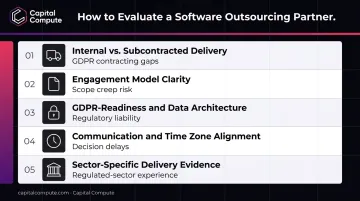
Each criterion targets a specific delivery or compliance risk:
- Internal vs. subcontracted delivery — Subcontracting introduces quality inconsistency, reduces accountability, and creates Privacy Act contracting gaps when personal data is involved. OAIC guidance under the Australian Privacy Principles requires appropriate contractual arrangements and oversight for sub-processors handling personal information downstream.
- Engagement model clarity — A well-structured fixed-price model with milestone gates keeps budgets predictable. A loosely defined T&M arrangement typically ends in scope creep.
- The Privacy Act-readiness and data architecture — Compliance gaps discovered after build are expensive to retrofit and carry regulatory liability for the controller. That's your business, not the vendor's.
- Communication cadence and time zone alignment — A six-hour gap with asynchronous-only communication creates delays that compound across a multi-sprint engagement.
- Sector-specific delivery evidence — Regulated-sector marketing is not the same as regulated-sector experience. Ask for references from clients in your sector, not aggregate ratings.
Why These Criteria Matter
The most common mistake Australian buyers make is selecting a vendor based on a polished pitch deck or a strong Clutch profile without verifying how the company actually runs engagements for Australian clients. Each criterion above ties to a concrete business outcome:
- Subcontracting model → quality inconsistency and OAIC compliance exposure
- Unclear engagement terms → scope creep and cost overruns
- The Privacy Act gaps at build → regulatory liability post-launch
- Poor communication cadence → delayed decisions and missed milestones
Conclusion
Choosing a software outsourcing partner in 2026 is a product decision and a compliance decision, not just a procurement exercise. The right partner should align with how your business operates — not simply tick a shortlist of technical capabilities.
Before signing any contract, assess three things specifically:
- Engagement model scalability — can the team grow with your product without renegotiating the entire relationship?
- Post-handover independence — what documentation and codebase access do you retain when the project closes?
- The Privacy Act posture — is compliance scoped at discovery, or reviewed as a pre-launch checklist?
Request direct references from clients in your sector rather than relying on aggregate ratings.
If those criteria matter to your evaluation, Capital Compute is worth considering. The company works with Australian businesses across SaaS, legal, finance, and marketing. Delivery runs through a senior internal engineering team on a fixed-price model, with APP-compliant architecture scoped from sprint one and no lock-in after handover. If you are evaluating outsourcing partners for an Australian product build or legacy modernisation programme, reach out for a conversation.
Frequently Asked Questions
What is a software outsourcing company?
A software outsourcing company is an external firm hired to design, build, test, or maintain software in place of in-house staff. Quality providers bring structured delivery processes, senior engineers, and compliance-aware practices — not simply cheaper labour with a project management layer on top.
Which companies outsource software development?
Businesses across SaaS, fintech, legal tech, retail, and healthcare outsource software development. The decision is driven by access to senior engineering talent, speed to market, cost efficiency, and the ability to scale without the overhead of permanent headcount.
How much does it cost to outsource software development?
Rates vary significantly by region, seniority, and engagement model. Senior software engineers in Australia carry a median total compensation of around A$178,428, with base salaries around A$152,000, based on current market data. Eastern European and South Asian teams operate at lower blended rates, though fixed-price project costs depend heavily on scope, complexity, and engagement model.
What should Australian businesses look for in a software outsourcing partner?
The Australia-specific criteria are: APP-compliant data handling scoped at discovery, a written no-subcontracting guarantee, Australian business hours communication, clear milestone-based engagement terms, and verifiable sector experience in regulated industries. Asking for direct references from clients in your sector is more reliable than relying on aggregate review scores.
Is outsourcing software development safe for regulated Australian industries?
It can be, but only if the outsourcing partner has APP-compliant architecture built into the discovery phase — not reviewed at go-live. Data residency, access controls, and IP assignment must be addressed in the contract before any work begins. For ASIC-regulated firms, SYSC 8 keeps regulatory responsibility with the authorised firm regardless of what the vendor contract says.
What is the difference between a fixed-price and time-and-materials engagement?
Fixed-price suits well-scoped projects with defined deliverables and predictable budgets. Time-and-materials suits evolving product development where scope changes frequently. For most Australian product builds, a milestone-based fixed-price model with fortnightly sprint reviews offers the strongest balance of cost control and delivery flexibility.