The problem usually isn't execution. It's structure. Businesses hire too many generalists, skip critical roles like QA, or delay architecture decisions until the codebase is already too fragile to scale.
This guide covers the core roles in a software development team, how to match team composition to your project stage, and a practical step-by-step approach to building one — whether you're hiring in-house or working with an outsourcing partner.
Key Takeaways
- A well-structured team spans three clusters: leadership and strategy, engineering, and quality and design
- Team size should be driven by project complexity and timeline — not convention
- Choose your development methodology before hiring — it determines which roles you need
- Never skip QA early or defer architecture decisions — both are consistently the costliest structural mistakes
- For Australian regulated-sector businesses, a structured outsourcing partner with APP-compliant architecture from discovery is faster and lower risk than building every role in-house
Core Roles in a Software Development Team
Rather than treating a dev team as a flat list of job titles, it helps to think in three clusters: leadership and strategy, engineering, and quality and design. This grouping clarifies accountability — who decides what to build, who builds it, and who ensures it works.
Leadership and Strategy Roles
Product Owner shapes the backlog and makes acceptance decisions at each sprint. The key distinction: a Product Owner focuses on what to build. A Project Manager focuses on when and how.
Project Manager / Tech Lead: the PM keeps delivery on track across timelines, scope, and sprint velocity. A Tech Lead or Engineering Manager handles technical direction, code review oversight, and developer mentorship. In smaller teams these roles overlap; in larger builds, both are needed separately.
Capital Compute assigns a dedicated lead engineer from sprint one — not introduced partway through — alongside a VP of Operations and Delivery (holding DASSM, PMP, and PSMI certifications) who owns milestone governance and fortnightly review coordination.
Business Analyst translates business requirements into clear technical specifications before any code is written. Particularly valuable in regulated sectors like legal and finance, where requirements must be documented precisely to satisfy compliance obligations.
Engineering Roles
Software Architect defines the system's overall structure: technology stack, scalability patterns, and integration points. This role should be active in sprint one. Delaying architecture decisions until after the initial build is one of the most expensive mistakes Australian product teams make — it leads to technical debt that compounds with every subsequent sprint.
Software Developers (Front-End, Back-End, Full-Stack) — the three specialisations each serve different purposes:
- Front-end developers build the user-facing layer (interfaces, interactions, performance)
- Back-end developers handle server logic, databases, and APIs
- Full-stack developers span both — useful in leaner teams, though rarely as deep as specialists in either area
According to the 2025 Stack Overflow Developer Survey of 24,759 professional developers, JavaScript leads language usage at 68.78%, followed by HTML/CSS at 63.01% and SQL at 61.34%. Full-stack developers make up the largest developer type at 27% of respondents.
Junior, mid, and senior tiers carry different cost and autonomy trade-offs. Senior developers require less oversight but command higher day rates — a relevant consideration when scoping team composition against budget.
DevOps Engineer bridges development and operations through CI/CD pipelines, automated deployments, and monitoring. Critical for SaaS products, fintech platforms, and any product where release frequency and uptime directly affect revenue. Often added too late on early-stage builds.
Quality and Design Roles
QA Engineers (Manual and Automation): manual QA covers exploratory testing, usability, and edge cases; automation QA handles regression and performance testing at scale. Both are distinct skills. Skipping QA in early sprints dramatically increases the cost of fixing defects post-launch — issues caught during development cost a fraction of what they cost after release.
UX/UI Designers — UX designers shape the product experience through user research and journey mapping; UI designers translate that into visual interfaces. In smaller teams these are combined. Done well, this work reduces user drop-off rates before launch. Done late, it becomes a rebuild — not a refinement.
Team Size and Structure: Matching Your Project Stage
Team composition should scale with project stage. Here's a practical breakdown:
| Project Stage | Typical Roles | Team Size |
|---|---|---|
| Discovery / Proof of Concept | Product Owner, BA, Architect, Designer | 2–4 |
| MVP Development | Above + Developers (FE/BE), QA Engineer | 5–7 |
| Full Product Build | Above + DevOps, Tech Lead, expanded dev team | 8–12+ |
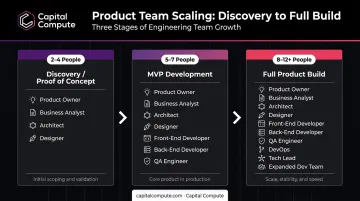
Starting with a lean team and scaling incrementally is more effective than over-hiring upfront. Every additional person added before the architecture is stable introduces coordination overhead that slows delivery.
Methodology Determines Structure
Digital.ai's 17th State of Agile Report found that 71% of organisations use Agile in their software development lifecycle. There are good reasons for that dominance:
- Agile/Scrum teams — capped at 10 or fewer people per the 2020 Scrum Guide, require a Scrum Master, and prioritise iterative delivery with regular stakeholder feedback
- Waterfall teams — not size-capped, but require stricter role segregation and upfront documentation; better suited to projects with fixed, stable requirements
- Hybrid models — increasingly common, blending Agile sprint delivery with Waterfall-style milestone gates
Choose your methodology before you hire. Bringing on developers before settling on Agile versus Waterfall creates structural mismatch that forces expensive re-organisation mid-build.
The T-Shaped Professional Advantage
Your methodology choice also shapes the kind of people you need. For leaner teams where role overlap is inevitable, T-shaped professionals — deep expertise in one area, working knowledge across others — outperform pure generalists or narrow specialists.
In practice, this means a front-end developer who can contribute to API design discussions, or a QA engineer who can write basic test automation scripts. They reduce communication friction and adapt as project scope evolves without creating bottlenecks.
Key traits to look for when hiring T-shaped engineers:
- Strong primary discipline with demonstrable depth (portfolio, shipped products)
- Cross-functional experience across at least one adjacent area
- Comfort contributing to team ceremonies outside their specialism (sprint planning, architecture reviews)
- Track record working in lean or startup-stage environments
How to Build a Software Development Team
Building the right team is less about headcount and more about sequencing. Each step below prevents a category of structural mistake that commonly delays delivery or inflates cost.
Step 1 — Define Scope and Choose a Methodology
Before hiring anyone, document:
- Core features and project complexity
- Regulatory requirements (the Privacy Act, ASIC, Australia's public health system, SRA)
- Target timeline and budget envelope
- Whether Agile or Waterfall fits your delivery model
Skipping this step leads to structural mismatch. Teams built without a clear scope document typically need costly re-organisation within the first three months.
Step 2 — Map Roles to Project Phases
Not every role is needed from day one. A phased hiring plan prevents over-commitment:
- Discovery phase — prioritise Product Owner, Business Analyst, and Software Architect
- Build phase — add developers (start with the specialism your architecture demands most)
- Scaling phase — introduce DevOps and expand QA before increasing developer headcount
Both DevOps and QA are routinely added too late. QA should be present from the first sprint; DevOps before your first deployment pipeline is needed — not after.
Step 3 — Choose a Hiring Model
| Model | Control | Cost | Speed to Assemble | Risk |
|---|---|---|---|---|
| In-house | Highest | Highest | Slowest | Medium |
| Freelance | Medium | Variable | Fast | High (for long builds) |
| Nearshore / Offshore | Medium | Lower | Fast | Medium |
| Dedicated External Team | Medium-High | Predictable | Fast (10–14 days) | Low (if partner is structured) |
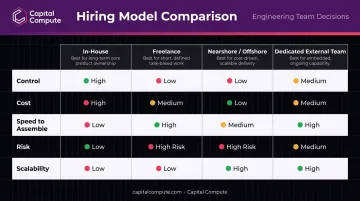
When evaluating a dedicated external team, the key question is whether the same engineers who scope the architecture stay on the project through delivery. Capital Compute operates this way — internal engineers only, no subcontracting — deploying within 10–14 days and working inside the client's own tools and backlog. Continuity matters because mid-project handovers between engineers are one of the most common sources of defects and delayed releases.
Step 4 — Establish Communication Practices
A well-structured team fails without clear workflows. Standard practices that work:
- Sprint planning at the start of each cycle with written scope agreement
- Fortnightly sprint reviews with client approval gates at every milestone
- Asynchronous documentation (Confluence, Notion) for decisions and specs
- Project tracking (Jira, Trello, Linear) for sprint-level visibility
- Daily communication channels (Slack, Teams) for continuous progress transparency
For distributed or outsourced teams, agreed rituals matter more than the specific tools. A sprint review with no agenda and no documented outcomes is a status call, not a checkpoint. A 45-minute structured session with written sign-off keeps scope honest and gives both sides a clear record of decisions.
Step 5 — Define Success Metrics from Day One
Set these before the first sprint, not after the first problem:
- Sprint velocity — are you delivering the planned scope each cycle?
- Cycle time — how long from ticket creation to deployment?
- Deployment frequency — how often are you releasing to production?
- Change failure rate — what percentage of deployments cause incidents?
- Defect density — how many defects per sprint, and at what stage are they caught?
These metrics create a baseline for objective performance conversations. Without them, structural issues compound silently until they become crises.
Common Mistakes When Building a Dev Team
Delaying Architecture Decisions
Teams that begin coding before the architect has defined the system structure accumulate technical debt at a compounding rate. The result is predictable: scalability failures and costly refactoring that could have been avoided in week one.
Architecture should be locked in sprint one. At Capital Compute, senior engineers define the system structure before a single line of production code is written. Architecture decisions that determine a product's ceiling don't get revisited after the first scale event.
Treating QA as an Afterthought
Adding QA engineers only near launch treats testing as a final gate rather than a continuous practice. According to NIST's 2002 software lifecycle cost model, defects found post-release can cost up to 30 times more to fix than those caught at the design stage.
QA should be embedded from sprint one — both to catch defects early and to establish automated regression testing before the codebase grows complex enough to make retrofitting it painful.
Failing to Plan for Team Growth
Teams scoped for the current sprint, not a two-year product roadmap, frequently re-hire and re-onboard as the product scales. This resets institutional knowledge and disrupts delivery momentum.
Build with a growth pathway in mind from the start. A hiring model that supports incremental expansion matters more than one optimised for today's sprint. Consider:
- Adding engineers to an existing sprint cadence rather than restructuring mid-project
- Choosing outsourcing partners who can scale team size without re-onboarding overhead
- Documenting architecture decisions early so new team members can onboard without disrupting delivery
In-House Team vs. Outsourcing: What Makes Sense for Australian Businesses
In-house teams offer full control, strong cultural alignment, and deep institutional knowledge over time. The trade-offs are high overhead, slow specialist depth to build (senior engineers in Australia take months to recruit), and significant fixed cost regardless of project phase.
Outsourcing to a structured partner is faster to assemble, delivers predictable costs through fixed-price milestones, and provides access to specialist depth — DevOps, QA automation, regulated-sector architecture — that most businesses cannot maintain in-house at sustainable cost.
The critical variable is partner quality. Outsourcing fails when roles, responsibilities, and approval gates are retrofitted mid-project. It works when the partner has its own senior engineering structure, not a freelancer network dressed up as a team.
Regulated Sectors Require a Different Standard
For Australian businesses in legal, finance, or healthcare, team structure decisions carry compliance weight that generic outsourcing cannot address. Standards like the Privacy Act, ASIC operational resilience obligations, SRA confidentiality requirements, and Australia's public health system DCB0129 must be factored into architecture from the start — not added post-launch.
The OAIC recorded 12,412 personal data breach cases in 2024/25, and enforcement costs have reached millions of dollars in penalty notices. That level of regulatory exposure makes compliance a structural concern, not a go-live checklist item.
That means scoping the following before a line of code is written:
- Lawful basis mapping and consent management architecture
- Data subject rights handling and deletion workflows
- Audit trail systems and data residency controls
- Incident response and breach notification procedures
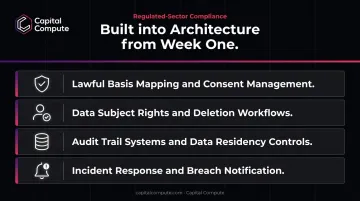
Capital Compute scopes each of these in week one of discovery. For regulated-sector clients, compliance becomes a structural decision built into the architecture — not a risk review at handover.
A Simple Decision Framework
- Build in-house if you have long-term, complex product roadmaps, existing internal technical leadership, and the runway to recruit senior specialists over 3–6 months
- Outsource to a dedicated partner if you need to move quickly, lack internal engineering depth, operate in a regulated sector, or want fixed-price milestone delivery with no long-term lock-in after handover
Capital Compute offers a free 30-minute scoping call with senior engineers — no sales process — and delivers a fixed-price estimate within two business days. For businesses weighing the outsourcing decision, that conversation is the lowest-risk starting point.
Frequently Asked Questions
What does a software development team consist of?
A typical team spans three clusters: leadership and strategy (Product Owner, Project Manager, Business Analyst), engineering (Software Architect, Developers, DevOps Engineer), and quality and design (QA Engineers, UX/UI Designers). Exact composition varies significantly by project stage and complexity — a discovery team looks nothing like a full-scale product team.
How much does it cost to hire a software development team in Australia?
Costs vary by team size, seniority, and hiring model. In Australia, a senior software engineer earns a median total compensation of around A$178,428, with a base salary near A$152,000 (Levels.fyi). Outsourcing can reduce costs without sacrificing quality, though milestone-based contracts outperform time-and-materials billing.
What is the ideal size for a software development team?
Agile teams are most effective at 5–10 members per the 2020 Scrum Guide. Larger projects run multiple parallel teams rather than expanding single teams beyond that threshold. Starting small and scaling incrementally is more effective and cheaper than over-hiring upfront.
What is the difference between a Product Owner and a Project Manager?
The Product Owner defines what to build — product vision, backlog prioritisation, and user requirements. The Project Manager focuses on how and when — timelines, resource allocation, and risk management. In smaller teams, one person may cover both, though that introduces trade-offs in focus and accountability.
Should I build an in-house team or outsource software development?
In-house suits businesses with long-term product roadmaps and existing technical leadership. Outsourcing suits those that need speed, specialist depth, or regulated-sector architecture from the start. The outcome depends almost entirely on the quality and internal structure of the outsourcing partner.
How do I know which roles my project actually needs?
Start with project scope, timeline, and regulatory requirements, then map those to the three role clusters. A discovery phase with a Product Owner, Business Analyst, and Architect is sufficient to produce a team structure recommendation before committing to a full build — and far cheaper than discovering the structural gaps after development has started.