Introduction
Ten years ago, most businesses simply picked an app off the shelf and adapted their workflow to fit it. That trade-off is getting harder to justify.
The stakes keep climbing: mobile is where attention lives now. Sensor Tower's 2026 State of Mobile report found users spent 5.3 trillion hours inside iOS and Android apps in 2025 alone, roughly 3.6 hours per person, per day. That time is spent inside apps, not browser tabs.
Generic apps rarely match how a real business actually operates. Off-the-shelf tools force teams to bend their processes around someone else's assumptions. Custom mobile app development flips that: the software conforms to your existing processes rather than forcing you to change them.
This guide covers what custom app development actually means, the main build approaches available, the delivery process, what it costs, and how to pick a partner who won't leave you stuck mid-build.
Key Takeaways
- Custom apps are built around your specific workflows, branding, and users — not a generic template.
- Native, cross-platform, hybrid, and PWA builds each suit different performance and budget needs.
- Build costs range from tens of thousands to hundreds of thousands of dollars, plus ongoing maintenance.
- A structured process (discovery through maintenance) reduces risk and improves scalability.
- Fixed-price, milestone-based engagements protect Australian businesses from scope creep and unpredictable bills.
What Is Custom Mobile App Development?
Custom mobile app development means designing and building an application from the ground up around one business's operations, branding, and users. Instead of licensing pre-built software and adjusting your processes to match it, you get a product engineered specifically for how your team and customers actually work.
Custom vs. Off-the-Shelf Apps
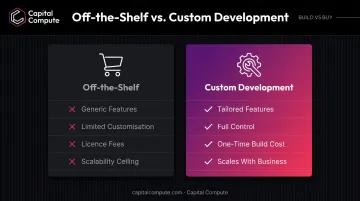
Off-the-shelf apps win on speed and upfront cost. You sign up, configure a few settings, and you're live within days. But that convenience comes with strings attached:
- Generic feature sets that rarely map to niche workflows
- Limited customisation once you hit the platform's ceiling
- Security and scalability constraints dictated by someone else's roadmap
- Ongoing licence fees that scale awkwardly with usage
Custom apps take longer to build. In exchange, you get full control over features, integrations, and how the product evolves as the business grows. There's no vendor deciding what you're allowed to build next.
Why Businesses Choose Custom Development
Three reasons come up again and again in client conversations:
- Brand and UX consistency. A custom app reflects your actual product experience, not a templated shell with your logo dropped in.
- Deep system integration. Off-the-shelf tools rarely talk cleanly to CRMs, ERPs, or internal APIs. Custom builds connect from day one: Capital Compute's engineering team works API-first across GraphQL and Node.js stacks, so third-party systems plug in without duct tape.
- Compliance from the architecture stage. Regulations like the Privacy Act are far cheaper to design in early than to retrofit after launch. Consent tracking, data minimisation, and audit trails belong in the data model, not bolted on before a deadline.
There's no verified industry-wide statistic proving custom apps universally beat off-the-shelf ones on ROI. Treat any agency claiming a fixed uplift percentage with scepticism. What's consistent is that businesses with non-standard workflows or regulatory obligations tend to outgrow generic tools quickly.
Types of Custom Mobile Apps: Choosing the Right Development Approach
"Custom" doesn't mean one technology. It means the build matches your requirements, and there are several ways to get there depending on performance needs, budget, and audience.
Native Apps
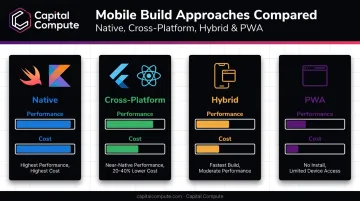
Native apps are built specifically for one operating system: Swift for iOS, Kotlin for Android. This gives full access to device hardware (camera, GPS, biometrics, sensors) and the smoothest possible performance.
The trade-off is cost. Maintaining two separate codebases means double the engineering effort for feature parity across platforms.
Cross-Platform Apps (Flutter, React Native)
Cross-platform frameworks let one codebase serve both iOS and Android. Flutter compiles natively for each platform; React Native renders through native UI components. Both aim for near-native performance without duplicating work.
The cost impact is significant. A GoodFirms study of 267 mobile app companies found cross-platform development typically cuts initial build costs by 20% to 40% compared to building native apps for each platform separately.
For most standard business apps (forms, dashboards, API-driven workflows), cross-platform is the practical default.
Hybrid Apps and Progressive Web Apps (PWAs)
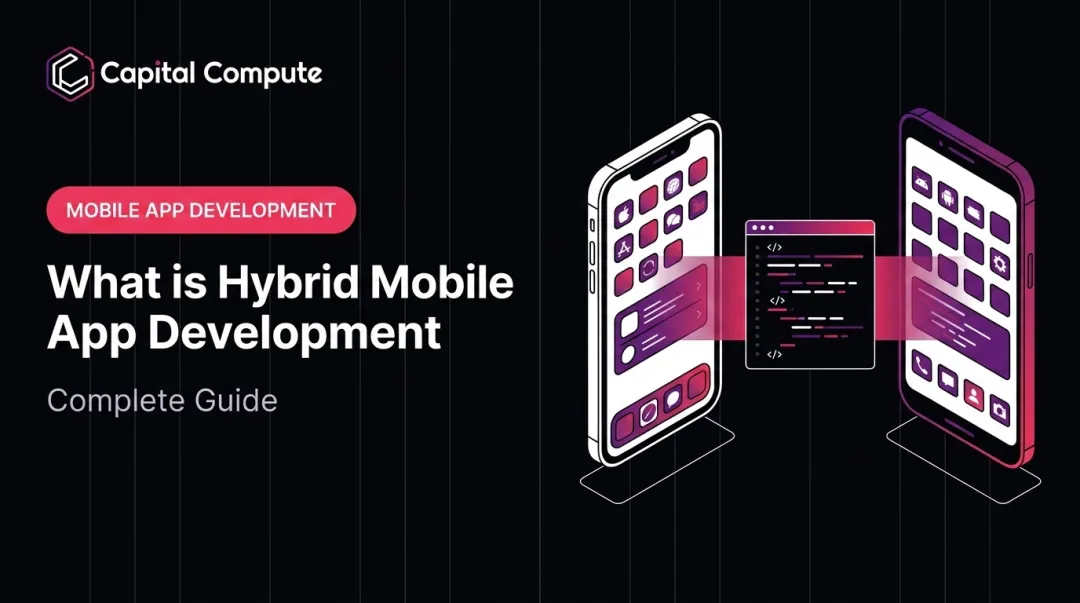
- Hybrid apps wrap standard web technology (HTML, CSS, JavaScript) in a native container. Lower cost, faster build, but noticeable performance trade-offs for complex interactions.
- PWAs run entirely in the browser. No app store, no install friction, offline capability built in, but limited access to native device features.
Quick decision rule: if your app leans heavily on camera use, AR, Bluetooth, or day-one access to new OS features, native is worth the extra spend. If it's mostly forms, lists, and API calls, cross-platform will serve you well without the added cost.
The Custom Mobile App Development Process
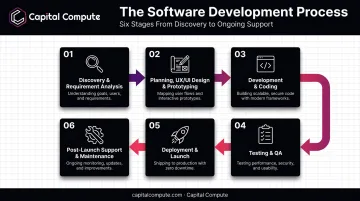
A structured process turns a vague idea into a working product without the guesswork. Here's how it typically breaks down.
Discovery & Requirement Analysis — This phase defines business objectives, target users, and competitive positioning before a single screen gets designed. It validates that the concept solves a real problem worth building for.
Planning, UX/UI Design & Prototyping — Technology stack decisions get locked in, wireframes take shape, and MVP scope gets defined. Early usability testing on prototypes catches confusing flows before development time gets spent on them.
Development & Coding — Front-end and back-end work proceed in parallel, with API integrations woven in throughout. Agile sprints, typically fortnightly, allow course correction rather than discovering problems at the end.
Testing & Quality Assurance — Before launch, apps go through several testing layers:
- Functional testing: Does every feature behave as intended?
- Performance testing: How does it hold up under real usage load?
- Security testing: Are data flows and authentication solid?
- Device/OS compatibility testing: Does it work consistently across screen sizes and OS versions?
Deployment & Launch — App store submission comes with strict requirements. Apple, for example, now requires newer Xcode and SDK versions for every upload. Staged rollouts or soft launches to a limited user group help catch issues before the full release goes live.
Post-Launch Support & Maintenance — Launch isn't the finish line. Apple's own App Store Improvements policy flags apps that go unmaintained for three years for possible removal, giving developers just 90 days to submit an update once flagged. There's no universal weekly or monthly cadence mandated by Apple or Google, but regular bug fixes, feature updates, and security patches remain essential for retention regardless of platform. Capital Compute builds this in as standard, including a 90-day post-launch support window with no charge for defects in code it wrote.
How Much Does Custom Mobile App Development Cost?
Cost depends on four main drivers:
- Feature complexity: a simple booking app costs far less than one with real-time sync, AI features, or offline mode
- Number of platforms: iOS-only, Android-only, or both
- Development team location: rates vary significantly by region
- Integration and compliance depth: connecting to CRMs, ERPs, or building APP-compliant data architecture adds engineering time
Typical Cost Brackets
Based on GoodFirms' 2026 global benchmarking study, drawn from 267 mobile app companies:
| Project Tier | Build Cost (USD) | Approx. AUD | Delivery Time |
|---|---|---|---|
| Basic / small | $15,000–$40,000 | A$18,000–A$25,000 | 3–6 months |
| Mid-level | $40,000–$120,000 | A$25,000–A$500,000 | 6–9 months |
| Advanced | $100,000–$250,000+ | A$25,000–A$500,000+ | 9–12 months |
| Enterprise-level | $250,000–$500,000+ | A$500,000+ | 12–18+ months |
These are global benchmarks, not Australian-specific quotes. AUD values are approximate conversions for reference, so treat both as a directional guide rather than a fixed quote.
What's an App With 10,000 Users Actually Worth?
Value at scale isn't a fixed number. It depends on how infrastructure, support, and maintenance costs grow alongside your user base, and the same GoodFirms study puts annual maintenance and ongoing support at 15% to 25% of the total software budget, covering hosting scale-up, bug fixes, and feature iteration.
Budget for this every year, not just at launch.
Why Fixed-Price, Milestone-Based Models Matter
Hourly or loosely-scoped contracts invite scope creep: the classic "just one more feature" problem that quietly doubles a timeline. Fixed-price, milestone-based engagements avoid this by:
- Locking in scope and cost before development starts
- Tying invoices to delivered, agreed sprint outputs
- Requiring client sign-off before moving to the next phase
This is the model Capital Compute uses for Australian clients: fixed-price estimates within two business days of a scoping call, fortnightly sprint reviews, and no charge for defects in delivered code.
How to Choose the Right Development Partner
Before evaluating anyone, get clear internally on three things: your must-have features, your long-term scalability needs, and your budget ceiling. Vague briefs produce vague quotes.
When comparing partners, look past the lowest bid:
- Technical depth: can they genuinely deliver native (Swift, Kotlin) and cross-platform (Flutter, React Native) work, or do they only know one?
- Portfolio quality: has their work shipped, and does it match your industry's complexity?
- Client references: will previous clients confirm delivery matched what was promised?
Businesses should also prioritise partners offering transparent, fixed-price or milestone-based engagements with no long-term lock-in.
Firms like Capital Compute, for example, keep engineering work in-house rather than subcontracting it out, pairing fixed-price scoping with APP-compliant architecture from the discovery stage. That combination gives Australian SaaS founders and regulated-sector businesses predictable costs and fewer surprises six months into a build.

Finally, confirm the post-launch support model and data compliance approach before signing anything. For Australian and EU businesses handling sensitive user data, this isn't optional. Ask directly:
- What happens after the 90-day support window closes?
- Is there a lock-in clause tying you to further work?
Frequently Asked Questions
How much does custom mobile app development cost?
Cost depends on complexity, platform scope, and team location. Industry benchmarks range from roughly A$15,000 for basic apps to A$500,000+ for enterprise-grade builds.
How much is a custom mobile app with 10,000 users worth?
There's no fixed value — it depends on infrastructure scaling, ongoing maintenance, and revenue potential. Budget annual maintenance at roughly 15–25% of your total software spend alongside the build cost.
What's the difference between custom and off-the-shelf mobile apps?
Custom apps offer full control over features, integrations, and long-term flexibility, but take longer to build. Off-the-shelf apps launch faster and cost less upfront, with limited customisation.
Should I choose native or cross-platform development for my app?
Choose native if your app relies heavily on camera, AR, Bluetooth, or biometric hardware. Cross-platform suits most standard, form-and-API-driven apps at a lower cost.
How long does it take to build a custom mobile app?
Simple apps typically take 3–6 months, mid-complexity builds 6–9 months, and enterprise-grade apps 12–18 months or more, depending on features and integrations.
What happens after my custom app is launched?
Post-launch, ongoing bug fixes, security patches, and feature updates are essential for user retention. Most providers include an initial support window, followed by optional monthly retainer support.