What's changed in 2025 is the buyer. They arrive informed, cautious, and already halfway through their decision before they speak to anyone. According to 6sense's B2B Buyer Experience Report, buyers complete 61% of their journey before making contact with a vendor. That shifts the entire burden of trust-building to your marketing, positioning, and pre-sales content — not your sales calls.
This guide covers what actually moves the needle for software development firms trying to win more projects in 2025: how buyers decide, how to position your firm to get shortlisted, how to structure first-step offers that convert, and how to handle the conversations that close deals.
Key Takeaways
- Buyers complete most of their research before contacting you — trust must exist before the first call
- Specialisation is the primary mechanism for winning better clients at better margins
- A paid, structured scoping engagement converts better than a free discovery call
- Budget must be surfaced early — it respects both parties' time
- Post-delivery is a direct sales channel — retaining clients costs far less than acquiring new ones
How Buyers of Custom Software Development Services Make Decisions in 2025
They're Buying Certainty, Not Development Hours
The most common mistake software firms make is pitching capability — their stack, their process, their team size. Buyers don't care about that yet. What they're actually purchasing is certainty that a complex, expensive project will deliver the business outcome they've promised internally.
The dominant psychological driver is personal risk — specifically, the fear of being accountable for a project that fails publicly inside their organisation. That concern shapes everything. Buyers default to vendors with industry-specific case studies, recognisable client names, and frameworks that visibly reduce their exposure if the project underperforms.
The Shortlist Gets Built Before You Know About It
Forrester research confirms that the average B2B purchase decision now involves 13 stakeholders, and 74% of buying teams experience unhealthy conflict during the process. Even one sceptical stakeholder — a CTO who's been burned by an offshore firm, a CFO who questions the ROI, a legal lead worried about the Privacy Act — can kill a deal entirely.
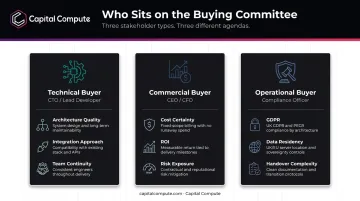
This means your sales process must address multiple roles simultaneously:
- Technical buyers (CTOs, lead developers) — concerned with architecture quality, integration approach, and team continuity
- Commercial buyers (CEOs, CFOs) — concerned with cost certainty, ROI, and risk exposure
- Operational buyers (operations leads, compliance officers) — concerned with the Privacy Act, data residency, and handover complexity
Australian Regulated Sectors Add Another Layer
That multi-stakeholder pressure intensifies in regulated industries. For buyers in legal, finance, and healthcare, compliance questions — the Privacy Act data architecture, data residency, ASIC operational resilience requirements — are now raised during vendor evaluation, not after contract signing.
A software firm that can't answer these questions with specifics loses credibility with regulated sector buyers before the shortlist is even finalised. The questions to prepare for include:
- How is personal data segregated across client environments?
- Where is data hosted, and does that satisfy the Privacy Act data residency requirements?
- How does your architecture address ASIC operational resilience obligations?
Capital Compute, for example, scopes APP-compliant data architecture at discovery rather than treating it as a go-live review — a structural commitment that directly addresses the concern regulated sector buyers raise first.
Define Your Niche and Craft a Value Proposition That Wins Shortlists
Why Generic Positioning Loses
"We build custom software for businesses" tells a buyer nothing. It doesn't reduce their risk, it doesn't help them assess fit, and it gives them no reason to choose you over a cheaper competitor. Vague positioning forces buyers to compare you on price, and on price alone, most firms lose.
Specialisation does the opposite. A firm that builds software specifically for Australian fintech startups navigating ASIC compliance immediately answers three buyer questions at once: Do they know my industry? Have they solved my problem before? Can they reduce my risk?
Hinge Marketing's research on high-growth professional services firms found that high-growth firms are three times more likely to be highly specialised than their slower-growing counterparts. Specialisation narrows your pitch but widens your pipeline — buyers self-select in, and price comparisons drop out.
Choosing Your Specialisation
There are four practical axes to specialise along:
- Industry vertical — legal tech, fintech, healthcare, logistics
- Company stage — SaaS founders at Series A, enterprise legacy modernisation programmes
- Technology context — greenfield builds, legacy system migration, API integration
- Regulatory environment — APP-compliant builds for Australian regulated sectors
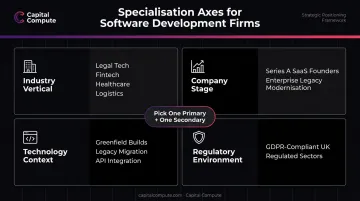
Pick one axis as your primary and one as a secondary. "We build ASIC-compliant fintech platforms for Series A SaaS founders" is a position that gets you shortlisted, because the buyer immediately recognises themselves in it.
Building a Value Proposition That Actually Works
Map your UVP across four elements:
| Element | What to Document |
|---|---|
| Feature | What you specifically do (e.g., internal engineers only, no subcontracting) |
| Benefit | What the client gets (consistent quality, no bait-and-switch) |
| Proof | How you demonstrate it (named team, sprint review structure) |
| Rank | How important is this to your specific buyer? |
This table becomes the source material for every sales deck, case study, and LinkedIn post.
Delivery Transparency as a Differentiator
Australian buyers in 2025 ask directly about subcontracting, team continuity, and what happens after handover. Firms that answer these questions with concrete commitments — internal-only teams, documented APIs, no long-term lock-in — convert at higher rates than those that deflect.
Capital Compute's positioning is built around exactly this principle. The engineers who scope a project are the ones who build it. APIs are versioned and documented so a client's internal team can maintain them after handover. Retained support runs month-to-month with no long-term contract required. These are structural commitments, not marketing language, and they address the buyer's biggest fears before those fears are even raised.
The First-Step Offer: Reduce Buyer Risk and Close More Projects
What a First-Step Offer Is
Instead of attempting to sell a full development project in the first conversation, lead with a low-cost, time-limited engagement: a scoping session, discovery workshop, architecture review, or proof of concept. The buyer gets a structured experience of working with your team before committing to a large investment. You get a paying client who has already said yes once.
This model works because it solves the buying committee problem. All 13 stakeholders can voice concerns, align on requirements, and build shared confidence in a structured, low-risk environment. One paid scoping session does more to accelerate internal alignment than three rounds of proposals ever will.
What a Well-Structured First-Step Offer Looks Like
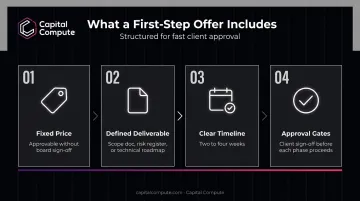
A scoping engagement should include:
- A fixed price — approvable without board sign-off in most organisations
- A defined deliverable — written scope document, architecture decision record, risk register, or technical roadmap
- A clear timeline — typically two to four weeks
- Approval gates — client sign-off before proceeding to each phase
Capital Compute's approach applies this model at scale: fixed-price scoping with fortnightly sprint reviews and client milestone approval gates built into every engagement. Clients receive a concrete technical roadmap and fixed-price estimate within two business days of the initial call: a standalone deliverable with real value whether or not the larger project moves forward.
That clarity is what separates firms that close consistently from those stuck in proposal loops.
The Most Common Mistake
Running a free discovery session with no deliverable and no follow-up structure. Free, unstructured scoping signals low confidence in your own value. It generates no shared output for the buying committee to rally around and no psychological commitment from the buyer. A paid, deliverable-based first-step offer changes that entirely: it positions you as a professional firm that respects its own time and the buyer's investment.
Marketing Strategies That Generate Quality Leads in 2025
Start With a Target Account List
Before running any marketing, build your Ideal Customer Profile (ICP) and use it to create a list of 50–500 target accounts. Filter by:
- Industry — your chosen vertical
- Company size — relevant to your typical project value
- Geography — Australia-focused, with regulatory context in scope
- Technology signals — existing stack, cloud provider, modernisation indicators
You're not trying to reach everyone. You're trying to be impossible to ignore by the right 200 companies — and a defined list makes every dollar of marketing spend count toward that goal.
Content as Credibility
Buyers research vendors before they ever make contact. Case studies, technical blog posts, webinars, and conference talks serve as evidence of expertise — building trust before any conversation begins.
The practical challenge for resource-constrained teams is output volume. The solution: repurpose one asset aggressively. A 45-minute webinar on building ASIC-compliant data pipelines becomes:
- A long-form technical blog post
- Three LinkedIn posts covering individual insights
- A short-form video clip for LinkedIn
- A PDF guide for outreach follow-up
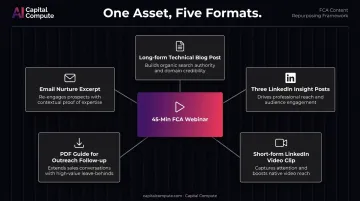
One piece of genuine expertise, distributed across five formats, reaches your ICP multiple times without requiring five separate content creation efforts.
LinkedIn and Niche Communities
Choosing the right channels matters as much as the content itself. For high-ticket B2B services, consistent insight-led engagement where your ICP already gathers consistently outperforms paid advertising. That means:
- LinkedIn posts addressing specific pain points your ICP faces
- Contributions to relevant Slack communities, industry forums, and sector-specific groups
- Speaking at niche industry events where your buyers congregate
Account-based marketing approaches yield measurably better performance than broad campaigns for high-value B2B services — 6% higher performance on average compared to non-ABM approaches — which means a tightly scoped target account list isn't a constraint, it's a competitive advantage.
Navigating the Sales Conversation: Budget, Fit, and Objections
Surface Budget Early
Discussing budget in the first or second conversation is respectful, not pushy. A simple framing works well: "Is this project well-funded, or are you working within a defined ceiling?" This opens the conversation without making it feel transactional. Gong's research on sales calls shows that raising price earlier lifts win rates by roughly 10% — it filters poor fits quickly and aligns expectations before either side invests further.
Adjust by Stakeholder Type
The same project benefit gets framed completely differently depending on who's in the room:
Technical buyer (CTO, lead developer):
"We make architecture decisions in sprint one, not after the first scale event. The same engineers who scope the project build it — no junior handoff after contract signing."
Commercial buyer (CEO, CFO):
"Fixed-price delivery means no cost surprises mid-project. For a SaaS product generating A$50,000 MRR at maturity, launching three months sooner is worth A$150,000 in revenue. Our milestone-based invoicing means you only pay on successful sprint delivery."
Same firm, same delivery model — different emphasis based on what each stakeholder is accountable for.
Handling the Three Most Common Objections
"It's more expensive than we expected."
"Custom development costs more upfront than off-the-shelf tools — that's true. The relevant comparison is the cost of rebuilding architecture that doesn't scale, which tends to consume 20–40% of future development capacity. Our fixed-price scoping means you know the number before committing."
"Can you deliver faster?"
"Timeline is a function of scope. We can run a fixed-price scoping engagement to define what's genuinely required for the first phase versus what can follow in iteration two. That conversation usually surfaces two to three months of work that can safely be deferred."
"How do we know you'll deliver?"
"You don't have to take our word for it. We structure every engagement with fortnightly sprint reviews and client approval gates at each milestone — you review before we proceed. And we use internal engineers only, no subcontracting, so the team you meet is the team that builds."
Retaining Clients and Building Long-Term Revenue
Post-delivery is not the end of the sales process — it's the beginning of the next one. Research published in Harvard Business Review puts the cost of acquiring a new client at 5 to 25 times higher than retaining an existing one. In custom software, where trust takes months to build, that gap is even wider.
Retained clients become three revenue channels simultaneously:
- Repeat projects — feature additions, infrastructure scaling, new product lines
- Upsells — AI agent integration, mobile extensions, additional platform verticals
- Referrals — the highest-converting lead source for any professional services firm
Each of those channels depends on the same foundation: structural conditions that make continued engagement the obvious choice — without trapping clients into it.
Structural Conditions for Retention Without Dependency
Clients who know they can leave and choose not to are more loyal than those held by contractual obligation.
The structural conditions that make this work:
- Clean handover documentation — versioned APIs built for client-side maintenance
- Month-to-month retainer options — no long-term commitment required post-delivery
- Consistent communication — the same team, same contact, same sprint rhythm
- Transparent scope — each retainer sprint agreed in writing before work begins
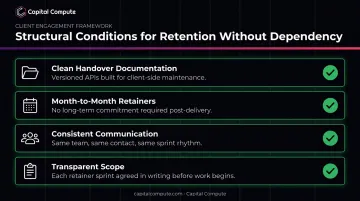
Capital Compute's model illustrates this directly. APIs are documented and versioned for maintenance by the client's internal team after handover, and retained support runs month-to-month with no lock-in beyond the initial 90-day post-launch window. The absence of contractual dependency is itself the signal — clients who re-engage do so because the work holds up, not because they have no alternative.
Frequently Asked Questions
How much does it cost to develop custom software?
Cost varies widely based on complexity, team seniority, timeline, and technology stack. In the Australian market, projects typically range from around A$15,000 for a proof of concept to A$400,000 or more for enterprise systems, with most mid-market builds sitting somewhere in between. A fixed-price scoping engagement is the most reliable way to get a realistic budget estimate before committing to a full build.
What is a discovery or scoping session, and do I need one?
A scoping session is a structured, time-limited engagement where the development team defines scope, architecture, risks, and budget before any code is written. It reduces project failure risk for both sides and should be a paid, deliverable-based engagement — not a free consultation. If you're spending more than A$15,000 on software, a scoping session is worth doing.
How do I choose between a fixed-price and time-and-materials contract?
Fixed-price suits well-defined scope and risk-averse buyers who need cost certainty. Time-and-materials suits projects with evolving requirements where flexibility matters more than predictability. Milestone-based fixed-price (with sprint reviews and approval gates at each phase) offers a practical middle ground for most custom builds.
How long does it typically take to close a custom software development sale?
Sales cycles range from a few weeks to several months, depending on project size and the number of stakeholders involved. Using a scoping session as a first-step offer rather than pitching the full project typically accelerates internal alignment and shortens the cycle by weeks, in most cases.
What should I look for when evaluating a custom software development partner?
Evaluate on these criteria:
- Team continuity — same engineers throughout, no subcontracting
- Compliance architecture — the Privacy Act and sector regulations built in from discovery
- Transparent pricing — fixed-price delivery with milestone-based payment gates
- Post-handover documentation — enables your internal team to maintain the system independently
- Relevant track record — case studies or references from your specific industry
How do I convince non-technical stakeholders to approve a custom software investment?
Frame the ROI in business terms (cost savings, revenue uplift, risk reduction) rather than technical outputs. Use a phased investment structure where the first commitment is a low-cost scoping session rather than a full project. Milestone-based payment gates and a verified vendor track record address the personal risk concern driving most stakeholder scepticism.