Introduction
Australian financial institutions are under more pressure than at any point in recent memory. Neobanks have stripped out friction that legacy providers spent decades building in. Embedded finance platforms are turning non-financial brands into lending and payment providers. And customers who once tolerated a 10-day account opening process now abandon it after 90 seconds.
This has moved digital transformation from an IT backlog item to a board-level conversation — fast.
According to the ABS, 12% of Australian businesses used AI in 2024-25, up from just 1% in 2021-22, with adoption higher among larger businesses. For most institutions, the question has shifted: not whether to transform, but how to do it without destabilising regulated operations.
This article covers the definition, the 2025-specific drivers, the technologies reshaping the sector, the most common implementation challenges facing Australian institutions, and a practical roadmap for getting started.
Key Takeaways
- Financial services firms are under increasing scrutiny for AI use — ASIC's REP 798 reviewed 23 AFS and credit licensees, finding nearly half had no policies addressing consumer fairness or bias
- Incremental API-wrapping modernises legacy systems without disrupting core infrastructure
- ASIC Consumer Duty and the Privacy Act are active transformation drivers, not just compliance burdens
- Compliance architecture must be designed from sprint one — not reviewed before go-live
- Iterative, milestone-based delivery reduces risk in regulated environments
What Is Digital Transformation in Financial Services?
Digital transformation in financial services is the deliberate integration of digital technologies — AI, cloud infrastructure, APIs, and automation — into core operations, products, and customer interactions. The goal is to replace manual, legacy-driven processes and build more agile, data-informed institutions.
It is not simply moving paperwork online or launching a mobile app. Plenty of institutions have done both and changed nothing fundamental. True transformation requires rethinking processes, data architecture, and operating models from the ground up.
How the Definition Has Shifted for 2025
The distinction matters more now than it did five years ago. There are two levels of change:
- Digitisation — converting existing processes to digital format (scanning documents, PDF forms, online portals)
- Transformation — redesigning products, delivery models, and customer relationships around digital-first capabilities
In 2025, the bar has moved to genuine transformation. Institutions are redesigning products around real-time data and rebuilding customer journeys around agentic AI — restructuring their data infrastructure to enable meaningful analytics, not just faster versions of the same workflows.
For Australian regulated institutions, this shift carries direct regulatory weight. ASIC Consumer Duty requires firms to monitor outcomes, maintain retrievable records, and review performance at governing-body level — none of which is achievable with fragmented data and manual reporting. Firms that treat transformation as optional are, in practice, treating compliance as optional too.
Key Drivers Accelerating Digital Transformation in 2025
Three forces are pushing Australian financial institutions to accelerate simultaneously — competitive, regulatory, and behavioural.
Competitive and Technology Pressure
KPMG's 2025 financial services technology report found that 81% of banking and insurance CEOs identify generative AI as a top investment priority. That's where strategic investment is concentrating across the sector.
The competitive pressure is coming from multiple directions:
- Fintechs and neobanks continue expanding into traditional banking territory
- Embedded finance is placing financial products inside non-financial customer journeys
- Every month a traditional institution delays modernisation, the capability gap widens
Regulatory Requirements as a Transformation Catalyst
Competitive pressure alone would be enough to accelerate investment. Regulation is adding urgency. Australian regulatory obligations are now actively driving specific technology decisions:
- ASIC Consumer Duty requires ongoing outcome monitoring, appropriate management information, and annual governing-body review. Firms that tried to meet this with manual data collection are finding it unsustainable
- Open Banking mandates have created an API-first imperative across the sector
- The Privacy Act requires data protection by design, with high-risk automated decision-making requiring Data Protection Impact Assessments
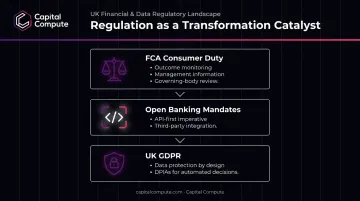
The ASIC's own good-practice guidance cites website analytics, proactive vulnerability detection, and centralised data systems as examples of how firms are meeting Consumer Duty requirements — practical technology choices, driven by regulatory obligation.
Customer Behaviour
AI adoption among Australian SMEs reached 44% in February 2026, up from 43% across the December-February quarter. Customers expect 24/7 self-service, real-time transparency, and personalised product experiences. Institutions that cannot deliver these are losing accounts, not just market share.
Core Technologies Reshaping Financial Services in 2025
Artificial Intelligence and Automation
AI has moved well past the chatbot phase. ASIC's REP 798 review of 23 AFS and credit licensees found many now embed AI in automated decision-making, with leading applications in fraud detection, cybersecurity, and internal process optimisation — yet nearly half had no policies addressing consumer fairness or bias.
Agentic AI — systems that can plan, act, and iterate across multi-step workflows — is now in production environments handling compliance-adjacent tasks: underwriting assistance, regulatory reporting, and client onboarding sequences. Capital Compute has shipped production AI agents in the finance sector, built around ASIC-compliant audit trail systems and real-time reporting requirements. Compliance architecture is scoped from discovery — not added post-deployment.
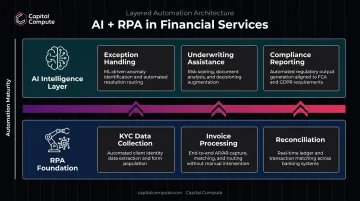
Robotic process automation (RPA) remains the entry point for many institutions — automating high-volume, repetitive tasks like KYC data collection, invoice processing, and reconciliation. AI layers on top of RPA to handle exceptions and judgment-dependent steps that rules-based automation cannot manage.
Cloud Infrastructure
Cloud adoption in financial services is advancing — but unevenly. Accenture's Banking Cloud Rotation Index found that nearly 100 banks had moved an average of just 15% of workloads to cloud, with core banking functions at only 7%. That gap represents both the challenge and the opportunity.
82% of financial services organisations prioritised investment in cloud and XaaS in 2024, with nearly a third reporting reductions in technology debt and total cost of ownership. Cloud-first and hybrid architectures deliver the underlying gains: scalable infrastructure, faster product launches, and real-time data access without the capital burden of on-premises systems.
Open Banking and APIs
AI adoption in Australia has reached genuine scale. The ABS recorded 12% of Australian businesses using AI in 2024-25, up from 1% in 2021-22, with SME adoption reaching 44% by February 2026.
For financial institutions, the open banking framework is not just a consumer-facing feature — it is a structural driver for API-first architecture decisions. Institutions that build API-first can integrate third-party services, share data with authorised partners securely, and participate in ecosystem-based product models. Those that do not are building against the direction the market is moving.
Data Analytics and Real-Time Reporting
Batch-based reporting — where dashboards update overnight and risk models run weekly — is no longer fit for purpose. Modern data platforms enable real-time financial dashboards, continuous risk monitoring, and personalised product recommendations.
Breaking down data silos is the prerequisite. Fragmented data across departments, channels, and legacy platforms produces inconsistency, duplication, and analytics that cannot be trusted. A unified data architecture requires:
- Technical integration — APIs, middleware, and data pipelines connecting disparate systems
- Data governance — clear ownership, definitions, and quality standards across teams
- Organisational alignment — agreement on who controls what data, and how it is used
Cybersecurity and Compliance Technology
Digital transformation expands the attack surface. Regulators such as ASIC and AAPRA continue to flag cyber incidents as a growing risk for regulated firms, and IBM found that the average financial-sector data breach cost reached USD $6.08 million globally.
RegTech tools, automated compliance monitoring, and AI-driven fraud detection are not optional add-ons for a transformed financial institution — they are foundational components. APP-compliant data architecture must be designed at the start of any build. Retrofitting security and compliance controls after deployment is expensive, often technically disruptive, and can leave gaps that satisfy neither auditors nor regulators.
Key Benefits for Financial Institutions
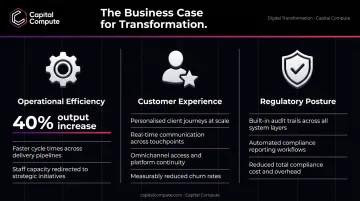
The business case for transformation shows up in three measurable areas: operational throughput, customer retention, and regulatory cost.
Operational Efficiency
McKinsey documented a regional bank achieving a 40% increase in average output through a generative AI deployment. Automation of reconciliation, onboarding, and compliance reporting frees staff for advisory and strategic work. Cycle times that previously took days compress into hours.
Customer Experience and Retention
Personalised digital journeys, real-time communication, and omnichannel access improve satisfaction scores and reduce churn. Digital-native challengers built without legacy constraints — which means matching their experience quality is now a competitive requirement, not an enhancement.
Regulatory Posture
Digital systems with built-in audit trails, automated reporting, and structured data governance reduce the cost and risk of regulatory review. For Australian institutions under ASIC and APRA oversight, this translates directly into operational savings, not just reduced exposure.
Biggest Challenges and How to Overcome Them
Legacy System Complexity
Most established institutions operate on core banking platforms that were not designed for API connectivity, real-time processing, or cloud deployment. Ripping and replacing these systems is high-risk and operationally disruptive.
The practical alternative is incremental modernisation: wrapping legacy systems with APIs, migrating functionality in defined stages, and maintaining operational continuity throughout. Capital Compute applies this model when working with Australian finance sector clients — using milestone-based delivery with client approval gates at every fortnightly sprint review, so transformation moves forward without destabilising live operations.
Regulatory and Compliance Risk
Implementing new technologies while maintaining compliance with the Privacy Act, ASIC Consumer Duty, AML, and KYC requirements means compliance must be embedded at the architecture stage, not reviewed before go-live. Organisations that scope data architecture and access controls with regulatory requirements in place from sprint one avoid the costly rework that comes from treating compliance as a launch checklist.
For Capital Compute's regulated finance builds, this means APP-compliant data architecture, ASIC-aligned audit trail capability, role-based access controls, and PCI-DSS data handling are all scoped during the discovery phase — before a line of production code is written.
Cybersecurity Threats
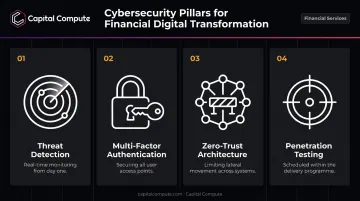
More endpoints, more integrations, and more cloud services mean a larger attack surface. Financial institutions need to treat security as a core workstream, not a post-deployment add-on. That means building in:
- Threat detection and real-time monitoring from day one
- Multi-factor authentication across all user access points
- Zero-trust network architecture to limit lateral movement
- Penetration testing scheduled within the delivery programme
Workforce and Culture Resistance
Technology adoption fails when the people using it are not brought along. Finance teams with long-established manual workflows need upskilling, clear communication about what is changing and why, and visible sponsorship from senior leadership. The technical implementation and the change management programme must run in parallel, not sequentially.
Data Silos and Integration Complexity
Fragmented data across departments and legacy platforms creates inconsistency and undermines the analytics and AI initiatives built on top of it. Resolving this requires both technical work (APIs, middleware, data lakes) and organisational decisions about data ownership, quality standards, and who is accountable when data quality breaks down. Without that clarity, even well-architected integrations degrade quickly.
How to Execute Digital Transformation: A Practical Roadmap
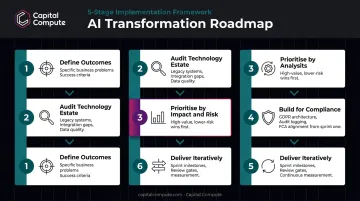
Step 1 — Define Outcomes Before Technology
Start with specific business problems, not platform selections. "Reduce onboarding time from 10 days to 24 hours" or "automate 80% of reconciliation tasks" gives a transformation programme clear success criteria. Technology choices follow from that clarity — not the other way around.
Step 2 — Audit Your Current Technology and Data Estate
Document your full technology estate before planning any new architecture. For each component, establish:
- Which legacy systems can be wrapped with APIs versus requiring full migration
- Where integration gaps exist between current platforms and data flows
- Where data quality problems will limit downstream AI or analytics value
Step 3 — Prioritise by Impact and Risk
Rank initiatives by expected business value against implementation complexity. High-impact, lower-risk automation wins — RPA for reconciliation, AI-assisted compliance reporting — prove value before tackling core system overhauls.
Step 4 — Build for Compliance from the Start
For Australian regulated institutions, compliance requirements must be scoped at discovery, not reviewed at go-live. That means:
- APP-compliant data architecture designed before a line of code is written
- Audit logging and role-based access controls built into sprint one
- ASIC-aligned processes defined during discovery, not retrofitted at launch
Capital Compute structures every regulated finance engagement this way. A software partner who embeds compliance decisions in sprint one removes the risk of costly architectural rework before go-live.
Step 5 — Deliver Iteratively and Measure Continuously
Adopt a sprint-based delivery model with defined milestones and client review gates. Stakeholders should be able to course-correct early, validate adoption, and confirm each phase delivers measurable value before the next begins.
Avoid "big bang" delivery in regulated environments. When errors are costly and rollback is complex, catching misalignments within a two-week sprint window rather than at go-live is a risk management decision — not just a delivery preference.
Frequently Asked Questions
What are the current priorities for digital transformation in financial services?
In 2025, the top priorities are AI-driven automation, legacy system modernisation, and regulatory compliance technology — particularly around ASIC Consumer Duty and the Privacy Act. Improving digital customer experience across channels sits alongside these as a competitive necessity, not a secondary objective.
What is digital transformation in financial services?
Digital transformation in financial services is the deliberate integration of AI, cloud, APIs, and automation into operations, products, and customer experiences — replacing manual processes and building more agile, data-driven institutions. The goal is to rethink operating models entirely, not simply digitise what already exists.
What are the 7 pillars of digital transformation?
One recognised framework maps to seven practical priorities in financial services: data governance, cloud architecture, AI capability, open banking participation, workflow automation, CX design, and regulatory adaptability. These translate the theoretical pillars into deliverables that regulated institutions can act on.
What are the biggest challenges of digital transformation in financial services?
Legacy system complexity, regulatory compliance burden, cybersecurity risk, data silos, and workforce resistance are the primary challenges. Of these, legacy complexity and compliance risk are the most structurally difficult: both require careful sequencing and architectural discipline from the outset.
How long does digital transformation take in financial services?
Targeted automation initiatives can deliver measurable results within weeks. Core platform overhauls typically span 18–36 months. A phased, milestone-based approach generates early ROI and reduces costly corrections later in the programme.
What role does AI play in financial services digital transformation in 2025?
ASIC's REP 798 review of 23 AFS and credit licensees found that nearly half had no policies addressing consumer fairness or bias in their use of AI. Live applications include fraud detection, compliance reporting, client onboarding, and underwriting support. Agentic AI systems handling multi-step workflows with minimal human intervention are now operating in regulated environments.