This guide is for founders at that exact inflection point — where the platform that got you here is starting to hold you back.
We'll cover when the switch to custom actually makes sense, which features to build first, what Privacy Act compliance requires from an Australian ecommerce platform, how the development process works, what it realistically costs, and how to pick a development partner who won't create new problems while solving the old ones.
Key Takeaways
- Custom ecommerce gives founders full ownership of their platform — no transaction fees, no ceiling on what the product can become
- Going custom should be triggered by specific business signals — revenue thresholds, integration failures, or growth constraints — not frustration with your current platform
- Privacy Act compliance must be scoped at the architecture stage, not retrofitted after launch
- Cost varies significantly based on feature complexity, integration depth, and team location
- Vetting your development partner matters as much as vetting your tech stack — poor partner choices create dependency that survives the build
Custom vs. Platform-Based Ecommerce: When the Switch Makes Sense
Renting vs. Owning
Platform-based ecommerce — Shopify, WooCommerce, BigCommerce — gives you speed to market in exchange for control. You're building on someone else's infrastructure, operating within their constraints, and paying ongoing fees that scale with your revenue rather than your costs.
Custom ecommerce inverts that model. You own the codebase, control the data architecture, and build exactly the workflows your business requires. There's no permission structure between your team and your own platform.
Third-party payment provider fees on ecommerce platforms typically scale down as you move to higher pricing tiers, but even a small percentage translates into a significant ongoing cost at meaningful GMV — one that compounds annually and doesn't decrease as your operational complexity grows.
Business Signals That Suggest Going Custom
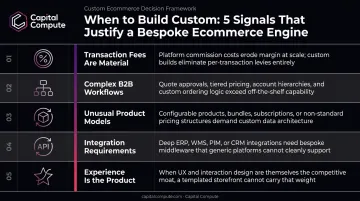
Not every founder should go custom. The decision makes sense when specific conditions are present:
- Transaction fees are material — your GMV has reached a point where platform fees represent a meaningful percentage of margin
- Complex B2B workflows — customer-specific pricing, purchase orders, multi-user accounts, or net payment terms that no plugin handles cleanly
- Unusual product models — rental, subscription, configurable builds, or anything that doesn't map to a standard catalogue structure
- Integration requirements — you need real-time two-way data sync between your ecommerce platform and an ERP, CRM, or warehouse management system
- Your experience is the product — checkout flow, personalisation logic, or dynamic pricing is a genuine competitive differentiator you can't engineer inside a template
The Headless Middle Path
If the signals above apply to your frontend but not your backend, headless commerce is worth understanding before committing to a full build. You keep an existing commerce backend — or a platform like Shopify as the engine — while building a fully custom frontend.
WP Engine's State of Headless 2024 report, which surveyed 1,015 IT and marketing decision-makers across Australia, US, and Australia, found headless architecture was already in widespread use among respondents. The drivers cited were consistent content experiences, faster innovation, and competitive differentiation.
Headless is the right call when your core commerce logic works but your frontend needs complete freedom. A full custom build is the right call when the backend workflows themselves don't fit the platform — when the business logic requires something the platform can't support, not just the design.
The Hidden Cost of Staying Too Long
Plugin sprawl is expensive and brittle. Multiple paid extensions, each maintained on different release cycles, create a dependency chain that breaks unpredictably and quietly consumes developer time. WooCommerce's own extension catalogue lists individual plugins carrying ongoing annual fees for core functionality like subscriptions and memberships — and that's before you account for the developer time spent maintaining compatibility.
The 3-question test: If you answer yes to two or more of these, a custom build is likely the right path:
- Are there workflows your platform simply can't support — no matter how many plugins you stack?
- Do you have workflows no plugin can replicate?
- Are platform and transaction fees consuming a material slice of margin at your current GMV?
- Do you need integrations that require real-time two-way data sync?
Key Features to Build Into Your Custom Ecommerce Platform
The advantage of going custom is building precisely what your business needs — nothing more at launch, nothing left out that's critical. The discipline is separating MVP from post-MVP before a line of code is written.
Customer-Facing Features
Core features that must be present at launch:
- Product catalogue with advanced filtering, variant management, and rich media support
- Product detail pages with customer reviews, video, and configurable options
- Cart and checkout with multiple shipping options, address management, and clear order summary
- Payment gateway support covering Stripe, PayPal, and digital wallets as a minimum; Buy Now Pay Later for relevant audiences
- User accounts with order history, tracking, and returns initiation
Mobile is not optional. Salesforce's 2024 holiday shopping data, drawn from 1.5 billion global shoppers, found that mobile generated 79% of ecommerce traffic and nearly 70% of orders during the November–December 2024 peak period. Mobile-first design should be a hard constraint from sprint one.

Admin and Operations Features
The admin side determines whether the platform actually reduces operational overhead:
- Order management with status workflows, fulfilment triggers, and exception handling
- Inventory tracking built for multi-warehouse and third-party fulfilment models
- Payment configuration covering refund workflows and dispute handling
- Content management that lets ops teams update listings without developer involvement
- Customer account moderation with verification, suspension, and communication tools
Beyond these features, the real ROI driver for businesses outgrowing SaaS platforms is deep ERP and CRM integration. Real-time two-way sync between the ecommerce platform and internal systems eliminates manual data reconciliation — the spreadsheet-and-copy-paste workflows that compound unnoticed until they're consuming hours of staff time every day.
Advanced Differentiating Features
These are worth planning at discovery but building post-MVP:
- AI-powered product recommendations personalised to individual browsing and purchase behaviour
- A/B-testable checkout flows — custom experiments without plugin constraints
- B2B-specific functionality — tiered pricing, customer-specific catalogues, net payment terms
- Subscription and rental models — for businesses with recurring revenue structures that don't fit standard transaction models
The Privacy Act and Security: Non-Negotiables for Australian Ecommerce Founders
Why Architecture Decisions Come First
Privacy Act compliance cannot be bolted on after launch. The decisions that determine your compliance posture — how customer data is stored, where it lives, who can access it, how it gets deleted — are made during architecture design. Reversing those decisions after go-live is significantly more expensive than getting them right at the start.
For Australian ecommerce platforms, the OAIC's guidance on lawful handling of personal information under the Australian Privacy Principles sets out the grounds for collection and use. The most relevant for ecommerce are:
- Contract — processing necessary to fulfil an order
- Legal obligation — where statute requires data retention
- Legitimate interests — where necessity and balancing tests are satisfied
- Consent — specific, informed, and freely given
Each processing activity on your platform needs a documented lawful basis. That documentation starts at the architecture stage.
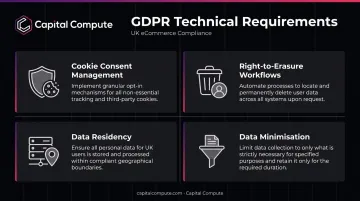
Technical Requirements Your Build Must Address
- Cookie consent management — Australian PECR requires active, unambiguous consent before non-essential cookies are set. Shopping basket cookies are exempt; analytics and advertising cookies are not
- Right-to-erasure workflows — baked into the user account system, with a one-month response window. OAIC guidance does not provide a blanket exemption for order records; continued retention must fit a specific exception such as legal obligation
- Data residency — international transfers outside Australia require an appropriate safeguard (IDTA, Australian Addendum, or Binding Corporate Rules). Australia or EEA server locations reduce complexity, though they're not mandated by a blanket rule
- Data minimisation — collect only what processing requires; document the justification
Capital Compute scopes Privacy Act compliance architecture during discovery, before any application-layer decisions are made. Compliance is part of the data model, not a review at go-live.
Payment Security
Data compliance and payment security sit on the same foundation: both need to be scoped at architecture, not reviewed at launch. The current standard is PCI DSS v4.0.1, published June 2024. Key requirements for any custom ecommerce build include:
- Hosted fields integration — Stripe Elements or Braintree Hosted Fields send card data directly to the provider, which can reduce merchant scope and may support SAQ A eligibility
- Merchant responsibility remains — hosted fields reduce scope, but do not remove PCI DSS obligation; the merchant must use an eligible integration and complete required validation
- Scoped at discovery — your development partner should define PCI compliance requirements before build begins, not surface them at launch
The Custom Ecommerce Development Process
Discovery: Where Risk Is Reduced, Not Just Defined
The discovery phase is the most important investment in a custom build. Decisions made here — tech stack, data model, integration architecture, compliance scope — are the most expensive to reverse later. A well-run discovery phase typically takes two to four weeks and produces a detailed specification and cost estimate before any code is written.
Discovery deliverables should include:
- Integration dependency mapping
- Compliance architecture scope (the Privacy Act, PCI DSS)
- Data model and API architecture plan
- Fixed-price project estimate
At Capital Compute, discovery includes a 30-minute scoping call followed by a fixed-price estimate within two business days. Compliance architecture — data flows, consent design, right-to-erasure workflows — is scoped in week one, before architecture decisions are finalised.
Sprint-Based Delivery and Milestone Gates
Once discovery produces a signed-off specification, development moves into structured sprints — each gated by client approval before the next phase begins. A rejected deliverable doesn't unlock the next invoice; it triggers a fix cycle first. That single rule prevents scope drift from compounding across the build.
Capital Compute runs fortnightly sprint reviews in Australian business hours, with daily async updates between sessions. Each sprint is scoped and agreed in writing before work starts, then billed only when the agreed output is delivered successfully.
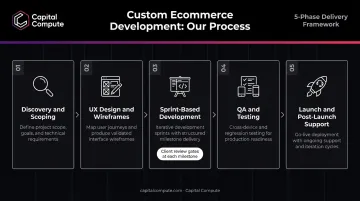
Key phases in sequence:
- Discovery and scoping — requirements, architecture, integration mapping, compliance
- UX design and wireframes — mobile-first from the first iteration
- Sprint-based development — with client review gates at each milestone
- QA and testing — load, payment flows, cross-device
- Launch and post-launch support
What Does Custom Ecommerce Development Cost?
Realistic Cost Ranges
Custom ecommerce builds vary significantly based on complexity. C9's analysis of Australian AI software implementation costs provides a useful local benchmark: a focused proof of concept or MVP typically runs A$40,000–A$120,000, with mid-scale bespoke AI systems reaching A$120,000–A$350,000. For Australian builds with senior engineers, costs scale with genuine complexity, not arbitrary pricing.
What Drives the Cost
| Cost Driver | Lower End | Higher End |
|---|---|---|
| Feature scope | Focused MVP | Full-featured platform |
| Integrations | One payment gateway | ERP + CRM + WMS |
| Data migration | New platform | Migration from live store |
| Team seniority | Mixed | Senior engineers throughout |
| Timeline | 3–4 months | 9–12+ months |
The ROI Case
Consider a hypothetical ecommerce business doing A$2 million GMV annually on Shopify's Advanced plan. At 0.6% third-party transaction fees, that's A$12,000 per year in transaction fees alone — before plugin costs, developer workaround time, and the opportunity cost of workflows that don't work properly.
A custom build at A$80,000 has a payback period of under seven years on transaction fees alone. That calculation ignores operational efficiency gains from proper ERP integration and the removal of plugin maintenance overhead — both of which compound the return year on year.
Budget Recommendation
Start with a scoped MVP. A well-scoped MVP that launches and generates revenue carries significantly less risk than a 12-month full-platform build. Iterate based on what the market tells you — then expand with confidence.
How to Choose the Right Custom Ecommerce Development Partner
What to Look For
- Verifiable ecommerce portfolio — case studies with named outcomes, not just screenshots
- Senior engineering involvement from sprint one — not a senior architect handing off to juniors after scoping
- Transparent pricing — fixed-price scoping and milestone-based delivery, not open-ended hourly billing
- The Privacy Act awareness at architecture stage — a partner who raises compliance during discovery, not at go-live
- Clear post-handover terms — full codebase ownership, documented APIs, no lock-in clauses
The Subcontracting Risk
Many development agencies subcontract work to third parties without disclosing it. This creates accountability gaps, inconsistent code quality, and knowledge transfer problems at handover. Ask directly: Is the team that builds this product your own internal engineers, or will work be passed to a third party? The answer should be unambiguous.
Capital Compute
For Australian founders who want the criteria above met without negotiating each point separately, Capital Compute builds custom ecommerce platforms using a fully internal engineering team — the same engineers from sprint one through handover. Fixed-price milestone delivery, fortnightly sprint reviews in Australian business hours, and APP-compliant architecture scoped at discovery are standard practice, not add-ons. At project close, full codebase and API ownership transfers to you with no lock-in.
Frequently Asked Questions
How much does custom ecommerce software development cost in Australia?
Most Australian custom ecommerce builds fall between A$120,000 and A$350,000, with complexity, integration depth, and team seniority as the main variables. A focused MVP sits at the lower end; a full-featured platform with ERP, CRM, and warehouse management integration sits at the higher end.
When should I choose custom ecommerce software over Shopify or WooCommerce?
The key triggers are: platform fees consuming a meaningful share of your margin, B2B workflows no plugin handles cleanly, product models that don't fit a standard catalogue structure, or integration needs requiring real-time two-way data sync that SaaS platforms can't support natively.
How long does it take to build a custom ecommerce platform?
A focused MVP typically takes three to six months. Complex builds with multiple third-party integrations run longer. Discovery resolves architecture questions early and keeps timelines intact.
What is the difference between custom ecommerce development and platform-based development?
Platform-based development builds on pre-existing infrastructure with built-in constraints on functionality, data ownership, and fees. Custom development produces a proprietary asset built around your specific workflows — you own the codebase, control the roadmap, and pay no ongoing transaction fees to a platform vendor.
How do I ensure Privacy Act compliance in my custom ecommerce platform?
Privacy Act compliance must be scoped at the architecture stage. Data storage decisions, consent management design, right-to-erasure workflows, and data residency choices all need to be resolved before application development begins. A development partner should raise these during discovery, not surface them at go-live.
What should I look for in a custom ecommerce development partner?
Prioritise an internal (not subcontracted) engineering team, a verifiable ecommerce portfolio, fixed-price or milestone-based pricing, demonstrated the Privacy Act awareness from discovery, clear post-handover ownership terms with no lock-in, and confirmation that the engineers who scope the project are the same ones who build it.