Introduction
Most startups and SMBs hit the same wall eventually. The spreadsheet that once tracked everything now has seventeen tabs and two people maintaining it manually. The CRM handles leads fine, but it has nothing to say to the invoicing tool, so someone exports a CSV every Monday morning. The off-the-shelf platform works — mostly — except for that one workflow that matters most to how the business actually runs.
Not because custom software is automatically the answer — but because the cost of not addressing it adds up fast:
- Wasted hours on manual workarounds
- Reporting gaps that distort decisions
- The Privacy Act and sector compliance gaps patched with processes instead of architecture
- A team adapting to a tool instead of the other way around
Once you frame it that way, the hesitation shifts. Custom software sounds expensive and slow — but the real question is not "can we afford to build it?" It is "what is staying with the current setup actually costing us?"
This guide covers the practical answers: what custom software development is, how to decide if it fits your current stage, what the build process looks like, what drives costs, and what to look for in a development partner.
Key Takeaways
- Custom software is built around your workflows — not the other way around
- Off-the-shelf tools work early on; custom development becomes the right call when workarounds multiply or compliance gaps start appearing
- A phased MVP approach keeps initial spend manageable without sacrificing production quality
- The Privacy Act and security requirements must be scoped at discovery, not reviewed at go-live
- Full code ownership after handover means no long-term dependency on the development partner
What Is Custom Software Development?
IBM defines custom software development as the process of designing, creating, deploying, and maintaining software for a specific set of users, functions, or organisations. The contrast is with what NIST calls commercial off-the-shelf (COTS) products — software that is pre-built and sold to the general public.
Put simply: off-the-shelf tools like Shopify, HubSpot, or QuickBooks are built for the widest possible audience. They cover the most common use cases well and handle the rest adequately. Custom software is built around one business specifically — its users, its workflows, its goals, and how it actually operates day to day.
What Custom Software Actually Looks Like
The form it takes depends entirely on the business. It could be:
- An internal workflow tool that mirrors how approvals actually move through the organisation
- A customer-facing SaaS platform built for a specific market segment
- A CRM structured around a non-standard sales process
- An APP-compliant data portal for a regulated legal or finance business
- A mobile app requiring native performance on iOS and Android
The common thread is that the software fits the business — not the other way around. For organisations in regulated sectors, that distinction carries real weight: a tool built for a generic audience rarely satisfies the specific obligations that Australian legal, finance, and healthcare businesses operate under.
Custom Software vs. Off-the-Shelf: Making the Right Call
When Off-the-Shelf Makes Sense
Early-stage businesses are often better served by off-the-shelf tools. Before product-market fit is confirmed, speed and cost efficiency matter more than precision. Using HubSpot for early CRM, Xero for accounting, or Shopify for an initial eCommerce presence is a rational choice — these tools are mature, well-supported, and available immediately.
The problems tend to emerge later:
- Licensing fees that scale with users, not with value delivered
- Features the business will never use, bundled into every tier
- Platform limits that become visible precisely when growth demands more
- Vendor lock-in that arrives when switching costs are highest
Gartner's research explicitly identifies SaaS vendor lock-in and switching costs as real sourcing risks for businesses that have grown beyond what their initial tools were designed to support. That friction — not company size — is usually what forces the conversation about custom software.
When Custom Software Is the Right Move
The clearest signal is operational friction. Specific triggers include:
- Manual workarounds: Teams filling gaps the software was not built to handle
- Data silos: Disconnected tools creating reporting delays and manual data re-entry
- Compliance gaps: the Privacy Act, ASIC, SRA, or Australia's public health system requirements that cannot be met through a generic platform's configuration settings
- Workflow uniqueness: A process, user journey, or integration that no existing tool replicates
A short decision framework — ask these questions:
- Are teams regularly working around the software rather than through it?
- Are data silos between tools creating reporting problems or decision delays?
- Does compliance require data architecture decisions the vendor will not make?
- Are licensing costs scaling faster than the value the tool delivers?
- Is the business model dependent on a workflow or user experience that off-the-shelf cannot replicate?
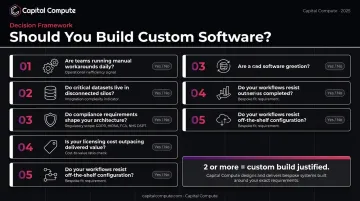
If two or more of these apply, the economics of a custom build typically justify the investment — and the sooner the scoping conversation happens, the less technical debt carries over from the workarounds.
The Hybrid Approach
Custom software does not have to replace everything. Many growing businesses build custom only where off-the-shelf falls short — keeping Xero for accounting while building a custom operations platform that integrates with it via API. For most startups and SMBs, this hybrid model is the lowest-risk entry point: extend what works, replace only what doesn't.
Key Benefits of Custom Software for Startups and SMBs
Tailored Fit and Workflow Alignment
Generic SaaS is designed for the broadest possible user base. That means it fits no single business perfectly. Custom software is built around the actual approval flows, user roles, reporting logic, and customer journeys of a specific organisation.
This matters most in regulated sectors. A legal firm, finance business, or healthcare provider cannot simply configure a standard platform to meet SRA, ASIC, or CQC requirements. The compliance workflow needs to be part of the architecture — not bolted onto a tool designed for a different industry.
Scalability by Design
A well-architected custom system can add users, modules, integrations, and geographic markets without being replaced. The global custom software development market was valued at USD 43.16 billion in 2024 and is projected to reach USD 146.18 billion by 2030 at a 22.6% CAGR — reflecting a broad shift toward building rather than buying.
The difference between scalable and non-scalable architecture is often made in sprint one. Decisions about multi-tenancy, API structure, access control, and data models set the ceiling for what the product can become. Getting those decisions right at the start — rather than revisiting them under pressure — is where senior engineering input pays for itself.
Integration with Your Existing Tech Stack
Custom-built APIs connect the systems already in use, including:
- Payment gateways and billing platforms
- CRMs and marketing automation tools
- ERPs and operational data sources
- Analytics platforms and regulated data feeds
This removes the manual data transfers and reporting gaps that build up when disconnected off-the-shelf tools are forced to work together through CSV exports and re-entry.
Security and the Privacy Act Compliance Built In from the Start
For Australian businesses in legal, finance, healthcare, or other regulated sectors, this is not optional. The Privacy Act 1988 and the Australian Privacy Principles require organisations to build privacy protections into systems from the design stage through the full processing lifecycle. Lawful basis mapping, data minimisation, consent management, and audit trail capability need to be part of the data model from the outset — not reviewed before launch.
A development partner who addresses compliance only at go-live is building the entire system before understanding whether its data flows are legally defensible. Finding gaps at that stage means architectural rework at the worst possible moment.
Capital Compute scopes the Privacy Act and security requirements in Week 1 of discovery, before any architecture begins — a direct consequence of operating in sectors where late-stage compliance remediation carries real regulatory risk.
Full Ownership and Competitive Differentiation
Owning the codebase means no vendor roadmap dictates which features exist or when they arrive. The business decides what gets built based on its own customers and operations. After handover, the client's internal team or future developers can maintain the codebase independently — with no ongoing dependency on the original development partner unless that is the client's choice.
The Custom Software Development Process: What to Expect
Discovery and Scoping
A proper discovery phase is where most project risk is either eliminated or locked in. It typically includes:
- Requirements workshops with key stakeholders
- User journey mapping
- Integration dependency mapping
- Compliance scoping (the Privacy Act, sector-specific regulations)
- Technical architecture decisions made before code is written
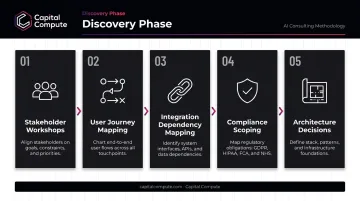
Vague requirements are one of the primary causes of IT project overruns — PMI's research on requirements management puts this consistently at the top of the list. Fixed-price scoping addresses this directly: scope is defined and agreed before development begins, which protects the client's budget from the start.
Capital Compute provides a fixed-price estimate within two business days of the initial scoping call, with compliance and integration requirements resolved in Week 1.
Design and Sprint-Based Development
After discovery, UX/UI design produces wireframes and prototypes for client review and approval before any engineering effort is committed. Changing a wireframe costs a fraction of rebuilding a feature mid-sprint — catching misalignments at this stage matters.
Development then runs in Agile sprints, typically two-week cycles, with client review and sign-off at every milestone. Startups and SMBs get ongoing visibility and control rather than a single reveal at the end of a six-month build.
Capital Compute's delivery model is built around this structure:
- Fixed-price scope agreed before development starts
- Fortnightly sprint reviews with client approval gates at every milestone
- Sprint reviews delivered during Australian business hours
- Same internal team that scoped the project delivers it — no handoffs, no rotating project managers
Testing, Deployment, and Handover
Quality assurance runs at each milestone before sign-off, not only at the end. Handover includes documented, versioned APIs and a clean codebase that the client's team — or any future developer — can maintain independently.
Capital Compute includes a 90-day post-launch support period as standard, with bugs in the delivered code resolved at no additional cost. After that, a month-to-month retainer is available with no minimum term — clients can scale it up, scale it down, or end it based on actual need.
Costs and Risks: What to Realistically Expect
What Drives Cost
There is no single Australian market benchmark that covers all project types reliably. Cost is shaped by the specific requirements of each build. The primary drivers are:
- Scope complexity — number of user roles, permission structures, and workflow modules
- Integrations — each third-party connection adds scoping, development, and testing time
- Compliance requirements — the Privacy Act, ASIC, SRA, Australia's public health system, or PCI-DSS architecture adds design and engineering effort
- Design complexity — custom UX/UI versus adapted templates
- Mobile development — cross-platform (React Native, Flutter) versus native (Swift for iOS, Kotlin for Android)
The right question for any project is not "what does custom software cost?" but "what does this project cost, given these requirements?" That answer comes from a scoped discovery — not a price list.
The Case for Building an MVP First
Rather than building the full vision in version one, an MVP delivers only the most critical workflows in production-ready form. This approach:
- Reduces financial risk by limiting initial spend
- Enables real user feedback before the full build is committed
- Keeps the project within a startup's budget without sacrificing quality
- Creates a foundation for phased expansion once the core is validated
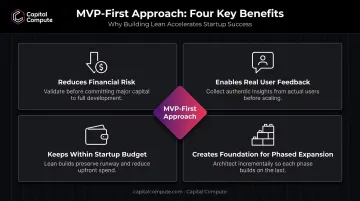
The logic is straightforward: validate the core assumption with real users before committing to the full build. What survives that test shapes version two.
Common Risks and How to Mitigate Them
| Risk | Mitigation |
|---|---|
| Scope creep from vague requirements | Rigorous discovery phase with a locked scope document before development begins |
| Vendor dependency after launch | Documented handover with full code ownership transferred to the client |
| Over-building in sprint one | Senior engineering input on architecture decisions before development starts |
| Compliance gaps discovered at go-live | Compliance scoped at discovery, built into architecture from sprint one |
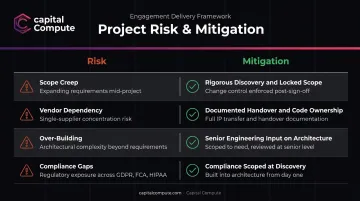
McKinsey's analysis of large IT projects found average cost overruns of 45% and value delivery 56% below forecast — with shorter delivery cycles identified as one of the primary controls. At startup and SMB scale, the implication is the same: smaller, defined sprints with client approval gates at each milestone contain the cost of any single poor decision.
How to Choose the Right Development Partner
What Matters Most
Not all development partners work the same way. For a startup or SMB making this decision, the criteria that carry the most weight are:
- Internal engineering team, no subcontracting — the people who scope the project should be the same people who build it. When front-end, back-end, and infrastructure are split across undisclosed subcontractors, the gaps between them are where projects fail.
- Transparent milestone-based process — fortnightly sprint reviews with client approval gates, not a black-box build with a reveal at the end
- Privacy-First architecture — compliance scoped at discovery, not reviewed at go-live
- Clear handover plan — full code ownership transferred to the client, with documented APIs the internal team can maintain independently
Capital Compute is an example of a partner built around these criteria: internal engineering only, sprint reviews during Australian business hours, and a month-to-month retainer with no lock-in. Each of these maps directly to a failure mode common in outsourced engagements — which the red flags below make concrete.
Red Flags to Watch For
Before signing with any development partner, watch for:
- No formal discovery phase before architecture begins
- Vague timelines with no defined milestones or approval gates
- Subcontracting without disclosure
- No handover documentation or IP ownership terms in the contract
- Compliance and accessibility reviewed at go-live rather than scoped at the start
- Proposals that do not clearly identify who will actually build the software
Key Questions to Ask Any Prospective Partner
- Who will actually build the software — your internal team, or subcontractors?
- What does the handover process look like, and will we own the full codebase?
- How is the Privacy Act handled — at discovery, or at deployment?
- What happens if we need to change something at a sprint milestone?
- What does your post-launch support look like, and are we locked into a term?
Frequently Asked Questions
What is custom software development?
Custom software development is the process of designing, building, and deploying software specifically for one organisation's workflows, users, and goals — as opposed to off-the-shelf tools built for the general market. The end product fits the business precisely, rather than requiring the business to adapt to a generic tool.
What are the 7 stages of the software development life cycle?
The standard SDLC covers seven phases: planning, requirements analysis, design, development, testing, deployment, and maintenance. In Agile-based custom development, these run iteratively rather than in strict sequence — meaning testing and design feedback loops continue throughout the build.
How long does it take to develop custom software?
Timelines depend on scope. Simple internal tools often take 8–12 weeks; mid-sized platforms with integrations typically run 3–5 months; complex SaaS or multi-tenant systems can take 6 months or more. Across all project types, industry benchmarks place average durations closer to 12–13 months when full product scope is included.
Is custom software development worth it for small businesses?
It depends on whether current tools are genuinely limiting growth or creating compliance risk. For SMBs with unique workflows, regulated data requirements, or scaling ambitions, the long-term value typically outweighs the upfront investment — particularly with a phased MVP approach that keeps initial spend manageable.
How much does custom software development cost for an Australian startup or SMB?
Cost is driven by scope complexity, number of integrations, compliance requirements, design needs, and mobile platform choices. No single Australia-wide price range covers all project types reliably. The most accurate figure comes from a properly scoped discovery — not a ballpark estimate. A phased MVP build can keep version-one spend significantly below the full product vision.
What is the difference between custom software and a SaaS product?
Custom software is typically built for one business's internal or client-facing use. A SaaS product is custom-built software designed to be sold to many customers under a subscription model — making it a commercial product in its own right, with multi-tenancy, subscription billing, and onboarding architecture built for scale from the start.