Introduction
B2B operations teams are under real pressure to do more with less. Manual handoffs, unstructured inboxes, and disconnected SaaS stacks continue to burn time that nobody can afford. In 2026, the question has shifted from whether to automate to which tool can actually handle production workflows.
What separates today's AI automation tools from traditional workflow builders isn't just speed. They can classify an incoming contract, extract key clauses, route it to the right reviewer, and log the decision — without a human in the loop.
That shift from data transfer to active decision-making matters for B2B teams handling emails, documents, and support queues at scale.
According to the ABS, only 12% of Australian businesses had adopted AI in 2024-25 — but among those who had, 56% reported increased employee productivity. Teams that moved early are compounding those productivity gains while others are still evaluating options.
With dozens of platforms now launching AI-native features, choosing poorly wastes both budget and engineering time. This guide evaluates the top AI automation tools for B2B workflows in 2026 — assessed specifically for Australian teams who need enterprise security, APP readiness, and genuine production capability.
Key Takeaways
- AI automation tools process unstructured inputs — emails, contracts, support tickets — not just structured data passed between apps
- The Privacy Act and data residency controls are non-negotiable for Australian regulated sector buyers
- Top picks by use case: n8n (technical/self-hosted), Zapier (non-technical), Make (ops-heavy), Workato (enterprise), Gumloop (AI-native)
- Start with your specific workflow pain point — not the platform with the most integrations
- Off-the-shelf tools handle ~80% of B2B workflows; custom AI agents are needed for the rest
What Separates AI Automation from Traditional Workflow Tools
Traditional automation platforms like early Zapier or basic webhook setups work well when inputs are clean and predictable. If a form submission arrives, create a CRM record. Simple, reliable, brittle.
AI automation changes what's possible with unstructured input. These platforms can read an inbound email and decide whether it's a complaint, a renewal request, or a sales enquiry. They can summarise a PDF contract, extract obligations, and flag anomalies — without a human touching it first.
For B2B teams dealing in documents, support queues, and multi-step approvals, that distinction is the entire value proposition.
The adoption numbers reflect genuine momentum in regulated industries:
- ASIC's REP 798 reviewed 23 AFS and credit licensees and analysed 624 AI use cases, finding around 60% of licensees intend to increase AI usage
- LexisNexis found more than 50% of Australian corporate and in-house lawyers surveyed already use AI tools
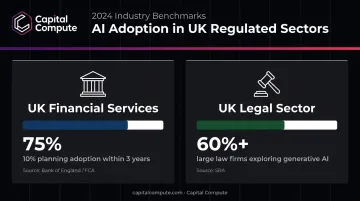
Finance and legal are moving fastest — both sectors where unstructured data, document-heavy workflows, and compliance obligations make rule-based automation inadequate on its own.
The tools below were evaluated specifically for B2B suitability — integration depth, compliance readiness, and how they perform on real workflows rather than controlled demos.
Best AI Automation Tools for B2B Workflows in 2026
Each tool below was assessed on B2B relevance, enterprise security posture, the Privacy Act-readiness, integration depth, and real-world workflow capability — criteria that matter most to Australian teams operating in regulated environments.
n8n
n8n is an open-source, self-hostable workflow automation platform with a node-based visual editor. It has built strong adoption among technical B2B teams — Vodafone's documented case study shows 33 workflows launched since August 2024, saving 5,000 person-days and significant cost, with approximately A$300K/month in continuing savings.
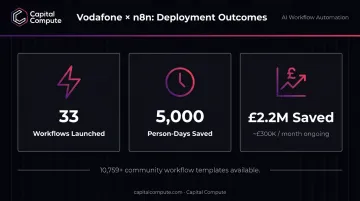
The community library now hosts over 10,759 workflow templates, making it one of the richest open ecosystems in workflow automation.
What makes n8n stand out for regulated Australian teams is self-hosting. Running on Docker or Kubernetes means data never leaves your environment — a hard requirement for the Privacy Act-sensitive workflows. Custom JavaScript and Python code nodes give engineers complete control over logic, and source-available code supports internal auditing.
| Attribute | Detail |
|---|---|
| Best For | Technical B2B teams wanting self-hosted, APP-compliant automation |
| Key Features | 1,000+ integrations, custom code nodes (JS/Python), AI agent builder, Docker/Kubernetes self-hosting |
| Pricing | Cloud from €20/month (Starter); free self-hosted Community Edition |
Zapier
Zapier remains the most widely adopted no-code automation platform, with 9,000+ app integrations and an interface that requires no engineering involvement to get live. Enterprises including Lowe's and Alibaba appear as logo references on its sign-up page.
For non-technical B2B teams, Zapier's speed-to-automation is unmatched. AI steps — extracting, classifying, and processing data — can be embedded directly into existing Zaps. Zapier Copilot helps build and configure workflows using natural language, while Zapier Agents handles more autonomous, multi-step tasks.
The trade-off: per-task credit costs can compound at enterprise scale, and AI capabilities are bolted onto the platform rather than built into its architecture from the ground up.
| Attribute | Detail |
|---|---|
| Best For | Non-technical B2B teams building fast, trigger-based automations across popular SaaS apps |
| Key Features | 9,000+ integrations, AI Copilot, Agents product, multi-step Zaps, Chatbots add-on |
| Pricing | Free tier (100 tasks/month); Pro from $19.99/month (billed annually) |
Make
Make (formerly Integromat) uses a visual scenario builder that gives ops teams granular control over multi-branch workflow logic. It now connects to 3,000+ apps, including over 350 AI-specific integrations — and supports bringing your own LLM key for AI model access.
Its router functionality branches a scenario into multiple paths with conditional logic, making it well-suited for complex B2B processes like invoice routing, CRM enrichment, or multi-step lead qualification. Failed runs can be retained as incomplete executions and retried manually or automatically — a meaningful feature when a workflow failure has downstream business impact.
Credit-per-step pricing requires cost modelling before scaling, but entry-level access is genuinely affordable.
| Attribute | Detail |
|---|---|
| Best For | Ops teams running high-volume, multi-branch B2B workflows with complex data logic |
| Key Features | Visual multi-branch builder, 3,000+ app integrations, error handling and replay, 350+ AI model connectors |
| Pricing | Free tier (1,000 credits/month); Core from $12/month (billed annually) |
Workato
Workato is an enterprise iPaaS with AI workflow capabilities built for mission-critical, cross-departmental automation. It documents SOC 2 Type II compliance and offers 1,200+ pre-built connectors — making it one of the most comprehensively governed platforms on this list.
For Australian enterprises in regulated sectors, Workato's governance controls are the main draw. Granular RBAC across workspaces, environments, and projects gives IT and compliance teams the oversight they need. Workflow and agent actions are auditable by design.
The AIRO feature (launched February 2026) acts as a solution-architect agent that maps requirements and generates an asset plan — distinct from its separate Copilot. MCP server support enables AI agent interoperability across enterprise tool stacks.
Pricing is enterprise-only and requires a sales conversation, which means it's not the right fit for SMBs.
| Attribute | Detail |
|---|---|
| Best For | Large Australian B2B enterprises in regulated sectors (legal, finance, HR) needing governance-first automation |
| Key Features | 1,200+ connectors, granular RBAC, AIRO architect agent, Copilot, SOC 2 compliance, MCP support |
| Pricing | Enterprise pricing only (contact sales) |
Gumloop
Gumloop is the newest platform on this list — and the most AI-native. Built around a visual canvas builder, it raised a $50M Series B from Benchmark in March 2026, one of the largest Series B rounds for a workflow automation startup in 2026.
Its customer evidence is concrete: Instacart achieved nearly 2x meetings per SDR and recorded 9.8 NPS among pilot users; Shopify created approximately 6,000 workflows executing 17M+ actions.
Gummie, Gumloop's AI assistant, helps debug and build workflows without requiring deep technical knowledge. A hosted MCP server enables agent-to-tool connections across the enterprise stack.
One note on LLM access: Gumloop supports organisation-level provider keys and BYOK (bring your own key) rather than fully keyless built-in LLM access — verify this against your infrastructure before committing.
| Attribute | Detail |
|---|---|
| Best For | B2B teams in marketing, sales, and ops wanting AI-native automation without managing LLM APIs manually |
| Key Features | Built-in LLM access (BYOK and org-level keys), Gummie AI assistant, MCP server, Gumstack enterprise security, 100+ integrations |
| Pricing | Free tier; Pro from $37/month (20,000 credits); Enterprise custom pricing |
How to Choose the Right AI Automation Tool for Your B2B Team
The most common mistake B2B buyers make is evaluating platforms by integration count or demo quality — then discovering post-contract that governance, observability, and the Privacy Act compliance weren't baked in.
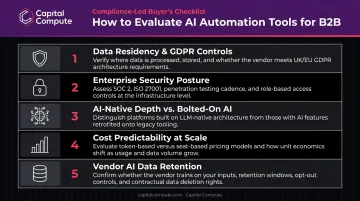
The right evaluation framework centres on five B2B-specific criteria:
- Data residency and the Privacy Act controls — Can the platform be self-hosted or VPC-deployed? Does it support Australian data residency? OAIC guidance requires documented controller-processor contracts covering data location, audit access, and exit arrangements. For legal and financial services workflows, data sovereignty often requires processing to happen on infrastructure you control
- Enterprise security posture — RBAC, audit logs, and SOC 2 compliance matter for regulated sector deployments; not all platforms offer these at every pricing tier
- AI-native depth vs. bolted-on AI — Gumloop and n8n treat AI as core architecture; Zapier and Make have added AI as a layer on top of existing automation logic
- Cost predictability at scale — Per-execution models (n8n Cloud) and per-step credit models (Zapier, Make) behave very differently at high workflow volumes; model this before committing
- Vendor AI data retention — Check whether the platform trains on your workflow data or retains inputs beyond session scope; most enterprise plans offer opt-out, but defaults vary significantly
When Off-the-Shelf Isn't Enough
Platforms like n8n, Make, and Workato cover the majority of B2B automation requirements well. But for workflows requiring sector-specific reasoning — contract clause extraction under Law Council of Australia obligations, ASIC-compliant audit trails, or AI-assisted matter routing across hundreds of live legal cases — off-the-shelf tools typically cover around 80% of the requirement.
The remaining 20% is where custom AI agent development becomes viable. Capital Compute has shipped production agentic systems for the legal sector, covering citation retrieval, docket file access, form population, paralegal task assignment, and scenario-based outcome modelling for lead attorneys managing hundreds of concurrent matters.
The underlying architecture includes full audit trails and APP-compliant data design — scoped at discovery, not retrofitted after build.
Conclusion
Choosing the right AI automation tool for B2B in 2026 comes down to fit — technical capability, data governance requirements, and predictable scaling as workflow volume grows. The number of integrations is rarely the deciding factor.
Before committing to a platform, assess three things:
- Data residency controls — the Privacy Act obligations require documented processor contracts and clear data location controls. Confirm these before procurement, not after.
- Pricing at scale — Run the numbers at 10x your current workflow volume. Some platforms look affordable at low usage and become prohibitive fast.
- Long-term extensibility — Your automation requirements in 18 months will look different from today. Platforms that can't be extended through APIs or custom logic become a ceiling.
For Australian B2B teams whose workflow complexity goes beyond what packaged platforms can address — particularly in legal, finance, or marketing — Capital Compute builds custom production AI agents with APP-compliant architecture and no vendor lock-in. Compliance requirements are scoped in Week 1, so architecture decisions reflect your regulatory obligations from the start — not after go-live.
Frequently Asked Questions
What are some AI automation tools for B2B teams?
Leading options include n8n, Zapier, Make, Workato, and Gumloop. They differ significantly in technical depth, security posture, and pricing model: n8n suits technical teams wanting self-hosting, while Zapier is better suited to non-technical users building fast automations.
What is the difference between AI workflow automation and traditional automation?
Traditional automation routes data between apps based on fixed conditions. AI workflow automation adds semantic reasoning: the ability to classify, summarise, generate, and make decisions on unstructured inputs like emails, contracts, or support tickets, without predefined rules for every scenario.
Which AI automation tool is best for APP-compliant B2B teams in Australia?
n8n (self-hosted) and Workato (enterprise governance with RBAC and audit logs) are the strongest options for Australian teams with strict data residency requirements. The Privacy Act compliance depends on both the platform's controls and how the workflow itself is architected. The tool alone is not sufficient.
Do B2B teams need a developer to implement AI workflow automation?
Zapier and Make are designed for non-technical users. n8n and Workato benefit from engineering involvement, particularly for complex or regulated workflows. For bespoke agentic systems, specialist development support significantly reduces both delivery risk and compliance exposure.
What B2B workflows deliver the highest ROI from AI automation?
McKinsey estimates generative AI could deliver 30–45% productivity value in customer care and 3–5% higher sales productivity. High-ROI use cases include lead enrichment, contract summarisation, support ticket triage, and invoice routing, where handling unstructured input creates the most measurable gains.