Introduction
Generic SaaS tools work fine — until they don't. The moment a business operates across multiple regulatory environments, runs workflows that don't map to any template, or needs to integrate with systems that predate the cloud, off-the-shelf software stops scaling with the business.
That gap is driving real market growth. According to Grand View Research, the global custom software development market reached $43.2 billion in 2024 and is projected to hit $146.2 billion by 2030 — a 22.6% CAGR. The US market alone is forecast to reach $32.7 billion by 2033.
Choosing the wrong development partner creates its own problems. The most common failures include:
- Technical debt that costs 20–40% of the development budget to resolve
- Scope creep that delays delivery and inflates cost
- Compliance gaps discovered at go-live rather than during architecture
- Handover overhead that leaves internal teams dependent on the vendor long-term
This article profiles five of the strongest custom software development companies in the USA and explains how to evaluate them. UK businesses will find a dedicated section covering GDPR architecture requirements, time zone alignment, and subcontracting risk — factors that matter before any partner is shortlisted.
TL;DR
- Custom software firms build tailored digital solutions — web apps, SaaS platforms, AI agents — designed around specific business workflows, not generic use cases
- The USA hosts some of the world's most capable custom software firms, with deep expertise across fintech, healthcare, legal, logistics, and enterprise platforms
- Top companies are evaluated on technical depth, delivery transparency, compliance capability, post-launch support, and engagement flexibility
- Pricing spans from fixed-scope MVPs under $30K to enterprise platforms exceeding $200K, so matching engagement model to business stage matters
- UK buyers evaluating US firms should confirm GDPR-compliant architecture, UK-hours sprint access, and a no-subcontracting policy before signing
Overview of Custom Software Development in the USA
Custom software development means building software to specification for a specific business — as opposed to purchasing commercially available tools and adapting workflows to fit them. Demand has surged as organizations outgrow the limits of generic SaaS platforms and face compliance requirements that off-the-shelf products were never designed to handle.
Grand View Research estimates the US custom software development market at $10.9 billion in 2025, growing at 14.8% annually through 2033. Enterprise software accounted for 71.45% of US custom software development revenue in 2025 — reflecting where the most complex, most compliance-sensitive demand sits.
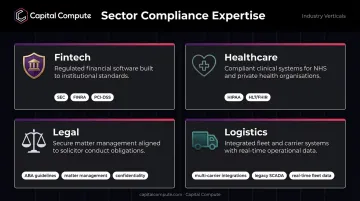
Sectors driving the most complex custom demand include:
- Fintech — SEC, FINRA, and PCI-DSS compliance requirements that generic platforms can't accommodate
- Healthcare — HIPAA, HL7/FHIR integration, and patient data architecture constraints
- Legal — ABA guidelines, state bar obligations, matter management, and confidentiality at the system level
- Logistics — multi-carrier integrations, legacy SCADA connectivity, and real-time fleet data
Given the compliance complexity across these sectors, selecting the right development partner matters as much as selecting the right architecture. The profiles below cover five strong options, evaluated on technical capability, delivery transparency, engagement flexibility, and cross-border client fit.
Top Custom Software Development Companies in the USA
Selection note: These companies were shortlisted based on technical capability, delivery transparency, client base diversity, engagement flexibility, and ability to serve both US and international clients — including UK businesses with regulated-sector requirements.
ScienceSoft
Headquarters: McKinney, Texas
ScienceSoft is a long-established IT consulting and custom software firm with particular strength in regulated industries — healthcare, banking, retail, and manufacturing. Their approach is consulting-led: architecture decisions are made before development begins, which reduces rework risk on complex enterprise projects.
| Attribute | Detail |
|---|---|
| Key Services | Custom software development, data analytics platforms, AI/ML, cloud engineering, cybersecurity and compliance, CRM and ERP solutions |
| Clutch Rating | 4.8/5 from 42 reviews |
| Hourly Rate | $50–$99/hr (Clutch verified) |
| Min. Project Size | $5,000+ |
| Best For | Mid-market and enterprise organisations in healthcare, finance, and manufacturing requiring compliance-heavy or security-critical systems |
Key differentiators: Security-first engineering, HIPAA compliance services, PCI-DSS consulting, and structured architecture reviews before any code is written. IAOP, Financial Times, and Newsweek have all cited ScienceSoft for delivery reliability.
Simform
Headquarters: Orlando, Florida
Simform is a cloud-native product engineering company with certified AWS partner status and strong CI/CD pipeline discipline. They're a frequent choice for B2B SaaS companies that need software capable of handling rapid user growth without re-platforming.
| Attribute | Detail |
|---|---|
| Key Services | Cloud application development, AI and ML engineering, DevOps and platform engineering, SaaS product development, enterprise software modernisation |
| Clutch Rating | 4.8/5 from 86 reviews |
| Hourly Rate | $25–$49/hr (Clutch verified) |
| Min. Project Size | $25,000+ |
| Best For | SaaS founders and B2B tech companies needing scalable, cloud-native systems from day one |
Key differentiators: Verified AWS partner presence, strong cloud consulting focus (20% of service mix), and named by Clutch as a top performer for Azure services and application modernisation in 2026.
Itransition
Headquarters: Decatur, Georgia (US office)
Itransition brings over 25 years of software engineering experience to full-cycle custom development. Their particular strength is legacy modernisation — taking complex, live systems and migrating them without disrupting operations — combined with deep ERP and CRM delivery capability.
| Attribute | Detail |
|---|---|
| Key Services | Custom web and mobile development, ERP and CRM systems, legacy modernisation and cloud migration, AI-driven analytics, QA and testing |
| Clutch Rating | 4.9/5 from 41 reviews |
| Hourly Rate | $25–$49/hr (Clutch verified) |
| Min. Project Size | $25,000+ |
| Best For | Enterprises and mid-market businesses modernising legacy infrastructure or building large-scale operational platforms |
Key differentiators: Milestone-driven delivery, strong QA practices, 25+ years of engineering experience, and Everest Group Major Contender recognition for product engineering.
FullStack Labs
Headquarters: US-led with US and LATAM engineering teams
FullStack Labs keeps all development within US business hours — eliminating the time zone friction that frequently slows offshore delivery. Their client roster includes Uber, Siemens, and Stanford University, with broad coverage across React, Node.js, Python, and SaaS product development.
| Attribute | Detail |
|---|---|
| Key Services | Custom web and mobile application development, SaaS platform engineering, DevOps and cloud integration, AI and data solutions, QA and testing |
| Clutch Rating | 4.8/5 from 7 reviews |
| Published Rate | $39–$150/hr (company-published); $25–$49/hr (Clutch) — confirm current rate directly |
| Min. Project Size | $25,000+ |
| Best For | Startups and growth-stage companies needing high-quality engineering with real-time collaboration and broad tech stack coverage |
Key differentiators: Real-time US business-hours collaboration, broad technology stack coverage, and a named-client roster across enterprise and higher education.
Note: There is a discrepancy between FullStack's published rate ($39–$150/hr) and their current Clutch profile ($25–$49/hr). Confirm the current rate card directly before budgeting.
Capital Compute
Headquarters: UK-based
Capital Compute is a custom software development partner built for UK businesses, with an internal engineering team covering custom SaaS platforms, AI agent development (shipped in legal, finance, and marketing), API integrations across NHS, fintech, and logistics systems, and legacy modernisation.
Every project begins with a discovery phase where compliance obligations — GDPR, FCA, SRA, NHS DSPT — are scoped into the architecture before any code is written. Sprint reviews run in UK business hours, and no work is subcontracted.
| Attribute | Detail |
|---|---|
| Key Services | Custom SaaS development, AI agent development (legal, finance, marketing), API and system integrations, legacy system modernisation, month-to-month retainer support |
| Engagement Model | Fixed-price scoping with milestone approval gates; sprint-by-sprint retainer with no long-term lock-in; sprint reviews in UK business hours |
| Min. Estimate | Fixed-price estimate delivered within 2 business days of scoping call |
| Best For | UK businesses in regulated sectors (legal, finance, healthcare) needing custom software with GDPR compliance built in and no dependency on subcontractors post-handover |
Key differentiators:
- No subcontracting — all engineers are internal, with compliance scoping from Week 1
- GDPR-compliant data architecture scoped at discovery, not reviewed at go-live
- Same senior engineers who build the initial product remain on the retainer — no handover overhead
- Fixed-price delivery with fortnightly milestone approval gates and client sign-off at every stage
- 90-day post-launch support included as standard
How We Chose the Best Custom Software Development Companies
Choosing a development partner on brand reputation or portfolio size alone is how technical debt starts. McKinsey estimates that technical debt already costs 20–40% of the technology estate value — and poor partner selection is one of its primary causes.
Core Evaluation Criteria
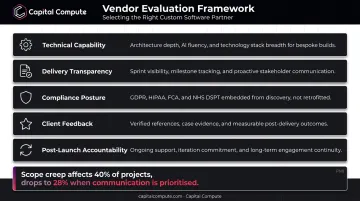
- Technical capability — modern stack coverage, cloud-native competence, and AI/ML engineering depth
- Delivery transparency — fixed-price vs. open-ended billing; milestone structure and client approval gates
- Compliance posture — documented capability for regulated industries (HIPAA, PCI-DSS, GDPR), not just claims
- Client feedback — Clutch-verified reviews covering communication quality and milestone adherence
- Post-launch accountability — what happens after go-live: maintenance terms, knowledge transfer, and retainer structure
PMI's 2023 research across 3,492 project professionals found scope creep affected 40% of projects at organisations that deprioritised communication and collaborative leadership skills. Where those skills were prioritised, the figure dropped to 28%. Communication practices are a more reliable selection signal than a polished portfolio.
Additional Criteria for UK Businesses Evaluating US Partners
UK businesses shortlisting US-based vendors face an additional layer of due diligence. These are non-negotiable before signing:
- GDPR-by-design architecture — confirm that data flow mapping, lawful basis decisions, and consent infrastructure are scoped at discovery, not audited at go-live
- UK time zone alignment — sprint reviews and engineering communication should happen within GMT/BST business hours
- No-subcontracting confirmation — under UK GDPR, Article 28 requires documented sub-processor agreements; the safest position is a partner with an internal-only engineering team
- Data residency clarity — confirm where data is hosted, processed, and backed up, and that international transfer safeguards are in place if applicable
Conclusion
The best custom software development company is not the largest or most decorated. It is the one whose delivery model, compliance posture, and communication practices align with your specific business context, sector requirements, and growth stage.
Beyond the initial build, assess how each firm handles ongoing maintenance, what knowledge transfer looks like at handover, and what happens if your requirements shift mid-sprint.
A firm that looks strong at pitch may create lock-in by design. Watch for:
- Undocumented APIs that require the vendor to interpret
- Dependency on proprietary tooling unavailable outside their environment
- Handover packages only their own engineers can action
- Absence of versioned documentation at project close
If the USA-based firms on this list do not fit your compliance requirements, delivery model, or time zone — Capital Compute offers UK businesses an alternative worth considering. Fixed-price delivery, GDPR-compliant architecture scoped at discovery, and a senior internal engineering team with no subcontracting are standard across every engagement. Capital Compute provides a fixed-price estimate within 2 business days of an initial scoping call.
Frequently Asked Questions
What is a custom software development company?
A custom software development company designs, builds, and maintains software tailored to a specific organisation's workflows — rather than forcing the business to adapt to an off-the-shelf product. The best firms provide architectural consulting before any code is written, so foundational decisions are made correctly from the start.
How much does it cost to develop custom software?
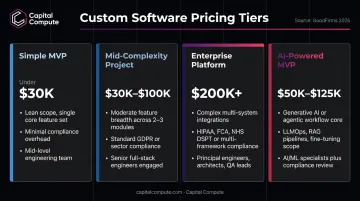
According to GoodFirms' 2026 survey (figures in USD), simple MVPs run under $30K; mid-complexity projects cost $30K–$100K; enterprise platforms exceed $200K; AI-powered MVPs start at $50K–$125K. Cost is primarily driven by scope complexity, compliance requirements, and team seniority.
What criteria should I use when choosing a custom software development company?
Prioritise technical stack alignment, delivery transparency, sector compliance experience, post-launch support terms, and verified client references. UK businesses should also confirm GDPR architecture capability, no-subcontracting policies, and sprint review availability within UK business hours before shortlisting any firm.
How long does it take to build custom software?
A well-scoped MVP typically takes 3–4 months; a complex enterprise platform with integrations and AI features may take 9–18 months. The biggest timeline risk is poor discovery and scoping at the outset — early architectural decisions are far cheaper to get right than to correct later.
What is the difference between custom software and off-the-shelf software?
Off-the-shelf software is built for general use, requiring businesses to adapt their workflows to the tool. Custom software is built around the business's actual processes — enabling better integrations, competitive differentiation, and long-term cost efficiency at scale. The trade-off is higher upfront investment against lower per-seat cost and greater operational fit.
Can a US custom software development company work with UK businesses?
Many US firms do work with UK clients, but UK businesses should verify three things before proceeding: that GDPR-compliant data architecture is scoped at discovery (not reviewed at go-live), that data residency decisions and sub-processor obligations are documented under Article 28, and that sprint reviews are scheduled within UK business hours rather than US time zones.