Key Takeaways
- AI automation marketing agencies use machine learning and AI agents to automate lead scoring, email sequencing, content generation, and paid media optimisation for B2B clients.
- B2B use cases centre on pipeline quality, account-based targeting, and longer sales cycles — not volume metrics.
- Evaluate agencies on tech stack, sector experience, data handling, and contract terms — not just case studies.
- Australian founders must confirm the Privacy Act compliance is built into the agency's data architecture from day one — not reviewed at go-live.
- For regulated sectors or complex workflows, a custom-built AI marketing agent may outperform any off-the-shelf agency engagement.
B2B marketing teams are stretched thin. Lead pipelines run inconsistent, outreach doesn't scale, and hiring more people to fix both problems isn't financially viable for most founders. AI automation marketing agencies have emerged as a direct response — promising to handle lead scoring, email sequencing, content, and campaign management through machine learning and automated workflows rather than headcount.
The pitch is compelling. But "AI marketing agency" has become a label applied to everything from sophisticated agentic systems to agencies that added a ChatGPT plugin to their existing process. For a B2B founder evaluating this space, that distinction matters enormously.
This guide is a practical evaluation framework. It covers what these agencies actually do, what the evidence says about results, how to choose one rigorously, and when building a custom AI marketing agent makes more sense than hiring an agency at all.
What Is an AI Automation Marketing Agency?
AI-Assisted vs. AI-Automated: The Distinction That Matters
Most agencies claiming to be "AI-powered" are AI-assisted — they use tools like ChatGPT for copywriting or automated reporting dashboards, but humans still execute the core campaign workflows. A genuine AI automation agency is architecturally different: AI agents execute tasks based on data triggers, with humans overseeing strategy and handling exceptions rather than running the day-to-day.
The difference plays out like this:
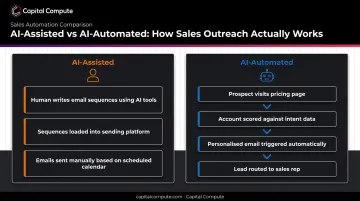
- AI-assisted: A human writes email sequences informed by AI content tools, then manually sends them based on a campaign calendar.
- AI-automated: The system detects a prospect visiting a pricing page, scores the account against firmographic and intent data, triggers a personalised email sequence, and routes the lead to sales when threshold signals are met — without human intervention at each step.
McKinsey's B2B Pulse research found 21% of commercial leaders reporting enterprise-wide generative AI adoption in B2B buying and selling, with another 22% piloting specific use cases. Full workflow automation isn't the market norm yet — which is precisely why understanding the gap between what agencies claim and what they actually deliver is worth the effort.
Why This Matters for B2B Specifically
B2B sales cycles are longer, involve multiple decision-makers, and rarely convert from a single touchpoint. That complexity is exactly where the adoption gap identified above becomes a genuine competitive opportunity.
AI automation that personalises outreach by role and adapts messaging based on buying stage delivers measurably faster pipeline progression than manual execution. But that only holds true when the automation is genuinely configured for B2B workflows — not repurposed from B2C playbooks built around individual buyers and impulse conversion.
Core Services B2B Founders Should Expect
Predictive Lead Scoring and ABM Automation
AI analyses firmographic data, intent signals, and behavioural patterns to rank and prioritise accounts continuously. Rather than a salesperson manually reviewing a CRM, the system surfaces which accounts are showing purchase intent and which are dormant.
The evidence here is specific rather than universal. Google's MVF case study reported 45% higher predicted lead quality, 37% higher ROAS, and 80% higher appointment rates after implementing machine-learning lead scoring — a named case, not a benchmark that applies to every deployment.
Separately, Demandbase (US) qualified $3.5 million in pipeline in a single quarter using G2 Buyer Intent data, with 80% of mid-market opportunities appearing in intent data a month before the deal opened.
These results depend heavily on data quality and ICP definition. An agency that can't articulate how their scoring model was trained or what signals it weights is one to avoid.
AI-Driven Email Sequencing and Nurture Campaigns
Automated email systems branch based on prospect behaviour — whether a prospect opened an email, visited a product page, or downloaded a resource — and adjust both timing and messaging tone dynamically.
For B2B founders with 90-180 day sales cycles and multiple buying stakeholders, this matters. The system maintains consistent, personalised contact across an entire buying committee without a salesperson managing each thread manually.
Conversational AI for Lead Qualification
AI-powered chatbots handle initial inquiry qualification, book demos, and route leads based on qualification logic — freeing sales to focus on prospects already showing purchase intent.
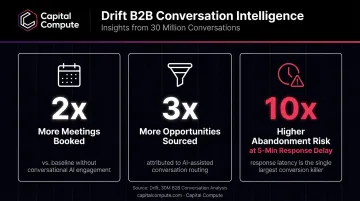
Drift's analysis of more than 30 million B2B conversations in 2023 found high-intent playbooks booked 2x as many meetings and sourced 3x as many opportunities as standard playbooks. One detail worth noting from their data: a five-minute bot-to-agent handover delay correlated with a 10x higher abandonment risk. Response time matters as much as qualification logic.
Content Creation and Distribution Automation
AI agencies use large language models to produce on-brand content at scale — blog posts, LinkedIn copy, email sequences, whitepapers — and automate distribution across channels. This reduces production time significantly for high-volume content requirements.
The human responsibility that doesn't go away: brand voice governance and quality control. An agency running unsupervised LLM output without editorial review will erode brand credibility faster than it builds pipeline. When briefing an agency, get specific about who reviews output before it publishes and what the escalation process looks like when the model produces something off-brand.
Paid Media and Campaign Optimisation
AI agencies use machine learning to optimise paid media in real time across Google, LinkedIn, and other B2B-relevant platforms:
- Bid management — automated adjustments based on conversion probability signals
- Creative rotation — underperforming variants paused and replaced without manual intervention
- Audience targeting — continuous refinement as engagement data accumulates
This is where AI tends to deliver the fastest measurable ROI lift — the feedback loop between spend and performance is tight enough for automated optimisation to outperform manual management at scale. The caveat: a machine optimising toward an ambiguous ICP will optimise efficiently toward the wrong prospects.
When Off-the-Shelf Agency Tooling Isn't Enough
For B2B companies in regulated sectors — legal, finance, compliance-heavy marketing — off-the-shelf agency tooling often hits a ceiling. The data handling requirements, workflow specificity, or compliance architecture needed simply isn't available in generic platforms.
In these cases, working with a specialist AI development partner to build custom marketing AI agents can deliver more precise, APP-compliant automation than a generic agency engagement. Capital Compute has built production AI agents for clients in legal, finance, and marketing sectors, with APP-compliant data architecture scoped from discovery — not reviewed at go-live.
Why B2B Companies Are Turning to AI Marketing Agencies
Three practical drivers are behind the shift:
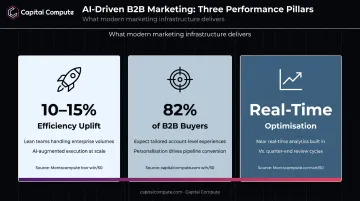
Speed and scale without headcount growth. AI automation lets a lean team handle outreach volumes, content production, and campaign management that would otherwise require significantly more resource. McKinsey reports a consistent 10-15% efficiency uplift among companies using technology-enabled B2B sales teams — modest on its own, but compounding across the full funnel.
Personalisation at account and buyer level. Forrester found 82% of global B2B marketing decision-makers agree buyers expect tailored sales and marketing experiences. AI enables agencies to tailor messaging by industry, role, company size, and funnel stage at a scale manual processes can't match.
Real-time optimisation, not quarter-end reviews. AI analytics surfaces performance detail in near real-time. For B2B founders who need to justify every dollar of marketing spend against pipeline impact, this is the difference between course-correcting mid-campaign and discovering a problem three months later.
How to Choose the Right AI Automation Marketing Agency
Check Sector Experience and B2B-Specific Case Studies
Ask for B2B-specific results, not B2C or eCommerce examples. Look for evidence of work in your sector (SaaS, legal, finance, professional services) and specifically for outcomes tied to pipeline or revenue, not impressions or click volume. Generic case studies showing engagement metrics are a weak signal. An agency that can't show you what happened to pipeline after their engagement probably didn't track it.
Scrutinise the Tech Stack
There's a meaningful difference between agencies that build workflows on top of general-purpose tools (HubSpot, Marketo, Zapier) and those with proprietary AI models or custom agent infrastructure.
Off-the-shelf tooling means:
- Capability ceiling defined by the platform's roadmap, not your requirements
- Data ownership questions when the agency holds your integration layer
- Switching costs if you want to move platforms later
Proprietary or custom infrastructure raises the capability ceiling. But ask directly: who built it, who maintains it, and what happens to your data if the relationship ends?
Evaluate the Privacy Act Compliance — Rigorously
For Australian B2B founders, this isn't a checkbox. Ask the following directly:
- Where does prospect and customer data reside geographically?
- What lawful basis does the agency use for outreach (consent or legitimate interests)?
- How is consent management built into their systems?
- Who are their subprocessors, and are they covered under Article 28 processor contracts?
- Is the Privacy Act compliance reviewed at go-live, or built into the architecture from discovery?
The OAIC's guidance on B2B marketing distinguishes between the Spam Act 2003's rules for corporate contacts (which permit unsolicited electronic marketing without prior consent, provided the sender identifies itself and offers opt-out) and the Privacy Act obligations that apply whenever business contact data identifies a person. An agency that can't explain this distinction clearly is a compliance risk.
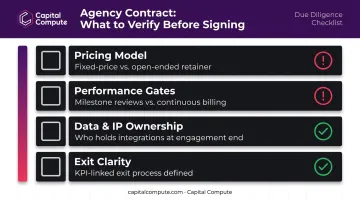
Understand Commercial Structure and Lock-In Risk
Contract terms deserve the same scrutiny as the pitch deck. Specifically:
- Is scope fixed-price or open-ended retainer?
- Are there milestone-based review gates, or does billing continue regardless of performance?
- Does the agency hold your data, integrations, or any IP at engagement end?
- What's the exit process if results don't meet agreed KPIs?
Month-to-month or sprint-based arrangements with clear handover protocols reduce risk significantly. Long-term contracts with ambiguous exit clauses are a warning sign, particularly when the agency's tooling becomes embedded in your CRM or ad accounts.
Define Success Metrics Before Signing
Establish specific, measurable KPIs before any contract is signed:
- Pipeline value generated per quarter
- Cost-per-qualified-lead
- Email engagement rates (not open rates — reply rates and meeting bookings)
- Account progression through funnel stages
A credible agency will define these metrics alongside you during discovery and report against them transparently. If an agency leads with impressions, click volume, or engagement rate as primary KPIs for a B2B engagement, that's a signal they're optimising for optics rather than pipeline.
Should You Hire an Agency, Buy a Tool, or Build Custom AI?
Hire an Agency When
Engaging an AI automation marketing agency makes most sense when:
- You need fast deployment without internal technical resource
- You're testing AI-driven marketing before committing to infrastructure build
- Your workflows are relatively standard and don't require custom data handling
The trade-off is less customisation and some dependency on the agency's tooling. If the agency holds your data architecture or integrations, your negotiating position weakens as the engagement deepens — worth factoring in before signing a long retainer.
Buy a Tool When
Purchasing AI marketing automation platforms suits founders with technically capable in-house teams who want control and lower per-unit cost at scale. Common options include:
- HubSpot AI — broad CRM integration, accessible for mid-market teams
- Adobe Marketo — AI personalisation from the Prime tier upward
- ActiveCampaign — AI features across tiers, with variation by plan level
This route requires internal expertise to configure, manage, and optimise properly. Gartner reports 84% of organisations acquire AI through a mix of building and buying — pure platform adoption without some custom configuration is uncommon among sophisticated users.
Build Custom AI When
B2B companies in regulated sectors — or those with proprietary workflows that off-the-shelf tools can't accommodate — often get better long-term results from purpose-built AI marketing agents.
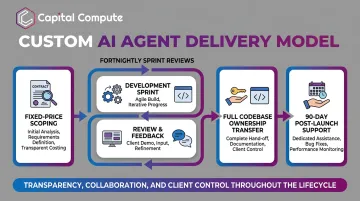
Capital Compute builds production AI agents for marketing, legal, and finance clients, with APP-compliant architecture scoped from day one. The delivery model is structured to address the specific risks that make agency and platform engagements problematic for regulated founders:
- No subcontracting — internal engineers only, with a single point of accountability throughout
- Written fixed-price estimate delivered within two business days
- Fortnightly sprint reviews with client approval gates at every milestone
- Full codebase ownership transferred from sprint one — no seat fees, forced upgrades, or vendor lock-in
- No lock-in after handover — documented APIs, full technical documentation, and a 90-day post-launch support window before independent maintenance
For regulated founders where data control and exit flexibility are non-negotiable, this is the arrangement worth evaluating first.
Frequently Asked Questions
What does an AI automation agency do?
An AI automation agency uses machine learning models and automated workflows to execute marketing tasks — lead scoring, email sequencing, ad optimisation, content generation — that would otherwise require manual effort at each step. The goal is to scale output without scaling headcount proportionally, with humans overseeing strategy and exceptions.
How does AI automation generate revenue for B2B founders?
AI automation increases revenue by accelerating pipeline velocity — more qualified leads reached faster — and reducing cost-per-acquisition through continuously optimised campaigns. The compounding effect comes from freeing sales teams to focus on closing rather than prospecting, while the system handles top- and mid-funnel activity.
What's the difference between an AI marketing agency and a traditional digital marketing agency?
A traditional agency relies on human execution for campaign management, content, and reporting. An AI automation agency replaces much of that execution layer with machine learning models and automated systems — producing faster iteration cycles, deeper personalisation, and reporting at a granularity that manual processes cannot match.
How much does an AI automation marketing agency typically cost?
Pricing varies widely based on scope, services, and whether the agency uses proprietary infrastructure or off-the-shelf tools. No authoritative benchmark exists for Australian B2B AI agency retainers specifically. Evaluate cost against pipeline impact — cost-per-qualified-lead and pipeline value generated — rather than service volume or hours delivered.
Is AI marketing automation APP-compliant for Australian businesses?
It can be, but compliance depends entirely on how the agency architects its data handling. Ask whether the Privacy Act is built into the system from discovery — covering lawful basis, consent management, data residency, and subprocessors — or only reviewed at go-live. The latter is a material compliance risk.