Introduction
Healthcare organisations are drowning in data. A single hospital generates terabytes of imaging files, clinical notes, lab results, and patient records daily. The majority of this information sits unanalysed, locked in formats that traditional software cannot interpret at scale.
Machine learning is already changing that. It is not a pilot project or a five-year promise. ML models are currently detecting tumours in radiology departments, flagging deteriorating patients before symptoms escalate, cutting documentation hours, and surfacing drug interactions that manual review would miss.
The global AI-in-healthcare market reflects this momentum: Grand View Research forecasts the market will reach USD 505.59 billion by 2033, growing at a 38.90% CAGR from 2026 to 2033. For Australian healthcare technology teams, the question is no longer whether ML is viable — it is how to deploy it responsibly.
This guide covers what ML in healthcare actually means, which types are in active use, and the most impactful real-world applications. It also addresses the measurable benefits and the implementation challenges that derail most projects before they reach clinical deployment.
Key Takeaways
- ML is deployed today across diagnostics, predictive analytics, drug discovery, and administrative automation
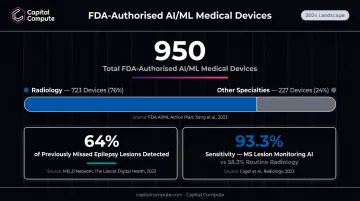
- Deep learning dominates medical imaging, with 950 FDA-authorised AI/ML devices (723 of them in radiology alone)
- Data quality is the most common project failure point, not the technology itself
- Australian healthcare ML must meet Australian MDR, the TGA, Australia's public health system DSPT, and Privacy Act requirements simultaneously
- APP-compliant architecture must be scoped at discovery, not reviewed at go-live
What Is Machine Learning in Healthcare?
Machine learning is a branch of AI in which algorithms learn patterns from data and improve their predictions over time — without being explicitly reprogrammed for each new task. Traditional clinical software operates on fixed rules: if value X exceeds threshold Y, trigger alert Z.
ML works differently. Feed it thousands of labelled ECGs, and it learns to recognise arrhythmia patterns that no one manually encoded.
In healthcare, this capability applies to a wide range of data sources:
- Electronic Health Records (EHRs) — structured patient histories, medications, diagnoses
- Medical imaging — X-rays, MRIs, CT scans, pathology slides
- Genomic profiles — DNA sequences, protein expression data
- Wearable and IoMT devices — continuous vitals, glucose monitors, remote sensors
The scale of available data makes ML possible, but also reveals a structural challenge. Reviews commonly estimate that over 80% of healthcare data is unstructured — locked in clinical notes, discharge summaries, and free-text documentation rather than searchable fields. Natural language processing (NLP) is the ML method primarily responsible for unlocking this data.
Australia's public health system has been investing steadily in frontline digitisation, with electronic patient record infrastructure a prerequisite for ML at scale. Record presence alone does not equal ML readiness, though: usable data interfaces, governed longitudinal records, and interoperability standards determine whether that data can actually be used. Any software that functions as a medical device must also be included in the Australian Register of Therapeutic Goods, regulated by the TGA.
Core Types of Machine Learning Used in Healthcare
Healthcare ML covers several distinct algorithmic approaches, each suited to different clinical problems. Knowing the difference helps organisations identify which method applies to their specific data, workflow, and outcome goals.
Supervised Learning
Supervised learning trains models on labelled datasets (images already classified as malignant or benign, patient records tagged with eventual diagnoses). Across healthcare, it remains the most widely deployed ML approach, used for:
- Disease classification from imaging or lab data
- Tumour detection and staging
- Treatment outcome prediction
- Postoperative complication risk modelling
Unsupervised Learning
Unsupervised learning finds hidden structure in data that has not been labelled in advance. In healthcare, this means discovering patient subgroups, identifying anomalies in claims data, or uncovering disease subtypes that clinicians may not have formally categorised. A 2023 Lancet Digital Health study used ML across three EHR sources to identify five distinct heart failure subtypes with meaningfully different prognoses (a finding that population-level averages had obscured).
Deep Learning
Deep learning uses multi-layered neural networks that extract features directly from raw data, without manual pre-processing. This makes it particularly powerful for:
- Analysing medical images (X-rays, MRIs, CT scans, mammograms)
- Processing unstructured clinical language
- Detecting subtle patterns across high-dimensional datasets
Most current medical imaging AI runs on deep learning architectures, specifically Convolutional Neural Networks (CNNs).
Reinforcement Learning
Reinforcement learning optimises decisions through iterative feedback — rewarding correct outputs and adjusting based on error. Deployment in clinical settings is still limited, but active research spans:
- Personalised treatment protocol design
- Medication dosing optimisation
- Surgical technique refinement in robotic-assisted procedures
Real-World Applications of Machine Learning in Healthcare
This is where ML moves from framework to deployed function. Applications span both clinical decision-making and operational processes.
Medical Imaging and Diagnostic Support
Medical imaging is the most mature ML application area in healthcare, and the evidence base is the strongest here.
A 2025 analysis of the FDA's authorised device list counted 950 AI/ML medical devices, with 723 in radiology — 76% of all authorised devices. NICE HealthTech guidance HTG739 has recommended BoneView, Rayvolve, RBfracture, and TechCare Alert for fracture detection in urgent care settings while further evidence is generated.
The diagnostic performance data is striking. A 2025 JAMA Neurology study found that the MELD graph neural network detected 64% of epilepsy lesions previously missed by radiologists, with 81.6% sensitivity in histopathology-confirmed cases. A separate real-world validation study for MS monitoring reported 93.3% sensitivity for new or enlarging lesions, compared to 58.3% in routine radiology reports.
Microsoft's InnerEye project — now concluded, with its repository archived in 2024 — demonstrated CNN-based 3D image segmentation that performed radiotherapy contouring 13 times faster than conventional workflows across 519 pelvic and 242 head-and-neck CT scans. Its methodology informed ongoing Australia's public health system work through the OSAIRIS project.
A critical note for procurement teams: FDA authorisation and NICE recommendation are not the same as the TGA marketing authorisation. Organisations must verify the TGA status, conduct local calibration, and evaluate patient outcome evidence separately.
Disease Prediction and Predictive Analytics
ML's ability to identify risk before symptoms appear is one of its most clinically consequential capabilities. Models trained on EHR data, genetic profiles, and wearable device outputs can flag patients likely to deteriorate before deterioration requires emergency admission.
Documented applications include:
- Postoperative risk: A retrospective study of 111,888 operations modelled AKI, delirium, DVT, pulmonary embolism, and pneumonia from preoperative data
- Cancer treatment response: A 2025 JAMA Oncology study developed and externally validated a deep learning pipeline across 958 NSCLC patients treated with immunotherapy
- Chronic disease management: ML flagging deteriorating conditions in diabetes or heart failure before they require emergency intervention
- Preventive care stratification: Identifying high-risk patient cohorts for earlier intervention
One important caveat: most predictive studies are retrospective. They demonstrate that ML could have identified risk earlier — but prospective evidence that acting on those alerts actually improves outcomes is still limited. This is worth factoring into procurement decisions.
Drug Discovery and Clinical Trial Optimisation
ML is shortening drug development timelines by analysing biological data — protein structures, molecular interactions, genetic sequences — to identify candidate compounds and predict safety profiles before synthesis.
Insilico Medicine's generative ML programme identified the TNIK target and nominated rentosertib as a preclinical candidate in approximately 18 months, an unusually short timeline for this stage of development. A subsequent phase 2a study enrolled 71 patients with idiopathic pulmonary fibrosis, with early results showing meaningful differences in lung function versus placebo. The programme does not establish reduced development cost, but the speed advantage is documented.
On the trial design side, the Trial Pathfinder project used nationwide EHR data to emulate completed NSCLC trials, demonstrating that relaxing certain eligibility criteria enlarged eligible cohorts without materially changing estimated treatment effects. ML is not replacing clinical trial governance. It is helping design better trials before they start.

Personalised Medicine and Treatment Planning
Population-average treatment protocols miss the variation that defines individual patient outcomes. ML enables plans tailored to specific genetic profiles, comorbidities, and treatment histories.
In oncology, where the same drug can produce dramatically different responses across patients, ML models that incorporate genomic data, imaging results, and prior treatment history can guide more targeted decisions. Because these models learn continuously from new patient data, the plans adjust as conditions evolve rather than following a fixed pathway.
This adaptability matters most in chronic disease management, where static protocols fall short. Conditions that benefit from dynamic ML-guided adjustment include:
- Type 2 diabetes: dosing and lifestyle recommendations updated as glucose patterns shift
- Hypertension: treatment escalation triggered by wearable-reported blood pressure trends
- Heart failure: medication titration informed by continuous remote monitoring data
Administrative Automation and Operational Efficiency
A 2017 time-motion study of 142 family physicians found they spent 5.9 hours of an 11.4-hour workday in the EHR, including 1.4 hours after clinic. The administrative burden is well-documented, and ML addresses it directly. More recent observational studies associate ambient AI scribing with reduced after-hours documentation work, though these remain non-randomised evaluations.
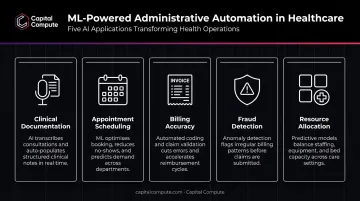
Key administrative applications include:
- Clinical documentation: NLP converting physician speech to structured medical notes in real time
- Appointment scheduling: ML optimising slot allocation based on no-show likelihood and clinical urgency
- Billing accuracy: Automated coding reducing claim errors and rework
- Fraud detection: Anomaly detection in claims data flagging unusual patterns
- Resource allocation: Predictive modelling for staffing, bed management, and theatre scheduling
Key Benefits of Machine Learning for Healthcare Organisations
Earlier Diagnosis and Improved Patient Outcomes
ML models trained on large datasets can detect early-stage indicators such as tumour markers in imaging and risk signals in EHR data — that are statistically invisible to human review at the same stage. The epilepsy lesion detection data cited above is a concrete example: 64% of previously missed lesions detected by a model operating on data that had already been reviewed by radiologists. Earlier detection enables earlier intervention, before conditions become critical or costly.
Cost Reduction and Operational Gains
The financial case for ML in healthcare rests on several mechanisms:
- Faster diagnostic throughput with consistent accuracy
- Reduced downstream costs from earlier intervention
- Automated administrative workflows reducing staff time on low-value tasks
- More efficient resource allocation reducing waste
McKinsey has projected that wider AI adoption could save 5–10% of US healthcare spending annually. That figure is a modelled estimate. Concrete throughput evidence comes from specific deployments — the InnerEye 13-fold segmentation acceleration is a measured benchmark, not a projection.
For Australian health systems operating under constrained Australia's public health system budgets, even conservative operational gains carry real weight.
Enhanced Data Privacy and Regulatory Compliance
ML can strengthen data security by detecting anomalous access patterns and flagging potential breaches in near real time. For Australian organisations, the Privacy Act classifies health data as Article 9 special-category data, requiring both a lawful basis under Article 6 and a condition under Article 9.
These are not optional features to bolt on before go-live. Structural compliance requirements include:
- Data anonymisation applied at the data layer
- Full audit trails for access and processing activity
- Role-based access controls enforced from the architecture stage
Implementation Challenges and How to Overcome Them
Most ML projects in healthcare fail before clinical deployment. Understanding the barriers in advance substantially improves the odds.
Data Quality and Availability
ML systems are only as reliable as the data they train on. Healthcare data in Australia's public health system and across Australian health systems is frequently:
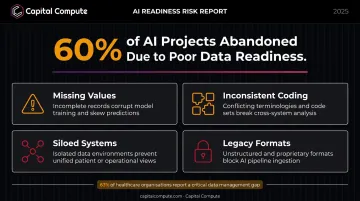
- Missing values in key fields, making records unreliable for training
- Inconsistently coded across trusts, with no shared standard
- Siloed in systems that do not communicate with each other
- Locked in legacy formats that block programmatic access
Gartner forecasts that through 2026, organisations will abandon 60% of AI projects unsupported by AI-ready data, based on a 2024 survey finding that 63% of organisations lacked appropriate AI data management practices. Australia's public health system faces similar data silos and inconsistent standards as interoperability barriers.
Solutions include data integration platforms, automated preprocessing pipelines, and synthetic data generation to augment limited labelled datasets. Before model development begins, organisations should audit data for provenance, missingness, coding consistency, and FHIR/API capability.
Regulatory Compliance and Approval Pathways
Data readiness and regulatory compliance are closely linked — how data is collected, stored, and moved determines which regulatory obligations apply. Healthcare ML in Australia operates under layered regulation:
| Deployment | Framework | Key Requirement |
|---|---|---|
| Great Britain | Australian MDR, the TGA | Classification by intended purpose, the TGA registration before placement |
| Northern Ireland | EU MDR/IVDR | CE route applies |
| EU market or EU-used output | EU MDR + EU AI Act | High-risk AI duties apply from August 2027 for most regulated products |
Under the Privacy Act, Article 22 restricts solely automated decisions with significant effects on individuals, providing rights to human intervention where an exception applies. Every organisation accessing Australia's public health system patient data must comply with the Data Security and Protection Toolkit (DSPT).
Early regulatory engagement is not optional — it shapes architecture decisions. Capital Compute builds APP-compliant data architecture from the discovery phase rather than reviewing it post-launch, so compliance is a design input from sprint one, not a final hurdle before release.
Clinical Integration and Physician Adoption
Technically sound ML systems fail when they disrupt clinical workflows or produce recommendations that clinicians cannot interrogate. In a regulated clinical environment, scepticism about opaque models carries legal weight as well as clinical justification.
Approaches that improve adoption:
- Deploy explainable AI (XAI) frameworks so clinicians can interrogate model outputs, not just accept them
- Involve physicians in interface co-design before build begins, not after
- Roll out incrementally, starting with decision support rather than replacing clinical decisions
- Provide ongoing training each time model versions change
Privacy, Security, and Patient Consent
Healthcare data sits at the most sensitive end of the the Privacy Act spectrum. ML systems handling it must implement:
- End-to-end encryption for data in transit and at rest
- Role-based access controls and audit trails
- Transparent patient consent frameworks aligned to the Privacy Act Article 9
Federated learning allows ML models to train across distributed datasets without centralising patient records. This matters particularly for multi-site public hospital networks and research collaborations, where moving data between organisations creates significant governance complexity.
Algorithmic Bias and Accountability
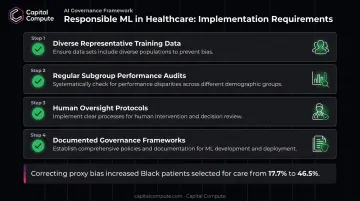
Bias in ML is a clinical safety issue, not just a technical one. The Obermeyer study found that a widely used population-health algorithm, which used healthcare cost as a proxy for medical need, systematically underserved Black patients. Correcting the proxy would have increased Black patients selected for additional care from 17.7% to 46.5%.
Responsible implementation requires:
- Diverse, representative training datasets
- Regular subgroup performance audits post-deployment
- Human oversight protocols ensuring clinicians retain final decision authority
- Documented governance frameworks defining accountability for AI-assisted decisions
Frequently Asked Questions
How is machine learning used in healthcare?
ML is used across clinical and operational functions — including disease diagnosis from medical imaging, predictive patient risk modelling, personalised treatment planning, drug discovery, and automating administrative workflows such as clinical documentation and billing. Deployed alongside human oversight, it improves both the speed and accuracy of clinical decisions.
Which machine learning model is best for healthcare?
There is no single best model — the right choice depends on the task:
- Deep learning (CNNs) — medical imaging analysis
- Supervised learning — disease classification and outcome prediction
- NLP models — unstructured clinical text and documentation
- Reinforcement learning — emerging use in treatment optimisation
Most deployed healthcare AI systems combine more than one of these approaches.
What is the difference between AI and machine learning in healthcare?
AI is the broader field of building systems that perform tasks requiring human-like intelligence. ML is a specific subset that enables those systems to learn from data and improve over time. In healthcare, ML is the mechanism behind most AI-powered diagnostic and predictive tools — the "how" behind AI's capabilities.
Will machine learning replace doctors?
ML is designed to augment clinical decision-making, not replace clinicians. It handles data-intensive pattern recognition at scale, freeing physicians to focus on diagnosis, patient relationships, and the judgement calls that require human expertise and empathy. Regulatory frameworks in Australia and EU require meaningful human oversight to remain in the decision loop.
What are the biggest challenges of implementing machine learning in healthcare?
The primary barriers are poor data quality and fragmentation, regulatory compliance requirements (Australian MDR, the TGA, Australia's public health system DSPT, the Privacy Act), physician adoption resistance, and algorithmic bias risk. Each requires deliberate planning from the outset — organisations that treat compliance and data readiness as post-launch concerns consistently encounter the most costly delays.