Yet most Australian businesses haven't acted yet. ABS data for 2024–25 shows only 12% of Australian businesses currently use AI — rising to 35% among large firms, but far lower across the broader market.
That gap is the opportunity. This article covers what AI automation services actually are, the concrete benefits they deliver, which service types suit which problems, which industries are moving fastest, and what to look for in an Australian AI automation partner.
Key Takeaways
- Only 12% of Australian businesses currently use AI, yet 63% of executives have flagged it as a top 2026 priority — making now the time to move
- AI automation spans from simple rules-based workflows to intelligent agents capable of multi-step decision-making
- Australia Post saved 18,000 hours annually and cut accounting costs by 15% through process automation
- Governance, explainability, and human oversight matter — especially in regulated sectors
- The right AI partner leads with a discovery process, scoping your needs before recommending any solution
What Are AI and Automation Services?
AI automation services combine two distinct capabilities: artificial intelligence (pattern recognition, natural language understanding, prediction) and process automation (executing tasks without human input). Together, they can handle work that previously required human judgment at every step.
Two types of automation matter here:
- Rules-based automation follows fixed, predefined logic — if X happens, do Y. It cannot handle exceptions, interpret ambiguous inputs, or adapt over time.
- AI automation uses machine learning or language models to interpret context, process unstructured data, handle variation, and improve with experience.
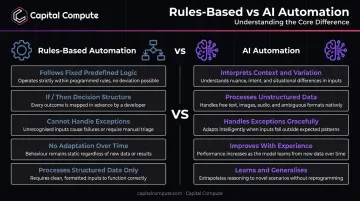
Most mature implementations combine both. Rules handle the predictable, rule-based steps; AI handles the exceptions, interpretation, and decision points.
What "AI Automation as a Service" Means
Engaging an AI automation services provider means working with a specialist to design, build, and deploy solutions around your actual workflows — not buying off-the-shelf software and hoping it fits.
The scope of what's possible spans a wide range:
- Workflow automation: Auto-routing emails, generating invoices, scheduling reports
- Intelligent AI agents: Interpreting unstructured data, accessing multiple systems, handling edge cases without manual intervention
The starting point for any serious engagement is understanding your specific processes, not selecting a platform.
Key Benefits of AI Automation for Australian Businesses
Operational Cost Reduction
The clearest evidence from Australia comes from Australia Post, which deployed 120 bots across 25 accounting processes — financial journal maintenance, credit uploads, agency pricing, and account processing. The result: 18,000 hours saved annually and a 15% reduction in accounting services costs.
That's a concrete, named outcome — not a vendor projection. For businesses running high-volume, repetitive back-office work, the cost reduction case is direct and measurable — and it extends well beyond accounting.
Speed, Accuracy, and Scale
AI-driven processes eliminate human error in tasks like data validation, invoice matching, and compliance checks — and execute them continuously without fatigue. Three related gains worth noting separately:
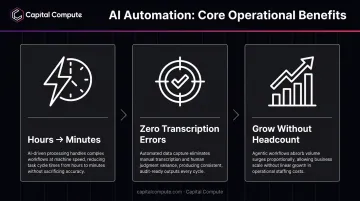
- Speed: Processes that take hours manually can run in minutes
- Accuracy: Removes the transcription and judgment errors that accumulate in manual workflows
- Scalability: Transaction volumes can grow without proportional headcount increases — a strategic advantage for growth-stage businesses
Better Decision Intelligence
AI automation doesn't just execute tasks — it surfaces patterns. Real-time anomaly detection, predictive flags, and operational dashboards give business owners and managers information they previously had to manually compile or simply didn't have. NAB's "Customer Brain" system, for example, generated 336 million real-time customer decisions in 2024 — a clear demonstration of decision-support automation operating at scale.
Competitive Positioning
With only 12% of Australian businesses currently using AI, early movers have a genuine window. Large firms are already at 35% adoption — meaning the gap between enterprise and SMB AI capability is widening. Businesses that delay hand that analytical edge to competitors who are already moving.
Types of AI Automation Services Available to Australian Businesses
Understanding what each service type does (and what it's suited for) prevents costly mismatches between tool and problem.
Process Automation and RPA
Robotic Process Automation (RPA) tools mimic human interactions with software: logging in, copying data, filling forms. They're best suited to structured, deterministic processes where the logic doesn't change. Worldwide RPA software revenue reached US$3.2 billion in 2023, growing 22.1% year-on-year — making it highly relevant for rules-based work.
Common use cases include:
- Payroll processing and accounts reconciliation
- Data migration between systems
- Compliance reporting and audit trail generation
AI Agents and Intelligent Virtual Assistants
AI agents go well beyond chatbots. They interpret natural language, access multiple systems, execute multi-step workflows, and handle exceptions. Production AI agents now operate in legal document review, financial analysis, and customer service workflows, handling tasks that previously consumed significant paralegal or analyst time.
One important caveat: McKinsey reports that fewer than 10% of deployed agentic AI use cases progress beyond pilots. Requiring production gates and bounded authority before scaling is essential.
Intelligent Document Processing (IDP)
IDP uses AI to extract, classify, and validate information from unstructured sources such as PDFs, contracts, invoices, and forms. Industry figures consistently put unstructured data at around 90% of total enterprise data, which means the opportunity for IDP across finance, legal, and logistics workflows is substantial. When implemented correctly, it removes the manual data entry layer entirely.
Predictive Analytics and Decision-Support Automation
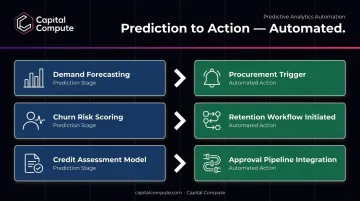
Machine learning models automate predictions (demand forecasting, churn risk scoring, credit assessment) and trigger downstream actions without human initiation. The value isn't just the prediction; it's that the prediction connects directly to a business action.
Key applications include:
- Demand forecasting tied to procurement triggers
- Churn risk scoring that initiates retention workflows
- Credit assessment models integrated into approval pipelines
Custom AI Workflow Integration
Many businesses need bespoke automation that connects AI capabilities to their existing systems : CRMs, ERPs, databases, and third-party APIs. This is where a software development partner builds purpose-built solutions rather than applying generic tools. Direct API integration, avoiding middleware overhead, is typically the cleaner and more maintainable approach.
Capital Compute, for example, builds custom AI workflow integrations using direct API connections — reducing latency and cutting the ongoing licensing costs that come with intermediary platforms.
Which Industries Benefit Most from AI Automation in Australia?
Legal and Professional Services
Thomson Reuters surveyed 869 Australian legal professionals and found 31% were already using unofficial generative AI — a clear signal of demand outpacing formal adoption. AI automation in legal handles: contract analysis, matter summarisation, citation retrieval, docket fetching, form completion, deadline tracking, and task routing.
Production systems are already running in Australian law firms, handling tasks that previously required hours of paralegal work per matter.
Finance and Accounting
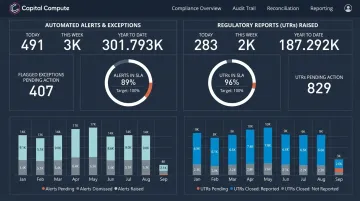
ASIC reviewed 624 AI use cases across Australian financial services licensees and found rapid expansion across customer interaction, fraud detection, and compliance functions — while warning that governance may not keep pace. Common deployments include:
- Automated reconciliation and exception flagging
- Fraud detection across transaction streams
- Loan processing and credit decisioning workflows
- Regulatory reporting with built-in audit trails
For regulated entities, the audit trail alone often justifies the investment — compliance records that once required manual assembly are generated automatically at each step.
Marketing and E-commerce
77% of Australian marketers use AI tools at least weekly, according to ADMA research. The applications range from personalised campaign triggers and lead scoring to customer segmentation and content workflow automation. Marketing teams are among the fastest internal adopters of AI agents in Australian organisations.
Common Pitfalls When Adopting AI Automation
Automating Broken Processes
AI amplifies whatever process it touches. Automating an inefficient workflow produces inefficiency at volume and at speed. Map and clean processes before automating them — identify where delays, errors, and workarounds live before any technology is applied.
Choosing Tools Over Outcomes
Many businesses select automation platforms based on brand recognition or feature lists, then struggle to fit those tools to their actual workflows. The right starting point is defining the business outcome — reduced processing time, fewer errors, lower cost per transaction — then identifying the right technology to get there. Avoid providers who lead with a platform pitch before understanding your actual problem.
Neglecting Governance and Human Oversight
Australia's own experience with automated decision-making is instructive. The Robodebt Royal Commission found that removing human review from automated processes contributed directly to harm — and Recommendation 17.1 specifically called for plain-language explanations, review paths, and independent scrutiny of algorithms and business rules.
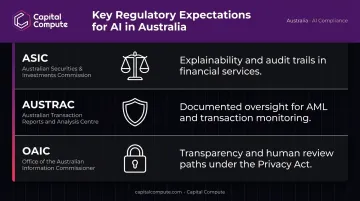
For Australian businesses in regulated sectors, this isn't abstract. Key regulators have clear expectations for AI-enabled processes:
- ASIC requires explainability and audit trails in financial services automation
- AUSTRAC expects documented oversight for AML and transaction monitoring systems
- OAIC mandates transparency and human review paths under the Privacy Act
Build governance in from the start — not as a retrofit before a regulatory review.
How to Choose the Right AI Automation Partner in Australia
Not all providers operate the same way. These criteria separate credible partners from those who'll cost you more than they save.
1. Start with Discovery, Not Tools
The right provider spends time understanding your specific workflows, data environment, and goals before recommending any technology. If the first conversation is about a platform rather than your problem, that's a signal.
2. Verify They Build for Your Team's Ownership
A good partner designs automation your team can operate and extend after handover — with documented code, versioned APIs, and architecture your internal engineers can manage. A credible provider structures delivery so clients retain full ownership with no ongoing vendor dependency after project close.
3. Assess Delivery Transparency
Look for fixed-price scoping, milestone-based delivery with client approval gates at each sprint, and fortnightly sprint reviews. This protects against budget blowouts and scope drift — the two most common failure modes in vague time-and-materials engagements. A scoping engagement that produces a clear technical roadmap before build begins sets a solid delivery baseline.
4. Check Sector-Relevant Production Experience
Ask whether the provider has shipped production AI automation in your industry — not pilots, not proofs of concept, but live systems handling real business volume. Sector experience cuts time to production significantly.
5. Confirm No Long-Term Lock-In
A credible partner offers month-to-month retainer arrangements and hands over full ownership of what they build. Your business should control its automation assets — not require ongoing vendor access to operate systems you've paid to have built.
Frequently Asked Questions
What are AI and automation services?
AI and automation services combine artificial intelligence — technologies like machine learning and natural language processing — with process automation to handle business tasks with minimal human input. They range from simple workflow automation to AI agents managing complex, multi-step decisions across connected systems.
How much do AI automation services cost for Australian businesses?
Costs vary widely depending on process complexity, the number of workflows automated, and whether the engagement involves custom development or platform configuration. Ask providers for a fixed-price discovery scope — this produces a bounded cost estimate before you commit to full delivery, and is the clearest way to compare options accurately.
How long does it take to implement AI automation?
Simple automations can go live in weeks. Complex custom AI agent deployments typically run two to four months from scoping to production. Milestone-based delivery means working outputs are visible at each sprint rather than only at final handover.
What is the difference between rules-based automation and AI automation?
Rules-based automation follows fixed, predefined logic and cannot handle variation or exceptions. AI automation uses machine learning or language models to interpret context, process unstructured inputs, and improve over time. Most mature implementations combine both: rules for deterministic steps, AI for everything that requires judgment.
Can small and medium businesses in Australia afford AI automation?
Yes. AI automation is no longer exclusive to enterprise organisations. SMEs can start with a single high-volume process, validate the return, and expand from there. The Australian Government has also committed A$17 million specifically to boost AI adoption among SMEs — recognising that the cost barrier is real but addressable.
Do I need to replace my existing systems to implement AI automation?
In most cases, no. AI automation layers on top of or integrates with existing systems via APIs. A good provider builds around your current stack rather than requiring a full replacement — particularly important for businesses with legacy systems already handling production workloads.