Introduction
Many Australian startups approach custom software development with one of two misaligned expectations: they either underestimate what the process involves and treat it like ordering a website, or they over-invest in a full build before validating whether the problem actually needs custom software at all.
Both paths burn budget — one through scope creep, the other through building something nobody needed.
According to Grand View Research, the global custom software development market was valued at USD 43.2 billion in 2024 and is projected to reach USD 146.2 billion by 2030 — a 22.6% CAGR that reflects genuine demand, not hype. But global market growth does not make custom software the right choice for every startup.
This guide covers what the custom software development process actually involves, how each phase works in sequence, what shapes it specifically for Australian startups, and when it is not the right choice at all.
Key Takeaways
- Skipping phases in the six-stage development lifecycle increases the risk of costly rework
- Privacy Act compliance and architecture decisions belong in discovery — not at go-live
- Sprint-based delivery with client approval gates prevents scope creep before it starts
- Choose your methodology (agile, waterfall, or hybrid) based on how clearly defined your requirements are
- Custom software is not always the right answer — validate the concept with SaaS or low-code tools first
What Is the Custom Software Development Process?
Custom software development is the end-to-end sequence of stages required to design, build, and maintain software created specifically for one organisation — not a mass market.
Unlike adopting an off-the-shelf SaaS tool or configuring a low-code platform, custom development builds the logic, architecture, and interfaces from scratch to match a client's exact workflows, data structures, and compliance obligations. The upfront investment is higher, but it's the only viable path for organisations whose requirements no packaged product can meet.
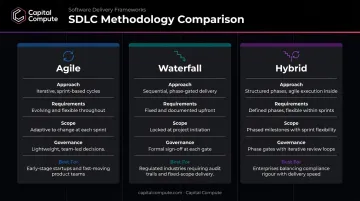
The process typically follows a Software Development Lifecycle (SDLC) model, which may be:
- Agile — iterative, flexible, suited to evolving requirements
- Waterfall — sequential, suited to fixed, well-defined scope
- Hybrid — structured phases with agile execution within them
The choice of model determines how much the project can adapt once work is underway. For most Australian startups, agile or hybrid approaches handle shifting priorities far better. Waterfall remains appropriate when scope is fully locked and regulatory documentation demands a sequential audit trail.
Why Startups Choose Custom Software Development
When Off-the-Shelf Tools Fall Short
The primary reasons startups opt for custom builds come down to three things:
- Unique workflows that generic SaaS products cannot accommodate without heavy workarounds
- Deep system integrations with existing infrastructure that packaged tools handle poorly or not at all
- Strategic differentiation — using software itself as a competitive advantage, not just an operational tool
When startups force packaged software onto workflows it was not designed for, the consequences accumulate over time. Teams build shadow processes around the tool's limitations, data quality degrades, and eventually the business hits a ceiling that requires a rebuild anyway.
At that point, the rebuild cost includes fixing all the technical debt the workarounds created — debt that never would have existed with a fit-for-purpose system.
The Startup-Specific Case
Custom development offers startups something off-the-shelf platforms cannot: the ability to launch an MVP with only the features that matter, then iterate based on actual user behaviour rather than a vendor's product roadmap.
Buying a feature-bloated SaaS platform means paying for capabilities your team will never use. That is not cost efficiency — it is funding someone else's assumptions about your business.
For Australian startups operating in regulated sectors, the case shifts further. Legal, financial services, and health sector businesses often face compliance requirements — around data residency, audit trails, or access controls — that off-the-shelf software cannot satisfy without expensive customisation. At that point, the cost comparison between SaaS and custom no longer favours SaaS.
How the Custom Software Development Process Works, Step by Step
Each phase produces defined outputs that feed directly into the next. Quality issues caught late are significantly more expensive than those caught early — research cited by IBM found that post-production defects can cost up to 15 times more to fix than those resolved early in development. The goal is structured progression with visible checkpoints so both client and development team stay aligned throughout.
Phase 1: Discovery and Requirements Gathering
Discovery defines what the software must do, who it serves, what systems it must connect with, and what success looks like. Outputs typically include:
- A requirements specification document
- Project scope and acceptance criteria
- Initial wireframes
- Risk assessment, including compliance obligations
Rushing discovery is the single most common root cause of project overruns in startup engagements. PMI data shows that 47% of unsuccessful projects failed to meet goals due to poor requirements management — and a separate PMI report found that 37% of organisations named inaccurate requirements as the primary reason for project failure entirely.
For Australian startups, APP obligations — lawful basis mapping, data residency, consent architecture, subject access request readiness — should be scoped here, not treated as a launch-week checklist. Capital Compute's approach addresses Privacy Act compliance in the first week of every engagement, before architecture begins, precisely because retrofitting it later is both technically disruptive and a regulatory risk.
Phase 2: System Design and Architecture
Design translates requirements into technical decisions:
- Architecture pattern — microservices vs. monolithic, cloud-native infrastructure
- Database schema and API specifications
- UI/UX wireframes and interactive prototypes
- Data architecture — including APP-compliant structures for Australian clients
Architecture decisions made at this stage are expensive to reverse once build has begun. This is why senior engineering input in sprint one matters — not as a reassuring gesture, but as a practical necessity. Capital Compute structures this explicitly: architecture decisions are made by senior engineers in sprint one, not revised after the first scale event.
Scalability also gets designed in here. A startup building for 50 users needs an architecture that can handle 5,000 without a full rebuild. Cloud-native design, containerisation, and API-first structure are not future upgrades — they are first-sprint decisions.
Phase 3: Development (Agile, Sprint-Based)
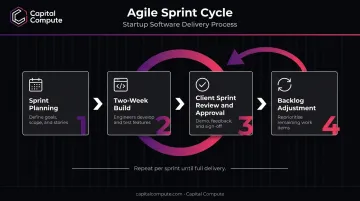
In practice, agile development for startups works like this:
- Work is broken into two-week sprints, each delivering working software increments
- The client reviews and approves each sprint's output before the next begins
- The backlog is adjusted based on feedback, keeping the build responsive to real business priorities
This sprint-review model — where clients see progress at each milestone rather than waiting months for a full delivery — is what separates well-managed engagements from ones that produce surprises at go-live. According to the 17th State of Agile survey, 71% of respondents used agile in their software development lifecycle, reflecting how widely this approach has become standard practice.
Engineering practices embedded throughout development include:
- Version control and CI/CD pipelines
- Peer code reviews
- Automated testing at unit and integration level
- Security scanning (SAST/DAST)
Each of these practices directly reduces the cost of defects — catching issues during development is a fraction of the cost of fixing them post-launch.
Phase 4: Testing and Quality Assurance
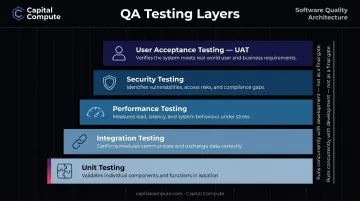
QA runs concurrently with development, not as a final gate after build completes. This matters because defects found during a sprint cost far less to resolve than those surfaced at UAT or in production. Testing layers include:
- Unit testing — individual components in isolation
- Integration testing — components working together
- Performance testing — behaviour under load
- Security testing — vulnerability assessment
- User acceptance testing (UAT) — client-side validation against requirements
The practical implication for startups: budget for QA from the start, not as an afterthought when the build is nearly done. Testing effort absorbs a meaningful share of total project time precisely because catching defects during development costs a fraction of what post-launch fixes require.
Phase 5: Deployment and Integration
Deployment involves considerably more than switching the software on. Key components include:
- Staging environment validation before any production traffic
- Zero-downtime deployment strategies — blue-green or canary releases
- Data migration from legacy systems
- Third-party integrations — CRM platforms, payment gateways, external APIs
- Monitoring and alerting setup — so issues surface immediately post-launch
- User training and handover documentation
For Australian regulated sector clients, this phase also confirms that live data handling meets the APP obligations scoped in Phase 2. That confirmation should be a formal checkpoint, not an assumption.
Phase 6: Maintenance and Continuous Improvement
The process does not end at launch. Ongoing maintenance covers:
- Bug fixes and security patching — particularly as dependencies update
- Performance optimisation as user volumes grow
- Feature enhancements based on real usage data
- Compliance updates as regulations evolve
SEI research puts maintenance at 40–80% of total software lifecycle cost — a wide range that reflects how differently organisations manage post-launch investment. The implication for startups is straightforward: maintenance is not optional overhead. Plan and budget for it before the build starts, not after the first production incident forces the conversation.
Key Factors That Affect the Custom Software Development Process for Australian Startups
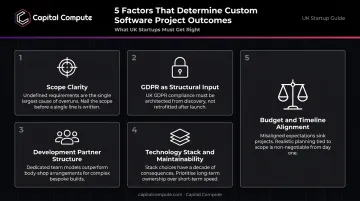
Five variables determine whether an Australian startup's software project delivers on time, on budget, and without regulatory exposure:
Scope clarity and requirement stability. Projects with well-defined, stable requirements are faster and cheaper to deliver. Late-stage scope changes are disproportionately expensive. Thorough upfront discovery reduces downstream costs — treat it as cost avoidance, not a scheduling overhead.
The Privacy Act as a structural input, not a checklist. Australian startups handling personal data in legal, finance, or health-adjacent sectors must design data architecture for compliance from the first sprint. This means data residency, access controls, retention policies, and SAR workflows — all scoped at discovery. Retrofitting Privacy Act compliance after build is technically disruptive and a direct regulatory risk; it should never be a go-live review item.
Development partner structure. Whether the team building your software is an internal engineering function or a network of subcontractors affects consistency, accountability, and institutional knowledge. Establish upfront whether the engineers on sprint one will still be working on sprint ten — and available for post-launch support.
Technology stack and long-term maintainability. The languages, frameworks, and infrastructure chosen during design affect how maintainable and extensible the software becomes. Confirm that the codebase and APIs will be documented to a standard your internal team — or a future partner — could work from without a costly knowledge-transfer process.
Budget, timeline, and complexity alignment. Clutch's verified review data shows global software development projects typically range from $10,000–$49,999, with an average engagement cost of $132,480 (USD) and a median duration of around 13 months. Australian projects will vary based on regulatory scope and sector complexity. Budget overruns typically stem from scope creep, inadequate discovery, or fixed-price models that lack milestone-based accountability mechanisms.
Common Pitfalls and When Custom Software Is Not the Right Choice
Treating Development as a Handover, Not a Partnership
Many startups assume they submit a brief and receive finished software weeks later. That is not how this works. Continuous stakeholder input, regular sprint reviews, and timely decision-making from the client side are required throughout.
Development teams cannot compensate for unavailable product owners or delayed feedback. When the client goes quiet, the sprint model breaks down — and delivery stalls regardless of the team's capability.
Underestimating the Discovery Phase
The pressure to start coding immediately is understandable, but it produces software built on assumptions rather than validated requirements. Rework typically costs far more than the time saved by skipping discovery: both in direct development cost and in the opportunity cost of delayed launches.
When Custom Software Is Not the Right Answer
Custom development is not appropriate for every situation. Consider alternatives when:
- The workflow is standard — scheduling, invoicing, basic CRM. A proven SaaS tool will be faster and cheaper.
- The timeline is under three months — validating a concept in that window calls for low-code or no-code prototyping, not a full custom build.
- The internal team cannot commit to product ownership — without a responsive product owner providing feedback at sprint reviews, the build will stall regardless of the development partner's capability.
These are honest signals worth taking seriously. The right moment for custom software is when the requirement is genuinely differentiated, the timeline allows for proper discovery, and the client side can stay engaged throughout delivery.
Conclusion
Custom software development delivers its full value only when each phase is executed with discipline: discovery that captures requirements and compliance obligations upfront, sprint-based development with visible approval gates, and post-launch maintenance that keeps the product secure as the business grows.
For Australian startups, the decision to build custom should be driven by genuine workflow complexity, integration requirements, or regulatory demands — not by the appeal of ownership alone.
Choosing the right development partner matters as much as the technical decisions. Look for a partner who uses an internal engineering team rather than subcontractors, runs sprint reviews in Australian business hours, and structures engagements on a month-to-month basis with no lock-in. Capital Compute is built around exactly that model — senior engineers from sprint one, fixed-price scoping, and full handover without ongoing dependency once the build is complete.
Frequently Asked Questions
What is custom software development?
Custom software development is the process of designing, building, and maintaining software created specifically for one organisation's requirements — covering unique workflows, system integrations, and compliance obligations that off-the-shelf solutions cannot address. Every component is scoped and built around the client's operating context, not adapted from a generic template.
What are the stages of the custom software development process?
The six core stages are: discovery and requirements gathering, system design and architecture, development (sprint-based), testing and QA, deployment and integration, and ongoing maintenance. Each stage produces defined outputs that feed directly into the next — quality issues compound when caught late.
How long does it take to develop custom software?
Simple applications typically take 3–6 months, mid-complexity products 6–12 months, and enterprise-level platforms 12–24 months or more. Timeline is heavily influenced by scope clarity, integration complexity, and how responsive the client is during sprint reviews.
How do you adapt the custom software development process?
Select a methodology that fits the project: agile for evolving requirements, waterfall for fixed scope, or hybrid. Sprint length and review cadence are then adjusted to match the client's availability. For startups specifically, an MVP-first approach scopes the minimum viable feature set before committing to a full build.
Should a startup use custom software or off-the-shelf software?
Off-the-shelf or SaaS tools are better for standard workflows and fast concept validation. Custom software is the right choice when the startup has genuinely unique processes, complex integration requirements, regulatory obligations the SaaS market cannot meet, or a strategic intent to use software as a competitive advantage.
How much does custom software development typically cost for a startup?
Based on Clutch's verified review data, typical projects fall in the $10,000–$49,999 range (USD), with an average project cost of $132,480 USD. Costs vary widely based on scope, complexity, and team structure. Maintenance — which SEI research places at 40–80% of total lifecycle cost — must be budgeted from the outset, not retrofitted after launch.