Introduction
Most growing businesses are drowning in data but starving for insight. Product teams export CSVs manually. Executives make strategic calls based on dashboards that refresh once a day. And somewhere in the background, a patchwork of disconnected tools is creating compliance exposure that nobody has mapped.
Gartner research puts the average annual cost of poor data quality at US$12.9 million — and that figure doesn't include the cost of re-architecting a platform that was never designed to scale. Choosing the wrong analytics setup early isn't just a technical inconvenience; it compounds.
This guide is written for Australian founders and CTOs who need to make a deliberate platform decision, not inherit one by default. It covers:
- What a data analytics platform actually is
- The four types of analytics and when your business needs each
- The features that matter at different growth stages
- How to evaluate architecture decisions
- A practical framework for comparing options — including when to build rather than buy
Key Takeaways
- Poor data quality costs organisations millions annually — platform decisions made early are hard to reverse at scale
- Match analytics capability to your business stage — enterprise-tier tools bought too early waste budget you can't recover
- The Privacy Act and Australian data residency requirements must be scoped at architecture design, not reviewed after deployment
- Total cost of ownership consistently exceeds headline licence fees — factor in integration, training, and scaling costs
- Build vs. buy hinges on your data model complexity, sovereignty requirements, and in-house engineering capacity
What Is a Data Analytics Platform?
A data analytics platform is an integrated software ecosystem that collects, processes, analyses, and visualises data from multiple sources through a single coherent interface. The key word is integrated — the platform manages the full analytics lifecycle, from raw data ingestion through storage, transformation, and insight delivery.
This stands in sharp contrast to the fragmented approach most teams still use: a separate tool for collection, another for storage, a third for reporting, and a BI dashboard bolted on at the end.
That model creates predictable problems:
- Data quality drift — the same metric means different things in different tools
- Collaboration failures — teams make decisions from different numbers
- Governance gaps — nobody can say with confidence where the data actually lives
What a Platform Is Not
A standalone BI tool is not a data analytics platform. Neither is a single-use reporting dashboard or a web analytics script. True platforms manage the pipeline — they don't just visualise the end of it.
A BI tool like Power BI or Tableau connects to data that has already been cleaned and structured. A full analytics platform manages the cleaning and structuring itself — alongside governance, access control, and machine learning capability.
Who Uses It
Analytics platforms aren't just for data teams. In a growing business, the users span the organisation:
- Product managers tracking feature adoption and retention cohorts
- Marketers measuring acquisition, attribution, and campaign performance
- Operations leaders monitoring fulfilment, support, and process efficiency
- Executives making quarterly strategic decisions from aggregated data
The platform has to serve all of them — which is why self-service capability matters as much as raw analytical power.
The 4 Types of Data Analytics (and Why They Matter to CTOs)
Understanding the four types isn't academic — it directly shapes which platform you need and when.
| Type | Core Question | Example Use Case |
|---|---|---|
| Descriptive | What happened? | Monthly revenue by channel |
| Diagnostic | Why did it happen? | Churn spike traced to onboarding friction |
| Predictive | What will happen? | Likelihood-to-churn score per user cohort |
| Prescriptive | What should we do? | Automated intervention triggered at churn risk threshold |
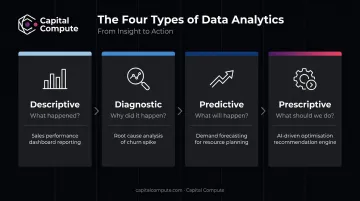
Most platforms support some types more strongly than others. Buying for all four before your team can act on them wastes budget and adds complexity you don't yet need.
Matching Analytics Type to Business Stage
Business stage should drive this decision, not vendor feature lists:
- Early-stage companies need descriptive and diagnostic analytics first — understand what users are doing and why before modelling what they'll do next
- Growth-stage companies benefit from predictive capability around churn, conversion, and lifetime value, where the data volume to train models actually exists
- Regulated or enterprise businesses often require prescriptive analytics with automated alerting, audit trails, and governance infrastructure to satisfy compliance obligations
The most common mistake is buying enterprise-tier predictive capability at Series A. If the team lacks the data science resource to build and validate models, the feature sits unused while the licence fee doesn't.
Deployment Model and Australian Data Residency
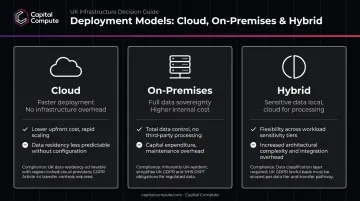
Deployment choice — cloud, on-premises, or hybrid — intersects with compliance obligations for Australian businesses:
- Cloud-based platforms deploy faster and scale without infrastructure overhead
- On-premises gives full data sovereignty, with higher internal infrastructure cost
- Hybrid splits workloads, typically keeping sensitive data local while using cloud for processing
Australian businesses in regulated sectors need to factor data residency into this decision from day one. Guidance from the OAIC under the Privacy Act 1988 and the Australian Privacy Principles treats overseas hosting of personal information as a matter requiring appropriate safeguards before data leaves the country.
Data residency compliance is not a configuration you retrofit at go-live. It needs to be scoped into architecture from the start.
Core Features Every Founder Should Evaluate
Data Integration and Ingestion Capability
A platform is only as good as the data it can access. Before anything else, map your sources and check whether the platform connects to them natively or requires custom engineering.
For SaaS businesses, the connectors that matter most are:
- Product event streams — capturing user behaviour within your application
- Subscription billing data — Stripe, Chargebee, or equivalent
- CRM systems — HubSpot, Salesforce, and similar
- Marketing platforms — ad channels, email tools, attribution providers
- Data warehouses — Snowflake, BigQuery, Redshift, Databricks
Amplitude and Qlik each document connections to hundreds of data sources. Mixpanel supports warehouse ingestion from Snowflake, BigQuery, Databricks, Redshift, and Postgres. Custom integrations for sources not covered natively add engineering time and ongoing maintenance cost — quantify that before signing.
Real-Time Dashboards and Self-Service Visualisation
Static scheduled reports tell you what happened yesterday. Real-time dashboards let product and growth teams act on what's happening now.
The practical question is whether non-technical stakeholders can build their own views without filing a ticket with a data engineer. Look for:
- Drag-and-drop interface builders
- Natural language query capability
- Shareable, embeddable dashboards with permission controls
- Auto-refreshing data connections (not scheduled batch imports)
Self-service capability determines whether analytics gets used across the organisation — or stays confined to the data team. That access question leads directly to the next: who should be able to see which data, and how is that enforced?
The Privacy Act Compliance and Data Governance
For Australian businesses, data governance isn't optional — it's foundational. The specific features to evaluate:
- Role-based access controls — who can see which data, enforced at the platform level
- Audit logs — full record of data access and processing events for OAIC readiness
- Data lineage tracking — visibility into where data came from and how it was transformed
- IP anonymisation — especially relevant for web analytics under PECR
- Data minimisation settings — collect what you need, nothing more
- EU/Australian data residency options — where your data is physically stored and processed
Platforms that require governance to be retrofitted after deployment create both technical debt and regulatory exposure. The OAIC's regulatory action against Australian Clinical Labs, which resulted in A$5.8 million in civil penalties over the Medlab data breach, shows that compliance often takes regulatory pressure to achieve, not proactive design.
For teams building bespoke data pipelines rather than deploying off-the-shelf platforms, the same principle applies: compliance decisions — lawful basis mapping, consent architecture, audit trail systems — need to be scoped at discovery, not reviewed at go-live. Capital Compute structures this into architecture from sprint one for Australian clients building custom analytics infrastructure.
Scalability Without Performance Degradation
Scalability means the platform handles 10x growth in data volume, users, and query complexity without requiring re-architecture or causing performance degradation. Ask vendors specifically about:
- Query response times at high data volumes
- Multi-user concurrency limits
- How storage limits are managed as data grows (Power BI's default semantic model limit is 1 GB, for example, though large-model storage expands this)
There's also a meaningful operational difference between SaaS-native platforms — where the vendor manages scaling — and self-hosted or partially managed options, where infrastructure scaling becomes the CTO's responsibility. That distinction directly affects your engineering overhead as the business grows.
Platform Architecture: What CTOs Need to Understand
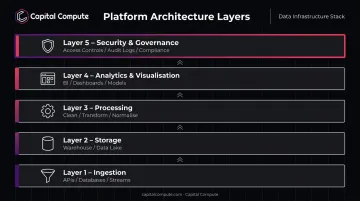
A well-designed analytics platform has five distinct layers. Understanding what each does helps CTOs evaluate whether a vendor's architecture actually meets their requirements.
Ingestion layer — collects raw data from databases, APIs, streaming platforms, product event systems, and marketing tools. The quality of authentication, error handling, and transformation logic here directly determines the reliability of everything downstream.
Storage and processing layers — data warehouses handle structured data; data lakes handle unstructured. The processing layer cleans, normalises, and transforms raw data into analysis-ready formats. Batch vs. real-time processing choices made here determine how quickly insights reach decision-makers.
Analytics and visualisation layer — where BI tools, dashboards, predictive models, and self-service reporting connect to processed data. Most end-users interact only at this layer, so usability and performance here drives adoption across the organisation.
Security and governance layer — manages access controls, encryption, compliance monitoring, and data policy enforcement across the entire architecture.
This last layer deserves particular emphasis. CTOs should treat security and governance as foundational infrastructure — scoped at discovery, not bolted on after launch. Poor decisions made early, such as insufficient access controls, untracked data lineage, or missing audit logging, become expensive to reverse at scale.
Gartner predicts that 80% of data and analytics governance initiatives will fail by 2027 — with the primary cause being organisations treating governance as a retrofit rather than a design requirement from day one.
How to Choose the Right Data Analytics Platform
Align Platform Choice with Business Stage and Data Strategy
The most common mistake founders make is buying for the business they hope to be, not the one they currently operate. A useful maturity model:
| Stage | Primary Need | Platform Profile |
|---|---|---|
| Early-stage | Speed, simplicity, quick insight | Lightweight product analytics (Amplitude, Mixpanel) |
| Growth-stage | Integrations, segmentation, experimentation | Mid-tier platforms with strong connector libraries |
| Enterprise/regulated | Audit trails, complex governance, data sovereignty | Full-stack platforms or custom builds with on-premise options |
Platform choice should also reflect team capability. A powerful but complex platform (Databricks, custom Apache Spark pipelines) delivers no value if the team lacks the engineering resource to maintain it. Factor in the realistic skill level of whoever will own and operate the platform after implementation.
Evaluate Total Cost of Ownership, Not Just Licence Fees
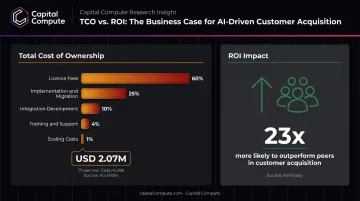
Licence fees are the visible part of the cost. The full TCO picture includes:
- Implementation and data migration effort
- Integration development for non-native connectors
- Ongoing training and internal support overhead
- Scaling costs as data volume and user count grows
- Vendor professional services for configuration and onboarding
A Forrester TEI study commissioned by Qlik modelled three-year present-value costs of USD 2.07M for a 5,000-employee composite — of which USD 916,529 was ongoing data-flow management, not licence fees. For growing SaaS businesses, hidden integration costs frequently exceed the headline subscription.
On the ROI side, a McKinsey survey of nearly 700 senior executives found that customer analytics high performers were 23 times more likely to outperform peers in customer acquisition. That gap compounds: the right platform actively drives acquisition, not just reporting efficiency.
Prioritise Security, the Privacy Act Compliance, and Vendor Reliability
For Australian founders, the compliance criteria to verify before signing:
- The Privacy Act and PECR compliance documentation (not just marketing claims)
- EU/Australian data residency options with clear DPA terms
- Encryption at rest and in transit
- Multi-factor authentication
- SLA-backed uptime guarantees — Tableau Cloud commits to 99.9% or better uptime
On vendor reliability: check support responsiveness in Australian business hours, disaster recovery plans, and whether the product roadmap is publicly maintained. Security certifications — ISO 27001, SOC 2 Type II, and Cyber Essentials Plus — provide a baseline. Note that these certifications don't by themselves establish Privacy Act compliance or a lawful international transfer mechanism.
The Build vs. Buy Decision
Those compliance requirements often shape the sourcing decision itself. Off-the-shelf platforms suit most teams with standardised data sources and a preference for faster time-to-value. Custom-built pipelines and bespoke analytics architecture make more sense when:
- Data models are genuinely unique and don't map to standard schemas
- Strict data sovereignty requirements demand full ownership
- Vendor lock-in is a strategic risk the business can't accept
- The analytics layer needs deep integration with proprietary systems
Custom builds require senior engineering involvement from the first architecture decision — not the last sprint before go-live.
Capital Compute structures custom data engagements with senior engineers defining architecture in sprint one and APP-compliant data architecture scoped at discovery. Deliverables are documented, versioned, and built for maintenance by the client's internal team — no ongoing dependency after handover.
Popular Data Analytics Platforms Compared
No platform is universally the best choice. The right fit depends on use case, compliance requirements, team capability, and growth stage. Use the columns below to match each tool against your current constraints.
| Platform | Best-Fit Use Case | the Privacy Act/Compliance Posture | Pricing Model | Technical Complexity |
|---|---|---|---|---|
| Amplitude | Product analytics, digital experimentation | DPA; US/EU hosting; ISO 27001, SOC 2 Type II | Event volume; free tier at 2M events/month | Event SDKs, behavioural analysis |
| Mixpanel | Event-based product analytics, warehouse sync | DPA; US, EU, or India residency; ISO 27001, SOC 2 Type II | First 1M events/month free, then ~$0.28/1K | Event instrumentation, warehouse connectors |
| Power BI | Enterprise BI, semantic models, Microsoft ecosystem | Microsoft compliance scope; tenant/service configuration required | Pro A$10.60/user/month; Premium Per User A$18/user/month | Power Query, semantic modelling, admin overhead |
| Tableau | Visual analytics, data prep, embedded analytics | Salesforce/Tableau privacy terms; Cloud certifications; Server option available | Role-based annual subscriptions | Desktop/Cloud/Server administration |
| Matomo | Privacy-first web analytics, the Privacy Act-native | Self-hosted or cloud; DPA; ISO 27001 (2025) | Free on-premises core; paid cloud tiers by traffic | Managed or self-operated stack |
| Databricks | Data engineering, AI/ML, large-scale pipelines | Cloud-region choices; DPA; Cyber Essentials Plus (AWS) | Consumption-based, per-second usage | Engineering-heavy; SQL, data science, governance |
| Qlik | Analytics plus data integration, associative model | DPA; ISO 27001, SOC 2 | Starter A$240/month (10 users), scaling tiers | Data integration, connector library, governance |
Many growing businesses end up combining platforms — a product analytics tool alongside a BI layer is a common and practical architecture. The condition for that working well is a coherent underlying data model connecting them. Without it, a multi-tool stack creates the same fragmentation problems as the old patchwork approach it was meant to replace.
Frequently Asked Questions
What are data analytics platforms?
A data analytics platform collects, processes, analyses, and visualises data from multiple sources through a single environment. Unlike standalone BI tools, it manages the full analytics lifecycle — from raw data ingestion to insight delivery — including governance, access control, and often machine learning capability.
Which platform is best for data analytics?
The right platform depends on your business stage, data volume, team capability, compliance requirements, and primary use case. Amplitude and Mixpanel suit product analytics in SaaS; Power BI and Tableau serve enterprise BI; Databricks and Qlik cover complex engineering and integration workloads.
What are the 4 types of data analytics?
Descriptive (what happened), diagnostic (why it happened), predictive (what will happen), and prescriptive (what action to take). Most platforms support some types more strongly than others — and most early-stage businesses need descriptive and diagnostic capability before predictive or prescriptive tools add real value.
What is the difference between a data analytics platform and a BI tool?
A BI tool focuses on reporting and visualisation of already-processed data. A full analytics platform manages the entire lifecycle — data ingestion, storage, processing, transformation, visualisation, and governance — and often includes ML capabilities. BI tools connect to the output of a data pipeline; platforms build and manage the pipeline itself.
Do I need a data analytics platform for an early-stage startup?
Most early-stage startups benefit more from a lightweight product analytics tool — Amplitude or Mixpanel — than from a full platform. Data model decisions made now will affect future scalability, so plan your data model with migration in mind from the start.
How do I ensure my data analytics platform is APP compliant?
Confirm the platform offers EU/Australian data residency, data minimisation, IP anonymisation, audit logs, role-based access controls, and a documented Data Processing Agreement. Privacy Act compliance must be scoped at architecture design — not reviewed after data is already flowing.