
Introduction
Cloud consulting in Europe has moved well beyond infrastructure migration. B2B organisations now use cloud partners to compress product delivery timelines, cut operational overhead, and compete at a scale that would be impossible to reach with on-premises systems alone.
The European dimension adds real weight to partner selection. GDPR obligations, data residency requirements, and the EU's Digital Decade policy targets mean that choosing a cloud consulting partner is simultaneously a compliance decision and a commercial one. Get it wrong and you inherit architecture that creates legal exposure on top of technical debt.
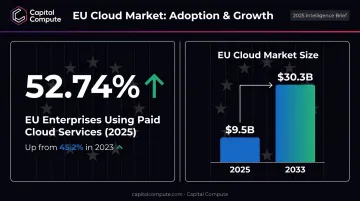
According to Eurostat, 52.74% of EU enterprises used paid cloud services in 2025, up from 45.2% in 2023 — a trajectory driven by real commercial demand, not IT refresh cycles alone.
Against that backdrop, the market for European cloud professional services is valued at $9.5 billion USD in 2025 and is projected to reach $30.3 billion USD by 2033.
This article profiles five of the top cloud consulting firms operating in Europe, walks through the selection criteria used, and gives UK B2B buyers a practical framework for evaluating partners — including what to look for if compliance-first architecture matters to your sector.
Key Takeaways
- 52.74% of EU enterprises now use paid cloud services — the market is mature, not emerging
- GDPR compliance, data residency, and processor agreements are non-negotiable selection criteria for UK and EU B2B buyers
- The best cloud consulting firms cover the full lifecycle: strategy, migration, and ongoing optimisation post-deployment
- Platform certifications (AWS, Azure, GCP) signal verified capability — not just claimed expertise
- Capital Compute builds GDPR-compliant software above cloud infrastructure for UK B2B clients — no subcontracting
What Cloud Consulting in Europe Actually Covers
Cloud consulting in a B2B context covers far more than migration projects. Strategic advisory, architecture design, compliance configuration, cost optimisation, and ongoing managed services all fall within scope — each tied to measurable business outcomes, not infrastructure checklists.
The EU's Digital Decade policy targets at least 75% of EU enterprises adopting cloud computing, big data, or AI by 2030. With adoption at 52.74% today, the gap creates substantial demand pressure — and a corresponding expansion in the cloud consulting market.
Why European Geography Matters for B2B Buyers
The distinction between a European cloud consultancy and an offshore alternative is not just about time zones. It affects your legal risk profile directly:
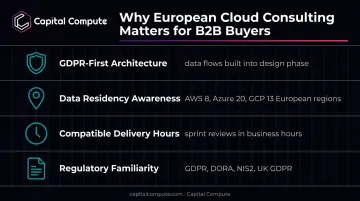
- GDPR-first architecture — European consultants build data flows, processor agreements, and consent mechanisms into the design phase, not the pre-launch checklist
- Data residency awareness — AWS operates 8 standard European regions (Frankfurt, Ireland, London, Milan, Paris, Spain, Stockholm, Zurich); Microsoft Azure has 20 public-cloud regions in Europe; Google Cloud has 13 European regions — knowing which workloads sit in which region is a compliance requirement, not a preference
- Compatible delivery hours — Sprint reviews, escalations, and architecture conversations happen in your business hours
- Regulatory familiarity — GDPR, DORA, NIS2, and UK GDPR carry specific technical implications that European consultants have navigated operationally
AWS, Microsoft, and Google collectively hold 70% of European IaaS, PaaS, and hosted private cloud revenue, according to Synergy Research. Only 4% of European organisations plan to abandon global public-cloud platforms entirely. That means hybrid, multicloud, and sovereign-control architectures are what B2B buyers actually need their consultants to understand.
Top Cloud Consulting Firms in Europe for B2B Growth
These firms were selected based on B2B growth track record, platform certifications, regulatory compliance capability, and engagement model flexibility — not brand size alone.
Accenture
Accenture operates one of the largest cloud practices globally, covering strategy, modernisation, infrastructure transformation, and AI integration across AWS, Microsoft Azure, and Google Cloud. For large European enterprises managing complex multi-cloud environments, that breadth is genuinely useful.
Regulated sectors in particular need a consulting partner with cross-industry experience — not just technical depth on a single platform.
Its positioning in the 2025 Gartner Magic Quadrant for Public Cloud IT Transformation Services as a Leader reflects sustained delivery at enterprise scale, not just credentials. The ability to connect cloud modernisation with AI-driven product development and digital transformation in a single engagement is a meaningful differentiator for B2B organisations that have outgrown point-solution consulting.
| Criteria | Detail |
|---|---|
| Key Cloud Platforms | AWS, Microsoft Azure, Google Cloud |
| B2B Industries Served | Finance, healthcare, telecoms, retail, public sector |
| Engagement Model | Enterprise projects, multi-phase consulting, long-term managed services |
Devoteam
Devoteam is a Paris-headquartered technology consulting firm with 11,000+ staff across 25+ EMEA countries — including France, Germany, the UK, Spain, Italy, and Sweden. Geographic presence matters here: GDPR processor agreements and data sovereignty decisions need to be stress-tested against local regulatory context, not assessed remotely.
The firm holds an AWS Premier Consulting Partner designation and self-identifies as a Google Cloud Premier Partner in Europe. Its value for B2B buyers lies specifically in European-native positioning: Devoteam operates within EU regulatory frameworks by design, which reduces the compliance gap that non-European consultancies often surface only at go-live.
| Criteria | Detail |
|---|---|
| Key Cloud Platforms | AWS, Microsoft Azure, Google Cloud Platform |
| B2B Industries Served | Financial services, media, public sector, professional services |
| Engagement Model | Project-based and retainer consulting, multi-cloud strategy, compliance advisory |
Protiviti
Protiviti brings a governance, risk, and compliance lens to cloud consulting — covering cloud strategy, platform migration, FinOps, and cloud security across AWS, Azure, and Google Cloud. Its AWS directory record confirms 3 AWS Competencies, 50+ AWS certifications, and 20+ customer launches, which provides more verification than many competitor claims.
For B2B scale-ups and enterprises trying to rationalise cloud spend without sacrificing operational performance, Protiviti's FinOps capability is a practical differentiator. Cloud cost management often becomes the dominant post-migration concern — and firms that can run a rigorous maturity assessment from day one save clients from expensive retrospective optimisation programmes.
| Criteria | Detail |
|---|---|
| Key Cloud Platforms | AWS, Microsoft Azure, Google Cloud |
| B2B Industries Served | Regulated industries, finance, professional services, enterprise B2B |
| Engagement Model | Advisory, migration, FinOps, governance — full lifecycle or phase-specific |
Future Processing
Future Processing is a Poland-headquartered technology consultancy founded in 2000, holding a verified AWS Advanced Tier Services Partner designation with 2 competencies and 20+ customer launches confirmed in the AWS directory.
Worth noting: many firms claim platform relationships that are not independently confirmed. The AWS directory listing removes that ambiguity.
Their delivery model bridges boutique quality with genuine scale capacity, making them a strong option for B2B buyers who need structured delivery without enterprise consulting overhead. A concrete outcome: Future Processing identified up to $35,000 in annual AWS savings for German client Staffbase, which speaks to their FinOps execution rather than just advisory capability.
| Criteria | Detail |
|---|---|
| Key Cloud Platforms | AWS (Advanced Tier Partner), Microsoft Azure, Google Cloud |
| B2B Industries Served | Fintech, media, insurance, manufacturing, healthcare |
| Engagement Model | Consulting, migration, managed services, cloud cost optimisation (FinOps) |
Software Mind
Software Mind is a Kraków-based software and cloud consulting firm with a European presence across Poland, Romania, Moldova, Germany, and Sweden. Their differentiator is early strategic involvement — teams are brought in at the planning stage to design custom migration paths that address technical, legal, and security considerations before any infrastructure provisioning begins.
Their AI and machine learning integration advisory is increasingly relevant for B2B organisations combining cloud infrastructure with intelligent automation. Key areas covered at the architecture stage include:
- AI and ML workload placement across multi-cloud environments
- Data pipeline design for model training and inference
- Compliance scoping for automated decision-making systems
Rather than treating AI as a post-migration add-on, Software Mind incorporates it into the architecture conversation from the start.
| Criteria | Detail |
|---|---|
| Key Cloud Platforms | AWS, Microsoft Azure, Google Cloud (multi-cloud and hybrid) |
| B2B Industries Served | Finance, retail, healthcare, SaaS, professional services |
| Engagement Model | Strategic planning, migration, cloud-native development, AI advisory, cost audits |
How We Chose the Best Cloud Consulting Firms
The evaluation prioritised B2B growth outcomes over credential lists. The most common mistake buyers make is selecting a firm based on name recognition alone — overlooking GDPR readiness, post-migration support gaps, or engagement models that create dependency rather than delivering capability transfer.
Platform Certifications
AWS, Azure, and GCP partner designations matter because they are independently audited. AWS's Advanced and Premier tiers require verified expertise, customer delivery records, and business investment — not a self-published badge.
When evaluating firms, cross-reference claims against the live AWS Partner Solutions Finder and equivalent Microsoft and Google directories. Several firms publish alliance pages that do not correspond to a current directory-verified tier.
Regulatory and Compliance Capability
For UK and EU B2B buyers, GDPR-aligned architecture and data residency awareness are baseline requirements. Under GDPR, controllers must select processors with sufficient guarantees of appropriate technical and organisational measures, and processor terms must define processing scope, purpose, data types, and subprocessor obligations in writing.
Firms that build this into the scoping stage reduce compliance risk materially compared to those that address it at go-live.
For UK businesses building custom software above their cloud infrastructure, this distinction matters. Capital Compute scopes GDPR-compliant data architecture at discovery, not as a pre-launch checklist. Sprint one deliverables include multi-tenant data isolation, role-based access controls, and data flow mapping for controller-processor relationships. Compliance decisions are made early enough to align with whichever cloud environment a third-party consultancy provisions alongside.
Engagement Model Flexibility
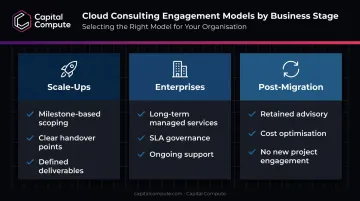
B2B organisations at different stages need different delivery structures:
- Scale-ups typically need milestone-based scoping with clear handover points
- Enterprises often need long-term managed services with SLA governance
- Post-migration optimisation requires retained advisory, not a new project engagement
Evaluate whether a firm offers genuine flexibility or defaults to a single engagement model regardless of client context. Specifically, check whether knowledge transfer and handover are treated as formal deliverables rather than afterthoughts once the project fee has been collected.
Conclusion
Selecting a cloud consulting partner in Europe is a strategic decision. The firms that deliver lasting B2B growth align cloud architecture to business objectives from the outset — credential lists and brand recognition matter less than execution quality and post-migration accountability.
Before committing, evaluate each firm on:
- GDPR architecture scoped at discovery, not reviewed at go-live
- Retained advisory and optimisation after migration, not just handover documentation
- Engagement models — milestone-based, retainer, or managed services — matched to your current stage
- FinOps capability and clear pricing structures that limit financial exposure over time
If your cloud engagement also requires software development capacity — building SaaS products, modernising legacy systems, or integrating APIs within a new cloud environment — those criteria apply equally to your dev partner. Capital Compute delivers all work through an internal engineering team (no subcontracting), with fixed-price scoping and GDPR-compliant architecture built in from sprint one. Contact Capital Compute to scope your requirements.
Frequently Asked Questions
What are the biggest cloud providers in Europe?
AWS, Microsoft Azure, and Google Cloud collectively hold around 70% of European IaaS and PaaS revenue, according to Synergy Research. European-native providers such as SAP and Deutsche Telekom hold smaller shares. The EU's Cloud and AI Development Act (currently a Commission proposal) aims to expand European sovereign cloud capacity, though most organisations use hybrid architectures combining global platforms with regional data controls.
What should UK B2B businesses look for in a cloud consulting firm?
Prioritise verified platform certifications (not just self-published badges), GDPR compliance built into the scoping phase, a clear post-migration support model, and an engagement structure that transfers knowledge rather than creating long-term dependency. Each of these is a business-outcome requirement — not a box to tick after contracts are signed.
What is the difference between cloud consulting and managed cloud services?
Cloud consulting covers strategic advisory, readiness assessments, architecture design, and migration planning — typically project-based work with a defined endpoint. Managed cloud services cover day-to-day infrastructure management, monitoring, patching, and cost optimisation on an ongoing basis — and leading firms offer both, with the consulting engagement often transitioning into a managed services retainer.
How do GDPR requirements affect cloud consulting in Europe?
GDPR requires controllers to use only processors offering sufficient guarantees, with processing scope, data types, and subprocessor obligations defined in writing — affecting data residency decisions, architecture choices, and transfer mechanisms for data leaving the UK or EU. A consulting partner that addresses these requirements at go-live rather than during scoping creates significant legal exposure for the client.
How much does cloud consulting typically cost in Europe?
Clutch's July 2026 IT Services Pricing Guide lists cloud consulting at $100–$149 per hour globally. European rates vary by firm size, geography, and engagement scope — enterprise firms typically cost more than regional consultancies. Fixed-price or milestone-based scoping reduces financial exposure for B2B buyers compared to open-ended time-and-materials arrangements.
How long does a typical cloud consulting engagement take?
A readiness assessment typically takes 2–4 weeks; a full migration and optimisation programme generally runs 3–9 months depending on infrastructure complexity and workload volume. Phased delivery with milestone-based reviews is standard — treat any proposal without interim checkpoints as a red flag.