This guide cuts through the noise. It covers the six evaluation criteria that separate reliable development partners from risky ones, the questions to ask before signing anything, and what to look for in contract terms. Written specifically for Australian businesses, it gives you a framework to move from a shortlist of vendors to a confident decision.
Key Takeaways
- Custom software is built around your workflows — off-the-shelf tools force the opposite compromise.
- Evaluating a partner goes beyond cost — assess team structure, compliance standards, pricing model, and post-launch terms.
- For Australian businesses, Privacy Act compliance must be scoped into architecture from day one.
- Ask whether the company subcontracts and request to meet the engineers before signing.
- Code ownership, IP transfer, and retainer flexibility should be written into the contract upfront.
What Is Custom Software Development?
Gartner defines custom software development services as professional services engaged to design, build, modernise, or iterate software tailored to an organisation's specific requirements — distinct from packaged SaaS products built for a general market.
In practice, Australian businesses typically pursue three types of engagements:
- New product builds — SaaS platforms, web applications, mobile apps built from scratch
- Legacy system modernisation — replacing or upgrading outdated systems while minimising business disruption
- API and systems integrations — connecting disparate platforms, data sources, or third-party services into a cohesive architecture
Off-the-shelf tools require your business to adapt its processes to the software's design. Custom software works in the opposite direction: built around how you actually operate, it eliminates workaround costs, reduces manual overhead, and scales with the business rather than against it.
The global custom software development market was valued at $43.2 billion in 2024, with forecasts of $146.2 billion by 2030. That trajectory reflects a broad shift across industries toward purpose-built systems over generic tools.
What to Consider When Choosing a Custom Software Development Company
Selecting a development partner is not a single-dimension decision. A vendor can have impressive case studies but use subcontractors. Another can offer competitive pricing but operate with no milestone structure. The wrong call on any one factor can result in scope creep, regulatory exposure, or dependency lock-in after the project closes.
The six factors below cover what to ask, what to watch for, and how to evaluate any shortlisted vendor before signing.
Team Composition and Use of Subcontractors
This is the first question to ask — and the one most vendors are least prepared to answer directly.
Many development firms present senior engineers during sales conversations, then hand the actual build work to offshore subcontractors or more junior team members once the contract is signed. This creates accountability gaps that are difficult to detect until something goes wrong mid-project.
What to look for:
- An internal, named engineering team with no subcontracting
- The same engineers who scope the project remain on it throughout delivery
- A dedicated project lead assigned from day one, not rotated between accounts
Capital Compute operates exclusively with internal engineers — no subcontracting at any stage. Named senior team members, including Chief Architect Debasish Sahoo and VP of Operations Sayan Maity, lead engagements from discovery through delivery.
Technical Expertise and Domain Knowledge
Technical skill alone is not sufficient. A development partner who understands your sector will make better architecture decisions, anticipate compliance requirements, and reduce onboarding time considerably.
A firm that has built ASIC-regulated fintech platforms will approach audit trail design very differently from a generalist agency. The same applies to legal software with SRA obligations, or healthcare systems with Australia's public health system data requirements — the domain context shapes every architectural choice.
How to validate domain expertise:
- Review case studies for relevant sector work, not just impressive-looking screenshots
- Ask about similar technology stacks and integration environments they have worked in
- Request references from clients in comparable industries, not just comparable project sizes
Pricing Model and Contract Transparency
Pricing structures carry different risk profiles. Understanding which model you are entering is non-negotiable before signing.
Industry guidance on contracting for Agile outlines three primary models:
| Model | Cost Control | Buyer Risk |
|---|---|---|
| Fixed-price | Time and cost constrained; scope variable | Valuable scope may be displaced |
| Time and materials | High flexibility | Buyer bears poor-quality risk; costs can accumulate |
| Outcome-based | Commercial incentive to deliver | Complex attribution and measurement |
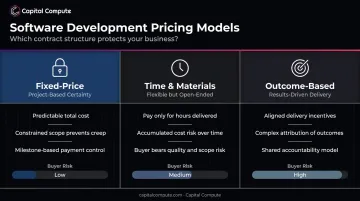
For most Australian businesses, a fixed-price model with milestone-based approval gates offers the clearest cost predictability and the strongest protection against scope drift.
Red flags to watch for:
- Vague estimates with no supporting scope document
- No milestone checkpoints or approval gates in the contract
- Change requests handled informally rather than through a defined process
Development Methodology and Communication Cadence
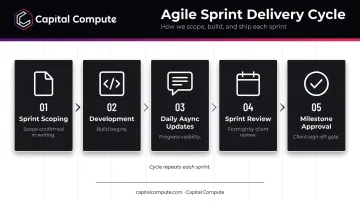
Sprint-based Agile delivery is the preferred methodology for most custom software engagements. It keeps requirements flexible as you learn and surfaces problems early — rather than surfacing them at a final delivery months down the line. Stakeholders stay actively involved throughout, not brought in at the end.
The 17th State of Agile Survey found 71% of respondents used Agile in their software development lifecycle — reflecting broad adoption across the industry.
Practical questions to ask any vendor:
- How often will sprint reviews be held, and are they during Australian business hours?
- What tools are used for transparency — sprint boards, project dashboards, daily updates?
- How is scope confirmed in writing before each sprint begins?
Capital Compute structures delivery around fortnightly sprint reviews with client approval gates at every milestone, daily async updates between reviews, and sprint scopes confirmed in writing before development begins.
Data Security and the Privacy Act Compliance
For Australian businesses — particularly those in financial services, legal, or healthcare — Privacy Act compliance cannot be a go-live checklist item. The Australian Privacy Principles require appropriate technical and organisational measures to be applied when determining processing means and during processing itself. That means architecture decisions, not configuration settings.
The Australian Clinical Labs case illustrates the stakes. The Federal Court ordered the company to pay A$5.8 million in civil penalties over the Medlab data breach, following failures in security and reporting obligations under the Privacy Act 1988.
What to ask any shortlisted vendor:
- Is data architecture reviewed and documented during discovery, before any build begins?
- Does the team have direct experience with Australian data protection requirements?
- Can you demonstrate prior compliant builds in regulated sectors?
Capital Compute scopes Privacy Act compliance in Week 1 of every engagement — covering data-flow analysis, consent architecture, data minimisation planning, and Subject Access Request readiness — before a single line of code is written.
Post-Launch Support, Code Ownership, and Lock-In Terms
The end of the build phase is where many vendor relationships introduce hidden risk. Vague IP terms, poor documentation, or retainer structures that make switching providers prohibitively expensive are common.
Australian Intellectual Property Office guidance is clear: for commissioned software, the creating party is normally the first copyright owner unless ownership is agreed in writing. IP transfer must be explicitly stated in the contract — not assumed.
A clean handover includes:
- Full IP and code ownership transferred to the client in writing
- Repository access from sprint one, not just at project close
- Documented and versioned APIs the client's team can extend independently
- A post-launch support period included as standard, not sold as an add-on
- Month-to-month retainer options with no lock-in commitment
Capital Compute transfers code ownership to the client from day one, includes a 90-day post-launch support period as standard, and offers month-to-month retained support with no long-term contract requirement.
Questions to Ask Before You Sign a Contract
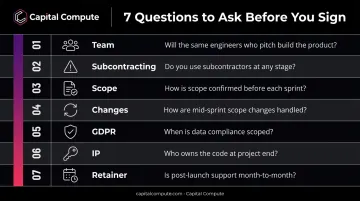
These seven questions should go to every development company on your shortlist. How directly and specifically they answer them is as informative as the answers themselves.
- Will the engineers pitching this project be the ones building it? — Ask for names and request to meet them before signing.
- Do you use subcontractors or freelancers at any stage? — Accept only a clear yes or no.
- How is the scope confirmed before each sprint begins? — Look for a written confirmation process, not verbal agreement.
- How do you handle scope changes mid-sprint? — There should be a defined change-request process with documented approval.
- What does Privacy Act compliance look like in your architecture, and when is it scoped? — The answer should reference discovery, not go-live.
- Who owns the code and IP at the end of the engagement? — This should be in writing from day one.
- What does your post-launch retainer look like, and is there a minimum commitment? — Month-to-month with no lock-in is the standard to aim for.
Companies that deflect, over-promise, or give vague answers during evaluation tend to underdeliver during delivery. If a vendor can't give a straight answer about who owns the IP before you've signed anything, that tells you something.
Once your shortlist is set, cross-check vendor claims independently before requesting references. Two platforms worth using:
- Clutch — labels reviews by verification status, making it easier to separate genuine client feedback from unverified submissions; useful for spotting gaps between claimed sector experience and actual delivery history
- G2 — broader review volume, less granular verification, but helpful for identifying consistent patterns across multiple client accounts
Neither replaces a direct reference call, but both surface inconsistencies that vendors rarely volunteer.
How Capital Compute Helps Australian Businesses
Capital Compute is an Australian-based custom software development and AI solutions company focused on the outsourcing risks that matter most to Australian businesses: subcontracted work, opaque pricing, and compliance gaps in regulated sectors.
Here is how the model maps to each evaluation factor covered in this guide:
- Team composition: All work is delivered by an internal engineering team with no subcontracting. A dedicated project lead is assigned from day one and remains through delivery.
- Pricing and transparency: Projects are priced on a fixed-price scope, with a technical roadmap and estimate delivered within two business days of an initial scoping call. Each sprint is scoped in writing before it begins.
- Methodology: Fortnightly sprint reviews with client approval gates at every milestone, daily async updates, and review sessions held during Australian business hours.
- Privacy Act compliance: Data architecture is scoped at discovery — covering data-flow analysis, consent architecture, data minimisation, and SAR readiness — not reviewed at go-live.
- Post-launch terms: Code ownership transfers to the client from sprint one. A 90-day post-launch support period is included as standard, followed by a month-to-month retainer with no lock-in.
Capital Compute has shipped production AI agents across legal, finance, and marketing sectors:
- Legal: Citation retrieval, docket fetching, form population, and scenario-based outcome modelling
- Finance: Automated report generation, fraud detection agents, and reconciliation assistants built within ASIC-regulated environments with PCI-DSS-compliant data architecture
- Marketing: Agentic workflow automation for campaign analytics and consent management systems
For Australian businesses in regulated industries, the engagement model is designed to be transparent and exit-friendly — fixed pricing, no subcontracting, and code ownership from sprint one. Contact Capital Compute to scope your project within two business days.
Conclusion
The vendor you choose directly shapes your product quality, budget control, data compliance, and long-term flexibility. That makes this a business partnership decision, not a technical procurement exercise.
The six factors in this guide — team composition, domain expertise, pricing model, development methodology, Privacy Act compliance, and post-launch terms — give you a practical framework for evaluating any vendor objectively. Use the seven pre-contract questions as a final filter before signing anything.
The right development partner at MVP stage may not be the right partner for scaling or legacy modernisation. As your business grows, revisit these criteria. The best development partners will tell you honestly which stage they are best positioned to serve, and refer you elsewhere when they are not.
Frequently Asked Questions
What is the difference between custom software development and off-the-shelf software?
Off-the-shelf software is built for a broad market, which means businesses must adapt their processes to fit the software's design. Custom software is built around your specific workflows, integration requirements, and scalability needs — making it more precise but requiring greater upfront investment in scoping and build.
How much does custom software development cost for Australian businesses?
Costs vary based on project complexity, team size, engagement model, and integration requirements. No single authoritative Australian benchmark exists. A fixed-price scoping process is the most reliable starting point because it produces a specific estimate based on your actual requirements rather than a generic range.
How do I know if a development company will subcontract my project?
Ask directly whether the company uses subcontractors or freelancers, and request to meet the engineers who will build the product before signing. Cross-check employment model claims against reviews on Clutch or LinkedIn — client feedback often surfaces discrepancies between what was pitched and who actually delivered.
What questions should I ask a custom software development company before hiring?
Focus on team composition, pricing model, methodology, Privacy Act compliance approach, and post-launch code ownership. Ask specifically who will build the product, how scope is confirmed in writing, and what the IP transfer terms are — these three points account for most post-project disputes.
What does a fixed-price software development contract include?
A fixed-price contract should define the full scope of work, milestone delivery points, client approval gates, and a clear change-request process. Unlike a time-and-materials model — where costs accumulate without a ceiling — scope boundaries are locked in writing from the start.
How long does custom software development typically take for an Australian business?
Timelines depend on scope, complexity, integrations, and regulatory requirements. For MVP engagements with a clearly defined core workflow, sprint-based delivery can move from discovery to working product in six to twelve weeks. Full-product builds or legacy modernisation projects take longer and are better estimated through a detailed discovery phase than through general benchmarks.