Introduction
Most Australian businesses don't abandon off-the-shelf software because it fails outright. They abandon it because it quietly accumulates friction — staff building workarounds in spreadsheets, data re-entered between disconnected systems, compliance gaps that only surface during audits.
Research from HBR found that employees lose nearly four hours per week simply switching between applications — roughly 9% of their working time. For a team of 50, that's the equivalent of losing four full-time employees to tool friction alone.
Custom software development addresses all of this directly — the workarounds, the re-keying, the compliance gaps, and the switching overhead. Rather than adapting your business to fit a generic product, you build software that fits how your business actually operates: its workflows, roles, compliance obligations, and integration requirements.
This article covers the concrete advantages of custom software for Australian businesses, what goes wrong when organisations stick with generic tools too long, and how to extract genuine value from a custom build.
Key Takeaways
- Custom software reflects real workflows — removing the friction that generic tools force teams to work around
- In Australian regulated sectors, the Privacy Act, ASIC, and Australia's public health system compliance is scoped into the architecture from day one — not bolted on at go-live
- Total cost of ownership drops as recurring licence fees, forced migrations, and integration workarounds are removed from the equation
- Off-the-shelf tools hit hard limits at scale — custom-built systems are architected to grow with your user base and data volume
- Architecture decisions made in sprint one — not revised after scale events — prevent costly rework later in the project
What Is Custom Software Development?
Custom software development is the design, build, and ongoing improvement of applications created specifically for one organisation's processes, data, and requirements — not adapted from a generic product.
It's typically applied in four scenarios:
- Replacing legacy systems that can no longer scale or meet current compliance requirements
- Building integrations between disconnected tools that create manual re-entry and data inconsistency
- Developing sector-specific platforms — legal case management, ASIC-compliant financial workflows, Australia's public health system-integrated clinical tools
- Automating processes that off-the-shelf tools handle poorly or not at all
Custom software isn't a technology choice made for its own sake. It becomes the right option when the cost of adapting your business to generic software — in time, errors, compliance risk, and lost capacity — exceeds the investment of building software that fits your business.
Gartner forecasts the custom software development services market will exceed USD 283 billion by 2028, growing at an 8.9% CAGR — reflecting how many organisations have concluded that off-the-shelf software can no longer keep pace with their operational complexity.
Key Advantages of Custom Software Development
The three advantages below cover operational fit, compliance architecture, and long-term cost efficiency. Each is grounded in outcomes rather than theoretical capabilities, and each becomes most meaningful when the software is scoped properly, built with your team's actual workflows in mind, and handed over with full ownership retained by your business.
Advantage 1: Software That Works the Way Your Business Actually Works
Operational fit means the software reflects your actual workflows, terminology, roles, and approval chains rather than the defaults of a product designed for thousands of different users.
Screens show only information relevant to a given role. Mandatory steps are enforced by the system. Optional steps are removed. Integrations between departments are built into the software, not managed through exports and emails.
Generic tools create the opposite problem. Staff work around fields that don't apply, re-enter data across systems, and manually bridge gaps the software was never designed to close. HBR research cited above puts a number on this: nearly four hours per week per employee lost to application switching alone, before accounting for re-entry errors or process deviations.
When hundreds of people run the same workflow every day, cutting even small inefficiencies from each task adds up to measurable capacity gains across the organisation.
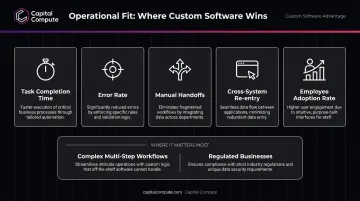
KPIs this affects:
- Task completion time
- Error rate per process step
- Number of manual handoffs
- Volume of cross-system data re-entry
- Employee adoption rate
Where this matters most: Organisations with complex, multi-step workflows and regulated businesses where process deviations carry audit risk. If your team has built a layer of spreadsheets and manual workarounds around your current software, that's a reliable sign operational fit has broken down.
Advantage 2: Security and Compliance Designed Into the Architecture
With custom software, security controls and compliance requirements (data residency, access permissions, audit logging, retention policies) are scoped and built into the architecture from the outset. They're not applied as a configuration layer on a generic platform after the fact.
This is especially material for Australian regulated businesses. The Australian Privacy Principles (APPs) under the Privacy Act 1988 require appropriate technical and organisational measures at the design stage and throughout the lifecycle. NIST makes the same point differently: addressing security earlier in the development lifecycle costs less and avoids the technical debt that comes from fixing flaws post-production.
Multi-tenant SaaS platforms serve many customers by design, which means their compliance defaults reflect a generalised risk model rather than the specific obligations of an ASIC-regulated firm, an Australia's public health system service provider, or a legal practice under SRA obligations.
For these organisations, the inability to control data architecture isn't a minor inconvenience. It's a material compliance exposure.
Capital Compute scopes APP-compliant data architecture during the discovery phase of every project, before a single line of production code is written. For regulated sector clients, this includes lawful basis mapping, consent infrastructure, role-based access controls, audit logging, and data residency decisions. All are documented as locked deliverables before development begins, not reviewed at go-live when changes are costly.
KPIs this affects:
- Compliance gaps identified post-build
- Audit preparation time
- Time to implement regulatory changes
- Data breach incident rate
- Vendor dependency risk
Where this matters most: Legal, financial services, and healthcare organisations operating under the Privacy Act 1988 (APPs), ASIC rules, public health system data requirements, or state Law Society obligations where architecture decisions carry direct regulatory consequence.
Advantage 3: Long-Term Cost Efficiency and Scalability Without Vendor Lock-In
Custom software requires a higher upfront investment than a SaaS subscription. Over a 3–5 year horizon, that picture typically reverses.
Licensing fees accumulate. Per-seat pricing rises with headcount, and Gartner reports that enterprise SaaS renewal increases often reach 10–20% or more. When a business outgrows a platform, the cost of migrating data, retraining teams, and rebuilding integrations is frequently higher than the original licensing savings.
McKinsey's survey of 443 CIOs found 75% of cloud migrations go over budget and 75% behind schedule — a figure that reflects the true cost of tool churn, not just the sticker price of the next platform.
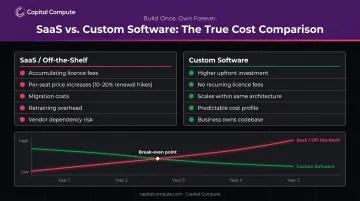
Custom software sidesteps this pattern. As the business grows, the system scales to absorb new users, data volumes, and process changes within the same architecture. Features are added, retired, or reworked in the existing codebase rather than triggered by a migration or a new licensing tier.
The ownership point matters just as much. With custom software, the business owns the codebase, the architecture, and the roadmap. The cost profile is predictable, and the evolution of the system isn't contingent on a vendor's pricing decisions or product discontinuation.
KPIs this affects:
- Total cost of ownership over a 3–5 year horizon
- Number of third-party tool subscriptions
- Integration maintenance overhead
- Time to implement new features
- Licensing cost per active user
Where this matters most: Businesses at a growth inflection point where per-seat costs are rising or a platform migration is being contemplated and Australian SaaS founders where architectural scalability determines long-term unit economics.
What Happens When Custom Software Is Missing
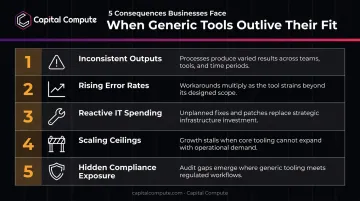
Businesses that stay on generic tools beyond their useful fit tend to absorb the cost in ways that are difficult to attribute directly. There's rarely a single visible failure — the damage accumulates quietly across teams and processes.
The most common operational consequences:
- Inconsistent outputs — caused by manual re-entry and process workarounds rather than enforced system logic
- Rising error rates — as volume increases and the gap between what the tool supports and what the business does continues to widen
- Reactive IT spending — patching integrations, resolving data conflicts, managing vendor issues — rather than investing in capability
- Scaling ceilings — the business cannot add users, automate new processes, or enter new markets without the software becoming a constraint
- Hidden compliance exposure — data handling, access controls, and audit trails managed manually rather than enforced by architecture, creating gaps that only surface during audits
A JAMIA study found 3.7% of manually transcribed clinical entries differed from interfaced results — a measurable illustration of what manual handoffs cost in accuracy, and a pattern that repeats across sectors wherever systems fail to enforce process logic.
The ANAO has flagged ongoing legacy system risk in government ICT procurement, and APRA has noted that entities it supervises rely heavily on legacy systems built on outdated software and hardware. For private-sector businesses, the same pressures apply — without the public accountability that forces the issue into the open before it becomes critical.
How to Get the Most Value from a Custom Software Build
Custom software delivers its strongest return when a few principles are followed from the outset.
Three principles separate high-performing builds from expensive ones:
- Lock in architecture early — multi-tenant isolation, API structure, data residency, and compliance design should be set by senior engineers in sprint one, not revisited after the first scale event forces a costly rebuild
- Deliver in stages, starting with your highest-impact workflows — this surfaces real user feedback early and keeps investment tied to outcomes rather than assumptions
- Own everything at handover — the codebase, documentation, and architecture should belong to the business from day one, not licensed from the delivery partner
Capital Compute's delivery model is built around each of these principles:
- Fixed-price scoping keeps costs predictable from the first conversation
- Fortnightly sprint reviews with client approval gates mean the build reflects real requirements throughout — not just at go-live
- Month-to-month retainer with no lock-in keeps ongoing development on the business's terms
- The same senior engineers who scope the project build it, so nothing is lost in handover
Conclusion
The advantages of custom software are the direct result of building systems that reflect your actual workflows, constraints, and regulatory obligations — not adapting your business to fit a generic product. Operational fit, compliance by design, and long-term cost efficiency follow from that alignment.
Those benefits compound when three conditions are met:
- Right architecture from the start — decisions made in sprint one, not revised after scale events
- Iterative delivery with milestone accountability — fortnightly reviews with client approval at each gate
- Full ownership retained by the business — documented, versioned handover with no ongoing dependency
Custom software is most effective when treated as an ongoing capability rather than a one-time project. The right delivery partner makes that transition straightforward, and shouldn't replace the vendor dependency you're trying to escape with one of their own.
Frequently Asked Questions
What are the benefits of software development?
Custom software enables businesses to automate manual processes, reduce operational errors, scale systems as the business grows, and build capabilities that generic tools cannot replicate. The benefits are strongest when the software is designed around real workflows rather than adapted from a product built for a different user base.
What is the future of custom software development?
Custom development is becoming more accessible as cloud infrastructure, mature API ecosystems, and AI capabilities reduce the cost of building bespoke systems. Capabilities like intelligent automation, anomaly detection, and data-driven interfaces are increasingly embedded into custom platforms built on a company's own data — making bespoke software a stronger differentiator than it was even three years ago.
How does custom software differ from off-the-shelf software?
Off-the-shelf software is built for a broad user base and requires businesses to adapt their processes to fit the product. Custom software is designed around a specific organisation's workflows, data, and constraints. The differences become most visible in compliance control, integration depth, scalability, and long-term cost of ownership.
Is custom software worth the higher upfront cost?
The upfront investment is typically recovered through eliminated licensing fees, reduced integration overhead, and the avoidance of costly platform migrations as the business grows. The return is strongest when scope is fixed, delivery is incremental, and architecture decisions are made correctly at the start rather than revisited after the first scale event.
What industries benefit most from custom software development?
Regulated sectors such as financial services, legal, and healthcare benefit most, because custom software allows compliance requirements to be built into the architecture rather than managed as a configuration layer on a generic platform. SaaS founders and businesses with complex, multi-step workflows also see significant gains where process fit directly drives operational performance.
How long does it take to develop custom software?
Timelines vary based on scope and complexity. Incremental delivery — starting with the highest-impact workflows and expanding in stages — allows businesses to see working software within weeks rather than waiting for a full build. A well-scoped discovery phase with clear milestones is the most reliable predictor of on-time delivery.