Introduction
Generic software is rarely free. The licence fees are modest at first — then headcount grows, integrations get bolted on, and your team starts spending Monday mornings exporting spreadsheets between tools that should talk to each other. That operational drag comdollars until it costs more than the software was ever worth.
That friction has a measurable cost. For Australian small businesses in 2025, it's an increasingly common inflection point. According to a 2022 Harvard Business Review study, workers switch applications nearly 1,200 times per day and spend roughly four hours per week reorienting after those switches — time that adds up to nearly 10% of annual working capacity, lost to friction rather than output.
This guide is a practical walkthrough of what custom software development actually means for a small business. It covers:
- When bespoke development genuinely makes sense over off-the-shelf tools
- What the development process looks like in practice
- What it costs, and what drives that cost
- How to choose a development partner who won't leave you dependent on them after handover
Key Takeaways
- Off-the-shelf software often forces workflows to bend around the tool, not the other way around
- Custom software spans a spectrum: full bespoke builds, API integration layers, and legacy modernisation
- The Privacy Act and sector compliance (ASIC, SRA, Australia's public health system) must be designed into architecture, not configured after launch
- Discovery and scoping quality determines whether a project stays on budget more than any other factor
- Full code ownership and no vendor lock-in are possible — confirm both explicitly in the contract before work begins
What Is Custom Software Development for Small Businesses?
Custom software development means building software specifically around how your business operates — not adapting your processes to fit a tool designed for thousands of different organisations simultaneously.
Off-the-shelf platforms like HubSpot, QuickBooks, or Salesforce serve a vast range of businesses well in many respects. But they're built around broad, one-size-fits-all workflows.
When your workflows diverge from the general case — as they typically do in regulated sectors, specialist niches, or businesses with complex integrations — that mismatch creates real cost.
What It Looks Like in Practice
Custom software isn't always built from scratch. For Australian small businesses, it most commonly takes one of four forms:
- Fully bespoke build — software engineered from the ground up around specific workflows, data models, and user roles
- Custom API integration layer — connecting existing tools (CRM, ERP, finance systems) so data flows automatically between them without manual exports
- Legacy modernisation — replacing or upgrading an older system incrementally to meet current load, compliance requirements, or integration demands
- Heavily configured platform with custom extensions — using a flexible base platform and adding the specific modules a generic tool cannot provide
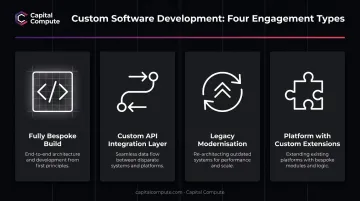
Each form addresses a different constraint. The examples below show what these look like in practice across Australian sectors.
Recognisable Australian Examples
- A legal firm needing a matter management system that integrates with their billing platform and produces SRA-compliant audit trails — rather than managing this across three disconnected tools
- A marketing agency automating client campaign reporting across multiple ad platforms, replacing a manual process that takes two to four hours per client per month
- An ASIC-regulated financial adviser firm requiring a client record system with role-based access, data retention controls, and audit logs that a generic CRM cannot provide without expensive configuration
- A healthcare organisation building an Australia's public health system-integrated patient portal that meets the Privacy Act special category data requirements from day one
In each case, the software is shaped around what the business actually does — its workflows, its regulatory obligations, its data — rather than what a vendor assumed most businesses need.
Why Off-the-Shelf Software Fails Growing Small Businesses
There are three predictable points where generic tools start breaking down for growing Australian small businesses.
The Three Breaking Points
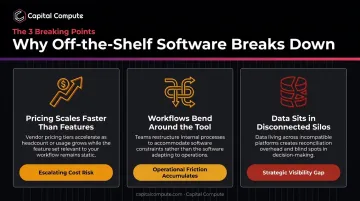
1. Pricing scales faster than features do
Per-seat SaaS billing means your software costs scale with headcount — but the features available to your team rarely improve proportionally. As you grow from 5 to 20 employees, you may be paying four times more for essentially the same product capability.
2. Workflows bend around the tool
Every workaround your team runs — a manual CSV export, a spreadsheet that bridges two systems, a shared inbox that substitutes for a proper workflow — represents a process your software couldn't handle directly. These workarounds compound over time, becoming embedded in how the business operates, and they carry real risk: errors, version conflicts, and key-person dependency.
3. Data sits in disconnected silos
When your CRM, your accounting tool, and your project management platform don't share a single source of truth, someone on your team is manually syncing data. According to the AI adoption insights report, research identifies compatibility with existing systems as a leading concern for Australian SMEs selecting software providers — alongside lock-in risk and products designed for much larger organisations.
The Hidden Cost of Workarounds
Those three breaking points carry a measurable price tag. If four hours per week per person is lost to application switching, a team of ten is losing roughly 160 hours of productive capacity every week.
At median earnings, that's a significant share of weekly pay absorbed by friction rather than output.
That number doesn't include error correction, rework, or the compliance risk that comes from manual data handling in regulated sectors.
The the Privacy Act and Compliance Gap
Off-the-shelf tools are built for a global user base. The Privacy Act data residency controls, retention schedules, role-based access, and audit trail requirements are frequently premium add-ons or afterthoughts — rarely built into the architecture from the start.
For Australian businesses in legal, financial services, or healthcare, this matters in a concrete way. The OAIC's guidance is unambiguous: privacy protections must be integrated from the design stage under the Australian Privacy Principles and throughout the system lifecycle, not configured at go-live. A generic platform that treats the Privacy Act as a settings menu is a different proposition from a system built with compliant data architecture at its core.
Key Benefits of Custom Software for Small Businesses
Precise Fit Eliminates Operational Drag
Every feature in custom software exists because the business asked for it. No unused modules, no paying for licence tiers that cover capabilities you'll never use, and no workarounds for the gaps between what the tool does and what the job requires.
For a firm operating under ASIC or SRA oversight, this precision matters beyond efficiency. A compliance tracking tool built specifically for your regulatory workflow — with the right access controls, audit trail structure, and retention settings — is a risk management asset, not just a productivity gain.
Automation of Repetitive Processes
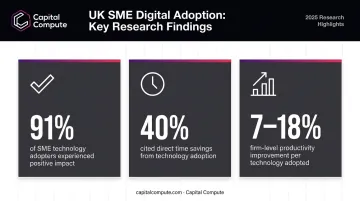
Custom software can eliminate the tasks that absorb disproportionate staff hours: invoice chasing, client onboarding forms, scheduled report generation, appointment scheduling. The ai.gov.au AI Adoption Insights update reports that 43% of Australian SMEs reported some level of AI adoption, down from 45%, showing SME technology adopters experienced a positive impact, with 40% citing direct time savings — and estimated firm-level productivity improvements of 7–18% per technology adopted.
Any digital tool can deliver some of those gains. Custom software captures a larger share because the automation is built around your actual processes, with no generic approximation filling the gaps.
Scalability Without Forced Migration
Custom software can be architected to grow with the business, adding users, new modules, or integrations without triggering a platform migration or a vendor renegotiation.
The decisions that determine a system's ceiling — data model, API design, multi-tenancy architecture — are made at the outset by senior engineers who understand the growth trajectory, not revisited when the system hits a scaling event.
Capital Compute applies this principle explicitly: architecture decisions are locked in sprint one, before development begins, so clients aren't rebuilding what should have been designed correctly the first time.
Full Ownership and Independence
Custom software gives the business complete ownership of the codebase, the data, and the architectural decisions. There is no vendor who can sunset the product, increase prices at renewal, or hold data access as leverage.
For Australian businesses that have experienced SaaS vendor lock-in, where switching means a painful migration, retraining, and a gap in service, this ownership structure changes the commercial risk profile entirely. The value of the software stays with the business.
The Privacy Act Compliance by Design
For regulated sectors, compliance cannot be retrofitted after launch without significant rework. The following need to be built into the data model from day one:
- Role-based access controls scoped to user function and data sensitivity
- Data residency decisions locked at architecture stage, not set in a config panel
- Audit log structure designed for regulator-ready export
- Retention policy enforcement embedded in the data layer
Capital Compute scopes Privacy Act 1988 data architecture during discovery, before any development begins. For businesses operating under APRA, ASIC, the Australian public health system, or OAIC obligations, this means the compliance posture is an architectural property of the system, not a configuration applied on top of it.
The Custom Software Development Process: What to Expect
Discovery and Scoping
A credible development partner spends significant time before writing a line of code. Discovery maps existing workflows, defines requirements, identifies integration points, and establishes the compliance architecture. The output should be a fixed-price scope document — not a loose estimate.
Skipping or rushing this phase is the most consistent source of budget overruns. A 2022 peer-reviewed study of 5,392 IT projects found average real-terms cost overruns of 73%, with 18% of projects exceeding 50% overrun — and that tail averaging 447%. The fat-tailed distribution of IT project failures means extreme overruns are far more common than conventional risk assumptions suggest.
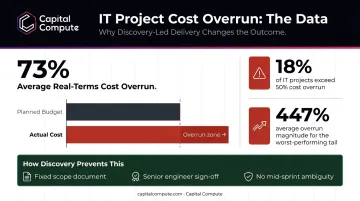
Good discovery prevents this. Capital Compute's process begins with a structured scoping call, after which a fixed-price estimate is delivered within two business days.
Architecture Decisions Made Early
With a fixed scope in hand, technology stack, data model, and integration approach must be settled by senior engineers before development begins — not revised after the product hits scale. These decisions determine what the system can do in two years, not just what it does at launch.
At Capital Compute, architecture is locked in sprint one. Database selection, API design, compliance architecture, and multi-tenancy decisions are all made with the full context of the discovery phase — by the same senior engineers who will build and support the system.
Sprint-Based Delivery with Client Approval Gates
Agile, sprint-based development means the client sees working software every two weeks, not at the end of a six-month build cycle. Capital Compute's model includes:
- Fortnightly sprint reviews delivered in Australian business hours
- A working increment demonstrated at each milestone
- Client approval required before the next sprint begins
- Daily progress updates between reviews
This structure catches misaligned requirements early, when correction costs a fraction of what it would at a full-product reveal.
Testing, Handover, and Post-Launch Support
Testing should run continuously throughout development, not as a single phase. This covers:
- Unit and integration testing during build
- User acceptance testing (UAT) before deployment
- Staged deployment to reduce go-live risk
Handover is structured to eliminate ongoing dependency. That means:
- Documented, versioned APIs ready for the client's internal team or a future partner
- A codebase built on open standards — React, Node.js, PostgreSQL, AWS — with no proprietary frameworks, so any competent engineering team can work with it after handover
- A 90-day post-launch support period included as standard
How to Choose the Right Custom Software Development Partner
Verify They Use an Internal Engineering Team
Ask directly: will the engineers who scope this project be the same engineers who build and support it? Subcontracted or offshore handoff models lose institutional knowledge at the transition point — the team that understood the requirements is no longer the team building the solution.
Capital Compute operates with no subcontracting. The same senior engineers who participate in discovery remain on the project through build, testing, and post-launch support.
Look for Fixed-Price Scoping with Milestone Gates
A partner who can't give a fixed price for a well-defined scope is transferring financial risk to you. Milestone-based approval gates mean you only proceed to the next phase once the current phase is signed off — scope creep is managed before it becomes a budget problem.
In practice, milestone gates look like:
- A signed-off discovery document before build begins
- Sprint-by-sprint client approval before the next phase unlocks
- A defined change request process so additions are scoped separately, not absorbed silently
Assess Their the Privacy Act Approach at Scoping Stage
Ask prospective partners how they handle data architecture, residency, and access controls during discovery — not at go-live. A partner who treats the Privacy Act as an end-of-project checklist item is a liability for any Australian business in a regulated sector.
This should be a structural part of how they scope. If they're fielding these questions during final testing, that's a warning sign worth acting on.
Confirm Post-Handover Independence
Lock-in looks like: proprietary frameworks, undocumented code, or a retainer model that requires the original development team to make any future change. Ask to see sample handover documentation before signing anything.
Post-project independence should be a stated contractual commitment, with specific handover deliverables listed — not an implied aspiration buried in goodwill.
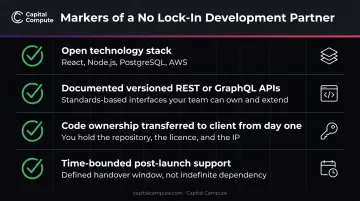
Practical markers of a no-lock-in model:
- Open, widely-used technology stack (React, Node.js, PostgreSQL, AWS)
- Documented, versioned REST or GraphQL APIs
- Code ownership transferred to the client from day one
- Post-launch support that is time-bounded, not dependency-creating
Evaluate Sector-Specific Experience
A partner with production software shipped in your sector understands the compliance requirements, the integration challenges, and the user expectations before scoping begins. Ask for specific examples of live products delivered — not just a list of industries served. In regulated sectors particularly, the difference between a partner who already understands ASIC or SRA requirements and one learning on your project will affect your timeline, your budget, and your audit trail.
Frequently Asked Questions
How much does custom software development for small businesses cost?
Costs range widely depending on scope, complexity, and integrations. One Australian source puts custom software costs at around A$15,000 for a simple internal tool, rising to A$500,000+ for complex enterprise systems. The most reliable approach is to commission a fixed-price scoping engagement before committing to a full build, which gives you an accurate number based on your actual requirements.
Is SaaS suitable for small businesses?
SaaS suits businesses whose needs align closely with what a platform offers out of the box. It becomes a poor fit when you need specific workflows, the Privacy Act compliance controls, or white-labelled functionality — generic platforms often can't support these without configuration costs that approach a custom build, with none of the ownership benefits.
What is the difference between custom software and off-the-shelf software?
Off-the-shelf software is pre-built for a broad audience and requires adapting your processes to fit the tool. Custom software is built around your specific workflows and data structure, with a longer initial build but better long-term operational fit, full code ownership, and no vendor dependency.
How long does custom software development take for a small business?
A focused MVP typically takes 8–16 weeks. A more complex product with multiple integrations generally takes 4–9 months. Both timelines are heavily influenced by how well-defined requirements are at the start — thorough discovery scoping compresses build time because the team isn't resolving ambiguities mid-sprint.
Do I own the code after a custom software development project?
Full code ownership is standard in a well-structured engagement, but verify this explicitly in your contract. Look for an IP assignment clause, full repository access, and documented APIs. Ownership should transfer from day one, not only at project close.
What should Australian small businesses look for in a software development partner?
Three things matter most: an internal (not subcontracted) engineering team, transparent fixed-price delivery with fortnightly milestone gates, and a demonstrable approach to the Privacy Act compliance from the scoping stage — not from the testing phase. These three criteria address the most common and most expensive outsourcing risks.