CB Insights analysed 385 classifiable startup shutdowns and found poor product-market fit behind 43% of them — companies that either never found demand or misjudged what the market would pay for (CB Insights). Two-thirds of those were early-stage companies that never found a market at all.
That's the case for treating MVP strategy as a real decision, not a default. There isn't one way to build a minimum viable product. It's a spectrum — from manually faking a service behind a simple webpage to shipping a fully coded prototype — and each option trades cost, speed, and realism differently.
Pick the wrong one for your stage, and you burn cash and months you don't get back. This guide breaks down five proven MVP strategies, the process that makes any of them work, and how to choose without guessing.
TL;DR
- MVP development validates one core problem with minimal effort, not a scaled-down final product
- Five proven strategies exist, from no-code tests to fully coded prototypes, matched to different budgets and goals
- Your risk tolerance, technical complexity, and speed-to-proof needs determine the right fit
- A disciplined process (discovery, design, build, test) matters more than the tech stack underneath it
- Fixed-price, milestone-based delivery cuts financial risk compared to open-ended builds
What Is an MVP and Why It Matters for Startups
An MVP is the smallest usable version of a product that lets you test a real business hypothesis with real users. It's an experiment with a user interface attached — not a smaller version of the final product.
That distinction changes what "done" means. A landing page that proves 200 people will pre-order is done. A feature-complete app nobody asked for isn't, no matter how polished the build.
The Build-Measure-Learn Loop
This is the engine behind every credible MVP strategy: build the smallest thing that tests your assumption, measure how real users actually respond, then learn whether to persevere, pivot, or kill the idea. Skip straight to a full build and you skip the feedback that would've told you to change direction months earlier.
What it typically costs and takes: A GoodFirms survey of over 300 agencies and freelancers found:
| MVP Type | Cost (USD) | Cost (AUD, approx.) | Timeline |
|---|---|---|---|
| Basic MVP or simple site | $1,000-$3,000 | around A$18,000 | 2-4 weeks |
| Custom-coded web application | $20,000-$50,000 | A$25,000-A$500,000 | 8-16 weeks |
The gap between those numbers is the point of choosing deliberately: spend the smaller figure until you've proven the assumption worth the larger one.
Below are the five strategies founders actually use, loosely ranked by technical commitment, along with when each one makes sense.
Top 5 MVP Development Strategies for Startups
The right pick comes down to four factors: speed to validation, cost, technical complexity, and how "real" the product needs to feel to the user testing it.
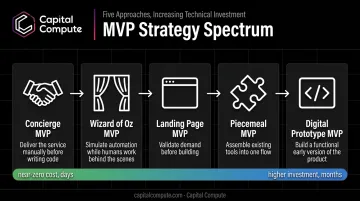
Concierge MVP
You manually deliver the service by hand while it looks automated to the customer. No backend, no algorithm: just you, doing the work behind a simple interface.
It stands out because development cost is close to zero, and feedback is direct and unfiltered. Airbnb's founders did exactly this early on: they personally visited hosts in New York, improved listings, and took the professional photos themselves, well before any of it was automated.
| Category | Detail |
|---|---|
| Best For | Service-based or marketplace ideas needing proof customers will pay before any code is written |
| Typical Cost & Timeline | Little to no development cost; days to set up |
| Key Risk | Doesn't test technical feasibility — only demand |
Wizard of Oz MVP
This strategy shows a seemingly automated front-end while a human handles the work manually behind the curtain. Users never know the "system" is a person.
This approach works well because it tests the full user experience and pricing tolerance without building complex backend logic. Zappos' founder tested this by photographing shoes at a local store and buying them himself only after a customer placed a real order online, proving people would buy shoes without seeing them in person first.
| Category | Detail |
|---|---|
| Best For | Products where the front-end experience needs to feel complete, even without automation built yet |
| Typical Cost & Timeline | Low cost; 1-2 weeks to build a believable front-end |
| Key Risk | Can't scale past a handful of users without breaking the illusion |
Landing Page / Smoke Test MVP
A simple page describing your value proposition, built to measure sign-ups or pre-order interest before you build anything.
Nothing beats it for gauging demand cheaply and fast. Dropbox's founder posted a three-minute demo video of a product that didn't fully exist yet, and the beta waitlist jumped from 5,000 to 75,000 sign-ups overnight, according to a TechCrunch report on Dropbox's early growth. One caveat worth remembering: sign-ups prove interest, not payment. Pair a smoke test with a paid pilot or pre-order if you want real validation.
| Category | Detail |
|---|---|
| Best For | Early-stage idea validation before any product commitment |
| Typical Cost & Timeline | Low-cost, no-code option; days to launch |
| Key Risk | Sign-ups alone don't prove paying demand |
Single-Feature (Piecemeal) MVP
You stitch together existing tools, APIs, or no-code platforms to deliver one core workflow, skipping custom backend development entirely.
This route gets a semi-functional product in front of real users faster than custom development allows. The trade-off: vendor lock-in and technical debt pile up fast if the core logic isn't kept portable from day one.
| Category | Detail |
|---|---|
| Best For | Testing one specific workflow with real users before investing in custom code |
| Typical Cost & Timeline | Low-to-moderate cost; 2-4 weeks |
| Key Risk | Hard to scale without rebuilding core logic in custom code later |
Digital Prototype (Full Lean-Build) MVP
This is a real, functional product with custom code, covering the single most important user journey end-to-end. Not a demo. Not a mockup.
It's the only strategy here that produces a scalable technical foundation and something investors will take seriously. Most funded startups move here once demand has been validated through one of the earlier methods, often starting with a fixed-price discovery sprint (the model firms like Capital Compute use) to lock down scope before writing any code.
| Category | Detail |
|---|---|
| Best For | Startups that have already validated demand and need a scalable product for real, paying users |
| Typical Cost & Timeline | Agency benchmarks put custom builds at roughly A$25,000-A$500,000+, spanning 10-20 weeks after a 2-4 week discovery phase |
| Key Risk | Higher upfront investment if the core problem hasn't been validated first |
The MVP Development Process for Startups
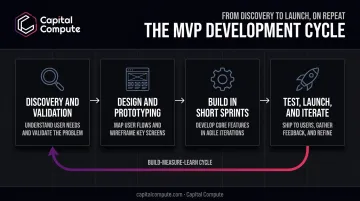
Whichever strategy you pick, process is what turns activity into actual learning. A disciplined four-stage sequence (discovery, design, build, test) matters more than which framework sits underneath it.
Discovery and Validation
This phase defines your target user, their core pain point, and the single workflow you're solving for. Nothing else. It should end with a written list of features explicitly left out of v1. If that list doesn't exist, scope creep starts before development even begins.
Design and Prototyping
Low-fidelity wireframes and clickable prototypes test navigation and flow before a single line of code gets written. Catching a confusing user flow on a wireframe costs an afternoon. Catching it after launch costs weeks of rework and a frustrated first cohort.
Build in Short Sprints
Two-week sprints with visible demos stop founders from discovering problems only after months of silent development. If you haven't seen working software in two weeks, that's a red flag, not a sign the team is "deep in the code."
Test, Launch, and Iterate
Launch is where the Build-Measure-Learn loop starts, not where it ends. Define success metrics before going live: activation rate, week-2 retention, or paid conversion, depending on what you're testing. Without a number to hit, "how did launch go?" is just an opinion.
How to Choose the Right MVP Strategy and Avoid Costly Mistakes
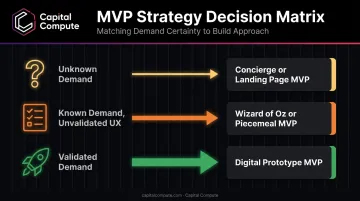
Match your strategy to what you already know about demand:
- Unknown demand → Concierge or Landing Page MVP
- Known demand, unvalidated UX → Wizard of Oz or Piecemeal MVP
- Validated demand → Digital Prototype MVP
Skipping straight to a Digital Prototype without validating demand first is the most expensive mistake founders make. Treating that first build as disposable is a close second: throwaway code accumulates technical debt that often forces a costly rebuild once the product needs to scale.
Large-company research from McKinsey found technical debt can consume 10-20% of technology budgets, with most CIOs surveyed spending more than a tenth of new-project budgets fixing it rather than building.
There's also the feature creep trap. Founders try to match a mature competitor's feature set in v1, which dilutes the core value proposition and slows validation. Y Combinator's advice here is blunt: ship with "extremely limited functionality," serve a small user group, and cut scope until you can launch in weeks, not months.
When evaluating a development partner to execute your chosen strategy, look for:
- Fixed-price, milestone-based delivery: scope agreed in writing before work starts, so costs can't creep silently
- Senior engineers from sprint one: architecture decisions made upfront by senior staff, not junior handoffs revised after the first scale event
- Transparent sprint reviews: fortnightly demos with client approval gates, not a black box until "launch day"
- No long-term lock-in after handover: month-to-month support once the build ships, not a multi-year contract you can't exit
This is the model Capital Compute uses with Australian founders who want scalable SaaS architecture without ongoing dependency post-launch: fixed-price milestones, senior engineers on every sprint, and no obligation to stay on retainer once the product ships.
This same diligence matters even more for regulated industries. For startups in fintech, legal, or healthtech, APP-compliant architecture needs scoping at discovery.
That means lawful basis for data processing, retention rules, and subject access request handling defined before a single feature is built, not bolted on after launch. Retrofitting compliance later is slower and considerably more expensive than designing for it from week one.
Conclusion
The right MVP strategy is the one that matches what you actually need to prove right now, at a cost your runway can absorb. Technical sophistication counts for nothing if it doesn't pass that test.
Before comparing strategies or partners, write down one problem, one user, and one workflow your MVP has to prove works. Everything else is a distraction until that's validated.
If you're an Australian founder ready to scope your MVP with a fixed-price, milestone-based build plan, Capital Compute's engineering team can walk through the right strategy for your stage. Get in touch to start the conversation.
Frequently Asked Questions
What is MVP development for startups?
MVP development means building the smallest usable version of a product to test a core business hypothesis with real users, before committing to a full build. It's a live experiment for validating assumptions before you invest in a full build.
How much does it cost to develop an MVP?
Costs vary by approach. A basic no-code MVP or landing page typically starts around A$18,000 over 2-4 weeks, while a custom-coded prototype can run A$25,000-A$500,000+ over 10-20 weeks, covering discovery, design, build, and QA.
What is an example of MVP development?
Dropbox validated demand with a three-minute demo video and a waitlist before the product existed, growing sign-ups from 5,000 to 75,000 overnight. Airbnb's founders manually hosted, photographed, and coordinated listings before building any automation.
How long does it take to build an MVP?
Timelines range from days for a smoke test or landing page to 8-16 weeks for a custom-coded digital prototype, depending on which strategy you choose and how complex the core workflow is.
What are the different types of MVP?
The five main types are Concierge, Wizard of Oz, Landing Page, Piecemeal, and Digital Prototype. They differ mainly in cost, speed, and how "real" the experience feels to the users testing it.
Should I build my MVP in-house or hire a development partner?
A partner brings cross-functional expertise and accountability that solo builds often lack. Look for fixed-price, milestone-based engagements with senior engineers involved from sprint one and no long-term lock-in after handover.