Key Takeaways
- Cloud consultants embedded in custom software and AI delivery prevent costly architecture mistakes before code is written
- Australian regulated sectors face specific the Privacy Act, ASIC, and SRA risks when cloud expertise is absent from early project sprints
- Gartner predicts 30% of generative AI projects will be abandoned after proof of concept, with infrastructure shortcomings cited as a primary driver
- Production AI systems need monitoring, fallback logic, and cost controls from day one, not post-launch
- The right cloud consultant hands over fully documented infrastructure your internal team can run independently
Australia's AI ecosystem now includes 1,533 AI companies, with adoption growing from 1% of businesses in 2021-22 to 12% in 2024-25. That growth is putting real pressure on the teams behind it.
Most businesses launching custom software or AI products reach the same point: a working prototype that nobody budgeted the infrastructure for properly. Architecture decisions get deferred, cloud costs climb, and compliance gaps surface at the worst possible moment: during a regulatory review or right before go-live.
Cloud consultants exist to prevent exactly that — but not all of them work the same way. Some focus purely on migration. Others embed directly in your delivery team from sprint one, making the infrastructure decisions that determine whether your product ships on time and holds up in production.
This guide covers what cloud consultants actually do in custom software and AI contexts, when Australian businesses genuinely need one, what services to expect, and the red flags worth watching for when choosing a partner.
What Cloud Consultants Do for Custom Software and AI Projects
A cloud consultant is a specialist (or specialist team) who advises on, designs, and often implements the cloud infrastructure powering your custom-built software or AI system. The role goes well beyond "which cloud provider should we use."
Cloud consultants who focus on infrastructure migration are a different breed from those embedded in custom software and AI delivery. The latter are involved from requirements gathering through to production deployment — not parachuted in to configure servers, but shaping how the entire system is architected.
Core Responsibilities
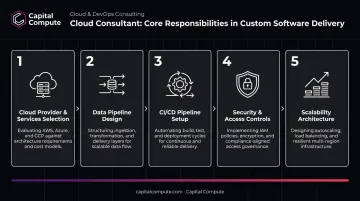
For custom software projects, a cloud consultant typically handles:
- Selecting cloud provider(s) and specific services — compute, storage, databases, managed AI platforms
- Designing data pipelines and defining how data moves between system components
- Setting up CI/CD pipelines so deployments are automated and repeatable
- Defining security controls, identity and access management, and network configuration
- Ensuring the architecture scales with the product as usage grows
The AI Infrastructure Difference
AI workloads introduce requirements standard software projects don't face. These include:
- GPU compute management for model training and inference
- Model environment configuration — whether using managed services like AWS Bedrock or deploying hosted models
- Vector database selection for RAG architectures (tools like pgvector or Pinecone)
- Data pipeline compliance — keeping data flowing into AI models within the Privacy Act and confidentiality boundaries
Each of these choices compounds. Architecture decisions made in the first sprint set the cost, performance, and maintainability ceiling for everything built afterward. Getting a cloud consultant involved at that stage — not after the first scale event — is the practical difference between a product that works at volume and one that needs expensive redesign.
When Australian Businesses Need a Cloud Consultant
Several common situations signal that cloud expertise should be part of your team — not an afterthought.
Typical trigger points:
- Launching a new SaaS product and need scalable infrastructure designed before development starts
- Adding AI functionality to an existing platform and unsure how to handle compute, cost, and data flows
- Modernising a legacy system to cloud-native architecture without disrupting live operations
- Hitting a scale event that's exposed earlier infrastructure shortcomings
Regulated Sectors: The Specific Risk
For Australian businesses in legal, finance, and healthcare, the stakes are higher. ASIC and AAPRA, under Prudential Standard CPS 230, require firms overseeing outsourcing and operational risk to retain full accountability. All organisations accessing patient data within Australia's public health system must comply with relevant privacy obligations. Solicitors face mandatory client confidentiality obligations under professional conduct rules. Nearly three-quarters of Australia's top 100 law firms have experienced cyber attacks — a figure that puts infrastructure decisions in sharp relief.
Without cloud expertise scoped early, Privacy Act compliance, data residency, and audit trail requirements frequently become expensive retrofits. Capital Compute scopes APP-compliant data architecture at discovery by default across all regulated sector engagements, not as a late-stage review.
When You Don't Need a Cloud Consultant
If your project involves adopting off-the-shelf SaaS tools with no custom build, a cloud consultant adds little value. Cloud consulting matters when you're building something bespoke — software with custom logic, data pipelines, or AI functionality that requires deliberate infrastructure decisions.
Key Services Cloud Consultants Provide for Custom Builds
Cloud Architecture Design
This covers far more than picking a cloud provider. Cloud architecture design means selecting the right services for your specific workload and deciding how the system is deployed — before application code is written. Key decisions include:
- Serverless, containerised, or VM-based compute
- Single vs. multi-region deployment
- Fault tolerance and failover configuration
The choices made here directly affect cost, performance, and how easily the system scales. Reversing them later is expensive.
Infrastructure as Code and DevOps Setup
Infrastructure as Code (IaC) tools like Terraform and AWS CloudFormation automate resource management and accelerate cloud provisioning. In practice, this means your infrastructure is codified, version-controlled, and reproducible across environments.
For clients, the real value is in handover: codified infrastructure transfers to an internal team with full documentation, so they can manage it without depending on the original development team.
Security, Compliance, and the Privacy Act Architecture
For Australian businesses, this means:
- Data encryption at rest and in transit
- Role-based access controls defined at the architecture stage
- Audit logging for regulatory traceability
- Data residency configurations aligned with the Privacy Act transfer requirements
The Federal Court ordered Australian Clinical Labs to pay A$5.8 million in civil penalties following the Medlab data breach. Security architecture retrofitted after a breach is always more expensive than security designed in from the start.
Capital Compute builds APP-compliant data architecture at discovery across all Australian regulated sector engagements — including access controls, lawful basis mapping, and consent management — before any development begins.
Cost Management
84% of organisations struggle to manage cloud spend, with budgets exceeding limits by an average of 17%. AI and data-heavy workloads are especially prone to overruns without deliberate design. Right-sizing compute, planning reserved capacity, and configuring spend alerting are architecture decisions — not something to address after the first monthly bill arrives.
API and Integration Design
Custom software almost always connects to third-party systems or internal tools. Cloud consultants design documented, versioned APIs so your internal team can maintain and extend integrations after handover — without depending on the original development team to keep them running.
What Sets Cloud Consultants Apart for AI Projects
AI workloads are fundamentally different from standard software infrastructure, and the gap matters more than most project teams expect.
Infrastructure Decisions Specific to AI
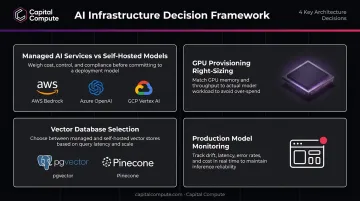
The key choices cloud consultants navigate for AI projects:
- Choosing between managed AI services and self-hosted models: AWS Bedrock, Azure OpenAI, and Google Vertex AI each carry different cost profiles, latency characteristics, and data handling implications
- Right-sizing GPU provisioning: training runs are compute-intensive, and over-provisioning here generates unnecessary spend fast
- Selecting a vector database for RAG architectures: pgvector, Pinecone, and similar tools have different performance and compliance profiles depending on your workload
- Production monitoring that tracks model performance and inference quality after deployment, not just infrastructure uptime
Data Compliance for AI in Regulated Sectors
Australian businesses in legal, finance, and marketing face a specific challenge: data sent to third-party AI APIs like OpenAI may contain personal or confidential information. Without defined data boundaries and anonymisation processes, this creates direct the Privacy Act and confidentiality exposure.
A cloud consultant defines these boundaries before AI agents are deployed — not retrospectively. Capital Compute has shipped production AI agents in legal, finance, and marketing sectors with this compliance layer built into the architecture from the outset.
Proof of Concept vs. Production
Gartner predicts 30% of generative AI projects will be abandoned after proof of concept by the end of 2025. Infrastructure unreadiness is a core reason — and it's avoidable.
A production-grade AI system requires:
- Monitoring for model performance and data quality
- Fallback logic when models return errors or unexpected outputs
- Rate limiting to prevent runaway API costs
- Audit logging for compliance and debugging
- Cost controls on inference API calls
None of these belong on a post-launch backlog. A cloud consultant scopes them in sprint one, before a single model call reaches production.
How to Choose the Right Cloud Consultant
Evaluation Criteria
When assessing potential partners, ask about:
- Production deployments — evidence of live custom software or AI systems, not just migration projects
- Senior involvement — who makes the infrastructure decisions, and at what stage? Senior sign-off at escalation points is not the same as senior involvement from sprint one
- Team structure — is delivery handled by an internal team or subcontracted? Subcontracting introduces accountability gaps and knowledge loss that compound across a project
- Pricing model — fixed-price scoped phases provide cost certainty; open-ended time-and-materials with no milestone controls is higher risk
One further question worth adding to that list: what happens at project close? The answer separates consultancies that hand over a working system from those that retain ongoing leverage over it.
The Lock-In Question
Ask any cloud consultant directly what project close looks like. The right answer involves fully documented infrastructure, versioned APIs, and a codebase your internal team can maintain without ongoing dependence on the consultancy. A vague answer here — "we can discuss that closer to the time" — typically means the handover process hasn't been designed in. Capital Compute structures this from discovery: documented APIs, versioned infrastructure, and an internal team that stays consistent across every sprint so there's no knowledge transfer overhead at close.
Red Flags When Hiring a Cloud Consultant
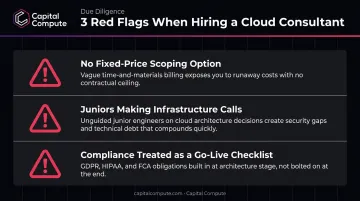
Not every consultant who can discuss cloud architecture can actually deliver it. Three warning signs are worth scrutinising before you sign anything:
- No fixed-price scoping option. If a consultant cannot scope architecture and delivery milestones clearly enough to offer a fixed-price phase, either their discovery process is thin or they lack experience with your type of project. Both are problems.
- Juniors making infrastructure calls. Ask directly who makes architecture decisions and when senior engineers get involved. A common model puts seniors on review-only duty — which means critical decisions get made by less experienced hands and revised after scale events, not before.
- Compliance treated as a go-live checklist. Any consultant working with personal data who doesn't raise data residency, access controls, and the Privacy Act architecture in the first sprint is creating enforcement exposure for you. Retrofitting compliance onto production systems is expensive — and rarely complete.
The cleanest signal that a consultant is operating at the right level: they raise these questions before you do.
Frequently Asked Questions
What do cloud consultants do?
Cloud consultants design, implement, and optimise the cloud infrastructure that powers software applications and AI systems. This covers architecture decisions, security, scalability, and system integrations — with the strongest consultants embedded in the delivery team from sprint one, not brought in only after development has started.
Who are the big 3 cloud providers?
The big three are Amazon Web Services (AWS), Microsoft Azure, and Google Cloud Platform (GCP), holding approximately 28%, 21%, and 14% of the cloud market respectively. The right choice for a custom software or AI project depends on your workload type, existing tooling, and regulatory requirements — not provider popularity alone.
Do I need a cloud consultant for an AI project?
AI projects consistently benefit from cloud consultancy. AI workloads require specific infrastructure decisions around compute, data pipelines, model deployment, and compliance that differ significantly from standard software builds. Without this expertise, cost overruns, performance problems, and compliance gaps are common outcomes.
What is the difference between a cloud consultant and a software development partner?
Cloud consultants focus on the infrastructure layer — where and how software runs. Software development partners build the application itself. The strongest custom software and AI engagements combine both under one team, so architecture and code are designed together from the start rather than integrated as separate workstreams.
How much does it cost to hire a cloud consultant for a custom software project?
Costs vary based on project complexity, team seniority, and engagement model. Look for consultants who offer fixed-price scoping phases, which provide cost certainty before full delivery — and be cautious of open-ended time-and-materials arrangements with no milestone-based controls.
How do I ensure my cloud setup is APP-compliant for an Australian AI project?
Privacy Act compliance for Australian AI projects requires data residency decisions, role-based access controls, anonymisation of personal data before it reaches AI models, and audit logging — all scoped at the architecture stage in the first sprint, not reviewed after the system is live.