Introduction
Most Australian startups that commission a mobile app spend A$40,000-A$120,000 before they see a production release. Whether that investment becomes a durable business asset or an expensive rebuild depends almost entirely on decisions made before a single line of code is written.
Custom mobile development means building an application from the ground up — shaped around your specific workflows, users, and technical environment — so you own the code, the architecture, and the business logic outright.
For Australian startups and SMBs, the wrong approach at this stage creates vendor dependency or generates APP exposure that only surfaces during a regulatory review — not during development, when it's cheap to fix.
This guide explains how the custom mobile development process works, what decisions actually drive cost and timeline, when it makes sense for smaller businesses — and when it does not.
Key Takeaways
- Custom development means owning your code, your architecture, and your roadmap outright
- Australian businesses gain full IP ownership, day-one scalability, and Privacy Act compliance baked into the architecture
- The build process covers discovery, design, development, testing, and maintenance — each stage carries distinct cost and timeline considerations
- Platform choice and feature scope are the two biggest cost drivers
- Validating your concept before committing to a full build is the smarter first step
What Is Custom Mobile App Development?
Custom mobile app development is the process of building a mobile application from the ground up, shaped entirely around a specific business's workflows, user base, and technical environment.
This is not configuring a pre-built platform or adding features to a template. It means the data model, user journeys, API connections, and security architecture are all designed for your use case — not adapted from a generic version built for someone else's business.
The outcome is a mobile product that:
- Integrates with your existing systems rather than duplicating them
- Reflects how your business actually operates
- Can evolve as your requirements change, without hitting a platform ceiling
No-code platforms and SaaS mobile builders work well for early validation, but they carry trade-offs that compound over time:
- You do not own the underlying code
- Feature development depends on the platform's roadmap and pricing decisions
- Meaningful customisation hits a hard ceiling quickly
Custom development removes those constraints. The architecture belongs to the business, and there is no ongoing platform dependency to manage.
Why Australian Startups and SMBs Choose Custom Development
Off-the-shelf tools are built for the common case. That works when your requirements match the common case. When they do not, the compromises accumulate quickly.
The Ceiling Problem
Generic app platforms accommodate standard workflows but struggle with unique business logic. They restrict third-party integrations to approved connectors, limit how data is structured and stored, and bind you to a vendor's commercial decisions — price increases, feature deprecations, or platform shutdowns.
For a business in an early growth phase, this matters more than it might appear. The integration you need in 18 months may not exist on the platform you chose today. The compliance review you undergo next year may surface gaps in a third-party platform's data handling that you had no visibility into.
What Australian Businesses Specifically Need
For Australian startups and SMBs — particularly those in regulated sectors — off-the-shelf solutions often fall short on:
- Full IP ownership — the code should be a business asset, not a licensed dependency
- Scalable architecture — infrastructure sized for current needs but designed to grow
- Integration flexibility — connecting to legacy systems, sector-specific platforms, or bespoke APIs
- Privacy Act compliance from the start — data architecture that meets Privacy Act requirements by design, not as a post-launch review
The OAIC's guidance is explicit: privacy by design is expected under the Privacy Act 1988 and the Australian Privacy Principles. That means compliance must be built into the architecture at the design stage — not retrofitted before go-live. Template platforms often cannot support that level of structural control.
Where Off-the-Shelf Typically Breaks Down
Businesses tend to hit the customisation ceiling at precisely the moment growth demands more from the product. They discover the platform they depend on cannot integrate with a key operational system, or that its data handling practices do not hold up to a compliance audit.
In regulated sectors, those gaps carry direct consequences:
- Legal — matter management workflows that cannot map to SRA requirements
- Finance — audit trail gaps that fail ASIC review
- Healthcare — data residency and access controls that conflict with Australia's public health system DSPT obligations
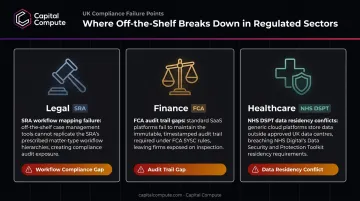
For Australian SMBs in these sectors, custom development is not a luxury reserved for enterprise budgets. It is the practical route to a product that can scale, integrate, and hold up to regulatory scrutiny — without rebuilding from scratch when growth demands it.
How the Custom Mobile Development Process Works
A well-scoped custom mobile project typically runs 3–6 months from discovery to deployment, with complexity and feature scope as the primary variables. Clutch's estimate puts a typical mobile project at 20–40 weeks — treat 3–6 months as a planning assumption for a tightly scoped MVP, not a guaranteed ceiling.
The process runs through distinct phases, each building on the last.
Step 1: Discovery and Scoping
This is where requirements are defined, user needs are validated, features are prioritised, and technical feasibility is assessed. Platform choice is made here — and it has cost implications that follow the project through to launch.
Key decisions in this phase:
- Native iOS (Swift) or Android (Kotlin) for maximum performance and full device-feature access, at higher cost
- Cross-platform via Flutter or React Native to share a single codebase across both platforms — the more cost-effective choice for most startup use cases
- Privacy Act compliance architecture — data flows, consent model, data minimisation, and lawful basis mapped before any code is written
- Feature prioritisation against the MVP scope
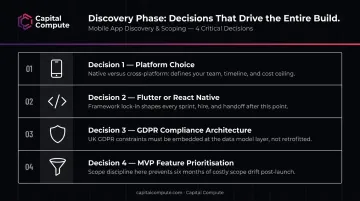
A structured scoping phase gives non-technical founders cost certainty before committing to a full build. Capital Compute's fixed-price discovery model, for example, delivers a firm estimate within two business days and includes milestone-based approval gates — so founders know exactly what they are committing to before development begins, rather than discovering scope ambiguity later.
Step 2: Design, Architecture, and Build
UI/UX design produces user journeys and screen flows. Backend architecture decisions made here — data model, API structure, infrastructure — are expensive to undo. Senior engineering involvement from sprint one matters precisely because the people designing the architecture should be the ones building against it.
Development runs in short sprints, typically two or four weeks, with features built, reviewed, and tested in cycles. A few structural points worth noting:
- Sprint reviews happen fortnightly, in Australian business hours, at every stage
- Architecture decisions are locked by senior engineers in sprint one, not revisited after a scale event
- Client approval gates at each sprint catch misalignment early, not at deployment
- No handoffs to subcontractors at any point — the same engineers who scope the build deliver it
Step 3: Testing, Deployment, and Ongoing Maintenance
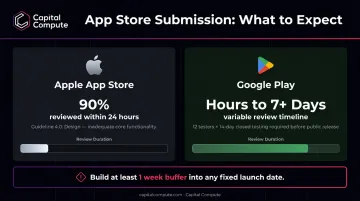
QA testing covers functional, performance, and security testing before submission to the Apple App Store and Google Play. Three store submission realities that affect your launch date:
- Apple reviews 90% of submissions within 24 hours, but rejections most commonly relate to completeness issues — submit a final, fully tested build with working credentials and complete metadata
- Google Play reviews can take a few hours to seven days or longer — build at least a week's buffer into any fixed launch date
- New personal Google Play developer accounts must complete a closed test with at least 12 opted-in testers for 14 continuous days before applying for production access — check account type during discovery, not at release
Post-launch, maintenance covers OS compatibility updates, security patches, bug fixes, and incremental feature additions. Budget for this from the outset. Annual maintenance is a real, recurring cost that many founders only discover after launch — plan for it as part of the total investment, not as an optional extra.
Key Factors That Affect Custom Mobile Development
Platform Choice
| Approach | Best For | Trade-Off |
|---|---|---|
| Native (Swift/Kotlin) | Platform-specific features, maximum performance, hardware integration | Separate codebases, higher cost |
| Flutter | Consistent custom UI across iOS and Android | Platform-specific features may still require native code |
| React Native | Teams with JavaScript/React skills, native UI components | Native modules may be needed for complex integrations |
Statista's 2023 survey of 29,269 cross-platform developers shows Flutter at 46% adoption and React Native at 35% — both are mainstream, well-supported choices. Platform fit depends on your feature set, performance requirements, and available engineering skills — not adoption numbers alone.
Cross-platform development does reduce cost relative to maintaining two separate native codebases, but verify the saving against your actual backlog rather than applying a universal percentage.
Feature Scope and MVP Discipline
More features mean longer timelines and higher cost. The most common mistake is building everything upfront. Scope to the minimum viable feature set, launch, gather real user feedback, and iterate.
The Privacy Act and Compliance Requirements
For Australian businesses in regulated sectors, data architecture must account for the Privacy Act from the earliest design decision. The OAIC requires that:
- Lawful basis is identified before data collection begins
- Consent is obtained where required
- Third-party technologies are examined — not assumed to be compliant
Capital Compute scopes Privacy Act compliance in week one of every engagement, including data-flow analysis, consent architecture, and data minimisation planning. This is a structural decision, not a pre-launch checklist.
Team Model and Consistency
Outsourcing to a specialist partner reduces overhead and accelerates delivery — but team consistency matters. Verify that:
- The same engineers who scope and build the initial product remain on the engagement
- No subcontracting takes place — handoffs between teams introduce knowledge gaps and quality risk
- Sprint reviews happen in Australian business hours, not around a misaligned time zone
Capital Compute's no-subcontracting policy is a core operating commitment: internal engineers only, no exceptions, with the same team carrying context from discovery through post-launch support.
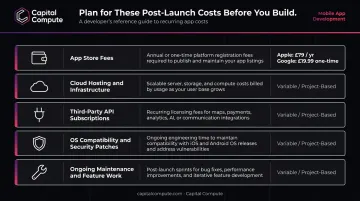
Post-Launch Cost Planning
Founders who plan only for the build cost are regularly surprised by the ongoing investment required to keep a live product secure and current. Budget from the outset for:
- App store fees (Apple Developer Programme and Google Play one-time and annual charges apply)
- Cloud hosting and infrastructure
- Third-party API subscriptions
- OS compatibility updates and security patches
- Ongoing maintenance and incremental feature work
Common Misconceptions About Custom Mobile Development
Three beliefs about custom mobile development stop Australian startups and SMBs from pursuing it. Most are wrong, or at least more nuanced than they appear.
"It Always Takes a Year or More"
A tightly scoped MVP can be delivered in 3–4 months when requirements are clearly defined before development begins. Timeline overruns come from scope creep, unclear requirements, or misaligned expectations — not from the development process itself.
"It's Only for Enterprise Budgets"
Australian startups routinely commission custom mobile products at startup-appropriate investment levels. Phased development (MVP first, then iteration) makes the approach accessible without demanding a full-scale build from day one. The key is scoping the first phase tightly.
"A Delivered App Is a Successful Product"
A technically well-built app still fails without user validation before and after launch. The development process produces working software. Market fit comes from post-launch iteration based on real user data. The two are not the same thing.
When Custom Mobile Development May Not Be the Right Choice
Custom development is not always the right answer. In some situations, it adds cost and complexity without proportionate return.
Off-the-shelf or no-code tools are more appropriate when:
- You are validating an early-stage idea before product-market fit is established
- The use case is fully covered by an existing SaaS platform
- You need simple internal tooling with standard, well-understood workflows
Custom development is higher risk when:
- The user need is not yet clearly defined
- Business logic is still evolving or undocumented
- Budget does not cover proper discovery and QA — building without these steps produces software that typically requires expensive rework
Beyond these categories, there is one specific pattern that warrants a harder look. If the only stated reason for custom development is wanting full control, that is a signal to pause. Custom work is justified by a genuine, defined gap between what off-the-shelf tools can do and what the business actually requires. Control matters, but only once you have identified what, specifically, you need control over — and why no existing tool provides it.
Conclusion
Custom mobile development is a structured, phased process that produces a mobile product aligned with your business's specific logic, users, and compliance requirements. The value comes from the decisions made at scoping — platform choice, feature prioritisation, compliance architecture, team model — not from the act of building itself.
For Australian startups and SMBs, the scoping decisions you make before a single line of code is written determine whether the investment holds its value at 18 months or needs replacing. Four things matter most:
- Scope tightly — define what the MVP must do, not what it could do
- Choose the right platform for your users and your runway
- Build Privacy Act compliance into the architecture from discovery, not as a retrofit
- Budget for maintenance before the project starts, not after launch
Get those right, and the build follows.
Frequently Asked Questions
How much does custom mobile development cost?
Cost varies based on platform choice (native vs. cross-platform), feature complexity, team model, and location. Australian businesses should also factor in Privacy Act compliance scoping and ongoing maintenance from the outset. The most reliable approach is requesting a work-breakdown estimate with assumptions and defined scope, rather than relying on market averages.
Can a custom mobile app make money?
Yes. Common monetisation models include subscription, in-app purchases, freemium, and advertising. A custom-built app gives full control over how monetisation is implemented within the user journey, without the revenue cuts or model restrictions that platform-dependent solutions impose.
What is the difference between native and cross-platform mobile development?
Native development (Swift for iOS, Kotlin for Android) builds separate apps for each platform with full device-feature access and optimal performance. Cross-platform frameworks like Flutter or React Native share a single codebase across both platforms. For startups without deep platform-specific requirements, cross-platform is usually the more cost-effective starting point.
How long does it take to build a custom mobile app for a startup?
An MVP-scoped project typically runs 3–6 months across discovery, design, development, and testing. Complex applications can take 9–12 months or more. The most important variable is how clearly requirements are defined before development begins, not how fast the development team moves.
Do I need a custom app or will an off-the-shelf solution work?
Off-the-shelf tools are appropriate for standard use cases, early-stage validation, and simple internal workflows. Custom development is the right choice when your business has unique processes, integration requirements, or compliance needs that existing platforms cannot accommodate without significant compromise.
What should I look for when outsourcing custom mobile app development in Australia?
Look for partners who can demonstrate a stable team with verifiable delivery history, rather than subcontracting work to third parties. Milestone-based contracts with client review points protect you commercially, and Privacy Act compliance should be scoped at discovery — not bolted on before launch.