The problem is building the team to deliver one. Hiring senior iOS, Android, or cross-platform engineers in Australia is slow, expensive, and often unsuccessful — which is why so many Australian businesses are looking offshore instead.
This guide covers what offshore mobile app development actually involves, how the process works, realistic 2026 costs by region and complexity, the risks worth knowing about, and how to pick a partner that reduces business risk rather than adding to it.
Key Takeaways
- Offshore teams give Australian businesses specialised iOS, Android, and cross-platform engineers at a fraction of local hiring costs
- Rates and total costs vary sharply by region, app complexity, and how the engagement is billed
- The right partner structure prevents communication gaps, inconsistent quality, and IP exposure risks
- Privacy-First architecture and milestone-based delivery are now the main things separating trustworthy partners from risky ones
- A good offshore partner operates as a transparent extension of your team
What is Offshore Mobile App Development?
Offshore mobile app development means hiring a mobile engineering team based in another country to design, build, test, or maintain a mobile application remotely. It's a specific subset of IT outsourcing, focused entirely on iOS, Android, and cross-platform work using frameworks like Flutter, React Native, Kotlin, and Swift, rather than general software or web development.
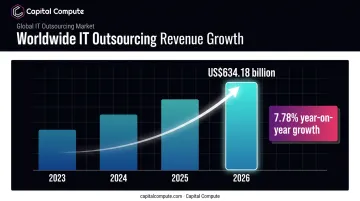
This isn't a niche activity anymore. Worldwide IT-outsourcing revenue is projected to hit US$634.18 billion in 2026, growing 7.78% year-on-year, according to Statista's IT outsourcing market forecast. Mobile-specific offshore work sits inside that broader trend, and it's growing for the same reason: companies need technical execution faster than they can build it themselves.
Onshore vs Nearshore vs Offshore: What's the Difference?
Not all outsourcing is offshore. The three models differ mainly in geography, cost, and how easily your team can talk to theirs during the working day.
| Model | Location | Relative Cost | Time Zone Overlap | Communication Ease | Best Fit |
|---|---|---|---|---|---|
| Onshore | Same country | Highest | Full | Easiest | Highly regulated projects needing constant face-to-face input |
| Nearshore | Neighbouring region | Medium | Partial | Good | Teams wanting some cost savings without losing daily overlap |
| Offshore | Distant region | Lowest | Minimal to none | Requires structure | Niche skills, fast scaling, or a fixed budget ceiling |
Plenty of Australian businesses now blend these models — an offshore-priced engineering team that still delivers reviews and updates during Australian business hours. It's the practical middle ground: the cost advantage of offshore, without losing the responsiveness of nearshore.
Choose offshore when:
- The mobile skills you need (Kotlin Multiplatform, SwiftUI, AI-integrated features) are scarce or overpriced locally
- You need to scale a team quickly without a lengthy recruitment cycle
- You're working to a defined budget and need cost predictability
Key Benefits of Offshore Mobile App Development
Offshore development offers more than lower costs. It unlocks faster delivery, specialised skills, and flexible scaling for a growing product team.
Key benefits include:
- Cost efficiency: Engineering talent in South Asia, Eastern Europe, and Latin America costs meaningfully less than equivalent Australian hires. Deloitte's 2024 global outsourcing survey found cost reduction remains a primary driver for 34% of outsourcing decisions, though it has declined as the sole motivator since 2020.
- Access to specialised talent: Niche mobile skills such as Kotlin Multiplatform, SwiftUI, and AI-integrated features are often expensive or unavailable in the Australian market. Offshore hiring widens that pool considerably.
- Faster time-to-market: A dedicated offshore team working in focused sprints skips the months of onboarding that come with in-house hiring.
- Scalability without commitment: Scale the mobile team up during a big push, then back down post-launch, without the overhead of permanent headcount.
How Does an Offshore Mobile App Development Company Work?
Reliable offshore partners follow a structured lifecycle, and that structure — not the team's location — is what separates dependable delivery from a risky handoff.
Discovery & scoping: requirements gathering, architecture decisions, and a fixed-price scope agreed before a single line of code is written. Capital Compute, for example, runs a 30-minute scoping call led by senior engineers and returns a technical roadmap and fixed-price timeline within two business days.
Design & prototyping: wireframes and clickable prototypes reviewed and signed off by the client before development starts.
Agile development in sprints: typically one-to-two-week cycles with regular demos, using Scrum practices and CI/CD pipelines to keep releases predictable.
QA & testing: functional, security, performance, and device-compatibility testing, with automated test suites where possible, before anything goes live.
Launch & post-launch support: App Store and Google Play submission handling, followed by ongoing maintenance, bug fixes, and updates.
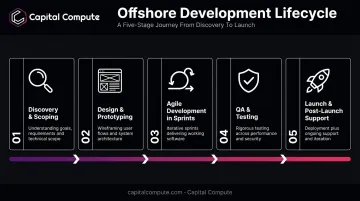
The strongest version of this model includes fortnightly review gates with client sign-off at each milestone, so you're never waiting weeks to discover a sprint went off track.
How Much Does Offshore Mobile App Development Cost in 2026?
Cost hinges on four things: app complexity, the region your team is based in, whether you're billed fixed-price or by the hour, and what ongoing maintenance looks like after launch.
Regional Hourly Rates
Based on GoodFirms' 2026 study of 267 mobile app development firms, here's how iOS and Android rates compare by region:
| Region | iOS/Swift (Junior–Senior) | Android/Kotlin (Junior–Senior) |
|---|---|---|
| South Asia (India) | Significantly lower than AU rates | Significantly lower than AU rates |
| Eastern Europe (Poland) | Lower than AU rates | Limited published data |
| Latin America (Brazil) | Lower than AU rates | Lower than AU rates |
| Australia | Higher cost region | Higher cost region |
The gap between South Asia and Australia is substantial: often three to four times the hourly rate for equivalent seniority.
Cost by App Complexity
- Simple MVP (login, basic navigation, push notifications): starts around A$18,000
- Mid-complexity app (custom UX, payments, third-party APIs, analytics): higher cost, scaling toward complex multi-platform builds
- Enterprise-grade app (custom architecture, compliance, AI features, multi-platform): A$500,000+
Fixed-price vs. time-and-materials: open-ended hourly billing is where most budget overruns happen. Fixed-price, milestone-based models (where each sprint is scoped in writing and invoiced only on delivery) are increasingly what Australian businesses ask for by name. It's why roughly half of Capital Compute's engagements now run on outcome-based billing rather than time-and-materials.
Maintenance and Hidden Costs
Budget 15%–25% of your original build cost annually for post-launch maintenance: bug fixes, security patches, and platform updates.
Watch for these common budget-overrun risks:
- Scope creep with no locked scope document
- Vague or missing IP ownership clauses
- No milestone gates to catch problems early
Risks and Challenges of Offshore Mobile App Development
None of these risks are unique to offshoring — they're management problems that show up more visibly when your team is remote.
Communication and time zone gaps. Limited overlapping hours delay decisions. Aim for at least 2-3 hours of daily overlap, even if it means one side starts early or finishes late.
Inconsistent quality and accountability. Subcontracted or rotating developers create knowledge gaps mid-project. Always ask whether the engineers who start the build are the ones who finish it.
Data security, IP, and compliance gaps. This is where Australian businesses run into the most trouble. Deloitte's outsourcing research found 46% of organisations bringing outsourced work back in-house cited risk and security concerns, and 38% cited regulatory or compliance issues.
For Australian and EU-facing apps, this means:
- Signed NDAs before any scoping conversation
- Clear IP ownership clauses in the contract, not implied
- Privacy Act-aligned data handling designed into the architecture from day one, not bolted on before launch
Capital Compute scopes APP-compliant architecture into every engagement at discovery, not as a fix applied before go-live — closing this gap before it becomes a liability.
How to Choose the Right Offshore Mobile App Development Partner
Picking a partner is about picking a structure. Here's what to check before signing anything.
- Verify technical fit. Ask for proof in the exact stack you need (Swift, Kotlin, Flutter, or React Native), and review live apps, not case study slides.
- Check the delivery structure. Favour fixed-price scoping with milestone approval gates over open-ended retainers, and treat vague sprint-failure answers as a red flag.
- Confirm data compliance readiness. For Australian and regulated-sector businesses, APP-compliant architecture should be scoped at discovery, not reviewed the week before launch.
- Ask about post-handover independence. A trustworthy partner leaves you with documented APIs and a codebase your team can maintain without ongoing dependency.
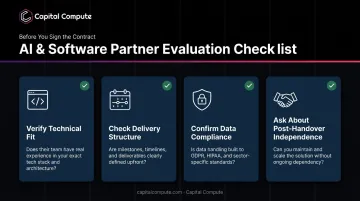
Capital Compute follows this model for Australian SaaS founders and regulated businesses. Its engineers work in-house with no subcontracting, deliver fixed-price sprints reviewed fortnightly, and agree Privacy-First architecture at discovery.
Retainers run month-to-month with no lock-in. Senior engineers stay on the project from first sprint to handover, with no swap to junior staff once the contract's signed.
Frequently Asked Questions
What is offshore mobile development?
Offshore mobile development means hiring a remote team in another country to design, build, or maintain iOS, Android, or cross-platform apps. It differs from nearshore in distance and time zone overlap, and from outsourcing in its focus on mobile frameworks.
How much does offshore mobile development cost?
Costs vary by region, app complexity, and billing model — a simple MVP might run A$18,000–A$25,000, while enterprise builds can exceed A$500,000. See the cost breakdown section above for full 2026 figures.
How does an offshore mobile development company work?
Most reliable partners follow a discovery-design-development-QA-launch lifecycle, with fixed milestones and regular client check-ins built in at every stage rather than a single handoff at the end.
Is offshore mobile app development safe for the Privacy Act-regulated Australian businesses?
Yes, provided the partner scopes APP-compliant data architecture from the discovery phase, signs NDAs upfront, and uses internal engineers rather than subcontractors who introduce compliance blind spots.
How long does it take to build an app with an offshore team?
A simple MVP typically takes 3–6 months, mid-complexity apps 6–9 months, and enterprise-grade apps 12–18 months or more, depending on integrations and compliance requirements.
What's the difference between offshore, nearshore, and outsourcing mobile app development?
Outsourcing is the umbrella term for hiring any external team. Offshore and nearshore describe how far away that team is geographically and how much their working hours overlap with yours.