A Minimum Viable Product is the antidote. It's the smallest functional version of a product you can put in front of real users to find out whether the idea has legs, before you've spent your runway building the wrong thing.
This guide covers what an MVP actually is (and isn't), why building one protects your capital and your timeline, a step-by-step framework for building one properly, real examples from Amazon to Dropbox, and how an MVP differs from related terms like MMP and prototype that get thrown around interchangeably.
Key Takeaways
- An MVP is a fully functioning product that tests real user assumptions, built for actual users
- Testing your riskiest assumption early reduces financial risk and speeds up learning
- MVPs launch with a tightly scoped feature set, taking weeks to months to build
- Cutting scope, not cutting quality, is what separates a good MVP from a broken one
What Is a Minimum Viable Product (MVP)?
Eric Ries, who popularised the term through the lean startup movement, defines it precisely: an MVP is "that version of a new product which allows a team to collect the maximum amount of validated learning about customers with the least effort," according to Lean Startup Co.. Notice what's missing from that definition: there's no mention of "small" or "cheap." The point is learning, not minimalism for its own sake.
The term itself predates Ries. Product strategist Frank Robinson coined "minimum viable product" in 2001, describing it as the product that maximises return on risk for both the company building it and the customer using it. Steve Blank later folded the idea into his Customer Development methodology, and Ries carried it into mainstream product thinking through The Lean Startup.
The Three Core Elements of an MVP
Each word in "Minimum Viable Product" carries specific weight:
- Minimum: the smallest feature set that still solves the core problem. This is a deliberate scoping decision, not an excuse to ship something incomplete or cheap.
- Viable: the product has to actually work. A signup flow that crashes half the time isn't an MVP; it's a bug list with a landing page attached.
- Product: real, installable, usable software. Not a Figma file. Not a "coming soon" page with an email capture form. Something a customer can genuinely use to accomplish a task.
Skip any one of these three, and you don't have an MVP. You have something else entirely.
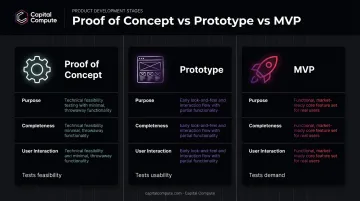
MVP vs. Prototype vs. Proof of Concept (PoC)
These three terms get used interchangeably far too often, and that confusion causes real project delays. Here's the distinction:
| Aspect | Proof of Concept | Prototype | MVP |
|---|---|---|---|
| Purpose | Tests technical feasibility | Tests design and usability | Tests market demand |
| Completeness | Internal experiment, not market-ready | Represents the design; no production functionality needed | Simple but genuinely functional |
| User interaction | Usually internal only | May involve user evaluation of an interface | Released to real, paying or early-adopter users |
A PoC answers "can we build this at all?" A prototype answers "does this design work for users?" An MVP answers "will people actually use this, and what do we learn from watching them?" If your team is calling a clickable Figma file an MVP, that's the source of most scoping arguments before development even starts.
Why Build an MVP? Key Benefits for Founders and Product Teams
The case for building an MVP comes down to three things: money, speed of learning, and credibility with investors.
It reduces financial risk. CB Insights analysed 431 VC-backed company failures and found that poor product-market fit accounted for 43% of them. That's the single biggest reason startups die, ahead of running out of capital, according to CB Insights' startup failure research.
An MVP exists specifically to test the riskiest assumption in your business: that people actually want this, before you commit months of engineering time to it.
It accelerates the build-measure-learn loop. Rather than spending a year building a fully-specced product based on guesses, an MVP gets you into a cycle:
- Build the smallest version that tests your core hypothesis
- Measure real usage against metrics you defined before launch
- Learn whether to persevere with the current direction or pivot
This loop comdollars. Each cycle gives you sharper data than the last, and you're making decisions based on behaviour, not assumptions.
It's more persuasive to investors than a pitch deck. Y Combinator has long emphasised traction, measured simply as usage, whether that's free sign-ups or paying customers. Real usage numbers from an MVP tell a story projections can't: people are already using this.
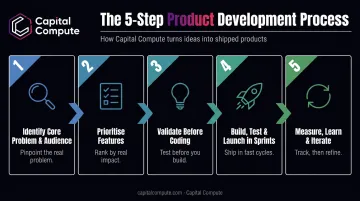
How to Build an MVP: A Step-by-Step Framework
Building an MVP well takes just as much rigour as building a full product. You're cutting scope, not cutting corners.
Step 1: Identify the Core Problem and Target Audience
Before writing a line of code, validate that the problem is painful enough to solve. Run customer interviews, study competitors, and dig through support tickets and forum complaints for recurring frustrations.
Uber's founders are a good illustration here. Garrett Camp's early research focused squarely on how genuinely broken San Francisco's taxi-hailing experience was: long waits, unreliable pickups, cash-only friction. That specific, well-understood pain point shaped everything that followed.
Step 2: Define and Ruthlessly Prioritise Core Features
Not every idea in the product backlog belongs in version one. A must-have/should-have/nice-to-have framework forces the tough calls:
- Must-have: the feature is the product; without it, the core hypothesis can't be tested
- Should-have: improves the experience but isn't essential to prove demand
- Nice-to-have: everything you're saving for the roadmap after launch
Successful MVPs tend to ship lean. If your feature list runs into double digits, you're probably building a version two disguised as a version one.
Step 3: Validate Before Writing Production Code
The cheapest validation happens before development even begins:
- Landing pages that describe the product and measure sign-up interest
- Concierge or Wizard-of-Oz tests where you manually deliver the service behind the scenes
- Clickable prototypes that simulate the experience without functioning code
Dropbox is the textbook case. Drew Houston released a simple explainer video showing how the product would work, with a waitlist sign-up attached. The beta waiting list jumped from 5,000 to 75,000 overnight, proof of demand before a single production feature existed.
Step 4: Build, Test, and Launch in Short Sprints
Work in short, focused sprints. The 2020 Scrum Guide allows cycles of one month or less, and most teams find one to four weeks keeps momentum without losing sight of the goal. Choose a tech stack your team already knows well over something trendy; an MVP is the wrong place to also be learning a new framework.
Test with a small group of real users before wider release. Nielsen Norman Group's research found that testing with just five representative users surfaces roughly 85% of usability problems in a given user group, according to NN/g's usability testing research. You don't need hundreds of testers to catch the issues that matter.
Step 5: Measure, Learn, and Iterate
Define your success metrics before launch, not after: activation rate, retention, task completion, whatever maps to your actual hypothesis. This is what lets you objectively judge whether the MVP validated the idea rather than retrofitting a good story onto whatever numbers came in. Feed what you learn straight into the next build cycle.
MVP Examples: Real Companies That Started Small
Some of the biggest tech companies today started as something far smaller and rougher than what they became.
- Amazon launched in July 1995 as a single-category online bookstore run from Jeff Bezos' home in Bellevue, Washington. New categories followed later, based entirely on customer demand.
- Uber began as UberCab in San Francisco in May 2010, taking requests via iPhone app or SMS. The founders raised capital to expand only after proving demand in that single city.
- Dropbox validated demand with nothing more than an explainer video and a waitlist, proving genuine interest before a broader product existed.
None of these launched polished. Each launched functional enough to let real users guide what came next.
MVP vs. MMP vs. MLP: Clearing Up the Confusion
Founders often use "MVP" when they actually mean something further down the product maturity curve. Here's how the three terms relate:
| Concept | What it tests | When it comes in |
|---|---|---|
| MVP (Minimum Viable Product) | Whether the core idea has real demand | First: the learning vehicle |
| MLP (Minimum Lovable Product) | Whether users emotionally connect with the experience, not just tolerate it | Alongside or after MVP validation |
| MMP (Minimum Marketable Product) | Whether the market will actually pay for it | After MVP learning is incorporated |
Product strategist Roman Pichler frames it as a sequence: one or more MVPs generate learning, and that learning shapes the MMP — the version complete enough for full market release.
MLP, popularised by Brian de Haaff, isn't a mandatory middle step so much as a different emphasis. It's about building delight into the product from day one rather than treating it as a later polish pass.
In short: MVP validates the idea, MLP builds emotional buy-in, and MMP is ready to sell.
In-House vs. Outsourced MVP Development: Choosing the Right Partner
Building in-house gives founders full control, but only works if you already have engineering capacity sitting available. Most early-stage founders don't. Outsourcing offers speed and specialist skills, but it carries real risk if the vendor scopes poorly: inconsistent teams, vague IP terms, or lock-in that leaves you dependent on the vendor long after launch.
If you're an Australian founder evaluating an outsourcing partner for an MVP build, look for:
- Fixed-price scoping with milestone approval gates: you should know the cost and see progress before the next phase starts, not get surprised at invoice time
- APP-compliant architecture built in from discovery: not reviewed as a checklist item right before go-live
- Continuity of the same engineers from initial build through to later scaling work, so institutional knowledge doesn't walk out the door
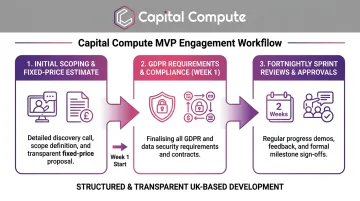
This is the model Capital Compute builds around for its Australian MVP engagements:
- A 30-minute scoping call, followed by a fixed-price technical estimate within two business days
- APP requirements (data-flow mapping, lawful basis, consent architecture) locked in during week one, before any code is written
- Fortnightly sprint reviews, with clients approving each milestone before the next sprint starts and before billing is triggered
The team is entirely internal, with no subcontracting, which means the engineers who scope your project are the ones who build it. If you're weighing up whether to hire in-house or bring in outside help, a discovery call is a reasonable way to pressure-test your assumptions about cost and timeline before committing either way.
Frequently Asked Questions
What is MVP in software development?
In software development, an MVP is a real, functioning piece of software built with only the features needed to test market demand. It's not a mockup, wireframe, or clickable prototype — users need to genuinely use it.
What is MVP with an example?
Amazon's 1995 launch as a single-category online bookstore is a classic example, as is Uber's early SMS-and-app-based UberCab service in San Francisco. Both stripped the offering down to test real demand before scaling into anything broader.
What's the difference between an MVP and MMP?
An MVP is built to validate an idea with early adopters and learn from their behaviour. An MMP (Minimum Marketable Product) is the next stage: polished enough that the broader market will actually pay for it.
What is the difference between an MVP and a prototype?
A prototype is typically non-functional and used to test design or usability with users. An MVP is real, working software that users can actually use to complete a genuine task.
How long does it take to build an MVP?
Timelines vary significantly by complexity. A simple MVP might take a few weeks, while one involving a database, user authentication, and several core features often takes closer to three to four months.
Can an MVP become the final product?
Yes, often. A well-architected MVP frequently becomes the foundation the full product is built on, expanded feature-by-feature based on real user feedback rather than being rebuilt from scratch.