Introduction
There's a recognisable moment in every growing Australian organisation's life: the headcount hits 80, then 120, and the HR tools that worked fine at 40 people start visibly straining.
Spreadsheets multiply. Someone's manually exporting CSVs to reconcile leave balances with payroll. Per-seat SaaS fees climb faster than headcount. Compliance obligations — the Privacy Act, the ATO RTI, sector-specific reporting — begin to outpace what any generic platform was built to handle.
Surveys of Australian HR leaders show that most organisations already use an HRIS — but among those without one, the gap is concentrated in smaller businesses. That scaling window is where HR infrastructure gaps create the most operational and compliance risk.
Custom HR software development is the strategic response to that exposure. This guide covers the signals that it's time to build, which modules matter most, the development process, APP obligations under Australian law, realistic cost expectations, and what to look for in a development partner.
This guide is written for HR directors, founders, and team leads at Australian organisations scaling from 50 to 500 people — at the stage where off-the-shelf tools start creating more problems than they solve.
Key Takeaways
- Custom HR software builds around your workflows — not the vendor's template
- Priority modules: employee data management, onboarding, time and attendance, payroll, performance management, and reporting
- Privacy Act compliance must be scoped at discovery; retrofitting it later is costly and leaves your organisation exposed
- Start with an MVP covering your two or three highest-pain modules, then expand
- Choose a development partner with senior engineers from sprint one, milestone-based pricing, and full code ownership at handover
Signs Your Growing Team Has Outgrown Off-the-Shelf HR Tools
Off-the-shelf HR platforms are built for the median organisation. That works well until your workflows diverge from the median — which often occurs within 18 months of meaningful headcount growth.
The Operational Tipping Points
The clearest signs aren't dramatic — they accumulate gradually:
- Per-seat fees scaling on the vendor's terms, not yours — paying for modules nobody uses because they're bundled into the tier you need
- Integration gaps between your HR platform and payroll, project management, or communication tools — resulting in manual CSV exports and duplicate data entry
- Approval workflows that don't map to your structure — off-the-shelf platforms assume org charts that don't match how your business actually operates
- Reporting that can't answer board-level questions — headcount trends, turnover rates, and payroll cost breakdowns require exports and manual manipulation rather than live dashboards
HR platforms typically charge on a per-employee, per-month basis, with pricing varying by feature set and support tier. At 200 employees, those per-seat costs accumulate quickly — and figures rarely account for add-on modules, integration costs, or the internal time spent working around platform limitations.
The Compliance Trigger
For Australian businesses in regulated sectors — legal, finance, healthcare — cost overruns are only part of the problem. Generic HR platforms introduce a distinct category of compliance risk that per-seat pricing doesn't capture:
- The Privacy Act SAR workflows must be completed within one calendar month — many off-the-shelf platforms have no structured process for this
- ASIC and SRA audit trail requirements frequently exceed what standard vendor packages provide
- ATO payroll obligations require accurate and timely reporting, and non-compliance can trigger financial penalties for employers
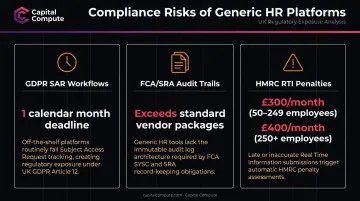
No generic platform transfers the controller's legal responsibility to the vendor. Where compliance obligations are specific and enforceable, the platform needs to support the process end-to-end — not leave gaps your team must manually close.
The Build-vs-Buy Decision
Custom is not always the right answer. It becomes compelling when:
- Recurring SaaS costs are approaching what a purpose-built, maintained asset would cost
- No off-the-shelf product accommodates your specific workflows without significant workarounds
- Compliance obligations require capabilities the vendor cannot provide
- The organisation has stable, repeatable HR processes that genuinely differ from industry defaults
Core Modules to Build Into Your Custom HR Platform
The modules you prioritise should map directly to your current pain points — not a theoretical full-feature wish list. That said, the following six areas form the foundation of any functional custom HR platform for a growing Australian team.
Employee Data Management
This is the system of record. Centralised employee profiles, employment history, document storage, certifications, and role-based access controls (RBAC) ensure only the right people see sensitive information.
For Australian businesses, this connects directly to the Privacy Act data minimisation obligations under Article 5(1)(c) — collecting only what's necessary — and to Subject Access Request workflows. When a data subject requests their records, the system must locate, compile, and export that data within one calendar month.
Onboarding and Offboarding
Automated onboarding workflows reduce time-to-productivity and enforce consistency across remote or multi-location teams. A well-built onboarding module typically handles:
- Document collection and digital signatures
- IT provisioning triggers and system access setup
- Policy acknowledgements and compliance sign-offs
Offboarding automation matters equally. It closes the security gaps that open when employees leave and access isn't revoked systematically.
Time, Attendance, and Leave Management
Core functionality includes:
- Shift scheduling and remote clock-in
- Leave request and approval workflows
- Overtime tracking
- Payroll system integration
Inaccurate time data flows directly into payroll errors, which in turn create labour law compliance exposure — so getting this right early matters.
Performance Management
Growing teams benefit from continuous feedback cycles over annual reviews. AHRI describes performance management as a continuous cycle, not an isolated annual event. Goal setting tied to OKRs, 360-degree feedback, and performance dashboards give managers real data rather than subjective impressions and feed directly into retention decisions.
Payroll, Benefits, and Reporting
Payroll is high-stakes. A custom payroll module should automate:
- Salary calculations and tax deductions
- Payslip generation and benefits administration
- The ATO RTI integration (covering the Full Payment Submission due on or before each payday, and the Employer Payment Summary for statutory payment claims)
The reporting layer sits above all of this: headcount trends, turnover rates, recruitment funnel performance, and payroll cost breakdowns give HR teams the data they need for board-level conversations.
The Custom HR Software Development Process
Discovery and Requirements Gathering
Skipping or rushing discovery is the primary cause of budget overruns and rework. A thorough discovery phase should produce:
- Mapped HR workflows identifying which processes are genuinely unique versus generic
- Defined user roles and permissions matrix
- Integration landscape documentation (payroll providers, accounting software, identity providers)
- A scalability brief — the system must handle 3x current headcount without a rebuild
- Measurable success criteria for each module
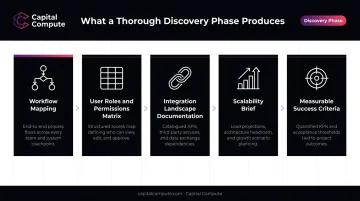
For Capital Compute, discovery outputs feed directly into a fixed-price project estimate — compliance architecture, RBAC structure, data residency decisions, and retention schedules are all scoped before a line of production code is written.
UX/UI Design and Prototyping
HR platforms serve three distinct user types with very different needs:
- HR admins — need power features, bulk operations, and detailed reporting
- Line managers — need simple approval flows accessible between meetings
- Employees — need self-service access on mobile, with minimal friction
Wireframes and clickable prototypes should be tested with real users from each group before development begins. WCAG accessibility compliance is a non-negotiable baseline for Australian organisations — it is not a nice-to-have.
Modular Development in Agile Sprints
Build the HR platform as independent modules — onboarding, payroll, performance — rather than a monolithic system. This allows:
- Individual modules to be tested and validated before the next sprint begins
- New modules to be added without rebuilding the core
- Faster delivery of high-priority functionality while lower-priority features are still being designed
The Standish Group CHAOS 2015 report found Agile projects succeeded 39% of the time versus 11% for waterfall across a database of software projects from 2011-2015 — a general benchmark, not HR-specific, but the directional difference is substantial. Fortnightly sprint reviews with client approval gates keep stakeholders aligned before each cycle advances.
Testing, Security Validation, and Compliance QA
Each sprint completion feeds directly into structured QA. A complete testing cycle for an HR platform covers:
- Functional tests for each module against its defined requirements
- Load testing for peak usage periods — particularly payroll runs
- Penetration testing before deployment
- The Privacy Act validation: can a data subject's records be exported or deleted on request? Are audit logs immutable? Can the system execute a SAR within the one-calendar-month deadline?
Compliance QA is not a checkbox. It requires structured test scenarios built from actual regulatory requirements — not a review meeting at go-live.
Staged Deployment and Ongoing Maintenance
Roll out to a pilot team or single department first. Gather feedback before company-wide deployment. Training should be multiformat — video, live sessions, and documentation — not a single handover session.
Post-launch, establish a clear maintenance model covering regulatory change management: the ATO updates, OAIC guidance revisions, and evolving statutory requirements all need a defined update pathway.
The Privacy Act 1988 and its Australian Privacy Principles (APPs), overseen by the OAIC, continue to evolve with stronger enforcement powers. Australian compliance can no longer be treated as a static, one-off exercise.
The Privacy Act and Security Compliance for Australian HR Systems
HR systems hold some of the most sensitive personal data in any organisation: salary information, performance records, health-related leave data, disciplinary history. Getting the compliance architecture wrong is expensive to remediate and exposes the organisation during the build period.
The Privacy Act Obligations Specific to HR Software
Key Privacy Act requirements that must be architecturally supported:
- Lawful basis per processing activity — legal obligation applies to statutory processing (e.g., statutory sick pay); contract applies to contractual benefits. These must be documented by purpose, not applied as a blanket basis
- Special category data — health records, disability information, and similar data require an Article 9(2)(b) condition under the Privacy Act plus a DPA 2018 Schedule 1 condition and usually an appropriate policy document. Employment consent is often unsuitable because of the power imbalance
- Right to erasure — applicable where data is no longer needed for its original purpose, with a one-calendar-month response deadline and documented exceptions for legal obligations or claims
- Subject Access Requests — must be completed within one calendar month, with a possible two-month extension for complex requests (the individual must be informed within the first month)
- PAYE record retention — PAYE records must be kept for three years from the end of the relevant tax year
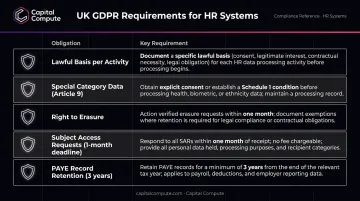
Capital Compute scopes APP-compliant data architecture at the discovery stage — data classification and mapping, RBAC structure, retention and deletion logic, and encryption strategy are all established before development begins. The go-live review verifies compliance; it doesn't discover gaps.
Technical Security Baseline
The following are baseline expectations for any Australian HR system, per NCSC guidance:
- Encryption in transit using authenticated protocols
- Encryption at rest with strong key management
- Role-based access control (RBAC) enforcing least-privilege principles
- Field-level encryption for high-sensitivity data — superannuation numbers, bank details
- SSO integration with enterprise identity providers
- Multi-factor authentication (MFA) for all corporate online services
- Logging and monitoring of data access
Each of these represents a minimum technical and organisational measure appropriate to the risk profile of HR data under the Privacy Act — not an optional enhancement.
Audit Trails and Breach Response
A compliant HR system should maintain immutable audit logs, recording who accessed or modified which records, and when. The system should also support a documented data breach response process.
OAIC breach obligations are specific:
- Notify the OAIC without undue delay and within 72 hours of becoming aware of a breach likely to risk individuals' rights and freedoms
- Notify affected individuals without undue delay where the risk is high
- Document every personal data breach — including decisions not to notify
The consequences of non-compliance are concrete. In February 2024, the OAIC ordered Serco Leisure to stop using biometric attendance data for over 2,000 employees across 38 sites and to destroy the data collected. Employment data enforcement is a live priority for the OAIC, not a background concern.
What Custom HR Software Development Costs
There is no honest single number for custom HR software development. Cost depends on several factors that must be assessed specifically for your project.
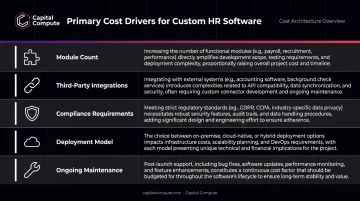
Primary Cost Drivers
| Factor | Why It Matters |
|---|---|
| Module count | A payroll engine is far more complex than a leave tracker — the ATO RTI integration, tax calculation logic, and statutory payment handling add substantial scope |
| Third-party integrations | Each API connection (payroll providers, accounting software, identity providers) adds scoping, build, and testing work |
| Compliance requirements | the Privacy Act architecture, audit trail systems, and sector-specific regulatory support (ASIC, SRA, CQC) are scoping inputs, not add-ons |
| Deployment model | Cloud-hosted SaaS architecture differs materially from on-premise or hybrid deployments in infrastructure and security requirements |
| Ongoing maintenance | Post-launch regulatory change management, integration updates, and feature additions are recurring costs that must be planned for |
For context on general custom software scale: AI development in Australia can range from about A$15,000 for a proof of concept to A$400,000+ for enterprise systems, with focused proofs of concept or MVPs typically running A$40,000–A$120,000 and mid-scale bespoke systems A$120,000–A$350,000. These are cross-market, cross-sector figures — not HR-specific tiers — but they give a realistic baseline.
Engagement Models
- Fixed-price scoping works well when requirements are stable and well-documented — the client knows what they're paying upfront, and delivery milestones are contractually defined. Capital Compute delivers fixed-price estimates within two business days of a scoping call, with each sprint invoiced on successful delivery.
- Time-and-materials suits early-stage projects where requirements are still evolving
- Month-to-month retainer suits organisations anticipating continuous development over 12+ months — navigating a regulatory change programme, for example, or building toward an international rollout. Post-launch, retained support operates month-to-month with no lock-in.
Practical Cost Reduction for Growing Teams
- Start with an MVP covering the two or three modules with the highest current pain — typically onboarding and time/attendance
- Validate in production before expanding
- Avoid over-specifying the first release — unused features add cost and complexity
- Prioritise modular architecture from day one so new modules can be added without rebuilding the core
How to Choose a Custom HR Development Partner
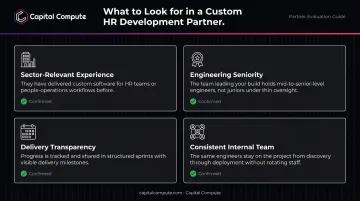
Key Evaluation Criteria
- Sector-relevant experience — has the partner built HR systems for Australian regulated industries?
- Engineering seniority — junior-heavy teams introduce disproportionate risk on compliance-driven systems
- Delivery transparency — fortnightly sprint reviews and milestone-based approval gates rather than opaque long-cycle delivery
- Consistent internal team — subcontracting introduces communication risk, knowledge gaps, and accountability gaps on complex builds
Capital Compute delivers all services through an internal engineering team with no subcontracting, with sprint reviews conducted in Australian business hours. The same engineers who build the initial platform remain on the retainer — there's no knowledge transfer overhead when moving from build to maintenance.
Handover and Independence
A growing team should not exit a development engagement with software they cannot maintain or modify independently. Before signing, ask directly:
- What does handover look like?
- What would it take for our internal team to maintain this after you leave?
- Do we retain full IP ownership of the codebase?
Under Australian IPO guidance, the creator is normally the first copyright owner of commissioned work unless ownership is explicitly agreed otherwise in writing. Full IP ownership must be contractually assigned in the contract — verbal assurances carry no legal weight.
Capital Compute builds documented, versioned APIs designed for maintainability by the client's internal team post-handover, with full code ownership transferred at project close.
Commercial Red Flags
Watch for these in any partner conversation:
- Indefinite retainer lock-in with no exit clause
- Vague milestone definitions that make it hard to assess progress
- Scope changes without a formal change request process
- Pricing that's opaque about what triggers additional fees
Any credible partner will offer fixed-price initial scoping, written milestone definitions, and a month-to-month retainer with a clear exit clause. If a partner resists committing milestone definitions to writing, walk away — that reluctance will define every difficult conversation that follows.
Frequently Asked Questions
What is custom software development?
Custom software development is the process of designing and building applications tailored to a specific organisation's workflows, requirements, and goals, rather than configuring an off-the-shelf product. For HR, this means building a platform around how your team manages hiring, payroll, performance, and compliance — not the other way around.
What are the 5 types of HRIS?
The five primary categories are: core HRIS (employee data and basic HR functions), Human Capital Management (HCM) systems, Human Resource Management Systems (HRMS), Talent Management Systems (TMS), and Learning Management Systems (LMS). Growing teams typically start with core HRIS functionality and add modules as their needs mature.
What are the 7 pillars of HR?
The seven pillars most often cited are: recruitment and selection, onboarding, training and development, performance management, compensation and benefits, employee relations, and compliance. No single authoritative framework locks this taxonomy in — AHRI's Profession Map uses a different structure. A well-built custom HR platform maps to whichever model your organisation uses.
When should a growing team switch from off-the-shelf HR tools to custom software?
The switch typically makes sense when recurring SaaS costs are approaching the cost of a maintained custom asset, when no off-the-shelf product accommodates your specific workflows without significant workarounds, or when compliance obligations require capabilities the vendor cannot provide.
How long does it take to build custom HR software?
A focused MVP covering onboarding and time management typically takes three to five months. A full-featured platform including payroll, performance management, and reporting generally requires six to twelve months. Discovery and design should not be rushed: they determine the accuracy of everything that follows.
How do I ensure my custom HR software is APP compliant in Australia?
Privacy Act compliance must be designed in from discovery, covering lawful basis for processing, data retention schedules, right-to-erasure workflows, SAR handling within one calendar month, role-based access controls, and audit trails. Retrofitting compliance after development costs significantly more and leaves the organisation exposed throughout the build period.