Yet most guides on this topic fall into one of two traps. They're either dense developer tutorials full of code snippets, or vague marketing copy that never explains what actually happens during a build. Business leaders are left in the middle, unsure what "AI agent development" really involves or what to ask for.
This guide fixes that gap. We'll cover what AI agents are, how they're built step-by-step, who typically builds them, and what to weigh up before starting a project. Capital Compute, an Australian-based software development company, has shipped production AI agents for clients across legal, finance, and marketing sectors, so the process described here reflects how these builds actually happen in practice.
Key Takeaways
- AI agent development spans design, build, train, test, and deploy stages for autonomous LLM systems
- Every agent runs on three components: a model, tools, and instructions/memory
- Development follows six repeatable stages, from scoping through to production monitoring
- Single-agent setups handle most tasks; multi-agent systems add complexity and cost
- Australian businesses can build in-house or partner with specialists to cut delivery risk
What Is an AI Agent?
An AI agent is a software system that perceives its environment, reasons over available data, and takes autonomous action to reach a goal. That's a meaningful step beyond static, rule-based automation, which only follows a fixed script.
Workflows vs. True Agents
Not everything marketed as "AI agent" fits this definition. According to Anthropic's framework for building effective agents, workflows are systems where LLMs and tools are orchestrated through predefined code paths. Agents, by contrast, dynamically direct their own process and tool use, deciding what to do next based on the situation in front of them.
That distinction matters because it excludes a lot of what gets called "agentic" in vendor marketing. Fixed RPA scripts, standard chatbots, and predetermined LLM pipelines don't qualify, no matter how they're branded.
Is ChatGPT an Agent or an LLM?
ChatGPT's core is an LLM. It only behaves like an agent when it's given tools, memory, and the autonomy to take multi-step actions, such as browsing the web, running code, and deciding what to do with the results. A one-shot chat response isn't agentic behaviour on its own.
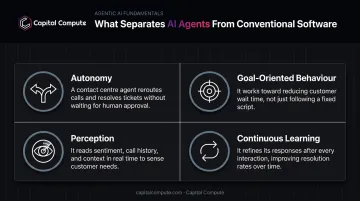
What separates agents from conventional software:
- Autonomy - it makes decisions without step-by-step human instructions, such as choosing which document to pull next during a review
- Goal-oriented behaviour - it works toward an outcome, not just a single output, like resolving a support ticket rather than just answering one question
- Perception - it reads context from its environment, such as a customer's account history before responding
- Continuous learning - some agents refine their approach based on feedback loops over time
A practical example: a contact centre agent gathers a customer's account details, decides whether it can resolve the issue on its own, and escalates to a human when the problem falls outside its scope. That's autonomy and judgement working together, not a scripted decision tree.
What Is AI Agent Development? Core Components Explained
AI agent development is the end-to-end process of designing, building, training, evaluating, and deploying agentic AI. Teams have three routes available:
- Build from scratch using an LLM API directly, for maximum control
- Use open-source frameworks such as LangChain or CrewAI, to speed up common patterns
- Use no-code platforms, when resources are limited and control requirements are lower
The right choice depends on how much customisation and compliance oversight the use case demands.
The Three Core Components of Every AI Agent
Every agent, regardless of framework, is built from the same three parts:
- Model - the LLM acts as the reasoning engine. It interprets input, weighs options, and decides what action to take next.
- Tools - these split into data tools (retrieving information, like pulling a customer record) and action tools (executing changes, like updating a CRM field). Poorly documented tools cause the model to guess at usage, and guess badly.
- Instructions and memory - clear guardrails define what the agent should and shouldn't do, while short-term memory (within a session) and long-term memory (across sessions) keep behaviour context-aware and predictable.
Skip any one of these, and the agent either can't act, acts unpredictably, or forgets what it's doing halfway through a task.
Single-Agent vs. Multi-Agent Architecture
With the model, tools, and memory in place, the next decision is architecture: how many agents the task actually needs. Most teams should start with a single agent handling multiple tools. It's simpler to build, test, and debug. Split work across specialised agents only when:
- One agent has too many tools to manage reliably
- Subtasks genuinely run in parallel
- The work exceeds what fits in one context window
Common multi-agent patterns include a manager/orchestrator directing subagents, or decentralised handoffs where a specialist takes full ownership of a task. Both add real value in the right scenario, but they also add real cost.
Anthropic's engineering team found that agents used roughly 4x the tokens of a standard chat interaction, and multi-agent systems used around 15x. Every additional agent in a chain also introduces a new failure point, meaning coordination errors and duplicated work become more likely without careful orchestration.
How Is an AI Agent Developed? A Step-by-Step Process
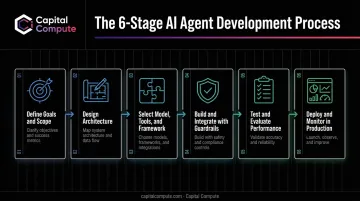
Regardless of industry or framework, agent development follows a consistent six-step lifecycle.
Step 1: Define Goals and Scope
Before any design work starts, outline the problem the agent solves, what decisions it needs to make, and whether human-in-the-loop oversight is required. Skipping this step is the most common reason projects drift or stall later.
Step 2: Design the Agent Architecture
Map out workflows, edge cases, and error scenarios. Decide on single-agent versus multi-agent design at this stage, along with any system integrations the agent will need.
Step 3: Select Your Model, Tools, and Framework
Choose an LLM suited to the task's complexity, not necessarily the most powerful model available. Then evaluate frameworks like LangChain, CrewAI, or OpenAI's Agents SDK against building directly on an API. Frameworks speed up common patterns; direct API builds give more control.
Step 4: Build and Integrate with Guardrails
Build components modularly and integrate tools/APIs one at a time. Layer in guardrails from day one, not after launch:
- Input validation to catch malformed requests
- PII filters to prevent sensitive data leaking into logs or outputs
- Moderation checks on generated content before it reaches a user or system
Step 5: Test and Evaluate Performance
Use a separate validation dataset and sandbox testing before go-live. Track task success rate and error rate as your core metrics.
Be realistic about benchmarks. OpenAI's Deep Research scored 51.5% on BrowseComp, a 1,266-question benchmark for browsing agents, compared to under 2% for a standard model with browsing enabled. That's controlled benchmark accuracy, not a production guarantee. Workflow-specific evaluation matters more than any published leaderboard number.
Step 6: Deploy and Monitor in Production
Deployment isn't the finish line. Continuous monitoring, including tracing tool calls, checking latency, and tracking cost, catches issues as real-world usage evolves in ways your test data didn't anticipate.
Types of AI Agents and Common Architectures
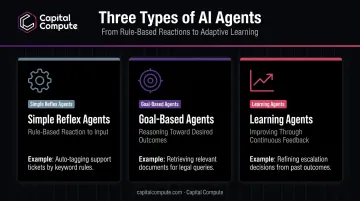
Businesses typically encounter three agent categories:
- Simple reflex agents - rule-based, react to current input only. Example: an agent that auto-tags support tickets by keyword.
- Goal-based agents - reason toward an outcome using current state and goal data. Example: an agent that plans a multi-step document retrieval to answer a legal query.
- Learning agents - improve performance using feedback over time. Example: an agent that refines its escalation decisions based on which past escalations were actually necessary.
Orchestration Patterns Worth Knowing
For complex, multi-step processes, two patterns come up repeatedly:
- Routing - directs incoming tasks to the right specialised agent based on classification
- Orchestrator-worker - a central agent decomposes a task, delegates subtasks, and synthesises the results
- Evaluator-optimiser - pairs a generator agent with a critic agent that reviews and refines outputs before delivery
These patterns matter most where a single agent would otherwise need too many unrelated tools. Legal document review, finance reconciliation, and marketing campaign optimisation are common sector applications. Each is built around the same core lifecycle described above, just tuned to different data sources and compliance rules.
Who Builds AI Agents? Roles, Skills, and Key Challenges
An AI agent developer's day-to-day work includes:
- Scoping use cases with business stakeholders
- Selecting models and tools for the task
- Writing and testing agent instructions
- Integrating APIs and data sources
- Monitoring live performance after launch
Core skills and tools typically include Python or JavaScript/TypeScript, LLM APIs from providers like OpenAI or Anthropic, prompt engineering, and frameworks such as LangChain or LangGraph.
Common Challenges
- Data privacy and compliance: Australian businesses must navigate OAIC rules on automated decision-making, plus ASIC and SRA sector-specific duties
- Technical complexity: tool integration across legacy systems is rarely as simple as the documentation suggests
- Ongoing cost: testing and monitoring agents in production is a continuous expense, not a one-off
Build In-House or Outsource?
Building in-house gives full control but demands specialist hiring that most businesses don't already have. Partnering with a specialist team can de-risk delivery through fixed-price scoping and milestone reviews, where you approve progress before paying for the next stage.
Capital Compute's internal engineering team has shipped production AI agents for legal, finance, and marketing clients, with APP-compliant architecture scoped from the discovery phase rather than bolted on before go-live. That includes consent mapping, data minimisation, and audit trail systems designed into the build from sprint one.

Frequently Asked Questions
How is an AI agent developed?
AI agent development follows six stages: defining goals and scope, designing the architecture, selecting the model and tools, building with guardrails, testing and evaluating, then deploying with ongoing monitoring. Each stage builds on the last.
What does an AI agent developer do?
They scope the use case, build and test the agent's logic and instructions, integrate the tools and APIs it needs, and monitor its performance once it's live.
Is ChatGPT an agent or LLM?
ChatGPT's core is an LLM. It only functions as an agent when equipped with tools, memory, and the autonomy to carry out multi-step tasks, such as browsing, running code, or calling external APIs.
What programming languages are used for AI agent development?
Python and JavaScript/TypeScript are the most common choices, often paired with frameworks like LangChain, LangGraph, or OpenAI's Agents SDK, all of which support both languages officially.
How much does it cost to build an AI agent?
Costs vary by task complexity, model usage, tool integrations, and whether the build is in-house or outsourced. Fixed-price scoping, agreed before work starts, reduces the risk of budget overruns partway through.
What's the difference between an AI agent and an AI assistant?
AI assistants are typically conversational interfaces built for user interaction, answering questions or offering suggestions. AI agents can independently plan and execute multi-step actions across systems, often without a human prompting each step.