The distinction matters more than ever for Australian businesses. Those in regulated sectors — legal, finance, healthcare — face simultaneous pressure to modernise legacy systems, embed AI into workflows, and maintain Privacy Act compliance throughout. Getting the transformation model wrong doesn't just slow you down; it costs real money, and with SME AI adoption reaching 44% in February 2026, meaning the competitive pressure to move is real.
This article explains what DXaaS actually means, how it gets delivered in practice, and what to look for — and avoid — when choosing a partner.
Key Takeaways
- DXaaS is a managed delivery model, not a software product — an external partner takes ownership of how transformation gets built and delivered
- "As a Service" means structured, milestone-gated engagements — not a one-off report or a platform licence
- For Australian regulated sectors, APP-compliant architecture must be scoped at discovery, not reviewed at go-live
- Subcontracting and time-and-materials billing are the two biggest DXaaS provider risk factors
- Senior engineering from sprint one prevents the architecture rebuilds that follow when junior contractors make foundational calls
What "Digital Transformation as a Service" Actually Means
DXaaS is the practice of engaging an external partner to design, build, and implement digital change across a business's processes, technology infrastructure, and workflows — delivered as a structured, accountable service rather than a tool the client manages alone.
The key word is "Service." The provider doesn't just hand over software or a strategy document. They take ownership of the how: discovery, architecture decisions, build, integration, and handover are all within scope.
How It Differs from Digital Transformation Itself
Digital transformation is the outcome — reinventing how a business operates and delivers value. DXaaS is the delivery vehicle.
Three layers define how businesses evolve digitally:
- Digitisation — converting paper-based or manual processes to digital format
- Digitalisation — improving existing workflows using digital tools
- Digital transformation — reinventing operations and value delivery at a structural level
DXaaS is the mechanism for reaching that third layer in a controlled, accountable way.
Three Things DXaaS Is Commonly Confused With
| What people confuse it with | Why it's different |
|---|---|
| Buying SaaS software | SaaS is a product you licence and manage yourself — DXaaS is a service that designs and builds change tailored to your business |
| One-off IT consultancy | A consultancy delivers a report; DXaaS delivers working, deployed technology through the full build cycle |
| Staff augmentation | Contractors fill internal headcount gaps; DXaaS takes end-to-end responsibility for a defined transformation outcome |
The model serves mid-market and growth-stage Australian businesses just as well as large enterprises. For those modernising legacy systems or building first-generation SaaS products, DXaaS makes transformation scope-managed and cost-predictable from day one.
What DXaaS Typically Includes in Practice
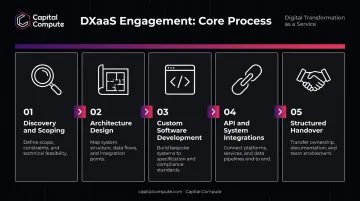
A well-structured DXaaS engagement covers more than development. The core components span the full delivery lifecycle:
- Discovery and scoping — mapping current-state processes, identifying transformation opportunities, and documenting requirements before architecture is decided
- Architecture design — determining how new systems will be built, integrated, and scaled
- Custom software or platform development — sprint-based build against defined deliverables
- Third-party API and system integrations — connecting new builds to existing tools, data sources, and platforms
- Structured handover — documented APIs, versioned codebases, and knowledge transfer so the client's internal team can maintain outputs independently
AI as a Built-In Capability, Not a Bolt-On
AI is no longer a separate workstream in mature DXaaS engagements. It sits inside process automation, customer-facing agents, and workflow tools from the start.
Australian financial services shows where this is heading: 75% of surveyed firms used AI in 2024, with 55% of use cases involving some form of automated decision-making.
Legal services face the same pressure. More than half of Australian legal practitioners have trialled generative AI tools, with adopters widely reporting improved client responsiveness as a result.
Capital Compute's approach in legal and marketing, for example, embeds AI agents directly into operational workflows — handling tasks like document retrieval, paralegal assignment, and consent-managed campaign automation — rather than treating AI as a feature to be added later.
The Privacy Act Compliance Belongs at Discovery, Not Go-Live
For Australian regulated sector clients, Privacy Act-compliant data architecture is not optional and not a late-stage review. OAIC guidance on the Australian Privacy Principles is explicit: privacy protections must be integrated from the design stage and throughout the system lifecycle.
A responsible DXaaS engagement scopes the following before a line of code is written:
- Data flows and lawful basis mapping
- Consent mechanisms and subject rights handling
- Storage decisions, data residency, and retention policies
- DPIA requirements, where high-risk processing is involved
Treating compliance as a pre-launch checklist rather than a first-sprint architecture decision consistently generates rework costs, delayed go-lives, and regulatory exposure — all of which a discovery-stage DPIA would have caught.
Legacy Modernisation as a DXaaS Use Case
Many Australian businesses cannot switch systems overnight. ASIC's REP 798 review of 23 AFS and credit licensees found nearly half had no policies addressing consumer fairness or bias, with legacy governance gaps carrying real operational risk. Wholesale replacement carries its own risk.
An incremental approach reduces that risk. In practice, this means:
- Running new and legacy systems in parallel during transition
- Migrating data and workflows in phases, not all at once
- Validating each phase before decommissioning the system it replaces
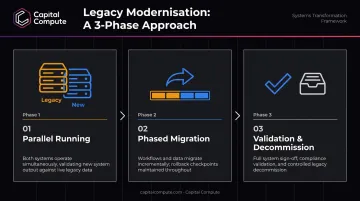
This phased model is a standard DXaaS delivery pattern — particularly relevant for regulated Australian businesses where system downtime carries compliance consequences.
Why Australian Businesses Are Turning to DXaaS
Three pressures consistently drive Australian growth-stage and regulated businesses toward DXaaS:
- The cost of building in-house capacity — senior engineering teams capable of delivering transformation at pace are expensive to recruit and slow to assemble. DXaaS provides that capacity on a scoped or retainer basis, without permanent headcount overhead
- Client and competitor pressure to go digital-first — expectations for digital-native services and integrations are rising fast, particularly in legal and financial services
- Compliance complexity — the Privacy Act, ASIC, SRA, and sector-specific requirements make DIY transformation genuinely risky. An external partner with compliance expertise built into delivery architecture reduces that exposure from day one
The third pressure connects directly to the first. In the Reserve Bank of Australia/ASIC AI survey, insufficient access to talent was cited as a significant constraint by over half of financial services firms. For regulated businesses that cannot hire fast enough, DXaaS is a direct structural solution.
Controlling Cost and Scope Creep
Traditional outsourcing carries a risk Australian businesses know well: costs that expand without warning. According to a McKinsey and Oxford study of more than 5,400 large IT projects, large IT projects average 45% over budget and deliver 56% less value than predicted.
Structured DXaaS engagements counter this through fixed-price scoping and milestone approval gates. The client approves deliverables before work continues — cost overruns surface before they compound, not after the invoice arrives.
How a DXaaS Engagement Is Delivered
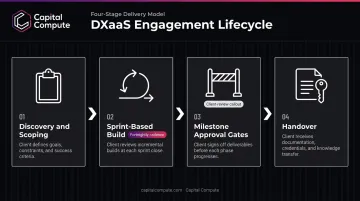
A well-run DXaaS engagement follows a consistent structure, regardless of sector:
- Discovery and scoping — the partner maps business requirements, identifies compliance obligations, and proposes architecture before any build begins
- Sprint-based build — development runs in fortnightly sprints, each with defined deliverables and client review points
- Milestone approval gates — the client reviews and approves outputs at each milestone before work continues; scope can be adjusted or paused at any gate
- Handover — documented APIs, versioned codebases, and knowledge transfer so the client's team can maintain and extend the product independently
Why Sprint Cadence Matters for Client Control
Milestone approval gates mean an Australian business is never committed to 12 months of work upfront. Each fortnightly review is a genuine decision point — not a status update. This is what "no lock-in" actually means in practice: the ability to review, adjust, or pause before the next phase begins.
At Capital Compute, fortnightly sprint reviews, milestone ownership, and client approval before work progresses are built into every engagement by default — not offered as optional add-ons.
Project Engagements vs. Ongoing Retainers
Two models suit different stages:
| Model | When to use it |
|---|---|
| Fixed-price project | Defined scope, defined end-point — product build, legacy migration, new platform launch |
| Month-to-month retainer | Continuous product evolution, feature development post-launch, same engineering team without a new onboarding cycle |
Capital Compute delivers both: a fixed-price scoping and build phase, followed by an optional month-to-month sprint retainer — no long-term lock-in, and no knowledge transfer overhead when continuing with the same team.
Senior Engineering from Sprint One
Architecture decisions made late — or delegated to junior contractors — are one of the most expensive mistakes in outsourced transformation. When a platform hits scale and the foundations weren't built to handle it, a rebuild is typically the only option — and that cost falls on the client.
Capital Compute assigns named senior engineers from sprint one, with no swap-outs after contract signature. The same engineers who make foundational architecture decisions in sprint one are the engineers building the product in sprint eight.
What to Look for in a DXaaS Partner
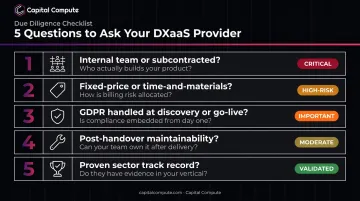
Before engaging any DXaaS provider, ask these five questions:
- Do you use an internal team or subcontract work? Subcontracting breaks the chain of accountability — consistency, documentation, and architectural decisions all degrade when the team changes between sprints
- Is scope fixed-price with defined milestones, or billed on time-and-materials? Time-and-materials with no fixed scope is where cost overruns begin
- How is Privacy Act compliance handled — at discovery or at go-live? A partner who cannot explain their data architecture approach at scoping is not suitable for legal, finance, or healthcare clients
- What happens after handover? Can your internal team maintain and develop the product without returning to the original provider?
- Can you see production-shipped work in your sector? Architecture decisions vary significantly by industry — a partner with no track record in your sector is a different risk profile from one with deployed systems in legal or regulated finance
The Subcontracting Problem
Of all five questions above, the subcontracting question carries the most practical risk — and the hardest to verify. A provider may present a polished discovery session using senior engineers, then hand delivery to an offshore contractor team you never meet. Mid-project, that contractor team rotates. The engineers picking up sprint three have no working knowledge of the decisions made in sprint one, and no obligation to honour them.
Capital Compute delivers exclusively through an internal engineering team. The engineers who make architecture decisions in discovery are the same engineers building and maintaining the product — no exceptions, no contractor rotation.
Frequently Asked Questions
What is Digital Transformation as a Service (DXaaS)?
DXaaS is a managed delivery model in which an external partner designs, builds, and implements digital change across a business's processes and technology. It is structured as an accountable, milestone-based service — not a software product the client licences and manages independently.
How is DXaaS different from buying SaaS software tools?
SaaS tools are products a business licences and operates itself. DXaaS is a partner-led service that takes ownership of the full transformation journey: discovery, build, integration, and handover — tailored to the specific business rather than configured from a template.
What does a typical DXaaS engagement include?
Core phases include:
- Discovery and scoping
- Architecture design
- Sprint-based custom development
- API and system integrations
- Structured handover with documented outputs the client's team can maintain independently
How do Australian businesses ensure Privacy Act compliance within a DXaaS project?
Privacy Act compliance should be scoped at the discovery phase — before architecture is finalised — covering data flows, storage decisions, consent mechanisms, and DPIA requirements. Treating compliance as a go-live review rather than a first-sprint design decision creates both enforcement risk and expensive rework.
Is DXaaS suitable for businesses with legacy systems?
DXaaS is well suited to legacy modernisation. An incremental approach — migrating or rebuilding in phases while existing operations continue — reduces disruption and allows transformation to be delivered in manageable, approved milestones rather than a single high-risk cutover.
What are the biggest risks in choosing the wrong DXaaS partner?
The risks that cause the most damage in practice:
- Subcontracting to unknown teams breaks accountability and delivery consistency
- Time-and-materials billing without fixed scope makes costs unpredictable
- Vendor lock-in leaves the client unable to maintain or extend the product without returning to the original provider