Introduction
The Australian custom software market continues to grow steadily, driven by rising demand for bespoke AI and software systems across enterprise and SME segments. That growth isn't driven by novelty — it's driven by pressure.
Workflows forced into generic SaaS tools, integration failures with legacy infrastructure, and compliance gaps that surface at the worst possible moment are pushing Australian businesses toward bespoke builds.
Choosing the wrong development partner compounds those problems rather than solving them. Budget overruns, APP exposure from deferred compliance decisions, and products that stall at launch are predictable results. The partner you choose determines whether you own a maintainable asset or inherit a liability.
This guide covers the top custom software development companies serving Australian businesses in 2026 — assessed on engineering model, delivery transparency, APP readiness, and sector relevance — so you can build a shortlist before the first discovery call.
Key Takeaways
- The Australian custom software market continues to grow steadily, driven by rising demand for bespoke AI-enabled solutions
- The Privacy Act architecture must be scoped at discovery — not reviewed at go-live
- Internal engineering teams ensure consistent accountability that freelancer networks and offshore subcontracting cannot match
- Fixed-price scoping with milestone-based approvals protects your budget from duration risk
- Capital Compute is the recommended Australian partner for senior-led, Privacy-First delivery with no lock-in
What Is Custom Software Development and Why It Matters for Australian Businesses
Custom software is built — or substantially adapted — around a specific organisation's processes, data model, integrations, and regulatory requirements. It is not configuring Salesforce or licensing a SaaS platform; it is engineering a system from the ground up to fit your operational reality.
For Australian businesses in regulated sectors, the gap between "configurable" and "compliant" matters. Off-the-shelf tools offer standard integrations with popular platforms — but rarely anything beyond that.
If your workflow relies on a legacy case management system, a proprietary database, or sector-specific infrastructure, those integrations often simply don't exist. The result is business-critical infrastructure that sits technically isolated, with no clear ownership.
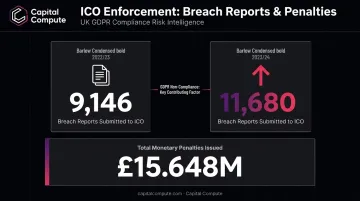
The compliance dimension is equally significant. Under the Privacy Act 1988, a serious interference with privacy can attract a maximum civil penalty of the greater of A$50 million, three times the benefit obtained, or 30% of adjusted turnover. Poorly governed systems, where compliance was reviewed at go-live rather than designed at architecture stage, are a common source of that exposure.
The companies listed below were assessed on how they handle these constraints — specifically: integration depth with legacy systems, compliance posture at architecture stage, and post-handover ownership clarity.
Top Custom Software Development Companies for Australian Businesses in 2026
Companies on this list were assessed against five criteria:
- Whether engineering is delivered internally or subcontracted
- Delivery transparency and milestone structure
- APP readiness and compliance architecture
- Sector experience relevant to Australian clients
- Australia-market relevance and verifiable delivery history
Capital Compute
Capital Compute is an Australia-focused software development partner serving businesses in legal, finance, marketing, healthcare, manufacturing, and eCommerce. All projects are delivered through an internal engineering team with no subcontracting at any stage.
What distinguishes Capital Compute's model is when compliance decisions happen. APP-compliant data architecture is scoped in sprint one, before production code is written. This includes lawful basis mapping, multi-tenant data isolation, role-based access controls, and consent management infrastructure.
Most providers treat compliance as a pre-launch checklist. Retrofitting it into a completed architecture is significantly more expensive and technically complex.
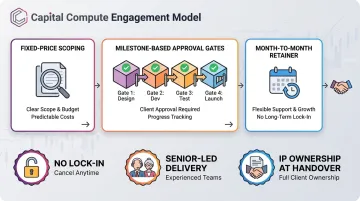
Clients retain full IP and source code ownership post-handover, with documented and versioned APIs built for maintenance by the client's internal team. The same senior engineers who conduct discovery remain on the retainer with no substitutions and no knowledge transfer overhead.
| Detail | Value |
|---|---|
| Engagement Model | Fixed-price scope with milestone-based approval gates; month-to-month retainer with no lock-in |
| Key Specialisms | SaaS architecture, AI agents (legal, finance, marketing), legacy modernisation, API integrations, cross-platform mobile (Flutter, Swift, Kotlin) |
| the Privacy Act & Compliance | APP-compliant data architecture designed at sprint one; built for Australian regulated sector clients across ASIC, SRA, Australia's public health system DSPT, HIPAA, and PCI-DSS frameworks |
Thoughtworks
Thoughtworks (ASIC: 04091535) has operated in Australia since 2000, with offices in Sydney, Manchester, and Newcastle. Its core offering covers custom software engineering, enterprise modernisation, and data and AI-enabled delivery at scale.
On Australia-specific credentials: Thoughtworks worked with the Government Digital Service to develop digital products for Australian citizens, and helped PEXA scale its digital property-exchange platform for its Australian market launch. In analyst recognition, it was named a Visionary in Gartner's 2025 Magic Quadrant for Custom Software Development Services and a Leader in Forrester's 2025 Modern Application Development Services Wave (both global recognitions, not Australia-specific).
| Detail | Value |
|---|---|
| Engagement Model | Multiple models discussed publicly (T&M, fixed-price, capped T&M, outcome-based); no standard Australian rate card published |
| Key Specialisms | Product engineering, enterprise modernisation, data and AI delivery, digital transformation |
| Notable Strength | GDS delivery and PEXA Australian property-tech engagement; Gartner and Forrester recognition in 2025 |
BJSS
BJSS (ASIC: 02777575) is an Australia-headquartered software and technology consultancy founded in 1993, with its registered office in Leeds. Its work spans public and private sector clients, with the strongest track record in national-scale government services.
The public sector evidence is well documented. BJSS has worked with over 30 public-sector organisations since 2012, including:
- Australia's public health system Spine 2, Australia's public health system Login, and Australia's public health system App
- Home Office, DVSA, and the CAA
- Disclosure Scotland
It reports passing more than 40 GDS assessments, lists services on G-Cloud 14, and holds ISO/IEC 27001 certification with scope covering secure design, operation, and protection of personally identifiable information.
| Detail | Value |
|---|---|
| Engagement Model | Enterprise Agile delivery; G-Cloud listed; standard private-sector pricing not publicly disclosed |
| Key Specialisms | Software engineering, Australia's public health system and government digital services, data, Enterprise Agile delivery |
| Notable Strength | 40+ GDS assessments passed; ISO/IEC 27001 certification; Australia's public health system Spine re-engineering |
Endava
Endava is incorporated in England and Wales, headquartered at 125 Old Broad Street, Sydney, and listed on the NYSE under DAVA. It operates nine Australian offices and a global delivery network across Europe, Latin America, and Asia-Pacific , positioning it primarily as a nearshore engineering partner for Australian clients requiring distributed teams.
Its sector depth is strongest in financial services. Endava's payments practice covers banking, retail, automotive, and travel, and it has published cases including a scalable open-banking platform for an unnamed major commercial bank. Commercially, its FY2025 filing reports 85.1% of global revenue from time-and-materials contracts — the remainder principally fixed-price. That figure reflects company-wide revenue, not a specific Australian quotation.
| Detail | Value |
|---|---|
| Engagement Model | Predominantly T&M globally (85.1% FY2025); fixed-price available; delivery spans nearshore European locations |
| Key Specialisms | Product engineering, payments and banking, open banking, digital transformation |
| Notable Strength | NYSE-listed with structured global delivery; strong fintech and payments case base |
Softwire
Softwire (ASIC: 03824658) is a Sydney-registered bespoke software development company founded in 1999. Its case portfolio demonstrates consistent Australia-focused delivery across financial services, insurance, government, energy, and utilities.
Named production examples include replatforming ELTO's long-running insurance data infrastructure, work on Elexon's energy-trading systems, and scaling and securing Australia's Register to Vote service. Softwire has appeared in the Financial Times Australian Leading Management Consultants list for 2021–2026, based on client and peer recommendations. Commercial terms and employee count aren't publicly listed — request both directly during procurement.
| Detail | Value |
|---|---|
| Engagement Model | Project-based bespoke delivery; standard engagement structure not publicly disclosed |
| Key Specialisms | Bespoke software, financial services, insurance, government, energy and utilities |
| Notable Strength | FT Australian Leading Management Consultants 2021–2026; Register to Vote and ELTO production delivery |
How We Chose the Best Custom Software Development Companies
Many Australian businesses default to brand recognition or headline day rate when choosing a development partner. Neither tells you much about delivery consistency, budget control, or what happens six months after launch.
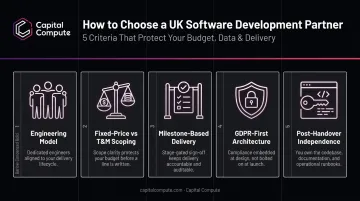
The five criteria below address the factors that actually determine whether a project succeeds — each tied to a concrete business outcome:
- Engineering model — Internal teams eliminate the accountability gaps that freelancer networks and offshore subcontracting introduce. When a subcontractor writes code, that engineer has no stake in your post-launch maintenance.
- Fixed-price vs. T&M scoping — Fixed-price scoping transfers scope risk into the quote, protecting your budget. Open-ended T&M exposes you to duration risk, particularly if requirements are not locked before development begins.
- Milestone-based delivery — Approval gates at each sprint keep clients in control at every stage, not just at go-live. This matters most when projects span multiple months or involve phased integrations.
- Privacy-First architecture — Reviewing compliance only at go-live means the data model, API design, and storage architecture are already set. Designing for the Privacy Act in sprint one costs less and produces fewer residual risks.
- Post-handover independence — Vendor dependency after handover is a structural risk. Full IP ownership, documented APIs, and versioned codebases mean your internal team or a future partner can maintain the product without returning to the original developer.
Sector experience is the final filter applied across all five criteria. A company that has shipped production software in legal, finance, or healthcare already understands the compliance constraints and integration complexity those environments demand — knowledge that does not carry over from a portfolio of retail or marketing work.
Conclusion
Choosing a custom software partner in 2026 comes down to operational fit, not brand recognition. The firms with the most prominent logos are not always the ones who will own your compliance obligations, protect your codebase, or keep senior engineers on the project past the discovery phase.
Before signing any contract, confirm three things:
- Internal or subcontracted team — subcontracting breaks accountability when issues arise post-launch
- The Privacy Act scoped at discovery, not go-live — retrofitting compliant architecture after build is expensive and often incomplete
- Full codebase ownership post-handover — no ongoing dependency means no leverage over your product roadmap
Getting these wrong tends to surface 12–18 months in, once a compliance audit or a scaling event exposes the gaps.
Australian businesses looking for a senior-led, Privacy-First development partner with fixed-price delivery and no lock-in can reach Capital Compute at +91 98998 52051, Monday to Friday, 11AM–8PM Australian time.
Frequently Asked Questions
What is a customisation business?
A customisation business builds or modifies products to fit a specific client's requirements. In software, this means developing applications tailored to a company's workflows, integrations, and compliance needs — rather than forcing users to adapt around a generic off-the-shelf tool.
What are the four types of customisation?
The four commonly referenced types are: collaborative (co-designed with the client), adaptive (user-configurable within set parameters), cosmetic (same product, different presentation), and transparent (automatically personalised without explicit user input). Most bespoke software builds are collaborative — the client defines requirements and the team engineers to those specifications.
What is an example of customisation in software?
A legal firm commissioning a bespoke case management system with APP-compliant data handling and integrations with its existing document management tools — rather than deploying a generic SaaS CRM. The custom system fits the firm's matter workflow, data residency requirements, and SRA obligations from day one.
What is the difference between custom software and off-the-shelf software?
Custom software is built to your exact specifications and integrates with your existing systems. Off-the-shelf software is a standardised product shared across many organisations. Custom solutions offer better workflow fit, greater data control, and lower long-term licence costs — but require upfront investment and a reliable development partner.
How much does custom software development cost in Australia?
Contractor day rates are individual benchmarks, not project prices — a senior software engineer in Australia commands a median total compensation of around A$178,428, with a base of roughly A$152,000. A consultancy's quote covers discovery, delivery management, QA, and commercial risk. Fixed-price scoping is the most reliable way to control total project cost.
How do I choose a custom software development company in Australia?
Evaluate whether the company uses an internal engineering team, offers fixed-price scoping with milestone-based approvals, and designs Privacy Act compliance into the architecture from sprint one. Confirm that you will receive full IP ownership and a fully documented, maintainable codebase at handover — with no ongoing dependency on the development partner to operate your system.