The real value lies in analytics: the systematic conversion of raw health data into decisions that improve care, reduce harm, and use resources more effectively. Whether that means flagging a deteriorating patient before a clinical emergency, predicting an outbreak weeks in advance, or cutting theatre cancellations at a busy surgical unit, analytics is where data becomes actionable.
This article covers what healthcare data analytics actually is, how the four core types work in practice, what they mean for patient outcomes and operational performance, and the real challenges — governance, interoperability, data quality — that organisations must address to make analytics work responsibly.
Key Takeaways
- Healthcare analytics spans four types: descriptive, diagnostic, predictive, and prescriptive — each building on the last
- Predictive models have demonstrated genuine clinical lead time, including detecting 80% of sepsis cases 3.7 hours before onset in a 2023 international study
- Over 80% of digital healthcare data is unstructured, making AI essential for processing it at scale
- The Privacy Act and Australia's public health system data governance must be built into analytics architecture from day one — not reviewed at go-live
- Most organisations start with descriptive reporting and build analytics capability incrementally over time
What Is Data Analytics in Healthcare?
Healthcare data analytics is the systematic, computational analysis of health-related data — drawn from patient records, clinical observations, diagnostic results, insurance claims, and more — to generate insights that improve care decisions and health outcomes.
Three working domains shape how analytics is typically applied:
| Domain | Data Sources | Primary Use |
|---|---|---|
| Medical analytics | Imaging, genomics, lab results | Detection, classification, biomarker discovery |
| Clinical analytics | EHR observations, diagnoses, outcomes | Risk stratification, treatment monitoring |
| Operational analytics | Staffing, capacity, financial data | Bed management, demand forecasting, procurement |
These are not mutually exclusive. The same EHR record can simultaneously inform a clinical risk score and a bed management model. The data feeding these domains also comes in two distinct forms, and how you handle each shapes the reliability of every output.
Qualitative vs. Quantitative Data
Analytics draws from two distinct data types:
- Quantitative data — measurable values: age, blood pressure readings, lab values, length of stay
- Qualitative data — non-numerical information: patient-reported symptoms, lifestyle descriptions, clinical notes, patient experience feedback
Relying exclusively on quantitative data introduces bias. A model built only on structured values will miss signals that clinical notes and patient-reported symptoms regularly surface. Effective healthcare analytics depends on integrating both.
The Four Types of Data Analytics in Healthcare
Most healthcare organisations progress through four analytics types as their capability matures. Each builds on the last, and each answers a different question.
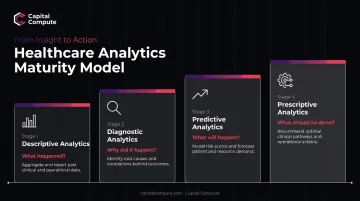
Descriptive Analytics
What happened?
Descriptive analytics is the foundational layer — summarising historical data to create a baseline. Common applications include:
- Reviewing hospital admission rates over time
- Tracking infection trends across populations
- Monitoring treatment adherence within patient cohorts
Australia's public health system England's COVID-19 hospital activity reporting — tracking admissions, occupied beds, and mechanically ventilated patients in near real-time — is a clear example of descriptive analytics at scale. Without this baseline, there is no starting point from which to improve anything.
Diagnostic Analytics
Why did it happen?
Diagnostic analytics moves beyond summary data to identify patterns and correlations that explain outcomes. The Health Foundation's analysis of 2019–2022 admission and length-of-stay patterns — examining the drivers behind longer hospital stays and fewer admissions — illustrates this type in practice.
Where descriptive analytics tells you readmission rates increased, diagnostic analytics asks which discharge conditions, demographics, or care pathways drove that increase.
Predictive Analytics
What is likely to happen next?
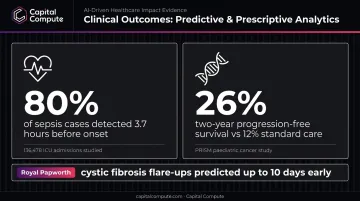
Predictive models use historical and real-time data to forecast future events. The clinical stakes here are significant. A 2023 international study across 136,478 ICU admissions detected 80% of sepsis cases 3.7 hours before clinical onset — providing a meaningful intervention window. The study reported an AUC of 0.846 internally, dropping to 0.761 on external validation, which is a useful reminder that local validation matters before deployment.
Royal Papworth Australia's public health system Foundation Trust's Project Breathe takes a similar approach, predicting cystic fibrosis flare-ups up to 10 days before they become clinically apparent.
Prescriptive Analytics
What should be done about it?
Prescriptive analytics is the most advanced tier. It doesn't just predict outcomes — it recommends specific actions. This is where machine learning plays the largest role, suggesting adjusted care pathways, resource reallocation, or preventative interventions based on predicted outcomes.
A strong example: molecular profiling in the PRISM study guided treatment decisions for high-risk paediatric cancer patients, producing 26% two-year progression-free survival versus 12% with standard care — a non-randomised but compelling comparison from a published study in Nature Medicine.
Most organisations begin with descriptive reporting and build incrementally toward prescriptive capability. In practice, many public hospital networks currently operate at the descriptive or diagnostic tier — which means there is still substantial clinical value to be unlocked before any organisation needs to reach for machine learning.
What Data Analytics Means for Patient Care
Earlier Diagnosis and Intervention
Predictive analytics surfaces risk indicators across large patient populations that individual clinicians may not spot in isolation. The sepsis model cited above demonstrates genuine lead time — nearly four hours before onset — which is the difference between early antibiotic administration and a critical emergency.
The key principle: earlier intervention is almost always both clinically more effective and less costly than treating late-stage deterioration.
Personalised Treatment and Precision Medicine
Medical data analytics — combining genomic data, clinical history, lifestyle factors, and real-time monitoring — allows treatment to be tailored to the individual rather than applied generically. The PRISM paediatric oncology study illustrates what precision-guided treatment can mean in practice — not by replacing clinical judgement, but by giving clinicians sharper information to act on.
Patient Safety and Reduced Clinical Errors
Real-time data monitoring through EHR systems and connected devices can flag anomalies before they escalate. Computer-based reminders have been shown to increase appropriate oral anticoagulant prescribing from 16% to 22% in one reviewed setting.
Evidence in this area is genuinely mixed. A BMJ Open review found insufficient evidence across 13 of 14 predefined safety areas and documented EHR-associated prescription errors alongside the benefits. EHR analytics can improve safety, but local medication-safety evaluation and human-factors assessment remain essential alongside any deployment.
Operational Impact on Care Quality
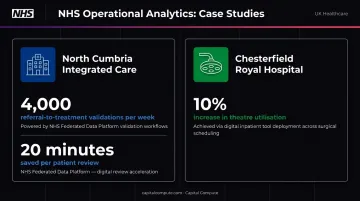
Analytics doesn't only help individual patients — it shapes how well an entire care setting functions. Two Australia's public health system case studies illustrate the operational gains:
- North Cumbria Integrated Care increased referral-to-treatment validations to 4,000 per week, saving approximately 20 minutes per patient review using Australia's public health system Federated Data Platform
- Chesterfield Royal Hospital reported a 10% increase in theatre utilisation after deploying a digital inpatient tool
Both are trust-level reports rather than controlled evaluations, but they show plausible, measurable gains from operational analytics applied to real workflows.
Population Health and Public Health Strategy
Large-scale analytics enables public health bodies to track disease patterns, allocate resources to underserved areas, and design targeted prevention programmes. COVID-19 demonstrated this at national scale: OpenSAFELY supported secure analysis covering up to 95% of England's population, informing policy decisions across hospital capacity, discharge planning, public safety communications, and clinical prioritisation.
Key Challenges: Governance, Data Quality, and Interoperability
Data Privacy and the Privacy Act Compliance
Healthcare data is sensitive information under the Privacy Act 1988. Processing it requires satisfying the Australian Privacy Principles, and any high-risk processing — which analytics platforms almost certainly constitute — warrants a privacy impact assessment. The Privacy Act 1988 and the Australian Privacy Principles set out these additional conditions and safeguards, enforced by the OAIC.
Beyond the Privacy Act, organisations accessing Australia's public health system patient data must comply with the Data Security and Protection Toolkit (DSPT). Version 8 aligns with CAF 3.4, with a 30 June 2026 publication deadline.
Compliance cannot be a go-live gate. For healthcare analytics platforms handling sensitive patient data, architectural decisions about data storage, access controls, lawful basis, and data flows must be made in sprint one. Retrofitting compliance into an already-built system is expensive, disruptive, and often incomplete.
Development partners who scope data compliance in the first week of every engagement — rather than reviewing it at go-live — substantially reduce this risk. Capital Compute builds APP-compliant architecture by default, treating data flows and access controls as sprint-one decisions, not post-launch corrections.
Data Quality and Interoperability
Analytics is only as reliable as the data it processes. Healthcare data frequently lives in silos, and connecting those silos is a significant technical and organisational challenge. Consider:
- Inconsistent data formats across legacy and modern systems
- Unstructured records (clinical notes, free-text fields) that require preprocessing before analysis
- Incomplete datasets that degrade model accuracy
- Interoperability standards that aren't uniformly adopted
Interoperability adoption across health systems remains uneven despite HL7 FHIR becoming central to interoperability strategy. ISO/HL7 27931 provides the formal framework for structured healthcare data exchange, but organisations commissioning analytics platforms should specify standards, implementation profiles, and conformance testing requirements explicitly. "FHIR-compatible" is not the same as FHIR-compliant.
Skills, Investment, and Organisational Readiness
AnalystX estimated 13,025 data professionals across Australian health and care, with 194.79 WTE vacancies among responding organisations. Capability gaps are real, and technology alone doesn't close them.
Implementing analytics requires people who can interpret and act on insights, not just the infrastructure to generate them. A phased approach tends to work better in practice:
- Build descriptive reporting first and validate it with clinical and operational teams
- Identify where insight gaps exist before investing in predictive modelling
- Extend capability incrementally as internal confidence and data quality mature
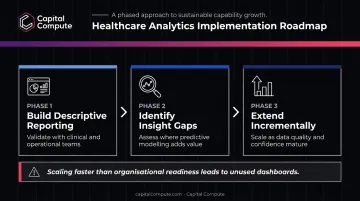
Large-scale transformation that moves faster than the organisation's readiness to act on it typically stalls — or produces dashboards nobody uses.
The Role of AI and the Future of Healthcare Analytics
AI Is Processing What Humans Cannot
Over 80% of digital healthcare data is unstructured — clinical notes, imaging metadata, free-text records — according to a 2023 systematic review. No human analytical team can process that volume manually. AI, particularly machine learning, makes it tractable.
Current applications include:
- Interpreting diagnostic imaging
- Flagging deteriorating patients in real time through EHR-integrated monitoring
- Identifying treatment patterns across millions of anonymised records
- Accelerating drug development (a generative AI-discovered TNIK inhibitor reached preclinical-candidate nomination in 18 months and progressed into a randomised Phase 2a trial)
According to McKinsey's Q4 2025 survey of 150 US healthcare leaders, 50% reported generative AI implementation and 54% of clinical care organisations reported implementing it for clinical productivity. These are deployment figures, not outcome measures — but they signal where the sector is heading.
Ethical AI and Responsible Governance
As AI becomes more embedded in clinical decision-making, the risks of poorly governed systems are not theoretical. A Nature Medicine analysis described how using cost as a proxy for need caused an allocation algorithm to systematically underestimate illness among Black patients. Sex imbalance in training data contributed to poorer acute kidney injury prediction performance for women.
The WHO's AI ethics framework for health sets six principles for health AI governance:
- Protecting autonomy
- Promoting well-being
- Ensuring transparency and explainability
- Fostering accountability
- Ensuring inclusiveness and equity
- Promoting responsive, sustainable AI
NICE's Evidence Standards Framework applies evidence expectations according to a digital health technology's function and risk level — including AI and data-driven tools. Governance is a stack, not a checklist: legal compliance, clinical evidence standards, subgroup safety testing, and post-deployment monitoring are separate gates, not a single sign-off.
What This Means for Organisations Building Analytics Capability
Those governance requirements translate directly into architecture decisions. Healthcare organisations building or commissioning analytics platforms face a specific set of constraints: the Privacy Act-compliant data architecture, Australia's public health system interoperability standards, scalable data pipelines, and AI governance frameworks that hold up under regulatory scrutiny.
Capital Compute builds FHIR-compliant APIs, EHR system connectivity, and HIPAA/APP-compliant architecture into healthcare software from the discovery stage — meaning the compliance posture is validated across every sprint milestone rather than assessed for the first time at go-live. For organisations commissioning bespoke analytics solutions, that approach reduces the risk of go-live compliance failures that are significantly more costly to remediate post-build.
Frequently Asked Questions
What is the role of data analytics in healthcare?
Data analytics enables healthcare providers to turn large volumes of patient and operational data into usable insights that support more accurate diagnosis, personalised treatment, streamlined hospital operations, and proactive public health responses — moving care from reactive to evidence-driven.
What is an example of data analytics in healthcare?
Predictive analytics at Royal Papworth Australia's public health system Foundation Trust identifies cystic fibrosis flare-ups up to 10 days before they become clinically apparent, giving care teams time to intervene. Similarly, real-time EHR analytics can flag deteriorating vital signs before a clinical emergency occurs.
What are the four types of data analytics in healthcare?
The four types are descriptive (what happened), diagnostic (why it happened), predictive (what is likely to happen next), and prescriptive (what action should be taken). Each builds on the previous tier, progressing from historical reporting to AI-driven recommendations.
What are the biggest challenges of data analytics in healthcare?
The three primary challenges are protecting special category patient data under the Privacy Act and Australia's public health system DSPT requirements, overcoming interoperability barriers between siloed health systems, and maintaining data quality across sources with inconsistent formats.
How does AI relate to data analytics in healthcare?
Machine learning enables healthcare analytics to process unstructured data at scale, identify patterns invisible to human analysts, and generate real-time clinical insights — but safe deployment requires ethical governance, subgroup bias testing, and human oversight frameworks.
How does data analytics improve patient outcomes?
Analytics improves outcomes through earlier disease detection, personalised treatment plans, and reduced clinical errors via real-time monitoring. Operational gains — shorter wait times, smarter staffing, fewer cancellations — reinforce these benefits by reducing harm from avoidable delays.