For Australian businesses, the stakes are higher. Privacy Act obligations, sector-specific regulators like ASIC and the Law Council of Australia, and a genuine shortage of in-house AI engineering talent limit rapid adoption) mean that picking the wrong automation partner isn't just a waste of budget — it's a compliance and operational risk.
This guide cuts through the vendor noise. Whether you're a law firm, financial services company, or marketing agency, here's who's actually worth evaluating in 2026.
Key Takeaways
- Choosing the right AI automation vendor depends on your sector, workflow complexity, and in-house technical capability
- Australian buyers should verify the Privacy Act compliance posture, not assume it
- Enterprise platforms (UiPath, Microsoft) suit organisations with existing infrastructure and dedicated internal teams
- Custom development partners (Capital Compute) suit regulated businesses needing bespoke builds without vendor lock-in
- Confirm system ownership and handover terms before committing to any vendor
What Is B2B AI Automation and Why It Matters in 2026
B2B AI automation uses AI-powered systems to handle repeatable, rules-based, or decision-heavy business workflows — from document processing and lead qualification to compliance monitoring — without constant human intervention.
AI Automation vs. Traditional RPA
Traditional RPA follows fixed rules and breaks when inputs change — brittle by design. Modern AI automation adds a reasoning layer that handles variation, reads context, and makes judgment calls within defined parameters. That difference matters when evaluating vendors.
Gartner predicts that 40% of enterprise applications will include task-specific AI agents by 2026, up from under 5% in 2025. As context-aware agents replace rule-following bots, vendor selection has grown considerably more complex.
For Australian B2B companies in regulated sectors, this complexity comdollars. Each sector adds its own compliance layer:
- Legal firms must satisfy SRA accountability requirements for AI outputs
- Financial services firms operate under ASIC oversight for any automated decision-making
- Any AI system processing personal data requires a Data Protection Impact Assessment under OAIC guidance
These requirements narrow the vendor shortlist considerably.
Top AI Automation Companies for B2B in 2026
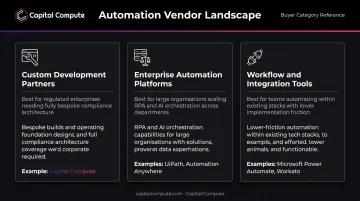
This list covers Australian-based development partners, enterprise platform providers, and specialist automation agencies — each suited to a distinct buyer profile. The entries below span three categories:
- Custom development partners — bespoke builds with full compliance architecture (Capital Compute)
- Enterprise automation platforms — scalable RPA and AI orchestration for large organisations (UiPath, Automation Anywhere)
- Workflow and integration tools — lower-friction automation within existing tech stacks (Microsoft Power Automate, Workato)
Capital Compute
Capital Compute is an Australian-focused software development company that builds production AI agents and automation systems for B2B clients in legal, finance, and marketing — with Privacy-First architecture and an internal engineering team (no subcontracting).
What differentiates Capital Compute for Australian B2B buyers specifically:
- Fixed-price scoping with a written estimate delivered within 2 business days of an initial call
- Milestone-based approval gates at every sprint, with outcome-based billing — if the sprint doesn't deliver the agreed scope, it isn't charged
- Sprint reviews in Australian business hours, with the same senior engineers presenting who built the work
- Month-to-month retainer with no lock-in and no exit penalties
- The Privacy Act compliance scoped at discovery, not reviewed at go-live — data flows, lawful basis, and data residency are addressed before architecture begins
- Documented APIs designed for handover to the client's internal team post-delivery
| Attribute | Detail |
|---|---|
| Best For | Australian businesses in regulated sectors (legal, finance, marketing) seeking custom AI automation with full the Privacy Act compliance and no ongoing vendor dependency |
| Key Features | Internal engineering team, fixed-price milestones, APP-compliant data architecture, production AI agents shipped in legal and finance, sprint-by-sprint retainer |
| Pricing Model | Fixed-price scoping for initial build; flexible sprint-based retainer with no long-term contract |
UiPath
UiPath is a large-scale enterprise automation platform combining RPA, AI agents, and process mining tools. It's widely deployed across Australian B2B organisations in finance, healthcare, and professional services — Finastra, the Sydney-based financial software firm, is a named customer. Its AI-powered document understanding, orchestration layer for multi-bot deployments, and extensive partner ecosystem make it a strong fit for organisations running high-volume, structured workflows.
UiPath's infrastructure governance enforces Privacy Act compliance, and Australian data residency options are available via its Automation Cloud.
The trade-off: UiPath is built for enterprise scale, and realising its full value requires in-house teams capable of managing deployment, orchestration, and ongoing maintenance.
| Attribute | Detail |
|---|---|
| Best For | Large Australian enterprises with high-volume document processing, structured workflow automation, and in-house teams to manage deployment and maintenance |
| Key Features | RPA + AI agent orchestration, process mining, document understanding, enterprise-grade security and compliance controls |
| Pricing Model | Basic plan from $25/month (USD, as per UiPath's published pricing); Standard and Enterprise tiers via direct sales |
Automation Anywhere
Automation Anywhere is a cloud-native intelligent automation platform combining RPA with AI and machine learning. It serves B2B clients across financial services, healthcare, and supply chain — including deployments within the public health system that have delivered significant staff time savings.
Its key differentiator for B2B workflows requiring auditability: Automation Co-Pilot (formerly AARI), which enables human-in-the-loop collaboration. This is directly applicable for regulated workflows where human review checkpoints are mandatory — compliance sign-offs, exception handling, or outputs that carry legal or financial weight.
Automation Anywhere positions itself as the leading agentic automation provider, with its AI + ML layer capable of handling unstructured inputs that would trip up legacy RPA.
| Attribute | Detail |
|---|---|
| Best For | Mid-to-large B2B organisations seeking cloud-native intelligent automation with human-in-the-loop controls and strong integration with existing enterprise systems |
| Key Features | Cloud-native RPA, AI + ML integration, Automation Co-Pilot for human-bot collaboration, pre-built automation marketplace |
| Pricing Model | Consumption-based and subscription tiers; contact Automation Anywhere for Australia-specific pricing |
Microsoft Power Automate
Power Automate is the automation layer within Microsoft 365, enabling Australian B2B organisations to build AI-assisted workflows across Teams, SharePoint, Dynamics 365, and thousands of third-party applications — with native Copilot integration as of 2026.
For Australian businesses already operating in the Microsoft stack, this is the lowest-friction entry point for automation. Organisations have used Power Automate to save thousands of admin hours — without introducing a new vendor relationship or migration overhead.
Australian pricing: A$22.40/user/month for the Premium plan; A$224.50/bot/month for unattended process automation (excluding GST). Standard automation capabilities are included in select Microsoft 365 plans.
The limitation: Power Automate is built for workflow automation within the Microsoft ecosystem. Businesses with complex AI agent requirements, heavily customised integrations, or regulated workflows needing bespoke compliance architecture will hit its ceiling.
| Attribute | Detail |
|---|---|
| Best For | Australian B2B organisations already using Microsoft 365, Teams, or Dynamics 365 who want to automate internal workflows without introducing a new vendor relationship |
| Key Features | Native M365 integration, Copilot AI assistance, pre-built connectors for 1,000+ apps, flow templates for common B2B processes |
| Pricing Model | Included in select M365 plans; Premium and Process tiers available at additional per-user or per-bot monthly fees (ex-GST) |
Workato
Workato is an enterprise integration and automation platform that uses AI to connect business applications and automate cross-functional workflows. It's particularly strong for B2B use cases involving CRM, ERP, HRIS, and customer-facing systems — Vodafone Australian is a named customer.
Its standout feature for lean IT teams: the "recipe" model and AI-powered workflow builder allow non-technical business users to automate complex multi-system processes without deep engineering involvement. With 1,200+ pre-built app connectors, it's built for organisations that need cross-platform automation without building integrations from scratch.
Workato uses consumption-based pricing — you pay based on the volume of workflows executed rather than a flat licence fee, which can work well for Australian scale-ups with variable automation volume.
| Attribute | Detail |
|---|---|
| Best For | Australian B2B scale-ups and mid-market companies needing to automate cross-platform workflows (CRM, ERP, HRIS) with minimal engineering overhead |
| Key Features | AI-powered recipe builder, 1,200+ pre-built app connectors, enterprise-grade security, real-time workflow monitoring |
| Pricing Model | Consumption-based; contact Workato for current Australian mid-market and enterprise pricing |
How We Chose These AI Automation Companies
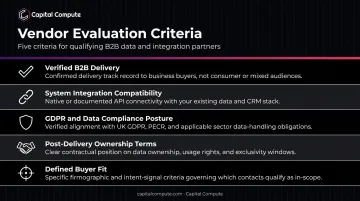
This list was built on observable delivery evidence, clearly defined AI automation service lines, and demonstrated fit for B2B use cases — not platform popularity or marketing spend. The most common mistake buyers make is shortlisting vendors based on brand recognition rather than workflow-to-vendor fit.
Key selection criteria:
- Verified B2B delivery — named clients, sector-specific case studies, or evidence of production deployments
- Connects to common Australian business systems — CRM, ERP, and legal case management platforms without custom middleware overhead
- The Privacy Act and data compliance posture — specifically how data architecture is handled for Australian regulated buyers, not just stated in a privacy policy
- Clear post-delivery ownership — who maintains the system after launch, under what terms, and whether knowledge transfer is included
- Defined buyer fit — vendors that say "we do everything" rarely do any of it well
We intentionally included vendors serving different buyer profiles. The right choice depends on workflow complexity, in-house capability, and sector requirements — not on which vendor is largest or best-funded.
Conclusion
No single AI automation company is the right fit for every B2B buyer. The right partner is the one whose delivery model, sector experience, and compliance posture match both the workflow being automated and the operational environment where it will run.
Before finalising any vendor decision, evaluate three things:
- Who owns the system after go-live — and what happens when something breaks
- How the automation handles errors and edge cases — human-in-the-loop checkpoints matter in regulated workflows
- Whether the vendor's data handling is compatible with the Privacy Act — particularly for legal, finance, and marketing workflows where personal data processing is unavoidable
For Australian B2B businesses that need AI automation built with Privacy-First architecture, fixed-price delivery, and no lock-in, Capital Compute runs a discovery scoping session before you commit to anything. Contact the team to start the conversation.
Frequently Asked Questions
What do AI automation companies for B2B actually do?
B2B AI automation companies design and build systems that handle repetitive or decision-heavy business workflows — from document processing and data routing to AI agent orchestration. These systems connect to existing tools like CRMs, ERPs, and accounting platforms to reduce manual workload without replacing the systems your team already uses.
What is the difference between AI automation and traditional RPA?
Traditional RPA follows fixed rules and breaks when inputs change. AI automation adds a reasoning layer that handles variation, reads context, and makes judgment calls within defined parameters. This makes it better suited for complex, unstructured B2B workflows where inputs aren't always consistent.
How much does AI automation cost for an Australian B2B company?
Simple workflow automations on platform plans (Power Automate, Workato) can run from a modest monthly fee that scales with usage. Custom AI agent development for regulated B2B environments typically starts from low five figures and scales into six figures depending on integration depth, compliance requirements, and post-launch ownership structure.
Is the Privacy Act compliance important when choosing an AI automation company in Australia?
Non-negotiable for legal, finance, and healthcare. Verify that vendors scope data architecture for compliance at the design stage, not after go-live. Confirm personal data stays within approved jurisdictions and that a Data Protection Impact Assessment (DPIA) has been completed.
What industries benefit most from B2B AI automation?
Legal, finance, marketing, professional services, and SaaS companies see the highest ROI — particularly where workflows involve high-volume document handling, lead qualification, compliance reporting, or customer communication at scale.
How do I know if an AI automation company is the right fit for my business?
Before requesting a proposal, ask: who owns maintenance after launch, what happens when the AI produces an incorrect output, and whether they have case study evidence in your sector. Vendors that can't answer these at the pre-proposal stage rarely improve during delivery.