Introduction: Why Australian Startups Are Turning to Software Development Outsourcing
Australian startups face a familiar bind: ambitious product roadmaps, limited engineering headcount, and investors expecting working software rather than slide decks. Hiring senior developers takes time — and costs far more than most founders budget for when employer superannuation, recruitment fees, and onboarding are factored in alongside salary.
That pressure makes outsourcing a strategic option worth understanding properly, not a fallback when hiring fails.
This guide covers what software development outsourcing actually is, which engagement models suit different startup stages, the risks that genuinely matter, and how to identify a partner who solves problems rather than creates them. The Privacy Act and Australian compliance obligations get specific attention throughout — because Australian startups cannot afford to treat these as an afterthought.
Key Takeaways
- Outsourcing eliminates recruitment fees, employer NI, and 3–6 month hiring cycles — not just developer day rates
- Model choice depends on stage: fixed-price suits defined builds; dedicated teams suit ongoing SaaS products
- IP ownership does not transfer automatically — a written assignment is required before code is written
- Australian startups remain APP entities regardless of who builds the software
- Verify whether your outsourcing provider subcontracts before signing — it is a common and overlooked risk
What Is Software Development Outsourcing?
Software development outsourcing means delegating the design, build, testing, or maintenance of software to an external team rather than employing in-house developers. It covers everything from a single feature build to full product lifecycle management.
Outsourcing is no longer primarily a cost-cutting measure. Australian startups now use it to access senior engineering talent on demand, bring in specialist capabilities — APP-compliant architecture, AI development, complex API integrations — and sidestep the six-to-twelve month risk of a permanent hire that doesn't work out.
Key Terms Worth Distinguishing
These four terms get used interchangeably, and they shouldn't:
- Outsourcing — the umbrella term for using an external team to deliver software
- Offshoring — the external team is based in a lower-cost country
- Nearshoring — the team is geographically closer, often in a similar or adjacent time zone
- Staff augmentation — pre-vetted engineers are embedded into your existing team under your direction
For Australian startups, the more useful question is which model fits your current stage — and what contractual protections belong in the agreement before work begins.
Why Australian Startups Are Choosing to Outsource Software Development
The True Cost of Hiring In-House
The salary figure is only part of the cost. Hiring a mid-level software engineer in Australia means:
- Median total compensation of A$178,428 for a senior software engineer in Australia, with base pay around A$152,000
- Superannuation Guarantee at 12% of ordinary time earnings, effective from 1 July 2025
- Minimum employer pension contribution of 3% of qualifying earnings
- Recruitment agency fees of 15–20% of first-year salary for permanent roles
- Hardware, software licences, and onboarding time before the engineer ships anything useful
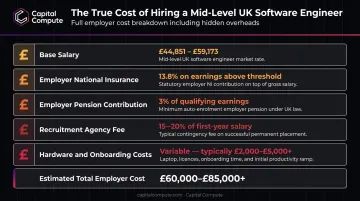
Outsourcing removes all of these on-costs — you pay for engineering output, not employment overhead.
Specialist Skills Without Permanent Headcount
Australian startups in regulated sectors consistently need niche capabilities that are expensive — or simply unavailable — to hire permanently at early stage. AI skills remain in short supply even as adoption accelerates: SME AI adoption reached 44% in February 2026, according to ai.gov.au, far outpacing the availability of specialist talent.
Outsourcing provides those skills for the duration of need only. Whether that's AI agent development, ASIC-compliant audit trail architecture, or a Privacy Act-ready data pipeline — you access the capability without carrying it permanently on payroll.
Speed to Market
Outsourced teams with established delivery workflows compress the time between idea and working software. For SaaS founders building towards a funding round, that difference matters. An internal hire who joins in month three typically takes two more months to become productive — then needs the architecture explained from scratch. An experienced external team removes that delay entirely.
Scalability Without Redundancy Risk
Engineering demand isn't constant. Build sprints need more capacity; quieter periods need less. Outsourcing flexes with that reality:
- Scale up for a sprint with no hiring lag
- Scale back without notice periods or redundancy obligations
- No awkward conversations when priorities shift
Permanent headcount doesn't bend this way — and at early stage, that rigidity is a real liability.
Freeing Founders to Focus
When technical delivery is handled externally, founders and non-technical leadership can concentrate on customer acquisition, investor relations, and product strategy — not daily engineering operations.
Outsourcing Models Explained: Which One Fits Your Stage?
Fixed-Price Project Model
The vendor delivers against a defined scope for a fixed budget. The provider carries the cost-overrun risk, provided the scope was well-defined at the outset.
Best for: One-off builds with a clearly specified end state — a defined MVP, a specific integration, a standalone feature.
Key risk: Scope creep when requirements are vague upfront. Milestone-based approval gates (not a single delivery at the end) are the mitigation.
Capital Compute structures this as a fixed-price estimate delivered within two business days of scoping, with every sprint defined in writing and fortnightly client approval gates throughout.
Time and Materials Model
The client pays for actual hours worked at agreed rates against a flexible scope. The buyer carries more cost exposure.
Best for: Exploratory or iterative builds where requirements evolve — early discovery phases, or products where the right solution isn't yet clear.
Key risk: Without sprint-by-sprint governance, budgets become unpredictable fast. Weekly or fortnightly sprint reviews with agreed scope per sprint are non-negotiable controls.
Dedicated Team / Staff Augmentation
Pre-vetted engineers work exclusively on your product, under your direction, as an extension of your team. This model compounds in value: engineers learn the codebase, accumulate context, and stay accountable across the engagement. Capital Compute's dedicated team model operates this way — the same engineers who build the initial product remain on the retainer, maintaining codebase continuity across sprints.
Best for: Ongoing SaaS product development where engineering continuity matters.
Contrast: Project-based outsourcing hands over and exits. A dedicated team retains the codebase context — and that accumulated knowledge is what makes ongoing development faster and cheaper over time.
How to Match Model to Your Stage
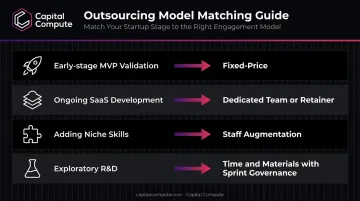
| Startup Stage | Recommended Model |
|---|---|
| Early-stage MVP validation | Fixed-price with defined scope |
| Ongoing SaaS product development | Dedicated team or retainer |
| Adding niche skills to an existing team | Staff augmentation |
| Exploratory build or R&D phase | Time and materials with sprint governance |
Onshore vs Nearshore vs Offshore
- Onshore (team in Australia) — highest cost, easiest collaboration, clearest privacy accountability
- Nearshore (adjacent time zones, e.g., Eastern Europe) — meaningful cost saving with workable overlap hours and daily communication intact
- Offshore (significantly different time zones, e.g., South Asia) — lower rates, but daily collaboration and governance alignment become harder to sustain
For regulated Australian projects, async-only working across a five-hour time difference creates governance gaps that typically cost more than the rate saving justifies.
The Real Risks of Outsourcing Software Development — And How to Manage Them
Managing the Real Risks of Outsourcing Software Development
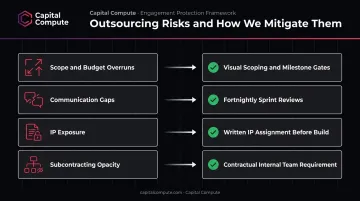
Misaligned Scope and Budget Overruns
The most common cause of outsourcing failure is starting development before requirements are clearly defined. Once engineers are building, changing direction is expensive.
Mitigation: Visual scoping, wireframes, and a documented MVP definition in sprint one. Milestone-based approval gates, not a single delivery at the end.
Communication and Governance Gaps
Time zone misalignment and infrequent check-ins allow small misunderstandings to become expensive course corrections. A two-week silence at the wrong moment can mean two weeks of work in the wrong direction.
Mitigation: Structure this with fortnightly sprint reviews, written progress reports, and defined approval gates at each milestone. Sprint reviews delivered in Australian business hours matter, particularly for regulated clients who need documented evidence of oversight.
IP Exposure
Australian copyright guidance is clear: for commissioned work, the commissioner does not automatically own copyright. Without a written IP assignment, you may be left with an implied licence rather than full ownership.
Mitigation: IP assignment clauses must be in place before the first line of code is written. An NDA alone is insufficient — the assignment must specifically transfer ownership of the codebase to you.
The Privacy Act and Data Security
The Federal Court's A$5.8 million penalty against Australian Clinical Labs over the Medlab data breach demonstrates that poor technical implementation by software providers carries direct regulatory consequence.
Mitigation: A Privacy Act-compliant data processing agreement signed before work starts. Privacy architecture scoped at discovery, not reviewed at go-live.
Subcontracting and Team Opacity
Many outsourcing providers win work and subcontract delivery to unknown third parties. This creates accountability gaps that are easy to overlook: inconsistent code quality, IP exposure, and unknown data handling practices.
Before signing anything, ask directly whether delivery is handled by an internal team or subcontracted. Make it a contractual requirement, not just a verbal assurance. Capital Compute delivers all work through an internal engineering team with no subcontracting at any stage.
Australia-Specific Considerations: the Privacy Act, Compliance, and Sector Risk
You Remain the Data Controller
Under the Privacy Act Article 28, the controller's obligations do not transfer to the processor. Australian startups remain responsible for the data architecture decisions their outsourced team makes — regardless of who wrote the code.
The practical consequence: APP-compliant architecture must be scoped and documented at discovery, not reviewed at go-live when changes are expensive and disruptive.
Regulated Sectors Demand More
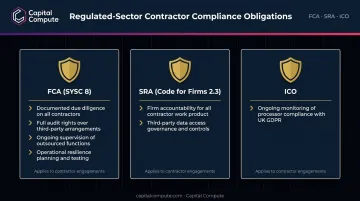
Australian businesses in legal, finance, and marketing face compliance obligations — ASIC, SRA, OAIC — that must shape technical architecture from day one. An outsourcing partner without sector experience may default to architecture choices that create remediation work later.
Key requirements include:
- ASIC-regulated firms: SYSC 8 requires documented due diligence, audit rights, ongoing supervision, and operational resilience mapping.
- SRA-regulated firms: Code for Firms rule 2.3 keeps the firm accountable for contractor work, including third-party access to client data.
- OAIC obligations: Controllers must monitor processor compliance on an ongoing basis — not as a one-time sign-off.
Capital Compute's Approach
Capital Compute scopes APP-compliant data architecture at the discovery stage — before any architecture decisions are made. Discovery deliverables include:
- Lawful basis mapping for each data processing activity
- Consent structure design and subject rights handling
- Oversight documentation formatted for ASIC, SRA, or OAIC audit requirements
Sprint reviews are delivered in Australian business hours, giving regulated-sector clients a clear record of what was built, why, and how it meets their compliance obligations.
How to Choose the Right Software Development Partner
Ask Whether the Team Is Internal or Subcontracted
This is the single most important due diligence question. Internal teams provide accountability, consistency, and a single point of responsibility. Subcontracted delivery creates opacity: you have no visibility into who is handling your code, your data, or your IP.
Check These Contract Terms Specifically
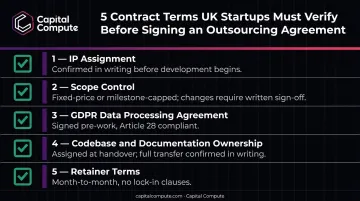
Before signing anything, verify:
- IP assignment: confirmed in writing before development begins, not deferred to handover
- Scope control: fixed-price or milestone-capped, not open-ended
- The Privacy Act data processing agreement: signed before work starts, covering Article 28 mandatory terms
- Codebase and documentation ownership: explicitly assigned at handover, including API docs
- Retainer terms: month-to-month with no lock-in and no exit penalties
Capital Compute's Model
The checklist above reflects what a well-structured engagement should look like in practice. Capital Compute offers fixed-price scoping with fortnightly sprint reviews and client approval gates at every milestone. All delivery is handled by an internal engineering team — no subcontracting. Post-launch support runs on a month-to-month retainer with no lock-in, and full codebase documentation is a standard handover deliverable so your internal team can maintain the product independently. Clients retain full IP ownership at close.
Frequently Asked Questions
What is software development outsourcing?
It's the practice of hiring an external team to design, build, test, or maintain software instead of employing in-house developers. It covers everything from a single feature build to full ongoing product development, including MVP engineering, SaaS builds, and legacy modernisation.
What are the four types of outsourcing?
The main models are fixed-price project (defined scope and budget), time and materials (billed for actual hours with flexible scope), dedicated team (engineers embedded into your product full-time), and staff augmentation (contractors added to your existing team). The key difference between them is who carries scope risk and how much client oversight is built in.
What is a BPO in software?
Business Process Outsourcing means delegating an operational function, such as QA or data processing, to an external provider. It differs from custom software outsourcing, where you're commissioning engineering work to build a product, not handing off a business operation.
What are the biggest risks of outsourcing software development for an Australian startup?
The top risks are unclear scope causing budget overruns, IP not contractually assigned before build begins, the Privacy Act architecture implemented incorrectly, and providers that subcontract without disclosure. Each has a direct mitigation: scoping documentation, written IP assignment, a the Privacy Act DPA at contract stage, and confirmed internal team delivery.
How do Australian businesses protect Privacy Act compliance when outsourcing software development?
Sign a the Privacy Act-compliant data processing agreement before work starts. Ensure data architecture, covering lawful bases, consent structures, and subject rights handling, is defined at the scoping stage, not reviewed at go-live. Verify that the outsourcing partner has demonstrable experience in regulated-sector builds, not just general software delivery.
What is the difference between a fixed-price and time-and-materials contract?
Fixed-price contracts lock scope and budget upfront, making them best for well-defined builds with clear requirements. Time-and-materials contracts bill for actual hours worked, which suits iterative builds where scope will evolve. Both models need milestone-based review points; without them, time-and-materials engagements can produce unpredictable costs.