Introduction
Building software without a full in-house engineering team is one of the most common — and costly — challenges Australian startups and SMBs face. The wrong partner, an ill-defined scope, or a mismatched service type can set a product back by months and drain budgets that were never large to begin with.
The risks compound quickly:
- Architecture decisions made in week one are expensive to reverse at month six
- Privacy Act compliance retrofitted before launch is far more disruptive than building it in from the start
- A development partner who disappears after handover leaves a codebase nobody can maintain
This guide covers what software development services actually are, which types matter at the startup and SMB stage, how the development lifecycle works in practice, and what to look for when choosing an Australian partner — so you can make those early decisions with fewer costly mistakes.
Key Takeaways:
- Match the service type to your current stage — not every model suits every objective
- Architecture and the Privacy Act decisions made at discovery are the costliest to reverse later
- Post-launch maintenance typically accounts for 40–80% of total software lifecycle cost
- Each build model (in-house, outsourced, retainer) carries distinct risks requiring contractual mitigation
- Choosing the right Australian partner means verifying compliance credentials before contracts are signed
What Are Software Development Services?
Software development services span every professional activity involved in designing, building, testing, deploying, and maintaining software — from initial discovery workshops and architecture design through to post-launch support and iterative feature development.
The term gets used in two distinct ways, and the confusion between them matters:
- Commercial services — the types of work a development company provides: custom builds, mobile apps, API integrations, DevOps, and so on
- Architectural services — modular, reusable software components that expose specific functionality via defined interfaces (APIs), forming the basis of service-oriented and microservices architectures
The architectural meaning has direct implications for how you scale. A monolithic application — where all functionality is tightly coupled — becomes progressively harder to modify as the product grows.
Breaking functionality into discrete services (authentication, billing, notifications) means each component can be updated, scaled, or replaced independently. For a startup expecting to iterate quickly, this distinction shapes every architectural decision made in sprint one.
That architectural clarity is one reason demand for external development partners has accelerated. The global custom software development market has been forecast to grow rapidly through the rest of the decade, reflecting how many businesses, at every stage, now depend on external engineering partners to build and maintain competitive software.

Core Software Development Service Types for Startups and SMBs
Not every service type is equally relevant depending on where you are. The key is matching the service to your current objective: validate an idea, go to market, scale an existing product, or modernise legacy infrastructure.
Custom Software Development and SaaS
Custom software development means building a product tailored specifically to your business problem — as opposed to adapting an off-the-shelf tool to fit a workflow it wasn't designed for.
Custom development makes sense when:
- Your workflow is genuinely unique and a SaaS tool would require too many compromises
- The software represents a proprietary competitive advantage
- You need to own the data model and architecture outright
For many Australian product startups, the relevant service is SaaS development — building a subscription-based product on a scalable cloud architecture, typically with multi-tenant data isolation, role-based access, and subscription billing logic designed from sprint one. This is the dominant commercial model for new software products in the Australian market.
The alternative — adopting existing SaaS tools — is faster and cheaper initially, but imposes fixed workflows, ongoing subscription costs, and no architectural ownership. The right choice depends on how central the software is to your competitive advantage.
Web and Mobile Application Development
Web application development covers browser-based platforms, internal portals, dashboards, and customer-facing tools built on frameworks like React or Next.js. These are the workhorses of most B2B software products.
Mobile app development splits into two approaches:
| Approach | Examples | Best for |
|---|---|---|
| Native | Swift (iOS), Kotlin (Android) | High performance, complex UI, device-deep integrations |
| Cross-platform | React Native, Flutter | Faster delivery, lower cost, shared codebase |
Cross-platform frameworks have matured considerably. Stack Overflow's 2023 Developer Survey found Flutter used by 9.12% of respondents and React Native by 8.43% — both well-established across production codebases. For most SMB use cases, cross-platform is the practical starting point. Native development becomes relevant when performance requirements or deep device integrations demand it.
API Development, System Integrations, and Legacy Modernisation
API development creates the documented interfaces that allow systems to communicate — connecting payment gateways, CRMs, third-party data sources, and internal tools. For SMBs with existing software stacks, clean API design is what makes integration maintainable rather than a recurring source of technical debt.
Legacy modernisation is particularly relevant to Australian finance, legal, and professional services firms sitting on ageing platforms that are expensive to maintain but too operationally critical to replace outright. The practical approach is incremental:
- Identify components that change most frequently or cause the greatest operational friction
- Modernise those first, before touching stable core systems
- Avoid full platform replacement in a single project — the disruption risk rarely justifies the speed
AI, Automation, and DevOps Services
AI development has moved from speculative to practical for many SMBs. Agent-based workflows, LLM integrations, and predictive tools now have real applications in legal document processing, financial compliance, and marketing automation.
According to the ABS, 12% of Australian businesses had adopted AI in 2024-25, up from just 1% in 2021-22 — with adoption reaching 19% among innovation-active small businesses, signalling where the market is heading.
DevOps (CI/CD pipelines, cloud infrastructure, automated testing) is not a luxury for startups expecting to ship regularly. DORA's research on continuous delivery shows that high-performing teams with automated test feedback loops get results in under ten minutes, directly reducing the cost of catching bugs late.
Teams that skip DevOps infrastructure tend to find out the hard way: a first scaling event that overwhelms a manual deployment process is an expensive lesson in what should have been built from the start.
The Software Development Lifecycle: What Startups and SMBs Should Expect
Understanding the SDLC matters for buyers, not just engineers. It helps you set realistic expectations, avoid scope creep, and hold development partners accountable at each stage.
Stage 1 — Discovery and Requirements
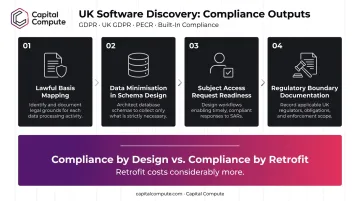
This phase defines what gets built and why — before a single line of code is written. A proper discovery process maps data flows, identifies integration dependencies, sets architecture principles, and establishes the regulatory boundaries within which every subsequent sprint will operate.
For Australian businesses in regulated sectors, discovery is where APP obligations are addressed:
- Lawful basis mapping and consent architecture
- Data minimisation principles embedded in schema design
- Subject access request readiness from day one
- Regulatory boundary documentation for every subsequent sprint
Decisions made here determine whether your platform is compliant by design or compliant by retrofit — and retrofit costs considerably more. The output is typically a fixed-price scope, a technical roadmap, and an architecture decision framework. These become your reference point for every sprint review.
Stage 2 — Design
Design covers three parallel workstreams:
- System architecture — how components connect, what services exist, how data flows between them
- UI/UX design — wireframes, user flows, and interface logic before front-end development begins
- Database modelling — schema design, relationships, indexing strategy
Validating design with lightweight prototypes before committing to full development is a practical way to test assumptions cheaply. A wireframe revision takes hours; reworking a data model mid-sprint takes days or weeks.
Stage 3 — Development and Testing
Agile sprint-based delivery — typically fortnightly cycles — keeps clients actively involved throughout the build. Each sprint produces working software that is reviewed, approved, and used to scope the next cycle.
Testing must run concurrently with development, not after it. The cost of finding and fixing a bug scales dramatically the later it is caught — a defect identified during development costs a fraction of one caught after deployment. Functional testing, performance testing, and security testing should all be embedded within sprints, not scheduled as a separate phase before go-live.
Stage 4 — Deployment and Post-Launch Maintenance
Production deployment covers environment configuration, infrastructure setup, and release management. But the work doesn't stop at launch.
Maintenance — bug fixes, security patches, feature updates, and performance monitoring — represents the majority of total software cost over a product's lifetime. The Carnegie Mellon Software Engineering Institute puts maintenance at 40–80% of total software lifecycle cost — a wide range, but the direction is consistent: owning software costs more than building it.
This is why post-launch arrangements — who maintains the system, on what terms, and with what level of continuity from the original engineering team — deserve as much attention during scoping as the build itself.
Build In-House, Outsource, or Use a Retainer? A Decision Framework for SMBs
Three primary models exist, and each suits a different scenario.
The Three Models
| Model | How it works | Ends when? |
|---|---|---|
| In-house | Full-time engineers on payroll | Never — ongoing employment |
| Project outsourcing | Fixed-scope build delivered by external partner | At delivery/handover |
| Retainer/SDaaS | Ongoing external team delivering iteratively | When client terminates |
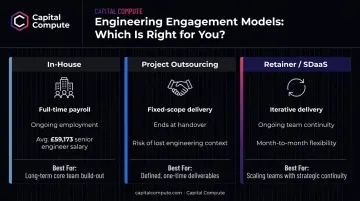
The key distinction: project outsourcing ends at handover, while a retainer keeps the same engineering team involved through maintenance and ongoing iteration — preserving the architectural context that typically gets lost at delivery.
Matching Model to Scenario
- In-house suits companies where software is the core product, team continuity is critical, and budget exists to hire, retain, and manage senior engineers. Levels.fyi salary data puts the median Australian senior software engineer total compensation at A$178,428 (base ~A$152,000) — before Superannuation Guarantee, benefits, and management overhead
- Project outsourcing suits well-defined, one-off builds with a clear scope that won't require significant post-launch iteration
- Retainer models suit startups that need to ship fast, iterate often, and scale without full-time hiring overhead — where architectural continuity matters more than keeping costs down
Risks and Mitigations
In-house:
- High hiring cost, knowledge concentration, and attrition risk are the main concerns. Counter these with strong documentation standards and redundant engineering coverage across the team.
Project outsourcing:
- Scope creep and loss of engineering context at handover are the most common failure points. Contractually require full codebase documentation, versioned APIs, and a defined handover process tied to final payment.
Retainer models:
- Over-reliance on the provider becomes a risk if documentation standards slip. Require written scope per sprint, IP ownership at each milestone, and APIs documented specifically for maintenance by your internal team.
For Australian SMBs, the practical takeaway is straightforward: if your product will evolve post-launch, a sprint-by-sprint retainer with milestone approval gates outperforms a fixed-scope handover on almost every risk dimension. The engineering context stays intact, and you're not starting from zero when the next iteration begins.
What to Look for in an Australian Software Development Partner
The right partner for an Australian startup is rarely the cheapest. The cost of poor architecture decisions, missed Privacy Act compliance, or misaligned delivery far exceeds the savings from a low day rate.
Criteria That Matter
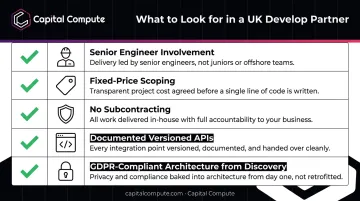
When evaluating partners, look for:
- Senior engineer involvement from sprint one — not a senior-led pitch followed by a junior-delivered build
- Fixed-price scoping with a written scope per sprint, not open-ended time-and-materials billing
- No subcontracting — the engineers who attend the discovery session should be the engineers building your product
- Documented, versioned APIs designed for maintenance by your internal team after handover
- APP-compliant data architecture scoped at discovery — not bolted on before go-live
Australian Regulatory Considerations
Under the Privacy Act 1988 and the Australian Privacy Principles, organisations must implement appropriate technical and organisational measures from the design stage. This is a legal obligation, not a best practice — and it applies to the software partner you commission, not just your internal data team.
During discovery, ask prospective partners:
- How do you handle data residency decisions for Australia-hosted products?
- At what stage is lawful basis mapping completed?
- How is role-based access control defined — at the data layer or only at the UI?
- Where do consent model decisions sit in your discovery process?
Partners who cannot answer these questions specifically are treating compliance as a retrofit.
An Example of the Right Approach
Capital Compute is an Australia-focused development partner that builds APP-compliant architecture as a design-stage requirement — with lawful basis mapping, consent models, and access controls scoped in sprint one, not reviewed before launch. Their model uses fixed-price scoping with fortnightly sprint reviews and client approval gates at every milestone, delivered entirely through an internal engineering team with no subcontracting.
Post-launch, clients move to a month-to-month retainer with no lock-in, maintained by the same engineers who built the product. APIs are documented and versioned for maintenance by the client's own team after handover, removing any ongoing dependency once the relationship ends.
Frequently Asked Questions
What is a service in software development?
A service is a modular, reusable software component that exposes specific functionality — authentication, payment processing, notifications — through a defined interface such as an API, forming the basis of service-oriented and microservices architectures. Commercially, the term refers to what a development firm actually delivers: custom builds, testing, DevOps, integrations, and related activities.
What are the 7 stages of the software development life cycle (SDLC)?
The commonly cited stages are: Planning, Requirements Analysis, System Design, Development (Coding), Testing, Deployment, and Maintenance/Support. In Agile environments, these stages overlap and iterate within sprints rather than following a strict sequential order — discovery feeds directly into design, and testing runs concurrently with development.
What is an example of an SDK in software development?
An SDK (Software Development Kit) is a packaged set of tools, libraries, and documentation that helps developers build for a specific platform or service. The Stripe SDK lets developers integrate payment processing without building from scratch; the iOS SDK provides everything needed to build native iPhone applications.
How do I choose the right software development services for my startup?
Align service selection to your current objective: custom development or SaaS architecture for building a core product, API integrations for connecting existing tools, and DevOps for reliable deployment. A discovery workshop with a senior engineer before committing to scope helps avoid costly over-engineering early and scoping too narrowly later — the most common and expensive mistake at the startup stage.
What is the difference between custom software development and off-the-shelf SaaS?
Off-the-shelf SaaS is faster and cheaper to adopt but imposes fixed workflows and ongoing subscription costs with no architectural ownership. Custom software offers greater flexibility, competitive differentiation, and long-term cost control. The deciding factor is how central the software is to your competitive advantage — if it is your product, build it custom; if it merely supports operations, an existing tool may be enough.