The challenge isn't finding an agent platform. It's avoiding the decisions that cause agents to underperform or introduce compliance exposure: choosing the wrong agent type, deploying without clean data, or treating the Privacy Act as a go-live checklist rather than an architecture decision.
Gartner forecasts that over 40% of agentic AI projects will be cancelled by the end of 2027 due to escalating costs, unclear business value, and inadequate risk controls. That's not a technology failure. That's a deployment discipline failure.
This guide covers when AI agents are the right choice, what you need in place before building, how to implement them correctly, and how to maintain consistent performance once they're live.
Key Takeaways
- AI agents are suited for variable, decision-dependent workflows — not just repetitive tasks that standard RPA handles adequately
- Data quality and process documentation must be in place before implementation begins — not addressed during it
- The Privacy Act compliance must be designed into the architecture from the start, not reviewed after deployment
- Agent type should match workflow complexity — not all agents require the same approach
- A phased rollout with defined KPIs outperforms full deployment from day one
When Should Your Business Use AI Automation Agents?
AI Agents vs. Standard Automation
The distinction matters before you build anything. Rule-based automation — RPA, scripted workflows, deterministic pipelines — handles stable, fully specified tasks reliably and cheaply. AI agents are appropriate when a workflow involves:
- Variable or unstructured inputs (documents in different formats, customer queries, mixed data sources)
- Conditional decision-making that requires interpreting context
- Outputs that feed into downstream systems or decisions
- Tasks where a human currently makes a judgment call, not just a mechanical one
If the process follows the same path every time with identical inputs, simpler automation will deliver faster, cheaper, and more reliable results. Choose the simplest solution that meets the requirement, and add complexity only where the value justifies it.
Four Signals That Indicate Agent Readiness
Before committing to an agent build, verify all four conditions apply:
- The task recurs frequently enough to justify build cost and ongoing maintenance
- A human currently interprets context — not just executes steps, but makes a judgement based on variable information
- Errors carry measurable cost in time, rework, compliance exposure, or customer impact
- The output connects to another system or decision, so improvements compound across the workflow
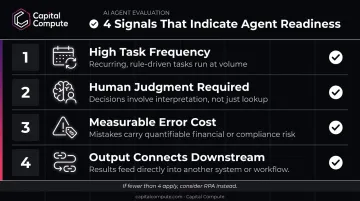
If only two of these are true, you likely have an RPA use case, not an agent use case.
Where Businesses Most Often Get This Wrong
Two errors account for most failed agent deployments:
- Wrong process type: Deploying an agent for a fully structured, predictable task — invoice matching against fixed templates, for instance — where standard automation would have been more reliable and considerably cheaper to maintain.
- Vague scoping: Selecting a use case because it sounds strategically impressive rather than because it has clear, measurable inputs, outputs, and success criteria. Agents built on vague requirements consistently underperform, and fixing a poorly scoped agent mid-deployment costs far more than getting the use case right at the start.
What You Need Before Deploying AI Agents
Skipping prerequisites is the most consistent cause of poor agent performance. Platform choice matters far less than what you have in place before the build begins.
Prerequisites Checklist
| Prerequisite | Why It Matters |
|---|---|
| Mapped process with defined inputs, outputs, and decision points | Agents cannot operate reliably on undocumented or inconsistently followed workflows |
| Clean, structured data (or a structured plan to get there) | Agent accuracy is directly tied to data quality — poor labelling and noisy data degrade model performance measurably |
| Defined governance framework | Establishes who oversees the agent, what actions require human approval, and how decisions are audited |
| System integration plan | Confirms which platforms (CRM, ERP, document management) the agent must connect to and whether APIs are available or need building |
| Named accountability | ASIC's review of AI governance found regulated firms are expected to have a named accountable person for their AI framework |
The the Privacy Act Requirement That Gets Skipped Most Often
Under the Privacy Act Article 22, solely automated decisions that produce legal or similarly significant effects require explicit safeguards — including the ability for a human reviewer to genuinely consider and change the outcome. Rubber-stamping doesn't satisfy this requirement.
For Australian regulated sector businesses, this means identifying which decisions your agent will make, and whether any of them cross that threshold, before architecture begins — not during a compliance review after go-live.
How to Implement AI Agents in Your Business Workflows
Implementation follows a defined sequence. Skipping phases — particularly discovery and governance — produces agents with inconsistent outputs or compliance exposure that only surfaces once something fails in production.
Mapping Workflows and Selecting a Use Case
Start with a workflow that is:
- High-frequency — enough volume to make the build cost worthwhile
- Already documented — with a known process that people actually follow
- Measurable today — you have a current cost, error rate, or time baseline
The goal is to demonstrate ROI early and build internal confidence for wider rollout. The single most common setup error is selecting a use case based on ambition rather than measurability.
For most Australian businesses starting their first agent deployment, the right first use case is typically in one of five areas: document processing, customer query handling, data extraction and routing, compliance reporting, or HR workflow management.
Choosing Your Agent Type and Build Approach
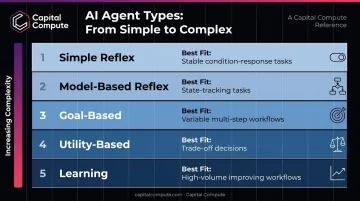
The five agent types from Russell and Norvig's framework map directly to workflow complexity:
| Agent Type | Best Fit |
|---|---|
| Simple reflex | Condition-response tasks with stable, observable inputs |
| Model-based reflex | Tasks where the agent needs to track state across steps |
| Goal-based | Multi-step workflows where the path to completion varies |
| Utility-based | Decisions requiring trade-offs across competing outcomes |
| Learning | High-volume workflows that improve with operational data over time |
Build, buy, or partner? The decision depends on your internal capability and timeline:
- Internal build requires ML and LLM engineering expertise, plus LLMOps infrastructure for production deployment
- Off-the-shelf platforms offer faster start times but limit customisation and often create data residency challenges for Australian regulated sectors
- Partnering with an engineering team that has already shipped production agents in your sector reduces privacy risk and shortens time to a working agent — Capital Compute, for example, has delivered production agentic systems in legal and finance, where agents handle citation retrieval, document extraction, form population, and compliance routing
Integrating with Existing Systems and Setting Guardrails
Agents connect to business systems via APIs. The quality of those integrations determines long-term reliability. Versioned, documented APIs that a client's internal team can maintain post-handover are significantly more durable than point-to-point connections built to meet a launch deadline.
Before go-live, confirm the following guardrails are in place:
- Scope of autonomous action — what the agent can execute without human sign-off
- Approval gates — which decisions require human review before the agent proceeds
- APP-compliant data handling — scoped at architecture stage, covering data minimisation, access controls, and audit logging
- Escalation logic — defined conditions under which the agent defers to a human
These aren't optional additions. They're the difference between a controlled deployment and one that creates regulatory or operational exposure.
Monitoring Agent Performance During Operation
Once live, track these metrics consistently:
- Task completion rate — did the agent complete the end-to-end objective, not just return an output?
- Accuracy against expected output — validated against human-labelled test cases or approved reference data
- Escalation rate — how often does the agent defer to a human? Too high suggests a scoping problem; too low may suggest it's overconfident
- Latency — end-to-end and per-step, especially for workflows with SLA requirements
- Tool and trajectory quality — are tool calls being made in the right sequence, without redundant retries?
Google's agent observability guidance covers performance, quality, traces, latency, and resource consumption as a baseline framework for production agent monitoring.
Early warning signs to watch for:
- Repeated escalations on the same input type
- Outputs that consistently require human correction
- The agent calling the same tool or step redundantly within a single task
Iterating, Scaling, or Replacing
At the end of the first deployment phase, review performance against the KPIs you defined before build. Then decide:
- Expand scope if the agent is meeting targets and edge cases are manageable
- Add a second agent for an adjacent workflow if the first has validated your deployment approach
- Revert to simpler automation if the agent is adding complexity without measurable improvement — a valid outcome, not a failure
Where AI Agents Are Commonly Applied Across Business Functions
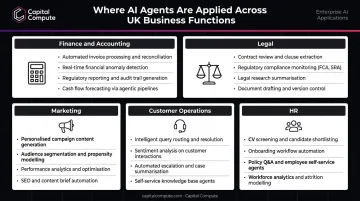
AI agent use cases cluster around five functions in most Australian businesses:
- Finance and accounting — invoice processing, reconciliation, compliance reporting, payment exception handling
- Legal — contract review routing, document extraction, citation retrieval, audit trail generation
- Marketing — content performance analysis, lead scoring, campaign optimisation, attribution
- Customer operations — inquiry handling, order management, escalation routing, returns processing
- HR — candidate screening, onboarding task management, compliance documentation, policy query handling
McKinsey's 2025 global survey reports 23% of organisations scaling agentic AI somewhere in their business and 39% experimenting — but no individual business function exceeds 10% at scale. Broad production deployment is still early-stage for most sectors.
Regulated vs. Unregulated Deployment Environments
Usage patterns differ significantly by sector:
- Legal and financial services require stricter guardrails, full auditability, and human oversight for consequential decisions — ASIC is explicit that existing governance, Consumer Duty, and systems-and-controls obligations apply to AI use
- Marketing and customer operations deployments typically prioritise throughput and speed, with lower compliance overhead
The Multi-Agent Opportunity
Where compliance requirements shape deployment boundaries, architecture has to follow. Processes that span departments — order-to-cash, claims processing, employee onboarding — benefit from multi-agent architectures where specialised agents handle sub-tasks and a coordinating agent manages the overall goal.
Microsoft documents this as a core-process pattern: a lead agent coordinates specialist agents while deterministic workflows handle controlled steps. Common cross-functional candidates include:
- Order-to-cash — from order capture and credit checks through invoice generation and payment matching
- Claims processing — intake, evidence retrieval, policy checking, and decision routing
- Employee onboarding — document collection, system provisioning, compliance sign-off, and manager notifications
This approach keeps each agent's scope narrow and auditable — a practical advantage in regulated environments where a single monolithic agent creates governance blind spots.
Best Practices for Getting Consistent Results from AI Agents
Follow these four practices to move from inconsistent agent behaviour to dependable, production-ready performance:
- Start with one well-scoped workflow. Measure baseline performance before you build, define success criteria, demonstrate ROI, then expand. Over-scoping the first implementation is the most reliable way to produce an agent that underperforms across the board.
- Scope APP-compliant data architecture in sprint one. For Australian regulated sector businesses, data handling decisions made during discovery determine compliance at scale. Data minimisation, role-based access controls, and audit logging need to be specified from the outset — not reviewed when a go-live checklist surfaces the gap. Lawful basis mapping, consent architecture, and audit trail design are first-sprint architecture decisions, not pre-launch additions.
- Keep humans in the loop for high-stakes decisions during initial rollout. Require human approval for actions affecting financial data, customer records, or legal documents until the agent's accuracy has been validated against real operational volume. Reduce oversight incrementally as confidence builds.
- Treat consistent outcomes as a discipline problem, not a platform choice. The businesses that get reliable results from AI agents share the same foundations: rigorous process mapping before build, defined governance from day one, and phased rollout with measurable KPIs at each stage. The agent type and platform matter far less than these disciplines.
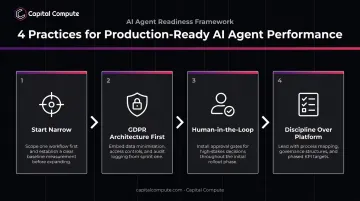
Capital Compute treats each of these as non-negotiable delivery standards — APP-compliant architecture is scoped at discovery, not reviewed at go-live, and production agents in legal, finance, and marketing sectors are shipped with governance frameworks already in place.
Frequently Asked Questions
What is an AI automation agent?
An AI automation agent is a software system that perceives its environment, reasons through a goal, and takes autonomous action to achieve it. Unlike rule-based automation, agents handle variable inputs and make context-dependent decisions — they aren't limited to scripted, predictable paths.
What are the five types of AI automation agents?
The five types are simple reflex, model-based reflex, goal-based, utility-based, and learning agents. They differ in complexity, from condition-response rules at the simpler end to agents that continuously improve performance from operational experience over time.
How do AI agents differ from traditional RPA?
Traditional RPA follows fixed, scripted steps and typically breaks when inputs vary. AI agents interpret unstructured data, adapt to changing conditions, and make decisions — making them suited for workflows where context matters and inputs aren't identical every time.
What does it typically cost to implement AI automation agents?
Costs vary based on build approach, integration complexity, and the number of workflows automated. A fixed-price scoping model is the most reliable way to manage cost risk: a discovery sprint produces a requirements document, data model, integration map, and priced delivery roadmap before any build commitment is made.
How do I ensure AI agents are APP-compliant for an Australian business?
The Privacy Act compliance requires scoping data handling, access controls, and audit trails at the architecture stage, not retrospectively. For Australian regulated sector businesses, data governance should be a sprint-one architecture decision, resolved before any build begins.
Can AI agents integrate with our existing business systems?
Yes, agents connect to existing platforms including CRM, ERP, and document management via APIs. The quality and documentation of those APIs directly affects integration reliability and long-term maintainability, particularly after handover to an internal team.