The global SaaS market was valued at $266.23 billion in 2024 and is forecast to reach $1,131.52 billion by 2032, growing at a 20% CAGR between 2025 and 2032, according to Fortune Business Insights. That growth is pulling founders and operations leaders into a search that starts with "what is SaaS" but actually needs an answer to a harder question: what does it take to build one?
This guide covers the definition, the technical foundations, the build process step by step, what actually drives cost, and how to pick the right development approach.
Key Takeaways
- SaaS application development delivers cloud-hosted software on subscription from one shared codebase, not local installs
- Multi-tenancy, elastic scalability, API-first design, and compliance-by-design are non-negotiable technical foundations
- A typical build runs through discovery, architecture planning, MVP development, testing, launch, and iteration
- Choosing in-house, freelance, or a dedicated partner shapes cost, speed, and risk more than any technical decision
What Is SaaS Application Development?
SaaS application development is the end-to-end process of designing, building, and maintaining software that's hosted centrally and delivered over the internet on a subscription basis, rather than installed on individual machines.
That model didn't appear overnight. Application Service Providers in the 1990s tried something similar, but each customer often ran a separate configured version of the software, sometimes with local installation still required. It was clunky and expensive to maintain.
The real shift came with cloud computing, which made multi-tenant architecture, centralised data, and zero local installation genuinely viable at scale, according to Oracle's history of SaaS.
The core distinction from traditional custom software is architectural, not cosmetic:
| Aspect | Traditional Software | SaaS |
|---|---|---|
| Deployment | One deployment, built and maintained for one client | One shared codebase serving many tenants |
| Updates | Applied separately for each client | Pushed to everyone simultaneously |
This matters because it changes almost every downstream decision, from how you structure your database to how you price your product.
You'll recognise the categories even if you haven't thought about the mechanics: CRM platforms, project management tools, fintech dashboards, legal case management systems, marketing automation suites. Each one runs on the same underlying principle. One codebase, many customers, continuous updates pushed to everyone at once.
Key Technical Characteristics of SaaS Applications
A SaaS product isn't just "software on the cloud." It carries specific technical requirements that don't apply to a standard website or single-client app build.
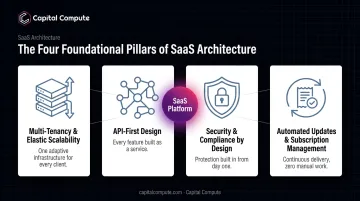
Multi-Tenancy and Elastic Scalability
Multi-tenant architecture means one application instance serves multiple customers, with each tenant's data logically separated from every other tenant's. It's more cost-efficient than building a separate instance per customer, but it demands careful isolation design from the start.
AWS's Well-Architected SaaS Lens calls tenant isolation "a foundational issue for every SaaS provider," noting that authentication and authorisation alone don't guarantee one tenant can't access another's resources.
Elastic scalability means infrastructure automatically scales compute and storage up or down based on demand, particularly during usage spikes when one tenant's traffic surge shouldn't degrade performance for everyone else.
API-First Design and Security by Design
Building around well-documented APIs from day one isn't a nice-to-have. It's what lets partners integrate, ecosystems form, and features extend later without a rebuild.
Security and compliance can't be bolted on afterwards either. For Australian customers, the OAIC is explicit: privacy by design is a core expectation under the Australian Privacy Principles set out in the Privacy Act 1988., applying from the design stage through to decommissioning.
This is one of the most common gaps we see at Capital Compute when reviewing platforms built without compliance architecture from the start. Fixing it after launch is almost always more expensive than designing it in during sprint one.
Automated Updates and Subscription Management
Two more pieces round out the technical picture. Continuous deployment pipelines push updates to every user simultaneously, without downtime or manual reinstallation. Subscription and tenant management handles recurring billing, plan tiers, and automated onboarding and offboarding logic unique to SaaS.
The SaaS Application Development Process, Step by Step
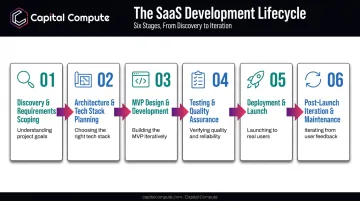
A SaaS build moves through six distinct stages. Skipping or rushing any one of them tends to show up as expensive rework later.
Discovery & Requirements Scoping
This stage defines your target user, the core problem you're solving, your MVP feature set, and how you'll measure success, before a single line of code is written. At Capital Compute, this typically produces a technical roadmap, a component blueprint, and a fixed-price timeline, usually within two business days of the initial scoping call.
Architecture & Tech Stack Planning
Here you lock in the multi-tenancy model, cloud provider, database structure, and security and compliance architecture. These decisions are the hardest and most expensive to reverse once development is underway. That's why compliance scoping (data-flow mapping, consent architecture, data minimisation) needs to happen at this stage, well ahead of go-live.
MVP Design & Development
Development proceeds in sprints, with UI/UX design running in parallel rather than as a separate handoff. The goal is the smallest feature set that proves genuine value to real users, not a feature-complete product on day one.
Testing & Quality Assurance
SaaS apps must perform reliably for many concurrent tenants at once, which means testing needs multiple layers:
- Functional testing to confirm features work as specified
- Security testing to catch tenant isolation gaps before customers do
- Load and performance testing under realistic concurrent usage
Deployment & Launch
CI/CD pipelines and phased, staged rollouts let teams catch issues before full customer exposure. A structured build-to-staging-to-production environment path, with data residency and backup locations defined ahead of go-live, is standard practice at this stage.
Post-Launch Iteration & Ongoing Maintenance
Launch isn't the finish line. SaaS products need continuous monitoring, feature updates, and support as real usage reveals what actually needs fixing.
Flexible, sprint-by-sprint retainer models, rather than rigid multi-year contracts, let you adjust scope as the product and your users evolve. Capital Compute includes a 90-day post-launch support window as standard, followed by a month-to-month retainer with no lock-in.
Tech Stack & Cost Considerations for SaaS Development
Choosing a Tech Stack
There's no universally "right" stack. The right choice depends on your scalability needs and integration requirements, not on what's trending.
Common combinations look like this:
| Layer | Typical Options |
|---|---|
| Frontend | React, Vue, Angular |
| Backend | Node.js, Python, .NET |
| Database | PostgreSQL, MongoDB |
| Cloud infrastructure | AWS, Azure, GCP |
For multi-tenant builds specifically, database choice and cloud infrastructure need to support tenant isolation and scale from day one. Capital Compute's engineering team works across React, Next.js, Node.js, GraphQL, and AWS, selecting the combination based on the client's compliance, integration, and scale requirements rather than defaulting to one fixed stack.
What Drives SaaS Development Costs
Cost varies enormously by scope. The main drivers are:
- Feature complexity: how many workflows, roles, and edge cases the MVP needs to handle
- Compliance requirements: the Privacy Act, HIPAA, ASIC, or sector-specific rules add architecture work
- Integrations: every third-party API adds scoping and testing overhead
- Team location and seniority: senior engineers cost more per hour but tend to avoid costly early mistakes
Engagement model matters as much as scope. Fixed-price agreements set price and functionality upfront, with the contractor bearing more risk if delivery overruns. Time-and-materials keeps scope flexible but shifts more cost risk to the client, who pays for however long the work takes, as Deloitte's analysis of Agile procurement models notes.
Fixed-price with milestone approval gates tends to reduce risk for businesses new to outsourcing, since you approve progress before paying for the next phase.
In-House, Freelance, or Outsourcing: Choosing the Right Development Approach
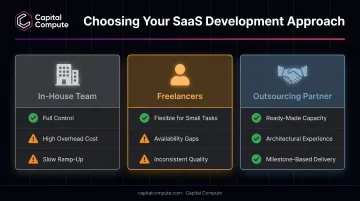
Three paths exist for building your SaaS product, and each comes with real trade-offs:
- In-house teams offer full control and culture fit, but building an internal engineering team from scratch is slow and expensive — recruitment, onboarding, and salary overhead add up before a single feature ships.
- Freelancers work well for smaller, affordable tasks, but availability gaps and inconsistent quality across contractors can stall larger, sustained builds when you need coordinated delivery.
- Dedicated outsourcing partners bring ready-made engineering capacity and architectural experience across multiple SaaS builds, helping you avoid early-stage mistakes like weak tenant isolation or compliance retrofitted late.
For Australian businesses and SaaS founders, Capital Compute operates as an internal engineering team with no subcontracting. Builds are fixed-price and milestone-based, with APP-compliant architecture scoped from discovery, and engagements run on a flexible sprint-by-sprint retainer with no long-term lock-in once the product is live. Clients hold repository access from the first commit.
Frequently Asked Questions
What is a SaaS developer?
A SaaS developer builds and maintains cloud-hosted, multi-tenant applications. The skill set spans cloud infrastructure, API design, and scalable architecture, going beyond what typical software development requires.
What is the difference between SaaS development and regular web development?
SaaS development supports many concurrent tenants sharing one codebase with continuous updates pushed to everyone at once. Regular web development usually targets a single deployment with fewer ongoing operational demands.
How long does it take to build a SaaS application?
Most production-ready MVPs take three to four months, depending on feature complexity and compliance needs. Upfront architecture decisions tend to affect the timeline more than the number of features alone.
What is multi-tenant architecture in SaaS?
It's an architecture where one application instance serves multiple customers, logically isolating each tenant's data from the others. This enables cost efficiency and easier maintenance as you scale.
Is SaaS application development expensive?
Cost varies widely by scope, feature complexity, and compliance needs. The engagement model, fixed-price versus time-and-materials, affects spend predictability more than hourly rate alone.
How do I choose the right SaaS development partner?
Look for proven multi-tenant SaaS experience, transparent fixed-price or milestone-based delivery, and compliance-by-design practices such as APP readiness built in from discovery, not added at launch.