Global insurance IT spending reached $232 billion in 2024, growing at a 9.4% annual rate according to Gartner. That figure signals urgency, but spend alone does not equal transformation. Many insurers are funding incremental upgrades rather than structural change, and the gap is widening between those building for the future and those patching the past.
This guide covers what digital transformation in insurance actually means, the four pillars that must advance together, the technologies driving change, the challenges most likely to derail programmes, and a five-step implementation framework designed to reduce delivery risk.
Key Takeaways
- Digital transformation touches underwriting, claims, customer experience, and compliance simultaneously — not one at a time
- AI, cloud, RPA, and IoT are the primary technology enablers; AI and cloud typically deliver the fastest visible ROI
- Legacy system integration and Privacy Act compliance rank as the most common blockers slowing insurer transformation programmes
- A phased, milestone-driven approach reduces the delivery risk that derails big-bang transformation programmes
- Only 7% of insurers have successfully scaled AI systems, per BCG — indicating the gap between adoption and realised value
What Is Digital Transformation in Insurance — and Why Does It Matter Now?
Digital transformation in insurance means the strategic integration of technology across all core functions — underwriting, claims, distribution, and customer service — to deliver faster, more personalised, and lower operating costs.
This is distinct from simple digitisation. Scanning paper forms and uploading them to a shared drive is digitisation. Replacing a manual underwriting checklist with a rules-engine that scores risk in seconds and routes complex cases to specialists is transformation — a different category of change entirely.
That distinction matters because the pressure on carriers to change is no longer theoretical.
The Forces Creating Urgency
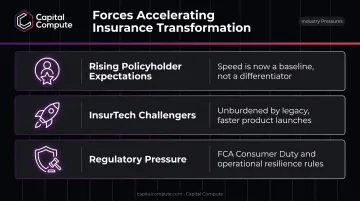
Three external pressures are accelerating the timeline:
- Rising policyholder expectations shaped by e-commerce and digital banking. Accenture's survey of 49,000 consumers across 33 markets found 60% willing to share data in exchange for faster claims processing. Speed has shifted from a differentiator to a baseline expectation
- InsurTech challengers unburdened by legacy infrastructure, able to launch products and price risk in ways that established carriers cannot match at equivalent speed
- Regulatory pressure from ASIC's Consumer Duty — effective from July 2023 for open products — and operational resilience rules requiring firms to identify important business services and demonstrate they can remain within impact tolerances during disruption
What Transformation Delivers
Executed well, transformation produces measurable gains across the core operations that drive profitability:
- Reduced claims processing time and lower loss adjustment expense
- Improved fraud detection through pattern recognition at scale
- Faster time-to-market for new products via configurable platforms
- Higher customer retention through proactive, personalised service
The Core Pillars of Insurance Digital Transformation
Insurers that treat digital transformation as a technology project — buy a new platform, migrate data, go live — are among those most likely to fail to realise ROI. Successful transformation requires change across four interconnected pillars simultaneously.
Pillar 1: People and Culture
Cultural resistance is consistently one of the top barriers to transformation success. Mid-level managers and underwriters who have operated manual workflows for years often interpret new systems as a threat to their expertise, not an extension of it.
Addressing this requires three elements working together:
- Executive sponsorship that signals the transformation has organisational weight behind it
- Structured change management with a communication plan explaining why the change is happening, not just what is changing
- Early visible wins — delivering a concrete improvement to one team's workflow builds the confidence that sustains momentum across the broader programme
Pillar 2: Process and Operations
Digital transformation requires retiring or redesigning legacy workflows, not digitising them in place. Two examples illustrate the distinction:
- First Notice of Loss (FNOL): Replacing a phone-in form with a digital intake is digitisation. Automating triage so simple claims route to straight-through processing and complex claims reach a specialist with pre-populated case data — that is transformation
- Underwriting decisioning: A rules engine that ingests structured and unstructured data and returns a risk score in seconds eliminates friction without removing underwriter judgement where it genuinely adds value
Pillar 3: Technology and Data
A scalable, interoperable technology architecture is the infrastructure layer that makes everything else possible. This means:
- Cloud-native platforms that can scale elastically and reduce the cost of launching new products
- Documented APIs that connect legacy systems to modern tools without requiring immediate full replacement
- Unified data pipelines that create a single view of the policyholder across underwriting, claims, and servicing
Without this layer, AI models have no clean data to learn from, and automation tools have no reliable systems to connect to.
Pillar 4: Regulatory Compliance and Governance
In Australia, the Privacy Act and ASIC regulations make compliance a foundational pillar, not a workstream that runs in parallel. Under the Privacy Act, health data is classified as special-category data requiring both a lawful basis under Article 6 and a separate Article 9 condition; automated decisions with significant effects on policyholders carry specific safeguard obligations under Article 22.
Embedding data governance, privacy by design, and audit trails into the transformation architecture from the outset is significantly cheaper than retrofitting them after go-live. This is a principle Capital Compute applies as a contractual default for Australian regulated sector engagements: the Privacy Act architecture is scoped at discovery, before any production code is written.
Key Technologies Driving Insurance Digital Transformation
No single technology delivers transformation on its own. Real value comes from combining multiple tools that work across a shared architecture. These are the five that matter most.
Artificial Intelligence and Machine Learning
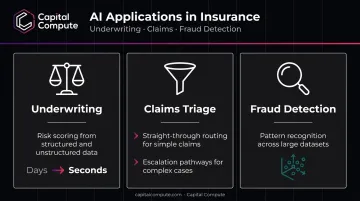
AI is reshaping three core insurance functions:
- Underwriting: Risk scoring from structured data (claims history, financial data) and unstructured data (satellite imagery, telematics feeds) — reducing underwriting time from days to seconds for personal and SME lines
- Claims triage: Automatically routing straightforward claims to straight-through processing while escalating complex cases to senior adjusters with pre-populated context
- Fraud detection: Pattern recognition across large claims datasets to flag anomalies that human reviewers would not identify at volume
Insurers using AI models across claims processing have reported meaningful reductions in assessment time and complaints, alongside significant cost savings, according to industry analysis. The challenge is scaling: most insurers have struggled to move successful pilots into enterprise-wide deployment, meaning the gap between pilot deployment and enterprise-wide value remains the defining problem for most carriers.
Robotic Process Automation (RPA)
RPA automates high-volume, rules-based tasks without requiring full legacy system replacement — which is why it typically delivers fast ROI:
- Data entry across policy administration, billing, and claims systems
- Regulatory reporting and MI production
- Renewal reminders and mid-term adjustment processing
- FNOL documentation population
Because RPA works on top of existing systems rather than replacing them, it is often the right first move for insurers whose modernisation budget cannot stretch to a core system replacement.
Cloud and SaaS Platforms
Cloud migration is the infrastructure shift that enables everything else. A cloud-first architecture:
- Reduces the cost and time required to launch new products and distribution channels
- Enables real-time data access across underwriting, claims, and customer service teams
- Provides the elastic compute needed to run AI models at scale
- Supports integration with modern SaaS tools through documented APIs
IoT and Telematics
Connected devices are shifting insurance pricing from population averages to individual risk profiles. Accenture's consumer research found 76% of consumers interested in premiums linked to safe driving behaviour, 64% interested in pay-as-you-drive products, and 72% open to smart home monitoring for security and energy applications.
These numbers carry a direct commercial implication. Usage-based and behaviour-based models improve pricing accuracy, reduce adverse selection, and give carriers a retention advantage over competitors still relying on annual renewal cycles with static rating factors.
Blockchain and Smart Contracts
The primary value of blockchain in insurance is fraud reduction and process transparency — not cryptocurrency. State Farm and USAA put a jointly developed blockchain system for auto-subrogation claims into full production in January 2021, handling approximately 75,000 subrogation checks annually through a tamper-proof bilateral ledger.
Smart contracts extend this further: when a flight delay exceeds a defined threshold, a parametric travel insurance policy can pay automatically without a claims handler touching the case. Adoption remains uneven across the sector, but insurers processing high volumes of rule-defined claim types — travel, motor subrogation, parametric products — have the clearest path to a near-term return.
Key Challenges in Insurance Digital Transformation
The combination of regulatory pressure, aged infrastructure, and risk-averse culture creates a demanding environment. BCG's finding that only 7% of insurers have successfully scaled AI systems suggests most transformation programmes are falling short of what was planned.
Legacy System Integration
Legacy systems remain widespread in insurance globally, and Australian carriers face a comparable picture. Full rip-and-replace of a core policy administration or claims system is expensive, disruptive, and carries significant delivery risk.
The preferred alternative is phased modernisation: building middleware API layers that connect legacy systems to modern tools (enabling AI models, automation workflows, and new distribution channels) without requiring immediate core system replacement.
Capital Compute's legacy integration approach begins in week one of an engagement, mapping existing systems and data flows before any architecture is committed. This reduces the rework and disruption that typically surface from mid-programme legacy discovery.
Regulatory Compliance (the Privacy Act and ASIC)
Australian insurers operate under dual regulatory pressure:
- The Privacy Act governs the handling of personal and sensitive policyholder data, including special-category health data, automated decision-making safeguards, and data subject rights
- ASIC Consumer Duty and operational resilience rules govern digital service delivery and require carriers to map important business services and demonstrate resilience against severe but plausible disruption scenarios
Compliance architecture must be embedded at the design stage, not reviewed at go-live.
Capital Compute scopes APP requirements during the discovery phase — covering lawful basis mapping, consent architecture, data subject rights handling, and audit trail generation — and produces a locked requirements specification before development begins. This eliminates the most expensive failure mode: finding compliance gaps in testing or after launch.
Cultural Resistance and Change Management
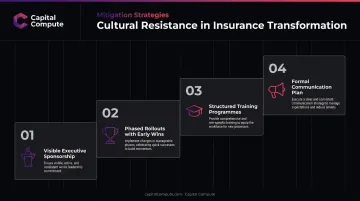
Employees who have operated legacy systems for years view digital transformation as a threat. Practical mitigation:
- Visible executive sponsorship — without it, budget approvals stall and resistance accelerates
- Phased rollouts that deliver early wins to specific teams before scaling broadly
- Structured training programmes that build confidence alongside capability
- A communication plan that is a formal deliverable, not an afterthought
Talent and Skills Gaps
Lloyd's Annual Report 2024 acknowledged that a skills shortage is making recruitment challenging, particularly for technical roles in AI, cloud architecture, and data engineering. The shortage of professionals who combine insurance domain knowledge with modern technical skills makes the build-vs-partner decision a material one.
Attempting to hire a full internal engineering team from scratch extends timelines by months and adds six-figure recruitment costs before a line of production code is written. Engaging a partner with both technical depth and regulated sector experience compresses time-to-value and reduces the risk of building the wrong system on the wrong architecture.
How to Implement Digital Transformation in Insurance: A 5-Step Framework
This framework is sequenced to balance ambition with risk management. Each step produces a tangible output — not just a plan — and milestone-based governance at each gate prevents scope creep and budget overrun.
Step 1: Assess Your Current State and Define Transformation Goals
Map existing technology, workflows, and data flows. Identify the highest-cost manual processes and the highest-risk compliance gaps. Define clear success metrics tied to business outcomes — not technology outputs:
- Claims processing time (target vs. current)
- Straight-through processing (STP) rate
- Customer satisfaction score (NPS or CSAT)
- Regulatory compliance posture against ASIC and APP requirements
Without measurable business outcomes attached, transformation goals lose their governance function: budget approvals become subjective and programme reviews have no baseline to measure against.
Step 2: Secure Leadership Buy-In and Align Stakeholders
Build a sponsor coalition that includes the CTO, COO, compliance leadership, and customer-facing leadership. Without visible senior commitment, budget approvals stall and middle-management resistance fills the vacuum. Treat the communication plan as a formal deliverable of this step. It should explain what is changing, why it is changing, and what each team can expect — produced now, not retrofitted once resistance surfaces.
Step 3: Modernise Infrastructure Incrementally
With stakeholder alignment confirmed, focus the first build on one or two processes carrying the most operational friction or regulatory risk. Claims processing and underwriting decisioning are the most common candidates. Build for those first, test the model, and prove value before expanding.
For Australian insurers, APP-compliant data architecture must be designed in sprint one. This is not optional. Capital Compute addresses this by scoping privacy and compliance requirements at the discovery stage — not at go-live — which materially reduces regulatory exposure on every subsequent sprint.
Step 4: Deploy Using Agile Sprints with Client Approval Gates
An iterative delivery model prevents the "big bang" deployment failures that are common in waterfall technology projects:
- Two-week sprints with clearly defined scope
- Fortnightly demos where completed work is demonstrated to stakeholders
- Milestone-based approval gates before the team advances to the next phase
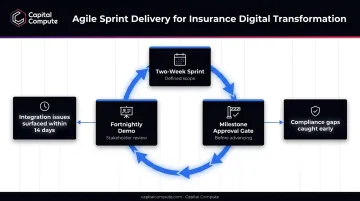
This structure surfaces integration issues and compliance gaps within a fortnight — not after months of accumulated development. Capital Compute's sprint-based delivery model applies this discipline across all regulated sector engagements, with all reviews conducted in Australian business hours.
Step 5: Measure Outcomes, Reinforce Adoption, and Scale
Post-deployment, track KPIs against the Step 1 baseline and run end-user feedback loops to identify friction points. Sustaining adoption requires a structured reinforcement plan. Common components include:
- Training refreshers as workflows evolve
- In-app guidance for new users onboarding post-launch
- Process updates triggered by end-user feedback cycles
Expand to the next process or product line only once adoption metrics confirm the initial deployment is stable. Scaling before that foundation is secure is how transformation programmes accumulate technical debt and lose the stakeholder confidence built in Steps 1 and 2.
The Future of Insurance Digital Transformation
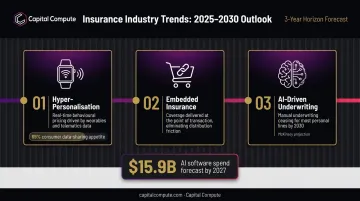
Three near-term trends will define competitive positioning over the next three to five years.
Hyper-personalisation driven by real-time behavioural data — usage-based motor pricing that reflects actual driving patterns rather than demographic proxies, and wellness-linked life products that update cover based on wearable data. Consumer appetite is already there: 69% of consumers said they would share significant health, exercise, and driving data for lower premiums, up from 58% in 2019.
Embedded insurance — coverage sold at the point of transaction, within travel bookings, mortgage platforms, and e-commerce checkouts. This model removes distribution friction entirely and shifts the customer relationship from annual renewal to continuous relevance.
AI-driven underwriting where models continuously update risk scores using live data feeds rather than annual renewal cycles. McKinsey projects that by 2030, manual underwriting will cease for most personal and small-business lines, with most decisions automated and underwriting reduced to seconds.
Gartner forecasts global insurance AI software spending will reach $15.9 billion by 2027, growing at an 18.2% five-year CAGR — insurers not building AI infrastructure now will be chasing from behind.
Insurers that establish clean, API-first architecture now will integrate these capabilities with far less friction than those still managing monolithic legacy stacks. That infrastructure gap compounds over time — the decisions made today directly determine how fast you can move in 2027 and beyond.
Frequently Asked Questions
What are the 5 steps of digital transformation for insurance?
The five steps are:
- Assess current state and define measurable business goals
- Secure leadership buy-in and build a sponsor coalition
- Modernise infrastructure incrementally, starting with highest-impact processes
- Deploy via agile sprints with fortnightly demos and milestone approval gates
- Measure outcomes and reinforce adoption before scaling to the next process
What are the pillars of digital transformation for insurance?
The four core pillars are people and culture, process and operations, technology and data, and regulatory compliance and governance. All four must advance together — treating transformation as a technology project alone is one of the most reliable predictors of poor ROI.
What technologies are most important for insurance digital transformation?
AI and machine learning, RPA, cloud platforms, IoT and telematics, and blockchain are the primary enablers. AI and cloud typically deliver the fastest and most visible ROI — AI through claims triage and fraud detection, cloud through the infrastructure flexibility required to launch new products and integrate modern tooling.
What are the biggest challenges of digital transformation in insurance?
Legacy system integration, cultural resistance, regulatory compliance under the Privacy Act and ASIC rules, and the shortage of professionals who combine insurance domain knowledge with modern technology skills. That talent gap is why the build-vs-partner decision carries so much weight — and why it should be resolved before any architecture work begins.
How does the Privacy Act affect digital transformation in Australian insurance?
The Privacy Act requires insurers to embed data minimisation, consent management, audit-ready data handling, and data subject rights into every new digital architecture — with health data subject to Article 9 conditions and automated decisions carrying Article 22 safeguard obligations. Compliance must be scoped at the design stage: gaps discovered at go-live create expensive rework and direct regulatory exposure.