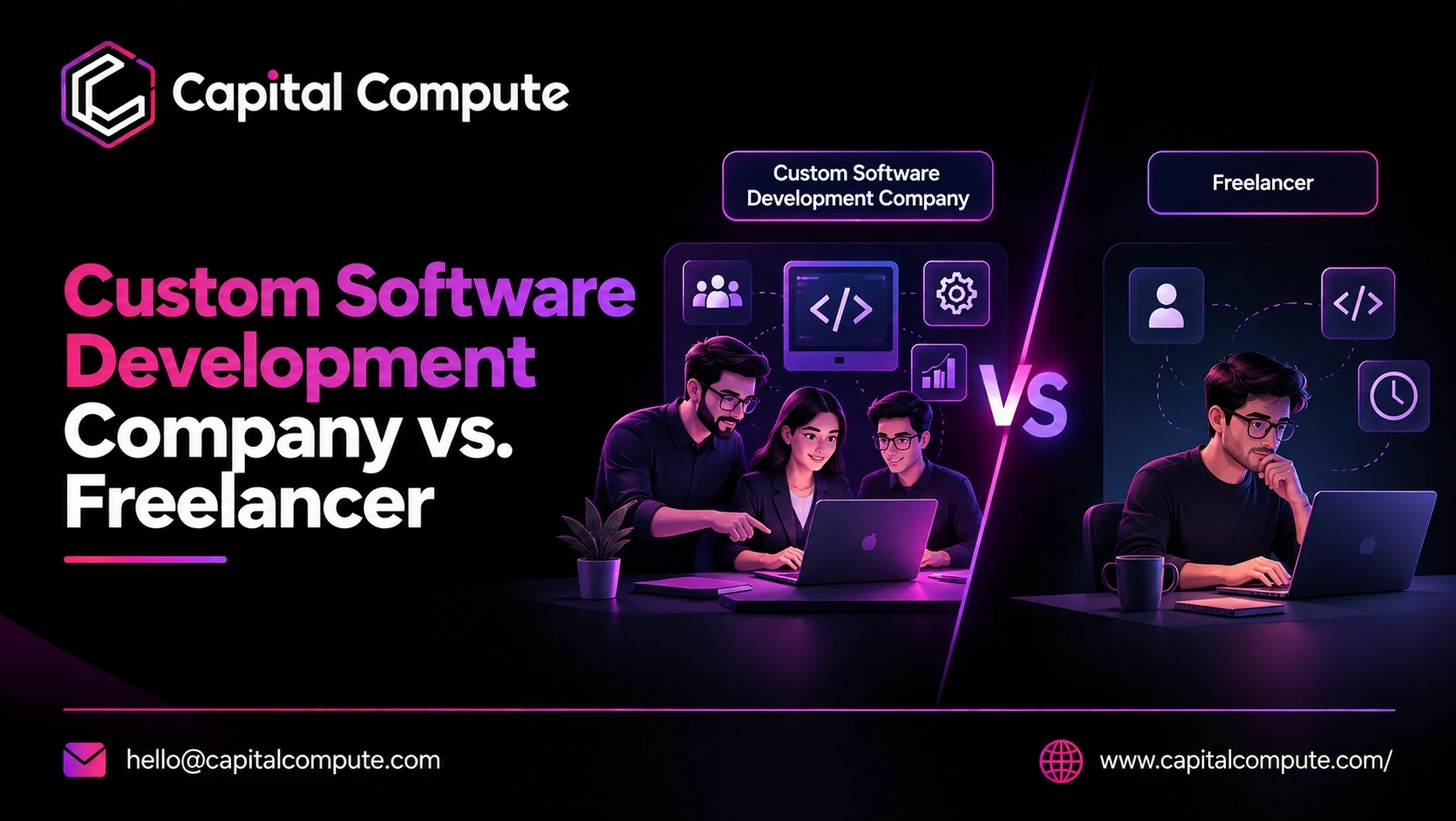
A development company is usually a stronger fit when a UK business needs several disciplines, delivery continuity and ongoing product support. A freelancer can suit a focused task when your own team can manage requirements, review and operation. Compare the responsibilities each option covers, alongside price, availability, ownership and data controls.
Quick summary
- A freelancer can be suitable for a bounded task with strong internal oversight.
- A company can provide a broader team, but verify its actual staffing and continuity.
- Compare the responsibilities retained by your business as well as supplier fees.
- Use the same acceptance, ownership and security standards for both options.
What are you actually buying from a company or a freelancer?
You are buying a combination of engineering capacity, judgement and responsibility. A software company can provide a coordinated delivery team. A freelancer provides an individual’s services. Neither label tells you how well requirements, review, release and support will be handled on your particular project.
For a UK founder comparing a custom software development agency in UK search result with an independent developer, begin by listing the work surrounding the code. Someone must define priorities, make design decisions, test integrations, manage the environment and respond when the product fails.
| Responsibility | Development company | Freelancer |
|---|---|---|
| Requirements and design | May provide several disciplines within scope | Often needs defined input or additional specialists |
| Code review | May provide a second engineer | Arrange another reviewer if needed |
| Continuity | May provide documented team cover | Agree individual availability and contingency |
| Delivery management | May include a project or product lead | Your team may need to coordinate the work |
| Support | Can offer a team-based agreement | Depends on capacity and the support contract |
Define what your business will retain
A company proposal can still exclude testing or infrastructure work. A freelancer can have excellent architecture and operational experience. Use the table as a starting point for questions, not as a verdict about every provider. Ask for the actual responsibilities and people behind the offer.
- Who turns the business problem into acceptance criteria?
- Who reviews the code before it is merged?
- Who can deploy and restore the software?
- Who owns the support queue after launch?
Our custom software development process helps identify the workstreams you need to assign. A responsible sourcing decision makes all of those workstreams visible, even if one supplier handles only some of them.
When is a freelancer a good fit for a UK business?
A freelancer can be a good fit when the task is contained and your team can provide the surrounding product and engineering oversight. Examples include implementing a defined interface component, improving a known integration or adding tests to an application your engineers already maintain.
An illustrative Manchester SaaS team might hire an experienced independent developer to implement a documented billing integration. Its own technical lead reviews the code and manages deployment. The engagement works because both sides understand the boundary and the team has the capacity to oversee it.
A search for “custom software development agency in UK” should be treated as a starting point for building a shortlist, not proof that a provider is right for your project. Check the team’s relevant experience, delivery responsibilities and ability to support the work after launch.
Consider the advantages and the conditions
Direct access to the person doing the work can simplify communication. A specialist may also bring experience your internal team lacks. Those advantages are most useful when the scope and review process are clear, rather than when the buyer expects one person to fill every product role.
- Use a freelancer for a defined task with accessible technical context.
- Confirm relevant experience and actual availability.
- Arrange an independent review if your team cannot assess the work.
- Agree documentation and handover while the task is still underway.
The limitation is capacity concentration. Leave, illness or another commitment can affect availability. That does not make independent work unsuitable; it means your business should decide how much interruption it can tolerate and agree proportionate contingency arrangements.
When is a development company a stronger fit?
A company can be a stronger fit when the product needs several disciplines working together and you want one accountable delivery relationship. A new portal, mobile product or legacy modernisation programme may require design, back-end work, testing, infrastructure and continued support at the same time.
For an illustrative Bristol operations business replacing a spreadsheet workflow, the uncertainty may extend beyond implementation. Staff need to agree their process, historical data needs cleaning and existing systems need investigation. A coordinated team can help manage those dependencies if that work is included in the engagement.
When comparing custom software development services in UK search results, look beyond the service label. Check whether the proposed scope covers the design, development, testing, release and support responsibilities your project actually requires.
Verify the team instead of assuming it exists
Ask who will do each part of the job and how the team handles a changed requirement. A company name does not remove dependence on a single developer. Meet the lead and confirm how another engineer would review changes or cover an absence.
- Check design, development, testing and release responsibilities.
- Ask if the proposed team is internal, contracted or mixed.
- Confirm the availability of the named engineers.
- Review change notification and post-launch support arrangements.
Our custom software development services for UK businesses are relevant when you need an accountable partner across those workstreams. Define the output you need first, then test how the proposed team would take responsibility for it.
A custom software development company in UK should be able to explain who will do the work, how the team is organised and what happens if a key person becomes unavailable. Ask for those details before treating the company structure as an advantage.
How should you compare the full cost of each option?
Compare the cost of the delivered and supported result, including your own team’s time. A freelancer’s fee may cover implementation alone. A company quote may include additional roles or workstreams. Without a common scope, comparing totals gives a misleading view of the purchase.
Build an illustrative cost model using actual proposals in pounds. Add design, review, testing, deployment, hosting, maintenance and management time where they apply. Do not add speculative percentages or assume that one model is always cheaper: the allocation of responsibility determines what needs funding.
When comparing custom software development services in UK, use the same brief and acceptance conditions for each supplier. A quote that includes more work should not be compared directly with a quote that leaves those responsibilities with your internal team.
| Cost to compare | Question for both options |
|---|---|
| Supplier work | Which outputs and revisions are included? |
| Internal oversight | Who briefs, reviews and accepts the work? |
| Specialist gaps | Who provides security, accessibility, design or testing? |
| Operating cost | Who pays for cloud licences, monitoring and maintenance? |
| Transition cost | What documentation, access and handover are included? |
Compare like-for-like acceptance conditions
If the freelancer will produce an API and your team will own the interface, compare that arrangement with a company offering the same boundary. If the company will deliver a complete product, account for the remaining work in the individual-developer option before judging value.
Our bespoke software development cost guide can help structure the discussion. Use project-specific figures for any purchasing decision. The cheapest headline quote can be appropriate when it covers exactly what you need and your business can reliably handle the rest.
When reviewing a bespoke software development company in UK search result, compare the proposed deliverables, exclusions and ongoing responsibilities rather than assuming that a bespoke offering includes every workstream.
- Separate one-off and recurring costs.
- State the assumptions behind estimates.
- Include the time of your product owner and technical reviewer.
- Agree payment against defined deliverables or recorded work.
Does a company automatically provide better quality and security?
No. Quality depends on the people, review process, tests and operating controls. An experienced freelancer with independent review can deliver sound work. A company with weak testing or unclear ownership can still create substantial delivery risk. Inspect the actual approach for both options.
A search for “custom software development agency in UK” can identify potential suppliers, but it cannot establish whether their quality controls are suitable. Ask for evidence of testing, code review, access control and release procedures.
The NCSC supply chain security principles provide a basis for proportionate supplier checks. Apply the same risk questions to a company and an individual, then assess how each would meet them within the proposed engagement.
Ask who verifies a change before release
Code review should identify more than style issues. A reviewer needs to consider permission boundaries, errors, dependencies and consistency with requirements. If only one engineer is available, agree how an additional reviewer will be provided for changes that justify independent scrutiny.
- Check tests for the business-critical workflow.
- Require controlled access to repositories and production.
- Ask how secrets and configuration are managed.
- Document who can approve and reverse a release.
For personal information, the ICO’s guidance on controller and processor contracts helps frame the processing relationship. Your privacy lead should review the arrangements. A smaller supplier is not automatically exempt from the obligations relevant to its role.
How do ownership and exit arrangements differ?
Both arrangements need clear written ownership and access terms. Company delivery does not automatically put every account under your control, and hiring a freelancer does not automatically transfer all rights in the work. Settle the relationship between code access, legal rights and operational control before work starts.
The Intellectual Property Office’s copyright ownership guidance explains why commissioned work needs agreed terms. Ask a suitable adviser to review the treatment of newly created software, pre-existing components and third-party licences in either contract.
Make the practical exit work
A useful handover includes source code, configuration instructions, dependency information and the ability to build and deploy. Keep agreed business accounts accessible to your organisation. Another engineer should not need the original developer’s private login to maintain a product your business relies on.
- Clarify ownership of newly created code and design assets.
- Record reused components and licence restrictions.
- Agree repository and hosting administration rights.
- Specify handover and transition support before the contract ends.
Our bespoke versus custom software guide explains the terminology. For this decision, the practical issue is the same under either label: can your business continue to operate and change the product when the original engagement changes?
How should UK working hours and support affect your choice?
Choose working arrangements that match the decisions and incidents your product creates. UK-headquartered suppliers can simplify local meetings, but location alone does not guarantee continuity or timely support. Confirm the actual contact window, escalation route and authority to make changes.
A London founder may be comfortable with a daily overlap for a prototype, while a national service provider may need a separately funded incident arrangement. State those expectations before comparing a freelancer’s availability with a company’s support offer. Neither should be assumed to provide round-the-clock cover.
Distinguish an acknowledgement from a resolution
An incident response commitment states when someone engages. A resolution depends on the cause and the available workaround. Agree severity definitions, communication intervals and rollback authority. These operational details matter more than a broad promise to ‘be available whenever needed’.
- Record ordinary support hours and bank-holiday arrangements.
- Define how urgent issues are reported.
- Ask who covers planned leave and unexpected absence.
- Separate warranty defects from paid enhancements and maintenance.
Does AI-assisted development change the company-versus-freelancer decision?
AI tools change how some engineering work is performed, but they do not assign product responsibility. An individual and a team can both use coding assistants. Compare how changes are understood, reviewed and tested, alongside the information permitted to enter each tool.
Capital Compute’s workflow uses domain-specific markdown rules, cross-model pull-request review and documentation with tribal-knowledge capture. Those mechanisms support a discussion about consistent engineering and reduced avoidable rework. They are not evidence that every AI-assisted team delivers faster or that a project can dispense with review.
Assess the method and the person using it
Ask a prospective freelancer or team to explain a generated change and its tests. A tool demonstration is less informative than the engineer’s reasoning. For product AI, our AI developer hiring guide covers another skills conversation involving evaluation and ongoing behaviour.
- Agree which project information can be used with AI providers.
- Keep responsibility for accepted changes with named engineers.
- Require tests for the user outcome and failure paths.
- Review dependency choices and documentation as part of delivery.
Could a hybrid model suit your business better?
A hybrid model can work when responsibilities are explicit. Your internal team might own the product and infrastructure while an external company provides a focused engineering team. Alternatively, you might use a freelancer for a specialist task and an independent reviewer for assurance.
Custom software development services in UK projects can involve an external team working alongside in-house specialists. If you choose this model, specify who owns requirements, integration, review, release and ongoing operation so that the split does not create gaps in accountability.
The risk is fragmented accountability. If several providers share the work, identify who owns integration and the release decision. One supplier’s completed component does not mean the full customer journey is ready, especially when interfaces between components remain untested.
Use a decision rule based on the work
Choose a freelancer when the task is bounded and your organisation can own requirements, review and operation. Consider a company when you need coordinated disciplines and continuing delivery capacity. Consider team extension when you already have a strong engineering lead but need additional implementation capacity.
- Start with responsibilities rather than company size.
- Match oversight to the complexity and consequence of failure.
- Put integration and release ownership in writing.
- Test the arrangement on a small real task before expanding it.
Our UK software outsourcing service is another starting point when deciding how work fits alongside your own team. Ask for a specific split of responsibilities rather than assuming outsourcing removes the need for an internal product owner.
How can you test the sourcing decision with a real task?
Give both options the same bounded problem and ask how they would organise the work. For example, an existing application may need a read-only integration with a documented order API. Compare the implementation plan, review coverage and release responsibility before considering a trial.
A custom software development company in UK procurement search should lead to questions about the people and coordination being supplied. A freelancer should explain what input and oversight they need from you. The distinction becomes clearer when each response addresses the same task, constraints and acceptance criteria.
- Use the same brief and representative test information.
- Compare the proposed review and testing responsibilities.
- Ask how the result would enter your existing release process.
- Document who operates the integration after completion.
Reassess when the task becomes a product
A successful small task may reveal a wider product opportunity. Revisit the arrangement before expanding the brief. The person who can implement a contained integration may still need additional design, architecture or support capacity to build a customer-facing product around it.
If you then compare a bespoke software development company in UK search result with independent specialists, examine the wider responsibilities again. Bespoke software development services in UK projects should match the new scope, rather than carry over an agreement designed for a much smaller task.
- Map the new workstreams before adding features.
- Identify capacity and review gaps in the current arrangement.
- Compare the cost of filling those gaps.
- Keep a clear integration and product owner as the scope grows.
What does Capital Compute offer UK buyers considering a team?
Capital Compute offers an internal engineering team with outcome-based billing, a one-week free trial sprint and code ownership from day one. Its post-launch model includes 90 days of support and no development charge for defects in our own code. Discuss the scope and support boundaries for your product before committing.
The Boom screen recorder case study provides a concrete example of cross-platform product engineering. The public account describes recording, lightweight editing and sharing across Windows, macOS and Linux, with an average opening-to-sharing journey of under one minute. It is a product example, not a UK-sector benchmark.
For buyers considering a custom software development company in UK, ask how the supplier’s delivery approach, ownership terms and post-launch support align with the needs of your particular product.
Start with a free scoping call. Explain the work you can manage internally and the responsibilities you need covered. A useful conversation will establish if a focused individual engagement, team extension or coordinated build best fits your first release.