Choosing the right frontend framework is one of the most important technical decisions you’ll make during software development. It influences everything from development speed and application performance to long-term maintenance, scalability, and hiring.
Two frameworks dominate this conversation: React and Angular.
Both have powered thousands of successful applications and are backed by large developer communities. React is known for its flexibility and component-based architecture, while Angular offers a complete framework with built-in tools for developing complex enterprise applications.
So, which one should you choose?
The answer isn’t as straightforward as comparing popularity or performance. The right framework depends on several factors, including your project goals, team experience, application complexity, expected growth, and long-term maintenance strategy. Working with an experienced custom software development services provider can help you select the right frontend technology before development begins.
For example:
- Building a startup MVP?
- Developing an enterprise ERP?
- Launching a SaaS platform?
- Modernising a legacy application?
Each scenario may require a different approach.
In this guide, we’ll compare Angular vs React from both technical and business perspectives. We’ll look beyond features and benchmarks to help founders, CTOs, engineering managers, and business leaders choose the framework that best supports their software development goals.
Angular vs React at a Glance
Although Angular and React are often compared, they solve frontend development in different ways.
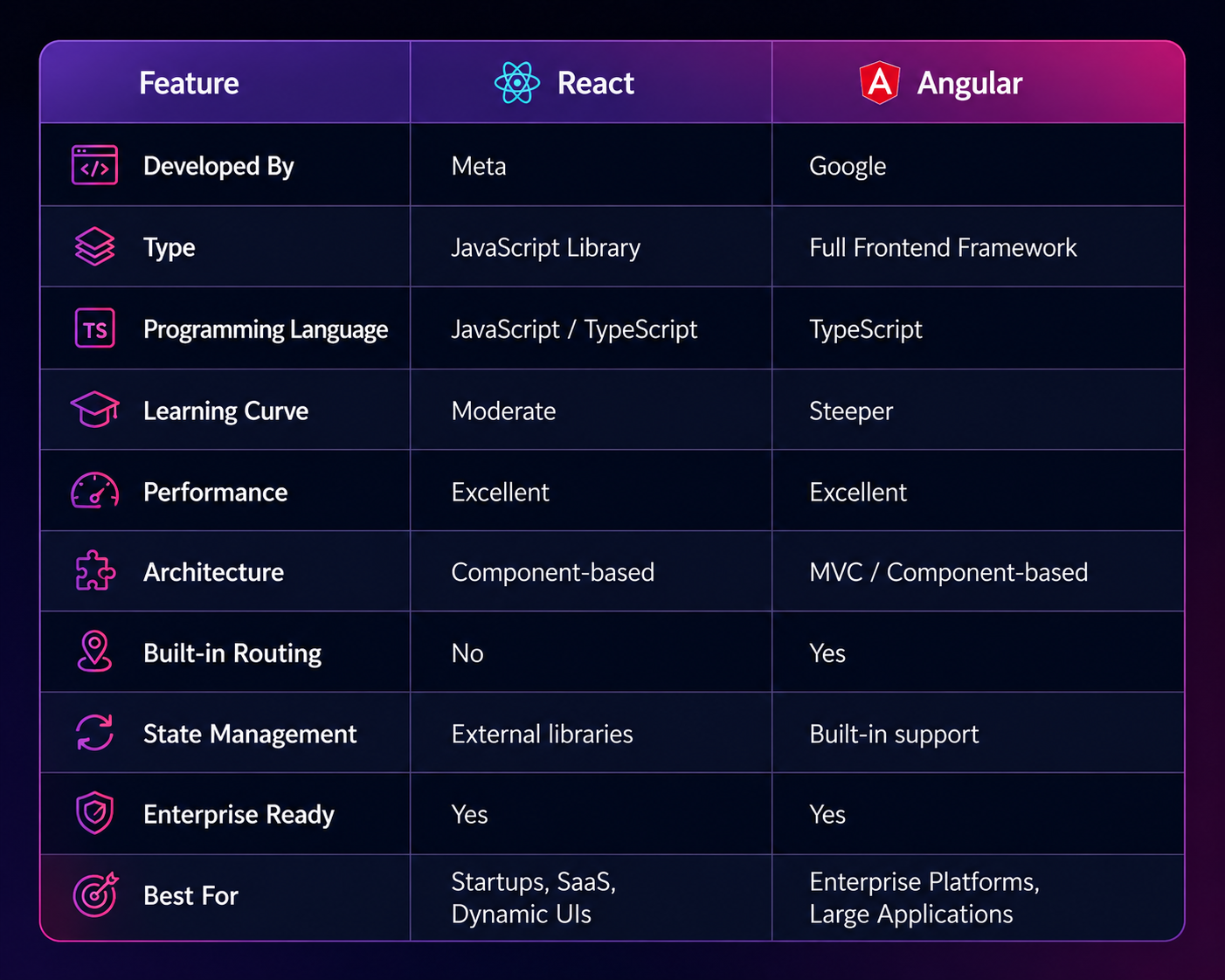
React is a JavaScript library focused on building user interfaces. It gives developers flexibility to choose supporting libraries for routing, state management, and other functionality.
Angular, on the other hand, is a full-featured frontend framework. It includes many built-in capabilities, making it particularly suitable for large applications that require consistency and structured development.
Here’s a quick comparison.
Quick Summary
Choose React if you need:
- Faster MVP development
- Flexible architecture
- Highly interactive user interfaces
- Large ecosystem of third-party libraries
- Faster developer onboarding
Choose Angular if you need:
- Enterprise-grade architecture
- Built-in development tools
- Structured coding standards
- Large engineering teams
- Complex business applications
Neither framework is universally better. The right choice depends on the type of software you’re building and how you expect it to evolve.
Angular & React Adoption Trends
Both Angular and React continue to be among the most widely adopted frontend technologies worldwide. Their popularity is reflected in developer surveys, open-source communities, hiring demand, and enterprise adoption.
The statistics below demonstrate why both frameworks remain leading choices for modern software development.
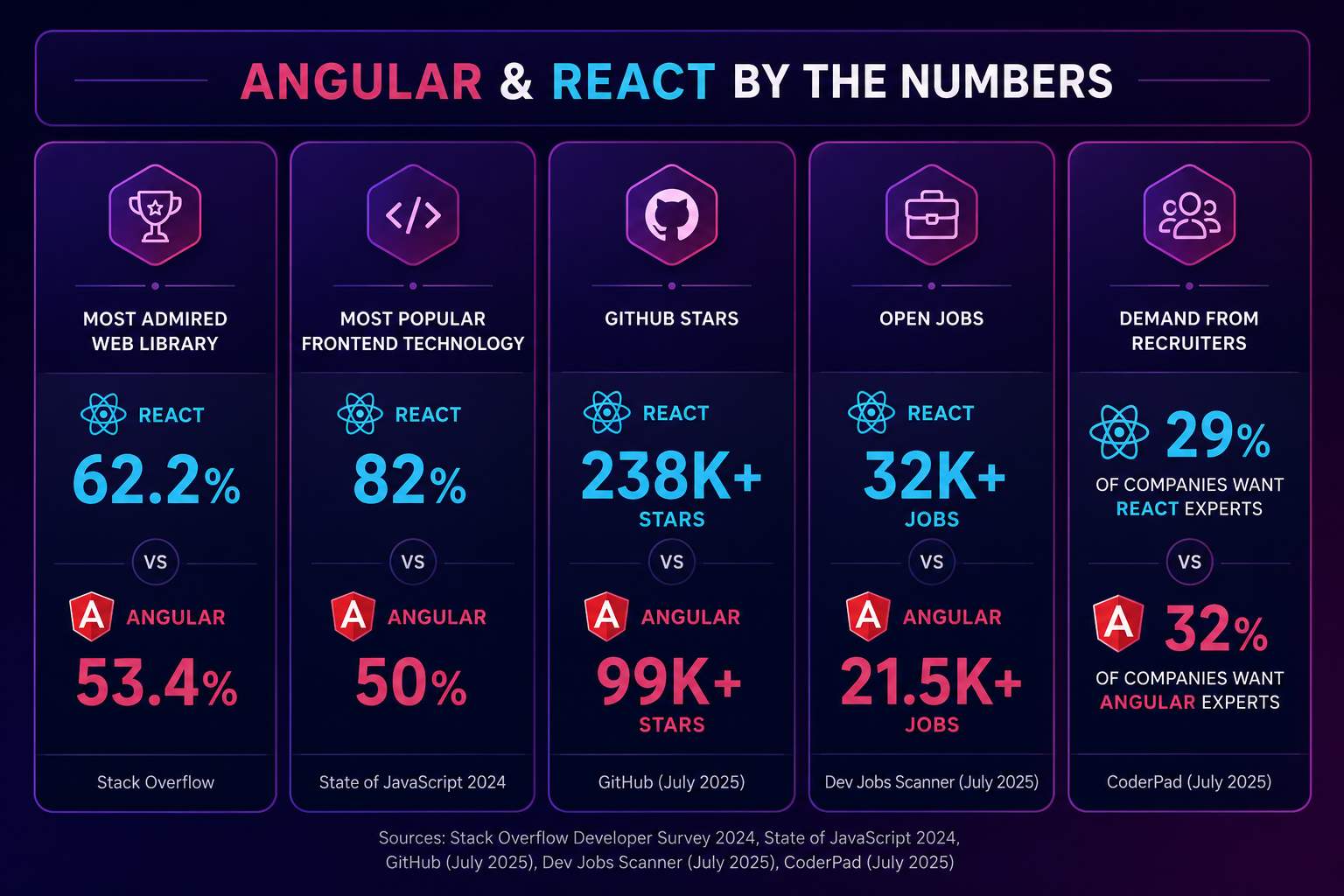
What These Numbers Tell Us
Both technologies continue to evolve and receive strong community support.
React stands out for:
- Massive developer community
- Extensive third-party ecosystem
- Rapid innovation
- Strong startup adoption
Angular excels in:
- Enterprise software development
- Long-term maintainability
- Structured architecture
- Large engineering teams
- Built-in development tooling
Popularity alone shouldn’t determine your technology choice. Instead, consider which framework aligns best with your business objectives, team structure, and long-term product roadmap.
What Is React?
React is an open-source JavaScript library developed by Meta for building fast, interactive, and reusable user interfaces.
Its component-based architecture allows developers to build applications using small, reusable UI components, making development more efficient and easier to maintain.
Because React focuses primarily on the user interface, developers can choose their preferred libraries for routing, state management, testing, and other functionality. This flexibility has contributed significantly to React’s widespread adoption.
Why Businesses Choose React
Many organisations prefer React because it offers:
- Faster frontend development
- Reusable UI components
- Strong ecosystem of libraries
- Excellent performance
- Large global developer community
- Easier hiring opportunities
React is particularly well suited for:
- SaaS products
- Ecommerce platforms
- Customer portals
- Startup applications
- Marketing platforms
- Interactive dashboards
Potential Limitations
While React is highly flexible, that flexibility also means developers often need to make additional architectural decisions.
Projects may require selecting separate libraries for:
- Routing
- State management
- Form handling
- API integration
- Testing
Without consistent standards, large React projects can become difficult to maintain if architectural decisions vary across teams.
What Is Angular?
Angular is a complete frontend framework developed and maintained by Google.
Unlike React, Angular includes many essential development tools out of the box, including routing, dependency injection, form management, HTTP services, and testing utilities.
Its opinionated architecture helps development teams follow consistent coding standards across large projects.
Why Businesses Choose Angular
Angular is commonly selected for applications that require long-term scalability and structured development.
Key benefits include:
- Built-in development tools
- TypeScript by default
- Strong architecture
- Consistent coding practices
- Better maintainability for large applications
- Enterprise-ready ecosystem
Angular is widely used for:
- Enterprise software
- ERP systems
- CRM platforms
- Banking applications
- Healthcare software
- Government digital services
Potential Limitations
Angular provides more built-in functionality than React, but this also creates a steeper learning curve.
Development teams may require additional time to become familiar with:
- Angular CLI
- Dependency Injection
- RxJS
- Modules
- Framework conventions
For smaller applications, some of Angular’s enterprise capabilities may be more than the project requires.
React vs Angular: Feature Comparison
Both React and Angular are powerful frontend technologies, but they take different approaches to application development. Understanding their strengths can help you choose the framework that best aligns with your project requirements.
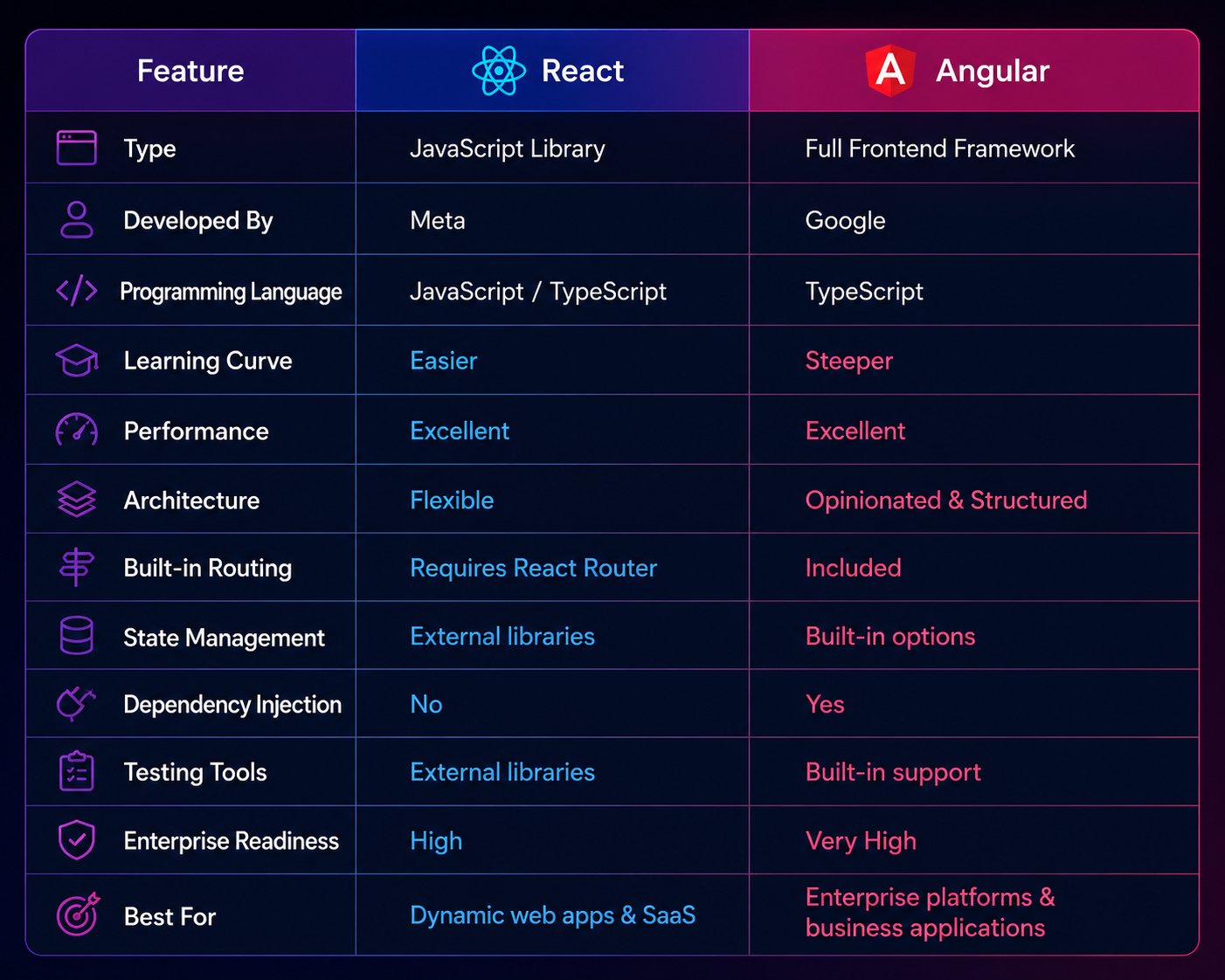
Key Takeaway
React provides greater flexibility and allows developers to choose the tools that best fit their project.
Angular offers a complete development framework with built-in features that promote consistency across large applications.
Neither approach is inherently better—it depends on your business requirements and development strategy.
When React Is the Better Choice
React is often the preferred option when speed, flexibility, and user experience are the primary priorities.
It’s particularly well suited to businesses building modern web applications that require frequent updates and highly interactive interfaces.
React is a good choice if you’re building:
- Startup MVPs
- SaaS platforms
- Ecommerce websites
- Customer portals
- Content-driven websites
- Progressive Web Apps (PWAs)
- Interactive dashboards
Why businesses choose React
- Faster development cycles
- Reusable UI components
- Large developer community
- Flexible architecture
- Easier recruitment
- Strong ecosystem of third-party libraries
Example
A startup launching a new SaaS platform may choose React to release features quickly, gather customer feedback, and iterate rapidly without unnecessary framework complexity.
Looking to build a React application? Explore our React development services to work with experienced frontend engineers who specialise in scalable web applications.
When Angular Is the Better Choice
Angular is designed for applications where consistency, scalability, and long-term maintainability are critical.
Its built-in architecture makes it easier for multiple developers to work on large projects while following consistent coding standards.
Angular is a strong choice for:
- Enterprise software
- ERP systems
- CRM platforms
- Banking applications
- Healthcare software
- Government platforms
- Manufacturing software
- Internal business applications
Why businesses choose Angular
- Built-in development tools
- TypeScript by default
- Strong project structure
- Easier long-term maintenance
- Better consistency across large teams
- Enterprise-focused architecture
Example
A financial services company developing a secure customer management platform may choose Angular because of its structured architecture, maintainability, and suitability for complex business workflows.
Our Angular development services help UK businesses build enterprise-grade applications with structured architecture, long-term maintainability, and high performance.
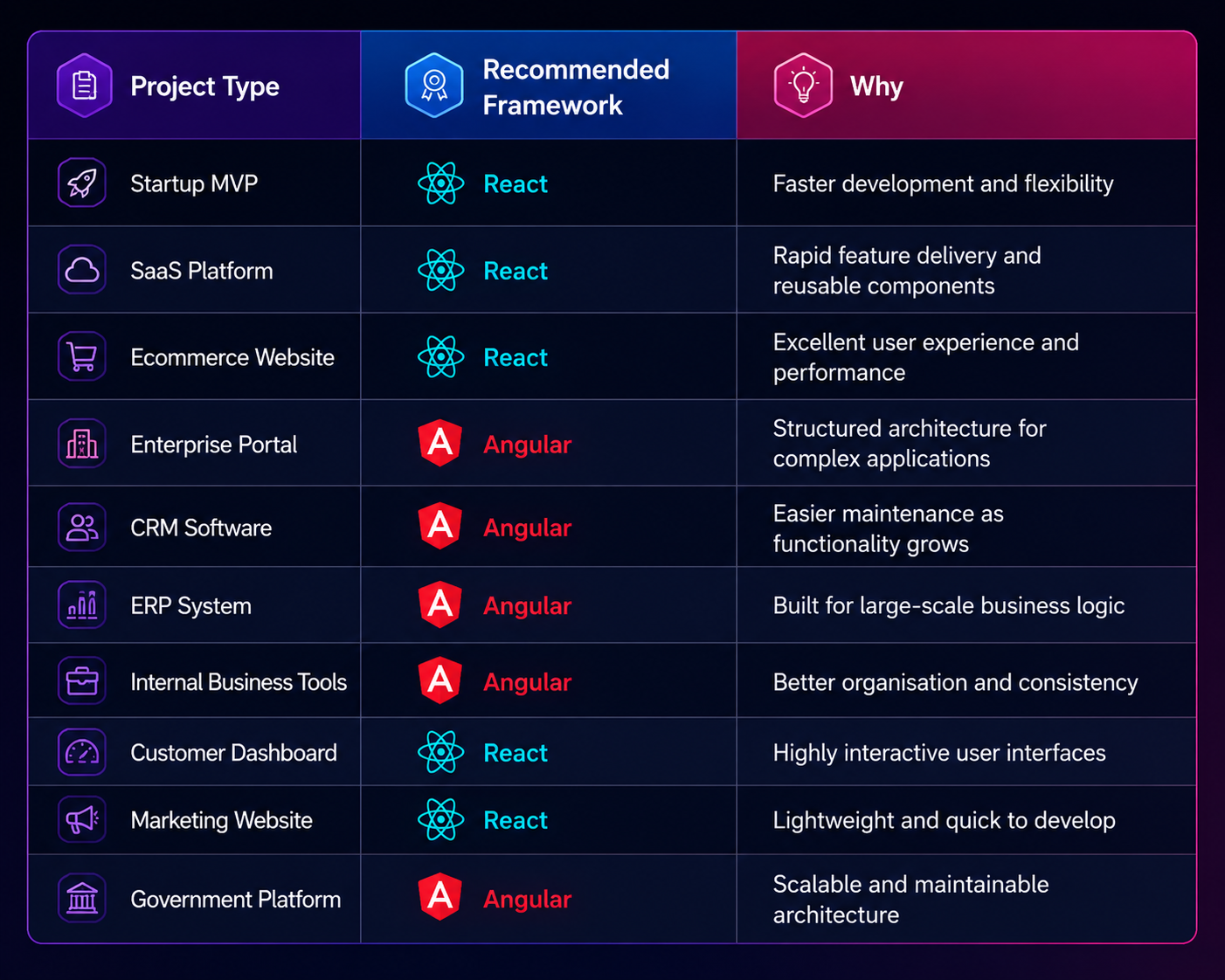
React vs Angular by Project Type
Different projects have different priorities. Rather than asking which framework is better overall, consider which one best supports your business goals.
React vs Angular by Team Size
The size and experience of your development team also influence the right technology choice.
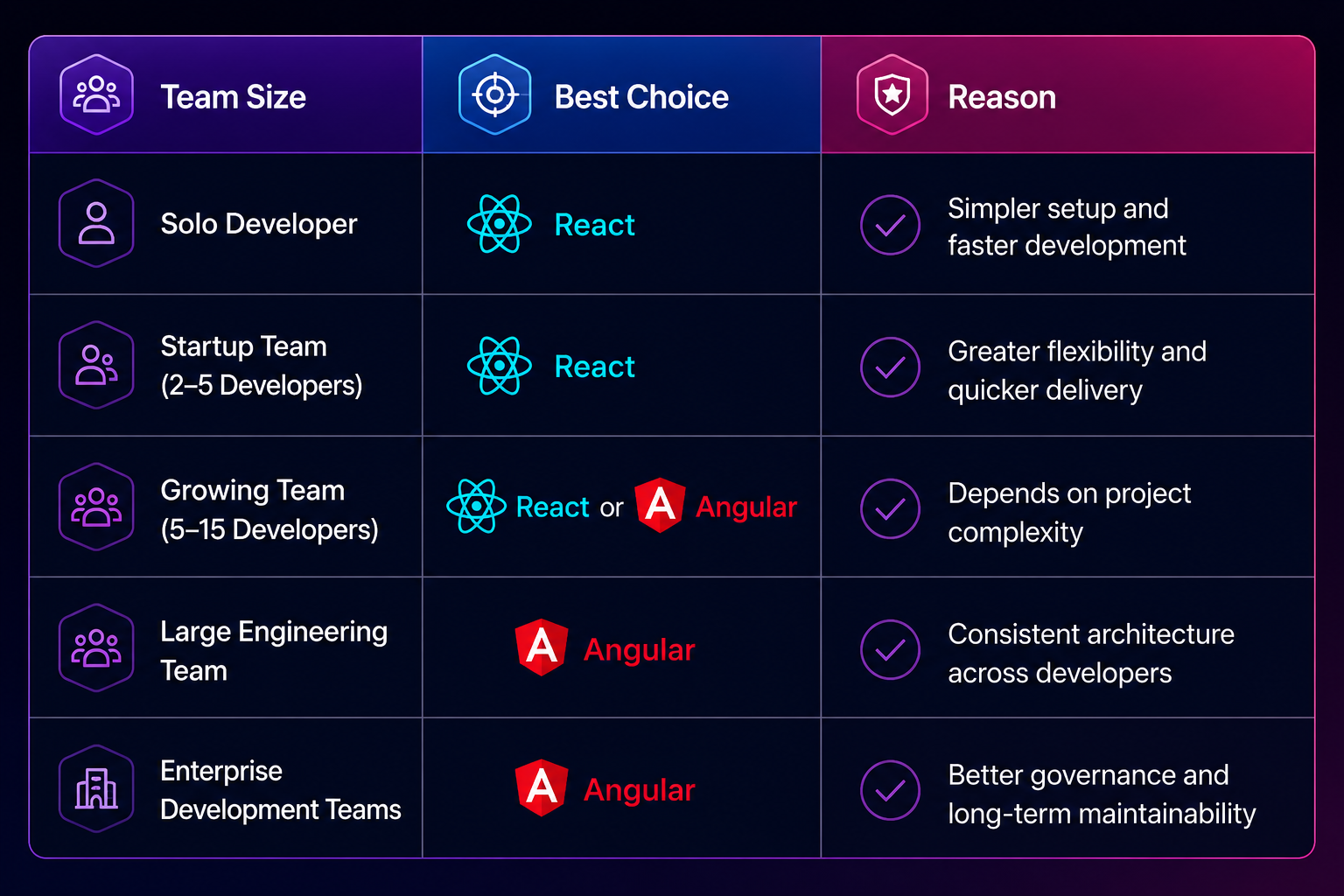
Key Takeaway
- Smaller teams often benefit from React’s flexibility and faster development cycle. If you’re looking to expand your engineering capacity, you can hire React developers with experience in building scalable SaaS products, customer portals, and modern web applications.
- Larger engineering teams typically appreciate Angular’s structured approach for managing complex business applications. Businesses can also hire Angular developers to extend their in-house teams and accelerate enterprise software development.
Quick Decision Matrix
Still unsure which framework to choose? Use this quick guide.
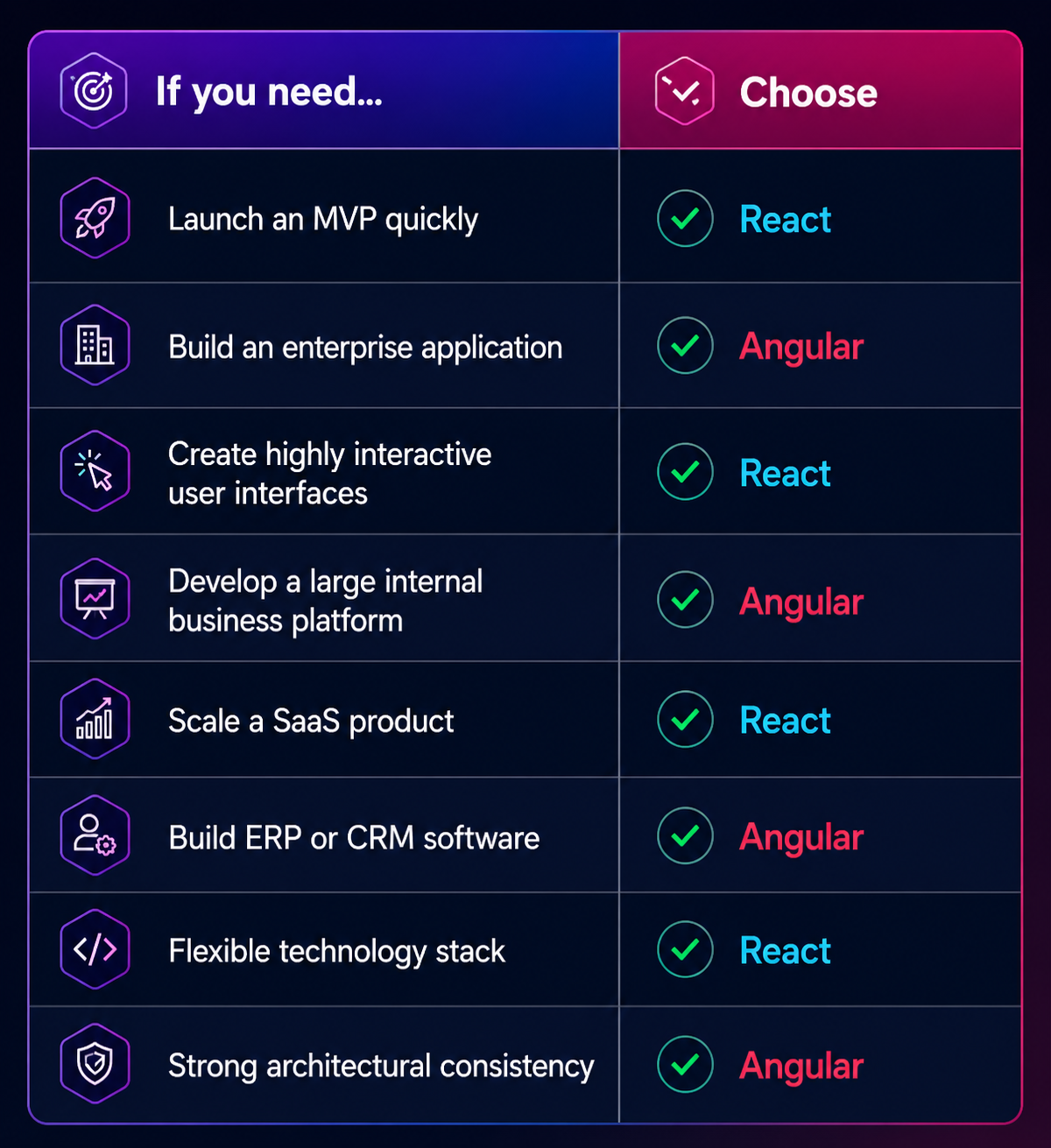
The Bottom Line
Choose React when your priority is speed, flexibility, and delivering engaging user experiences.
Choose Angular when you’re building large, business-critical applications that require structured architecture, long-term maintainability, and collaboration across multiple development teams.
The best framework isn’t the most popular one—it’s the one that best supports your product roadmap, engineering capabilities, and future business growth.
React vs Angular Performance
Performance is often one of the first factors businesses consider when choosing a frontend framework. The reality is that both React and Angular deliver excellent performance when applications are designed and optimised correctly.
Instead of focusing on benchmarks alone, it’s important to consider your application’s complexity, user experience goals, and long-term scalability.
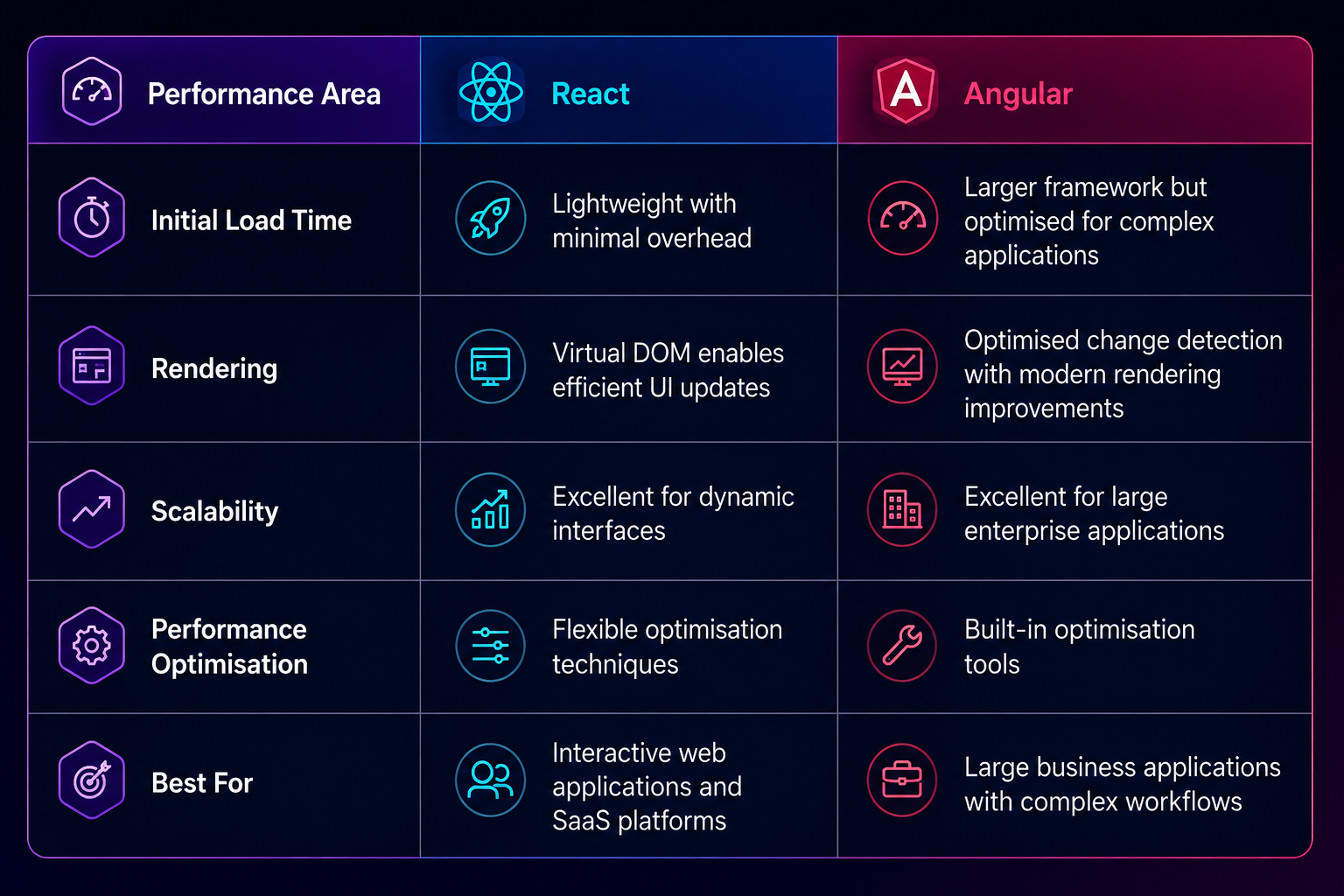
Performance Takeaway
Choose React if your priority is fast, dynamic user interfaces and highly interactive applications.
Choose Angular if you’re building enterprise software where long-term maintainability, consistency, and structured architecture are equally important as performance.
For most modern applications, user experience depends far more on good software architecture and optimisation than on the framework itself.
How Capital Compute Chooses Between Angular and React
At Capital Compute, we don’t recommend Angular or React based on popularity. Every technology decision starts with understanding your business goals, users, and long-term product vision.
Before selecting a frontend framework, our engineering team evaluates:
- Business objectives and product roadmap
- Application complexity
- Scalability requirements
- Team size and collaboration needs
- Integration requirements
- Security and compliance considerations
- Future maintenance and support
Why Businesses Choose Capital Compute
- Engineering-first approach led by experienced software architects.
- Free discovery sessions to understand your business before recommending technologies.
- Fixed-price estimation within two working days for faster planning.
- No subcontracting, ensuring consistent quality and accountability.
- Dedicated engineering teams focused on your product.
- Outcome-based delivery centred on measurable business results.
- AI-assisted engineering workflows to improve productivity and code quality.
- 90-day post-launch support with every software project.
- Flexible engagement models that grow with your business.
Whether you’re launching a startup MVP or building enterprise software, we recommend the framework that best supports your long-term success—not simply the latest industry trend.
Conclusion
There is no universal winner in the Angular vs React debate. Both frameworks are mature, reliable, and capable of powering modern web applications.
React is often the better choice for startups, SaaS products, and businesses looking for flexibility and faster development. Angular excels in enterprise environments where structured architecture, maintainability, and collaboration across larger engineering teams are essential.
The right decision depends on your project goals, technical requirements, team structure, and future growth plans. Choosing the right framework early can reduce technical debt, simplify maintenance, and provide a stronger foundation for long-term success.
Build Your Next Frontend Application with Confidence
Choosing the right frontend framework is only one part of building successful software. Equally important are architecture, scalability, security, and engineering expertise.
At Capital Compute, we help UK businesses design and develop scalable web applications using the technologies that best fit their business goals.
Planning a new software project?
Book a Free Discovery Call and speak with our engineering team about choosing the right frontend technology for your application.