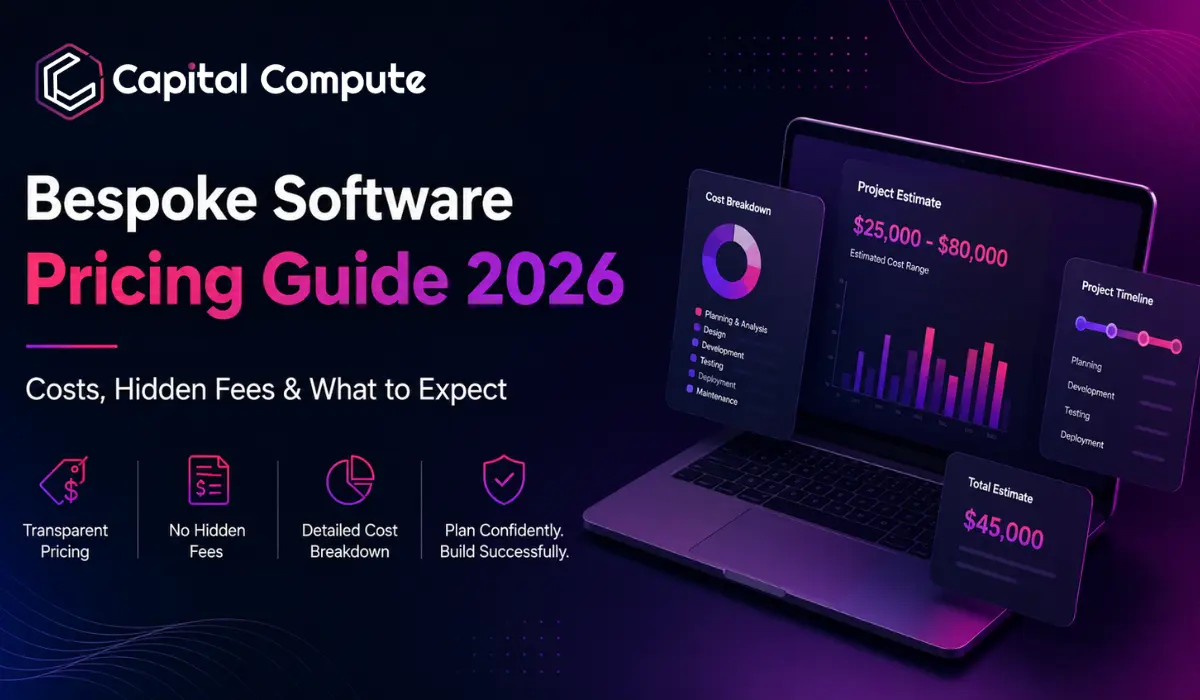
If you’ve ever asked a software development agency how much a project costs, you’ve probably heard some version of: “it depends.” That’s not wrong, but it’s not useful either.
This guide gives you real numbers, the factors that move them, and an honest framework to assess whether bespoke software development is the right investment for your business in 2026.
The Short Answer: Bespoke Software Development Cost at a Glance
Before diving into the detail, here’s a quick reference table based on real project data:
| Project Type | Typical Cost Range | Timeline |
|---|---|---|
| MVP / Proof of Concept | $5,000 – $25,000 | 4–10 weeks |
| Internal Business Tool | $8,000 – $30,000 | 4–8 weeks |
| Custom Web Application | $15,000 – $60,000 | 8–20 weeks |
| Cross-Platform Mobile App | $12,000 – $50,000 | 8–20 weeks |
| Custom SaaS Platform | $30,000 – $120,000 | 16–40 weeks |
| AI-Integrated Product | $25,000 – $100,000 | 12–30 weeks |
| Enterprise-Scale System | $80,000 – $300,000+ | 6–18 months |
These ranges reflect a skilled engineering partner working with modern tooling. The actual cost for your project depends on six core factors covered below.
What Actually Drives Bespoke Software Development Cost?
1. Feature Complexity
The number of features matters far less than how technically complex each one is. A user login form takes hours to build. A real-time scheduling engine that factors in availability, location, and historical patterns can take weeks. The clearer and more specific your requirements, the more accurate any quote will be.
2. Number of Integrations
Every third-party connection payment gateways, CRM systems, accounting platforms, APIs, adds time and cost. Each integration typically adds $2,000 – $8,000 depending on the quality of the external documentation and the complexity of the data flow. A system connecting to Stripe, a CRM, and a cloud storage service will cost meaningfully more than a standalone product.
3. User Roles and Access Control
A single user type is straightforward. Multiple user roles, say, admin, manager, and end-user, each with different permissions and dashboards, adds significant architectural complexity. Multi-role systems typically cost 30–60% more than single-role equivalents.
4. Compliance Requirements
Data privacy regulations, financial compliance, healthcare requirements, and security standards must be engineered in from the start, not added later. Retrofitting compliance to a live system is expensive and risky. Budget 10–20% additional cost for any project where compliance is a hard requirement.
5. Development Team Location
Development rates differ globally.
Average Hourly Rates in 2026
| Region | Hourly Rate |
|---|---|
| UK | $80 – $180/hr |
| Australia | $90 – $200/hr |
| Singapore | $70 – $170/hr |
| Offshore Teams | $25 – $80/hr |
While offshore development may appear cheaper, experienced development partners often provide better long-term ROI through quality assurance, scalability, and reduced maintenance issues.
6. Timeline Pressure
A compressed timeline usually means a larger team running in parallel, which increases coordination overhead and total cost. Projects forced into half their natural timeline often cost 20–40% more than the equivalent project with a sensible runway.
Fixed Price vs Time and Materials: Which Is Right for You?
The pricing model matters almost as much as the headline number.
Fixed price means you agree a total cost upfront based on a defined scope. Cost risk sits with the development firm. You know exactly what you’re paying before a line of code is written. This is the right model for most businesses that have clear requirements and a defined budget.
Time and materials means you pay for hours spent at an agreed rate. Cost is open-ended, and risk sits with you. This model suits exploratory projects where requirements are genuinely unclear and expected to evolve, but it requires close internal oversight to manage spend.
For most startups and SMEs commissioning bespoke software for the first time, fixed-price is the safer and more predictable choice.
The Hidden Costs Most Guides Don’t Mention
The build cost is only part of the total picture. Budget realistically for these ongoing costs from day one:
Hosting and infrastructure: A typical web application running on AWS, Google Cloud, or Azure costs $50–$400 per month, scaling with traffic and data volume.
Maintenance and support: Plan for 15–20% of your original build cost annually. This covers security patches, dependency updates, bug fixes, and minor improvements. A $40,000 build costs roughly $6,000–$8,000 per year to maintain properly.
Third-party service fees: Payment processors, email delivery, SMS, AI APIs, mapping services, each carries its own ongoing cost. Map every external dependency during the scoping phase and get a per-unit cost estimate from each provider.
Future enhancements: Once your product is live, you’ll almost certainly want new features. Budget 20–25% of the original build cost for Year 1 additions. This is not a failure of planning, it’s a sign the product is working.
Total Year 1 cost example: A $50,000 bespoke software build realistically costs $58,000–$68,000 in Year 1 once hosting, maintenance, and integrations are included. Years 2 and beyond typically run $10,000–$15,000 annually for a project of that size.
Is Bespoke Software Worth the Cost?
The ROI calculation is straightforward when the problem is concrete.
If your team spends 15 hours per week on manual data entry between systems at a loaded staff cost of $35 per hour that’s $27,000 per year in time cost. A $40,000 custom integration that eliminates that work pays for itself in under 18 months. Every year after that is pure return.
Bespoke software delivers strong ROI when:
- It eliminates a measurable, recurring cost (time, errors, manual processes)
- It enables revenue that wasn’t possible with existing tools
- It replaces multiple SaaS subscriptions with compounding licensing fees
- It gives you a product or capability that competitors cannot simply purchase
It is not the right investment when a SaaS tool already solves the problem adequately, when requirements are not yet clear, or when you’re validating an early-stage idea that hasn’t proven demand.
If you are still deciding whether a fully bespoke solution or a customized existing platform is right for your business, read our guide on bespoke vs custom software before finalizing your development budget.
Conclusion
Bespoke software development cost in 2026 ranges from around $5,000 for a focused MVP to $300,000+ for enterprise-scale systems, with most business applications falling in the $15,000–$80,000 range depending on complexity, integrations, and team model.
The most important factors are feature complexity, number of integrations, compliance requirements, and your choice of engineering partner. A fixed-price model with a detailed specification protects your budget. And accounting for ongoing hosting, maintenance, and enhancement costs from the start means no surprises after launch.
Bespoke software is not always the right answer. But when it is, when the problem is real, the requirements are clear, and the ROI is measurable, it delivers lasting value that no off-the-shelf product can match.
Ready to Get a Transparent Quote?
Capital Compute builds bespoke software, SaaS platforms, mobile apps, and AI-integrated products for businesses globally. We give you a straight scope, a fixed price, and an engineering team that owns delivery end to end.
If you want to understand how much your software idea could cost, speak with Capital Compute for a transparent project estimate based on your features, integrations, timeline, and long-term goals.