Choosing the right software delivery model isn’t about following industry trends, it’s about matching your business needs with the right level of expertise, ownership, and flexibility at each stage of your project.
Whether you’re a startup validating an idea, a growing SaaS business expanding your product, or an established organisation modernising legacy systems, one question often comes up early in the planning process:
Should we outsource software development or build our team through outstaffing?
At first glance, both approaches provide access to experienced software developers without the time and cost of traditional recruitment. However, they solve different business challenges.
Many comparison articles focus on factors like hourly rates, management responsibilities, or team structure. While these are important, they overlook the question that should come first:
What stage is your project currently in?
The engagement model that works well for an early-stage MVP may become inefficient as your product grows. Likewise, a mature engineering organisation may benefit more from extending its internal team than outsourcing an entire project.
Understanding this distinction helps businesses make more informed decisions, reduce delivery risks, and invest in a software development approach that supports both immediate goals and long-term growth.
In this guide, we’ll explore:
- The key differences between outsourcing and outstaffing
- The advantages and challenges of each approach
- How your project’s stage should influence the decision
- Common mistakes businesses make when choosing a delivery model
- A practical framework for selecting the right software development partner
By the end, you’ll have a clearer understanding of which approach aligns with your current business needs and how that choice may evolve as your software project matures.
Outsourcing vs Outstaffing: Understanding the Difference
Although the terms are often mentioned together, outsourcing and outstaffing represent two distinct ways of building software.
The biggest difference isn’t where developers work, it’s who owns delivery, who manages the work, and how responsibilities are shared.
Choosing the right model starts with understanding these differences.
What Is Software Outsourcing?
Software outsourcing is a delivery model where a business partners with an external software development company to design, build, test, and deliver a software solution.
Rather than hiring individual developers, you’re engaging an experienced team capable of managing the technical aspects of the project from discovery through deployment.
Depending on the scope, an outsourcing partner may provide:
- Solution architects
- Software engineers
- UI/UX designers
- QA engineers
- DevOps specialists
- Technical leads
- Project managers
Instead of coordinating multiple specialists internally, your business works with a dedicated delivery team responsible for achieving agreed outcomes.
This approach allows organisations to focus on strategic priorities while relying on experienced engineers to manage day-to-day software delivery.
For businesses that need end-to-end support, our Outsource Software Development service provides dedicated engineering teams, architecture expertise, quality assurance, and post-launch support, allowing organisations to accelerate delivery without expanding their permanent workforce.
Benefits of Outsourcing
- Faster project initiation without lengthy recruitment.
- Access to a multidisciplinary engineering team.
- Reduced management overhead for internal stakeholders.
- Predictable delivery processes with defined milestones.
- Easier access to specialist expertise such as cloud engineering, AI, DevOps, or cybersecurity.
- Flexible team scaling as project requirements evolve.
Potential Challenges
Outsourcing delivers the best results when both parties share clear expectations and communicate regularly.
Challenges can arise when:
- Project objectives aren’t well defined.
- Scope changes are poorly managed.
- Communication is inconsistent.
The delivery partner lacks relevant industry experience.
Choosing an experienced software development partner with transparent governance, structured delivery processes, and strong technical leadership significantly reduces these risks.
What Is Software Outstaffing?
Outstaffing follows a different model.
Instead of outsourcing the delivery of an entire project, businesses hire dedicated developers through an external provider to work as an extension of their existing engineering team.
These developers typically join your day-to-day workflows, attend sprint planning sessions, participate in stand-ups, and collaborate directly with your internal product managers and technical leads.
Unlike outsourcing, your organisation retains responsibility for:
- Product strategy
- Technical architecture
- Sprint planning
- Task prioritisation
- Code reviews
- Delivery management
- Quality standards
The provider supplies the engineering talent, while your internal team manages how that talent is used.
This model is particularly effective for businesses with established engineering capabilities that need additional development capacity without committing to permanent recruitment.
Benefits of Outstaffing
- Greater day-to-day control over development.
- Seamless integration with internal teams.
- Flexible scaling based on project demands.
- Direct communication with developers.
- Faster access to specialist technical skills.
Potential Challenges
Outstaffing assumes your organisation already has the experience required to manage software delivery effectively.
Without strong internal leadership, businesses may struggle with:
- Prioritising work
- Managing delivery schedules
- Reviewing technical quality
- Coordinating multiple developers
- Maintaining consistent engineering standards
Hiring additional developers doesn’t automatically improve delivery if the necessary management processes aren’t already in place.
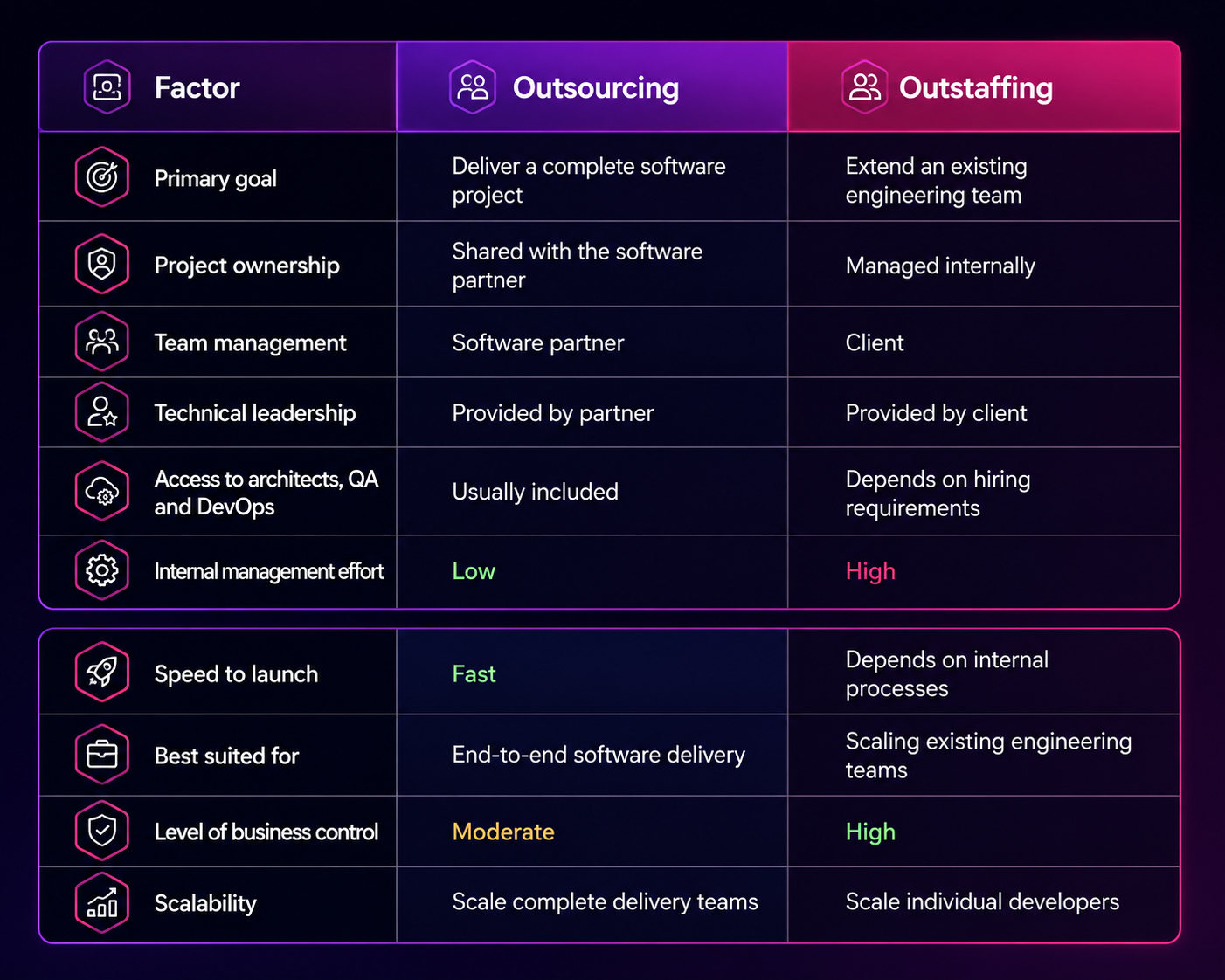
Outsourcing vs Outstaffing: Side-by-Side Comparison
At a Glance
If your business needs strategic guidance, technical leadership, and a team capable of delivering a software product from concept to launch, outsourcing is often the stronger option.
If you already have an experienced engineering department and simply need additional developers to increase delivery capacity, outstaffing may provide greater flexibility.
Neither model is inherently better the right choice depends on your organisation’s capabilities and the maturity of your software project.
Why Project Stage Matters More Than Cost
One of the most common mistakes businesses make is comparing outsourcing and outstaffing based solely on hourly rates.
While cost is an important consideration, it rarely tells the full story.
A lower hourly rate can quickly become more expensive if your internal team spends significant time managing developers, refining requirements, or resolving technical issues that could have been prevented with stronger delivery governance.
Likewise, investing in a fully managed outsourcing team may appear more expensive initially, but it can reduce delays, minimise management overhead, and accelerate time to market particularly during the early stages of a project.
The better question isn’t:
Which option costs less?
It’s:
Which engagement model gives our project the best chance of succeeding at its current stage?
As your software evolves, so do your delivery needs.
A startup validating an idea faces very different challenges from a business scaling an established SaaS platform or an enterprise replacing legacy systems. The engagement model that delivers the greatest value today may not be the best fit six or twelve months from now.
Instead of viewing outsourcing and outstaffing as competing options, think of them as complementary approaches that support different stages of your product journey.
In the next section, we’ll explore how your project’s maturity should influence your decision and why many successful organisations evolve from outsourcing to outstaffing, or adopt a hybrid model, as their products and teams grow.
Choosing the Right Model at Each Project Stage
There isn’t a single “best” approach when comparing outsourcing vs outstaffing. The right choice depends on where your project is today, not where you want it to be in a year’s time.
As your software evolves, your priorities change. Early-stage projects need strategic guidance and faster execution, while mature products often require additional engineering capacity and greater operational control.
Here’s how each project stage influences the right delivery model.
Stage 1: Idea Validation & Discovery
At this stage, you are testing an idea rather than building a finished product.
Your focus is on:
- Validating the business idea
- Understanding user requirements
- Defining the project scope
- Choosing the right technology
- Reducing delivery risk
Most businesses don’t have an in-house engineering team at this point. Even if they do, they may lack the time or specialist expertise needed to turn an idea into a technical roadmap.
Why Outsourcing Works Best
An experienced software development partner can help you:
- Run discovery workshops
- Validate technical feasibility
- Recommend the right architecture
- Estimate costs and timelines
- Build a clear product roadmap
- Identify potential risks early
Instead of hiring multiple specialists, you gain access to an entire delivery team from day one.
Best Choice: ✔ Outsourcing
Stage 2: MVP Development
Once your idea is validated, the next objective is simple launch quickly and learn from real users.
An MVP doesn’t need every feature. It needs the right features to test your assumptions and gather valuable customer feedback.
Your priorities usually include:
- Faster time to market
- Controlled development costs
- High-quality user experience
- Reliable product delivery
- Flexibility to adapt after launch
Why Outsourcing Still Makes Sense
A managed outsourcing team can:
- Start development immediately
- Handle project management and QA
- Deliver regular sprint updates
- Keep the project moving without additional hiring
This reduces internal management overhead and allows your business to focus on customers, investors, and product validation.
Best Choice: ✔ Outsourcing
Stage 3: Product-Market Fit & Growth
As your product gains users, development becomes more predictable.
Your business may now have:
- A product roadmap
- An internal product owner
- Engineering leadership
- Established development processes
The challenge shifts from building the product to scaling delivery.
Why Outstaffing Becomes Valuable
Instead of outsourcing the entire project, you can expand your existing team with dedicated developers.
Benefits include:
- Greater control over daily development
- Faster feature delivery
- Easier team expansion
- Direct collaboration with your internal engineers
- Flexible scaling as demand increases
This approach works best when your organisation already has the experience to manage software delivery effectively.
Best Choice: ✔ Outstaffing
Stage 4: Scaling & Enterprise Delivery
Established businesses often manage multiple products, legacy systems, and complex digital transformation programmes.
Their priorities typically include:
- Platform modernisation
- Cloud migration
- AI implementation
- Security and compliance
- Performance optimisation
- Team scalability
Why a Hybrid Model Often Delivers the Best Results
Many organisations combine both engagement models.
For example:
Keep your core engineering team in-house.
Add outstaffed developers to increase delivery capacity.
Outsource specialist projects such as AI, cloud engineering, cybersecurity, or platform modernisation.
This provides flexibility without compromising quality or delivery speed.
Best Choice: ✔ Hybrid (Outsourcing + Outstaffing)
Quick Decision Guide
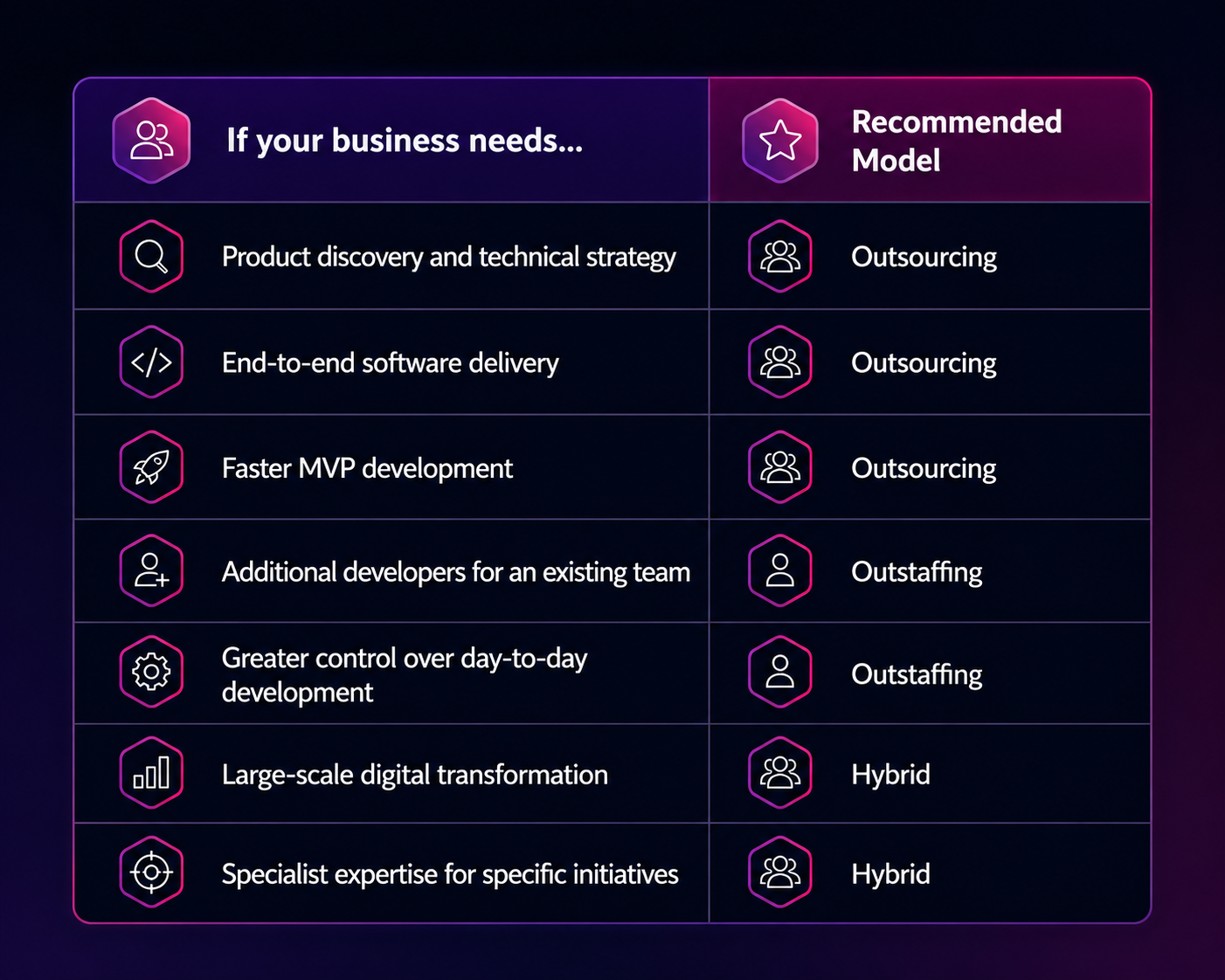
Key Takeaway
Your software delivery model should evolve as your business grows.
- Idea to MVP: Outsourcing provides speed, expertise, and lower management overhead.
- Growth Stage: Outstaffing helps expand your engineering capacity.
- Enterprise Projects: A hybrid approach offers the flexibility to scale while accessing specialist expertise when needed.
How to Choose the Right Software Development Partner
Choosing the right model at the right stage reduces delivery risk, improves collaboration, and helps your project move from concept to successful deployment more efficiently.
Choosing the right software development partner goes beyond comparing costs or team size. Look for a partner that understands your business goals, not just your technical requirements. Evaluate their experience in similar projects, delivery methodology, communication process, and ability to scale as your needs evolve.
Before making a decision, ask questions such as:
- Do they provide architecture and technical consulting?
- Who owns the source code and intellectual property?
- How do they manage project communication and reporting?
- What quality assurance and security practices do they follow?
- Can they scale the team as the project grows?
- What post-launch support is included?
A reliable development partner should act as a long-term technology partner, helping you reduce delivery risks, accelerate development, and build software that supports your business objectives.
How Capital Compute Helps UK Businesses Choose the Right Delivery Model
Every software project has different technical, operational, and commercial requirements. That’s why Capital Compute doesn’t recommend a one-size-fits-all engagement model. Instead, we assess your project stage, internal capabilities, business objectives, and delivery timeline before recommending the right approach.
Here’s what sets us apart:
- Engineering-first approach: Our projects are led by experienced engineers who focus on building scalable, maintainable software, not just delivering code.
- Free discovery sessions: We take the time to understand your business goals, technical challenges, and project requirements before recommending a solution.
- Fixed-price estimation within two working days: Receive a transparent fixed-price estimate quickly, helping you make informed decisions without lengthy sales cycles.
- No subcontracting: Your project is delivered by Capital Compute’s in-house engineering team, ensuring consistent quality, accountability, and communication throughout the engagement.
- Dedicated engineering teams: Work with a dedicated team of software engineers who understand your product, industry, and long-term roadmap.
- Outcome-based delivery: We measure success by delivering business outcomes, not simply billing development hours.
- AI-assisted engineering workflows: Our proprietary AI-powered development workflows help accelerate delivery, improve code quality, and streamline engineering processes without compromising quality.
- 90-day post-launch support: Every project includes 90 days of post-launch support to address issues, optimise performance, and ensure a smooth transition into production.
- Flexible engagement as you grow: Many clients begin with managed outsourcing to accelerate delivery and later transition to dedicated engineering teams as their product matures. This allows your delivery model to evolve alongside your business without disrupting development.
Whether you’re validating a new idea, launching an MVP, or scaling an enterprise platform, Capital Compute provides the engineering expertise, flexible engagement models, and long-term partnership needed to support every stage of your software development journey.