If you have spent any time in software development discussions, you have almost certainly heard both terms used in the same breath, sometimes by the same person in the same sentence. REST API. RESTful API. Most developers treat them as synonyms. Most documentation uses them interchangeably. Even large technology companies like Google, Amazon, and Stripe label their APIs inconsistently across their own documentation.
So is there actually a difference? Yes, and it matters more than most teams realise.
This is not a debate about naming conventions. The distinction between REST and RESTful touches on how much architectural discipline your API enforces, how safe your assumptions are when consuming a third-party API, and how much technical debt you are quietly accumulating in systems you are calling production-ready. Whether you are a developer building your first API, a technical lead making architecture decisions for a growing platform, or a product stakeholder trying to understand what your engineering team is actually building, this article gives you a clear and practical answer.
By the end, you will know the precise difference, be able to identify which type of API you are building or working with, and have a framework for making the right architectural choice for your specific situation.
A Quick Answer Before We Go Deeper
REST is an architectural style, a collection of constraints and principles that define how networked applications should communicate. RESTful is the adjective used to describe an API that fully implements all of those constraints.
Every RESTful API is a REST API. Not every REST API is RESTful.
Think of it like the Highway Code. REST is the rulebook. A RESTful API is a driver who follows every rule in that book, every time, without exception. A REST API is a driver who generally follows the rules, knows the rulebook exists, but occasionally rolls through a stop sign or ignores a speed limit when it feels inconvenient. Both are on the same road. Only one is fully compliant.
The rest of this article explains why that distinction has real consequences for modern software development.
What Is REST? The Six Constraints That Define It
REST stands for Representational State Transfer. It was introduced by Roy Fielding in his doctoral dissertation at the University of California, Irvine in the year 2000. Fielding was one of the principal authors of the HTTP specification, and REST emerged from his thinking about what made the web’s architecture so scalable and resilient.
REST is not a protocol. It is not a standard. It is not a framework or a library. It is a set of six architectural constraints. An API earns the RESTful label by implementing all six. Most APIs implement some of them.
1. Client-Server Separation
The client and the server are independent of each other. The client handles the user interface and experience. The server handles data storage and business logic. They communicate only through a defined interface. This separation means either side can evolve independently without breaking the other.
In practice: your mobile app can be redesigned completely without changing the server, as long as the API contract stays the same.
2. Statelessness
Every request from the client to the server must contain all the information needed to understand and process that request. The server stores no session state between requests. If a client needs to be authenticated, the authentication credentials must be sent with every request, not stored in a server-side session.
In practice: this is why JWT tokens are sent in every request header rather than stored server-side after login.
3. Cacheability
Responses must explicitly state whether they can be cached or not. If a response is cacheable, the client or an intermediary can reuse that response for subsequent equivalent requests, reducing load on the server and improving performance.
In practice: a product catalogue endpoint that changes once a day should be cacheable. A user account balance endpoint probably should not be.
4. Uniform Interface
This is the most important constraint and the one most frequently misunderstood or ignored. It means the way clients interact with the server must be consistent and standardised across all resources. This includes using resource-based URLs (nouns, not verbs), using HTTP methods correctly (GET to read, POST to create, PUT or PATCH to update, DELETE to remove), returning consistent response structures, and ideally implementing HATEOAS (covered in detail below).
In practice: an endpoint called /getUser violates a uniform interface. An endpoint called /users/123 that responds to a GET request correctly implements it.
5. Layered System
A client cannot tell whether it is talking directly to the origin server or to an intermediary such as a load balancer, cache, or proxy. Each layer only knows about the layer it is interacting with directly. This enables scalability, security, and flexibility in infrastructure design.
In practice: you can place a CDN or API gateway in front of your server without the client needing to know or care.
6. Code on Demand (Optional)
Servers can optionally extend client functionality by sending executable code, such as JavaScript, to be run on the client side. This is the only optional constraint in the REST architecture. Most APIs never implement it.
These six constraints are what REST actually is. An API that implements all six is RESTful. An API that picks and chooses is a REST API that is not fully RESTful.
What Is a REST API?
A REST API is any API that uses HTTP and draws on REST principles, without necessarily complying with all six constraints in full.
Partial compliance is extremely common. A typical REST API might use standard HTTP verbs correctly, return JSON responses consistently, and operate over HTTPS. But it might also store session state on the server, return inconsistent URL structures across endpoints, skip caching headers entirely, or label every error response with an HTTP 200 status code and bury the error in the response body.
These are REST APIs. They are not fully RESTful. And for many use cases, that is completely acceptable.
Partial compliance is often the right choice for internal tools, proof-of-concept builds, and low-traffic integrations where speed of development matters more than architectural rigour. A startup building an MVP does not necessarily need to implement HATEOAS before validating whether anyone wants the product. Understanding where REST APIs fit into the wider custom software development process helps teams make smarter decisions about when to invest in full compliance and when partial compliance is genuinely sufficient.
The risk of partial compliance is not that it is wrong. The risk is that it accumulates. A team that builds a partially compliant REST API, calls it RESTful, and then hands it off to another team, or opens it to third-party developers, creates a system where assumptions about behaviour are wrong. That gap between assumption and reality is where integration bugs live.
What Is a RESTful API?
A RESTful API fully implements all six REST constraints, including statelessness, a properly enforced uniform interface, explicit cacheability, and layered system compatibility.
The element that most clearly separates a truly RESTful API from a partially compliant REST API is HATEOAS. Hypermedia as the Engine of Application State is the principle that API responses should include links to related actions and resources, so the client can navigate the API dynamically without needing external documentation to know what to do next.
In a non-HATEOAS API, a developer reads the documentation, hardcodes an endpoint like /orders/456/cancel, and builds logic around it. If the server changes that endpoint, everything breaks.
In a HATEOAS-compliant RESTful API, the response to a GET request on /orders/456 would include something like:
json
{
“id”: 456,
“status”: “pending”,
“links”: [
\ { “rel”: “cancel”, “href”: “/orders/456/cancel”, “method”: “POST” },
\ { “rel”: “update”, “href”: “/orders/456”, “method”: “PUT” }
]
}
The client does not need to know the cancel endpoint in advance. The server tells it. This makes the API genuinely self-describing and reduces coupling between client and server.
Most developers have never built a fully HATEOAS-compliant API, and most APIs that call themselves RESTful do not implement it. Roy Fielding himself wrote publicly that he is frustrated by APIs that claim the RESTful label without implementing HATEOAS, calling it the most misunderstood and skipped constraint in practice.
Whether HATEOAS is worth implementing depends on your project. For a public API with thousands of third-party developers building on top of it, the long-term reduction in breaking changes is valuable. For an internal microservice consumed by three teams in the same company, it is probably over-engineering.
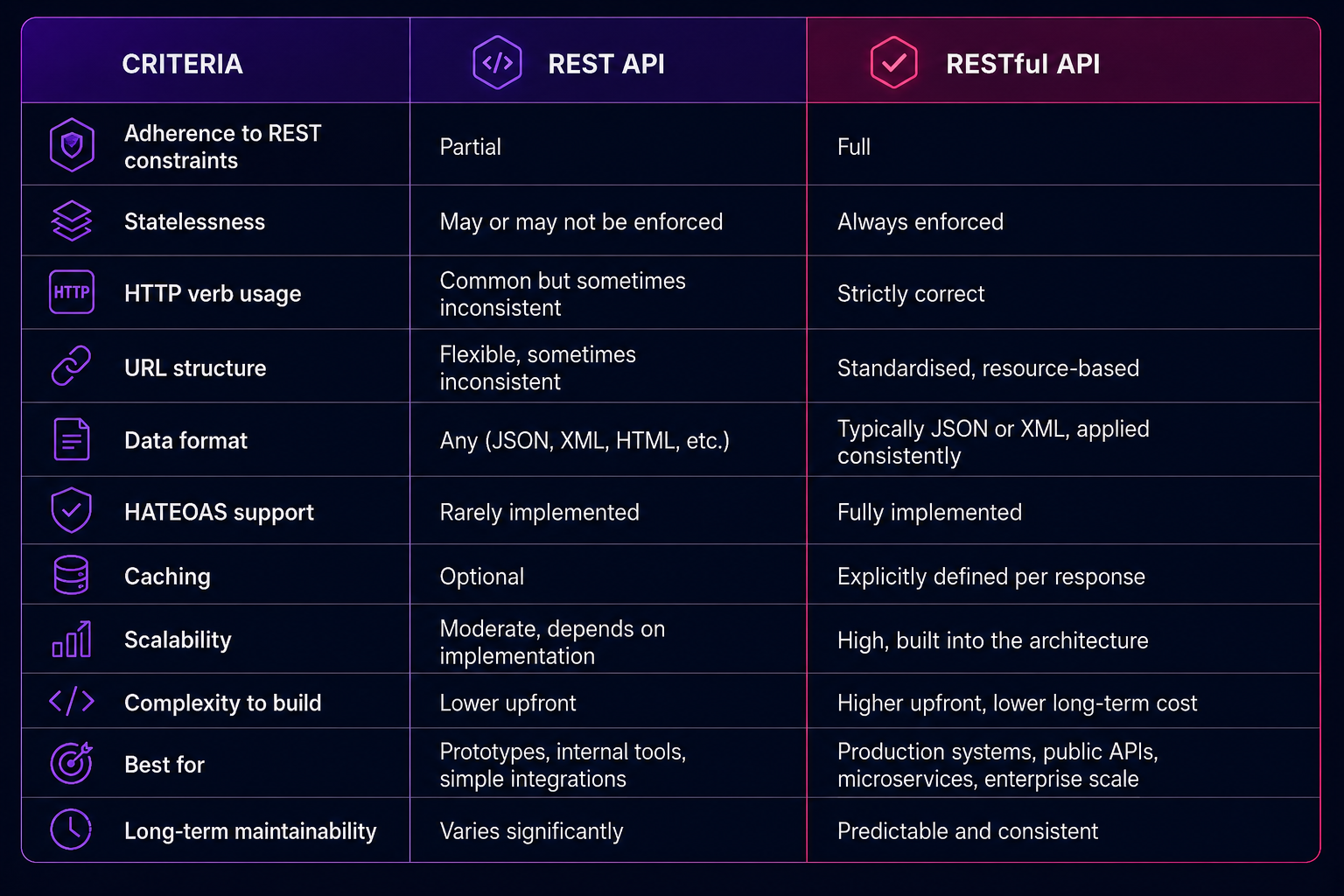
REST API vs RESTful API: Side-by-Side Comparison
Where the Confusion Comes From and Why It Persists
The terms have been used interchangeably for so long that the distinction has blurred in common usage. Stripe calls its API a REST API. Twilio calls its API RESTful. GitHub uses both terms in the same documentation page. None of this is wrong in a meaningful sense, because the labels are applied loosely by convention rather than against a formal compliance standard.
There is no REST certification. There is no RESTful API validator that tells you whether your implementation passes. The distinction exists in principle and in architectural discipline, not in any enforcement mechanism.
This creates a specific problem: when a team inherits a codebase described as RESTful, or when a third-party API is sold as fully RESTful, developers make assumptions based on that label. They assume statelessness is enforced. They assume URL structures are consistent. They assume HTTP verbs are used correctly. When those assumptions turn out to be wrong, the debugging and refactoring cost is real.
The “REST API is RESTful enough” trap is one of the most common sources of quietly accumulating technical debt in custom software projects. Staying across emerging custom software development trends helps technical teams understand when architectural shortcuts that were acceptable at one scale become liabilities at another.
Does the Difference Matter in 2026?
The API landscape has evolved significantly since Fielding published his dissertation. GraphQL, gRPC, and AsyncAPI are all serious alternatives that solve specific problems REST and RESTful APIs do not handle as elegantly.
GraphQL is worth considering when clients need to fetch variable shapes of data in a single request and you want to avoid over-fetching or under-fetching. gRPC is worth considering for high-performance, low-latency internal communication between services where HTTP overhead is a constraint. These are not replacements for REST, they are tools for different jobs.
REST still dominates public API design, web integrations, and CRUD-heavy applications. It is the default choice for a reason: it is well-understood, well-tooled, and compatible with virtually every platform and language. That is unlikely to change in the near term.
Where the REST vs RESTful distinction specifically matters in 2026 is in three scenarios. First, when you are building a public API that third-party developers will consume. Inconsistency in your API design directly increases the support burden and reduces adoption. Second, when you are building microservices at scale within a larger organisation, where multiple teams need to consume and trust each other’s APIs. Third, when you are making architectural decisions that need to hold for five or more years. Understanding the full picture of custom software development helps frame API design as a long-term investment rather than a short-term technical choice.
Where partial REST compliance is genuinely fine: internal tooling with a small number of consumers, MVPs in early validation, and low-traffic integrations between systems you control on both sides.
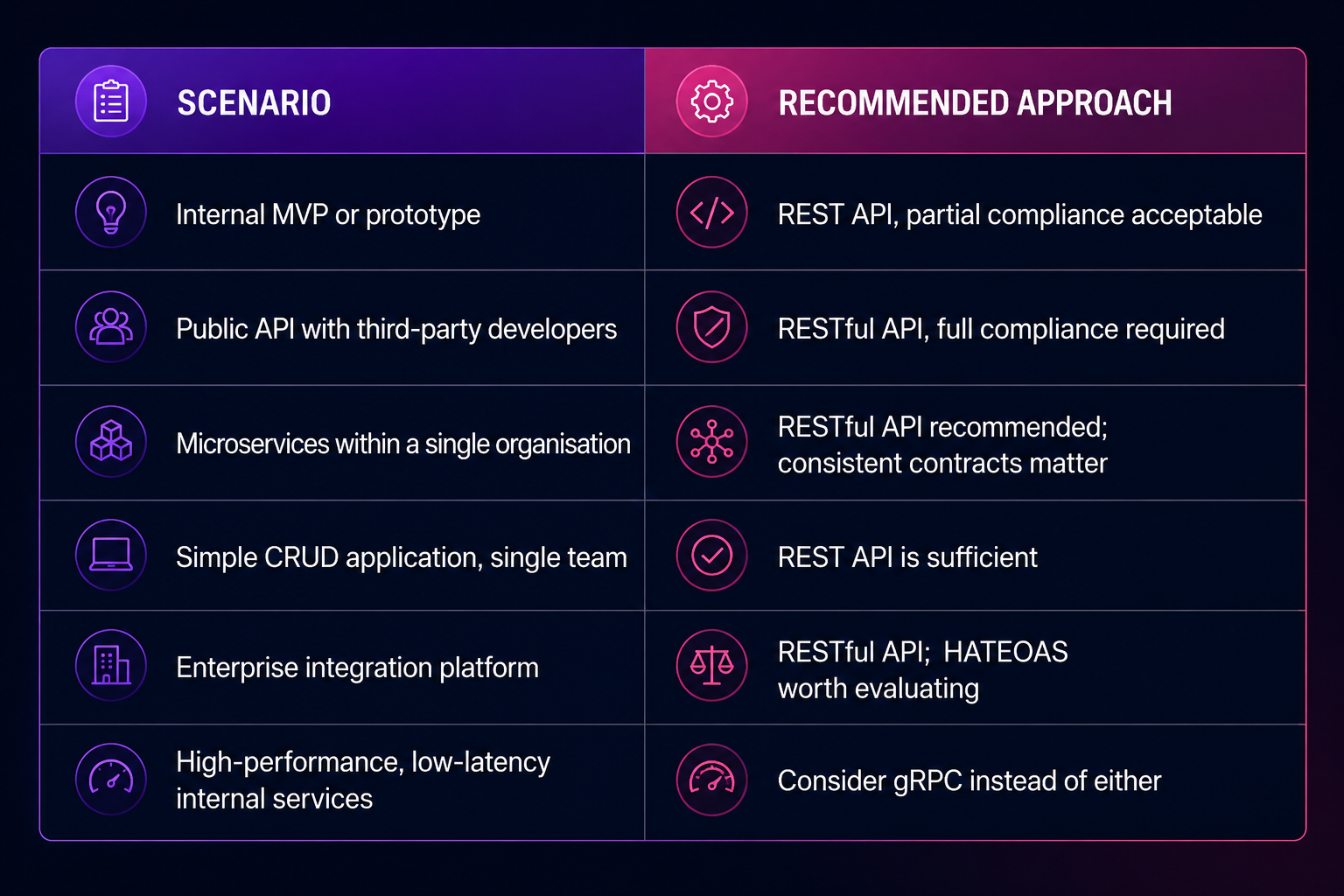
Choosing the Right Approach for Your Project
The question is not which term you should use. The question is which constraints you should implement, and being explicit with your team about that decision.
Work through these questions before committing to an approach:
Is this API public or internal? Public APIs demand more rigour because you cannot control how consumers use your endpoints or what assumptions they make.
How many developers will consume or build on top of it? The more external consumers, the more valuable consistency becomes.
What is the expected scale and lifespan? An API built for a five-year enterprise platform needs a different level of discipline than one built for an internal tool that might be replaced in 18 months.
Does your team have the discipline and tooling to enforce RESTful constraints consistently? Full RESTful compliance requires agreed conventions, code reviews that check for violations, and documentation that keeps pace with the implementation.
Do you need HATEOAS? For most projects, documented endpoints are sufficient. HATEOAS is worth the investment when your API will evolve frequently and breaking changes to clients would be costly.
A proper architecture review at the start of a project is one of the most effective ways to make this decision with clarity rather than defaulting to whatever the team used last time.
Common Mistakes Teams Make When Building REST APIs
These are the patterns that cause the most damage, and they are all avoidable with clear conventions established early.
Using POST for everything. Some teams default to POST for all requests because it feels safer or simpler. This breaks the uniform interface constraint and makes the API significantly harder to understand and cache correctly.
Building stateful endpoints. Storing session data server-side and then describing the API as RESTful is one of the most common technical misrepresentations in software projects. Stateful endpoints create hidden dependencies that cause failures at scale.
Inconsistent URL naming across endpoints. Mixing verbs and nouns, inconsistent pluralisation, and varying depth structures across the same API are all signs of partial compliance. A route like /getUsers sitting alongside /products/123/delete in the same API is a maintenance liability.
Returning HTTP 200 for errors. Returning a 200 status code with an error message buried in the response body is a surprisingly common pattern. It breaks every HTTP-aware tool in the chain: caches, proxies, monitoring systems, and client error handlers.
Claiming HATEOAS compliance without linking resources. Including the word HATEOAS in an API specification without actually returning hypermedia links in responses is not compliance. It is documentation debt that confuses every developer who reads it.
Not defining cacheability headers. Skipping Cache-Control headers is one of the fastest ways to create unnecessary server load. Explicitly defining what is cacheable and for how long is a basic RESTful requirement that most REST APIs ignore.
Understanding these patterns and the benefits of building custom software with clear architectural standards from the start prevents the kind of technical debt that compounds across years of a platform’s life.
REST API vs RESTful API in Software Architecture Decisions
API design is an architectural decision that compounds over time. A REST API built with loose constraints in year one will be the source of integration bugs, inconsistent behaviour, and expensive refactoring in year three. A RESTful API built with full constraint compliance in year one will be easier to extend, safer for third parties to consume, and more predictable in behaviour as the system grows.
The choice is not binary. Most real-world projects live somewhere on a spectrum between fully unconstrained REST and rigidly RESTful. The goal is to be intentional about where you sit on that spectrum and why, rather than defaulting to whatever is fastest to ship and discovering the consequences later.
This is part of what makes early architectural guidance so valuable. The decisions made in the first few weeks of a software project, including API design patterns, URL conventions, HTTP verb discipline, and caching strategy, shape everything that comes after. Reviewing those decisions before they are embedded in production code is far less expensive than refactoring them once three teams are building against the same endpoints.
The way Capital Compute approaches API architecture in custom software development projects is to establish the right constraint level for the project scope during discovery, before a line of code is written. For a public-facing API that will be the foundation of a product platform, full RESTful compliance is worth the upfront investment. For an internal integration with a defined consumer and a short expected lifespan, partial REST compliance is the pragmatic choice. Getting that decision right early prevents expensive course corrections later.
Conclusion
REST is the architectural style. RESTful is the discipline of following it fully. Every RESTful API is a REST API. Not every REST API is RESTful.
The difference is not just naming. It is a decision about how much architectural rigour you need upfront, how many assumptions you are comfortable with your consumers making, and how much you are willing to invest now to avoid refactoring costs later.
For small, internal, or short-lived projects, a partially compliant REST API is often the right choice. For public APIs, microservices at scale, and enterprise platforms built to last, full RESTful compliance is the architecture that protects your investment over time.
If you are designing a system and need guidance on API architecture, database design, or any aspect of your software’s technical foundations, Capital Compute provides a free discovery session and a fixed-price estimate within 48 hours. No obligation, no sales pressure, just clarity on the right approach for your specific situation.
Book a free discovery call with Capital Compute