The software engineering landscape has reached a tipping point.
Digital transformation is no longer discussed only as a future objective. In 2026, businesses are under pressure to build software that is faster to release, easier to adapt, more secure and capable of scaling without creating unsustainable technical complexity.
For CTOs, engineering leaders and enterprise architects, this requires a move away from rigid monolithic systems, disconnected development tools and manually managed infrastructure.
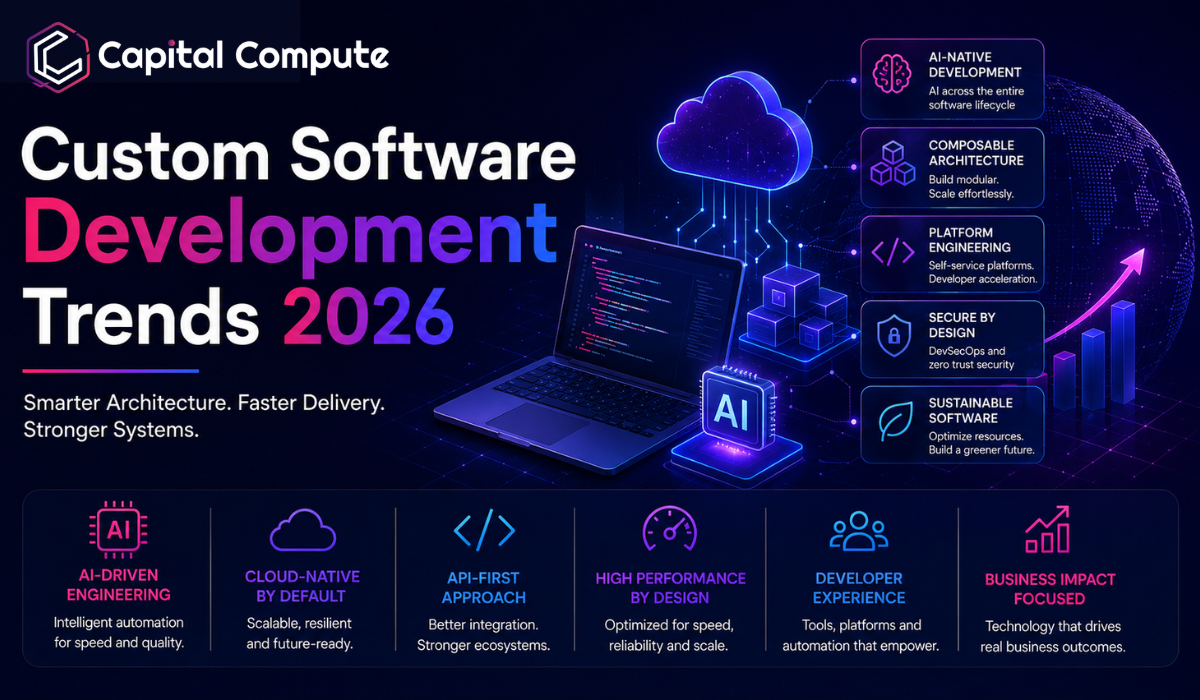
The most important custom software development trends shaping 2026 are not simply new frameworks or programming languages. They represent a broader change in how software is designed, developed, governed and operated.
Artificial intelligence is becoming part of the application architecture. Composable systems are replacing tightly connected platforms. Platform engineering is simplifying infrastructure access. Security and sustainability are becoming fundamental engineering requirements.
Here is what technology leaders need to understand.
1. AI Is Becoming a Core Software Architecture Layer
Generative AI initially entered software teams as a productivity tool. Developers used coding assistants to complete repetitive tasks, generate boilerplate code and improve documentation.
That role is expanding rapidly.
In modern custom software development, AI can influence the entire development lifecycle, including:
- Requirements analysis
- System architecture
- Code generation
- Automated testing
- Code review
- Security scanning
- Application monitoring
- Incident response
- Performance optimization
A controlled GitHub Copilot study found that participants completed a specific development task approximately 55% faster with an AI coding assistant. However, faster code production does not automatically mean secure, maintainable or production-ready software.
Engineering teams must therefore combine AI acceleration with strong technical governance.
Context-aware code reviews
Traditional static analysis tools generally identify syntax problems and common vulnerabilities. AI-supported review systems can evaluate a wider context, including repository patterns, architectural standards, performance expectations and compliance requirements.
For example, a context-aware review process may identify:
- Insecure data handling
- Poorly structured API logic
- Repeated code across services
- Performance bottlenecks
- Architecture rule violations
- Inconsistent error handling
- Regulatory compliance risks
This is especially valuable in healthcare, finance, legal services and other industries where software must meet strict security and data protection requirements.
AI-assisted application operations
AI is also moving into production environments.
Modern observability systems can detect abnormal behaviour, correlate incidents and recommend corrective actions. In carefully controlled environments, applications may automatically restart unhealthy containers, reroute traffic or scale resources when predefined conditions are met.
These capabilities support more resilient custom software, but businesses should avoid unrestricted autonomous code changes. Human approval, testing, audit trails and rollback mechanisms remain essential.
Planning an AI-enabled software product? Capital Compute can help you define a scalable architecture, select suitable AI capabilities and build secure integrations around your business requirements.
2. Platform Engineering Is Reducing Developer Complexity
Cloud-native development has given engineering teams access to powerful infrastructure. It has also created a complicated ecosystem of Kubernetes clusters, CI/CD pipelines, cloud accounts, infrastructure templates, secrets and monitoring tools.
When every developer must understand every infrastructure component, software delivery slows down.
Platform engineering addresses this problem by treating internal development infrastructure as a product.
A platform engineering team builds a reusable system that allows developers to access approved infrastructure, deployment workflows and development tools without configuring everything manually.
Internal developer platforms
An Internal Developer Platform, or IDP, can provide:
- Self-service cloud environments
- Pre-approved application templates
- Automated infrastructure provisioning
- Integrated CI/CD pipelines
- Centralized logging and monitoring
- Standard security controls
- Development documentation
- Service catalogues
These approved pathways are often called golden paths.
A developer may use a golden path to create a new service with authentication, monitoring, database access and deployment automation already configured.
Why platform engineering matters
Effective platform engineering can provide several business benefits:
- Faster product releases
- Consistent development practices
- Lower infrastructure complexity
- Easier compliance enforcement
- Faster developer onboarding
- Reduced configuration errors
- Improved developer experience
However, an internal platform should not become another layer of unnecessary complexity. It must solve real developer problems and provide flexibility for projects with specialised requirements.
3. Composable Architecture Is Replacing Rigid Systems
Traditional monolithic applications combine many business capabilities into one tightly connected system.
As these applications grow, even small changes can require extensive regression testing. One update may unexpectedly affect several unrelated functions, making releases slower and riskier.
Composable architecture takes a different approach.
It divides software into independent and interchangeable business capabilities. Each component performs a specific function and communicates with other components through clearly defined interfaces.
A composable business platform might contain separate services for:
- Customer authentication
- Payments
- Inventory management
- Order processing
- Search
- Reporting
- Recommendations
- Notifications
This enables businesses to update or replace one capability without rebuilding the entire platform.
API-first development supports composability
Composable architecture depends on well-designed APIs.
In an API-first process, teams define how services will communicate before writing the full application logic. They document endpoints, authentication methods, data structures, error responses and versioning rules early in development.
This creates clearer boundaries between the frontend, backend, databases, external services and mobile applications.
For full stack development teams, API-first design also allows frontend and backend engineers to work in parallel using an agreed contract.
Reduced vendor lock-in
Composable systems can make it easier to replace third-party technology.
Suppose a company needs to change its payment provider, search service or analytics platform. In a tightly coupled application, the integration may be embedded across many areas of the codebase.
In a modular system, the affected capability can be isolated behind a stable interface. The business can connect a replacement with less disruption to the wider platform.
Composability does not mean every application needs hundreds of microservices. The architecture should reflect the organisation’s scale, team structure and operational maturity.
4. Full Stack Development Is Becoming More Integrated
The separation between frontend, backend, infrastructure and application operations is becoming less rigid.
Modern full stack engineers increasingly work with:
- Component-based user interfaces
- Server-side rendering
- API and event-driven systems
- Cloud services
- Containerized deployments
- Automated testing
- Infrastructure as code
- Application monitoring
- AI-enabled development tools
JavaScript and TypeScript continue to support this integrated model because teams can use related technologies across web interfaces, backend services and cross-platform applications.
5. Security Is Moving Earlier in Development
Security can no longer be treated as a final review conducted immediately before launch.
Applications now integrate with cloud platforms, third-party APIs, AI services, payment systems and large volumes of sensitive data. Each connection can introduce additional risk.
DevSecOps integrates security into planning, coding, testing and deployment.
Common practices include:
- Automated dependency scanning
- Secret detection
- Static application security testing
- Infrastructure configuration scanning
- API security testing
- Role-based access controls
- Software bill of materials management
- Continuous vulnerability monitoring
Moving security earlier helps teams identify problems before they become expensive production issues.
Confidential computing
Confidential computing is also becoming relevant for applications that process highly sensitive information.
Traditional encryption protects data while it is stored or transferred. Confidential computing uses hardware-protected environments to help secure data while it is actively being processed.
This may support use cases involving financial records, healthcare information, proprietary algorithms and secure AI workloads.
It is not required for every application, but technology leaders should assess it when ordinary cloud security controls do not adequately address their risk model.
6. Sustainable Software Engineering Is Becoming Practical
Software architecture affects both environmental impact and cloud expenditure.
Inefficient applications can consume unnecessary compute resources through poor database queries, oversized infrastructure, excessive network traffic and uncontrolled background processes.
Green software engineering focuses on reducing this waste.
Practical improvements include:
- Optimizing database access
- Reducing unnecessary data transfer
- Selecting appropriate cloud resources
- Scaling infrastructure according to demand
- Removing unused services
- Improving caching
- Scheduling intensive workloads efficiently
- Monitoring energy and resource consumption
These practices do more than improve sustainability. They can also lower infrastructure costs and improve application performance.
What Should Technology Leaders Do Next?
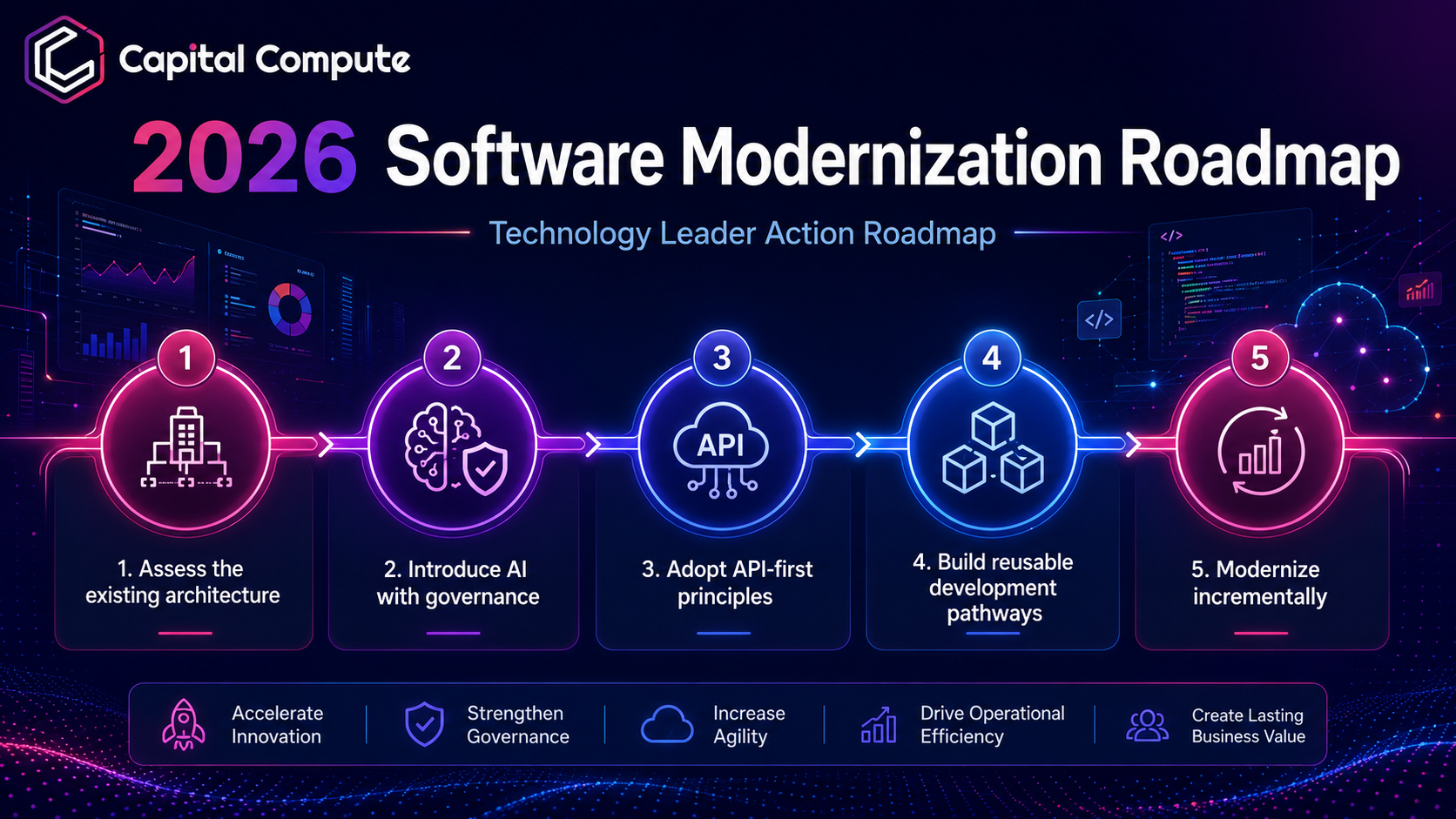
Businesses do not need to implement every trend immediately. They need a roadmap connected to measurable operational and customer outcomes.
Assess the existing architecture
Identify tightly coupled systems, repeated infrastructure work, security weaknesses and components that prevent teams from releasing changes quickly.
Introduce AI with governance
Use AI where it can reduce repetitive work or improve analysis, but establish rules for code review, testing, data privacy, intellectual property and human approval.
Adopt API-first principles
Define stable interfaces before implementing new integrations or services. This supports composability and reduces dependency between engineering teams.
Build reusable development pathways
Standardize common infrastructure, security and deployment requirements. Larger engineering organisations may formalize these capabilities through an internal developer platform.
Modernize incrementally
Replacing an entire legacy platform in one project can create major business risk. Begin by separating the capabilities that change frequently or create the greatest operational problems.
Build Software That Is Ready for What Comes Next
The technical decisions businesses make in 2026 will influence their ability to innovate for years.
AI can accelerate development, platform engineering can simplify delivery, and composable architecture can make software easier to evolve. However, these approaches only create value when they are supported by clear requirements, disciplined architecture, security controls and experienced engineering.
Capital Compute delivers custom software and full stack development solutions designed around scalability, maintainability and long-term business growth.
Talk to the Capital Compute full stack team to discuss your software requirements and create a practical development roadmap.