Most businesses run on software that was built for everyone — and, as a result, optimised for no one.
You have probably experienced it yourself. A CRM that almost fits your sales process but forces you to log activities in a way that makes no sense for your team. An invoicing tool that handles 80% of your needs, but the remaining 20% means someone is manually copying data into a spreadsheet every Monday morning. A project management platform that your staff use reluctantly, because it was chosen for the company rather than designed around how they actually work.
This is the quiet, cumulative cost of off-the-shelf software — and it is why more UK businesses, from ambitious SMEs to established enterprises, are asking a more fundamental question: what would software built specifically for us actually look like?
That question leads directly to custom software development. If you have heard the term but are not entirely sure what it means, how it works, or whether it is relevant to your business, this guide is for you. No technical jargon. No vendor pitch. Just a clear, honest explanation.
What Is Custom Software?
Custom software is software that is designed, built, and deployed specifically for one organisation — yours.
Rather than purchasing a pre-built product that thousands of other businesses also use, custom software is created from scratch (or assembled from components) to serve your exact workflows, your specific users, your data structures, and your business rules.
A simple analogy: buying off-the-shelf software is like buying a suit from a high-street retailer. It fits well enough, and for most occasions, it does the job. Custom software is the tailored equivalent — cut to your measurements, adjusted for your posture, and finished to your specification. It costs more and takes longer to produce. But it fits perfectly, and it lasts.
What Is Customised Software — and Is It the Same Thing?
This is one of the most common points of confusion, and it is worth addressing directly.
Customised software typically refers to an existing off-the-shelf platform that has been configured, extended, or modified to better suit your needs. For example, a heavily configured Salesforce environment with bespoke automation workflows and custom data fields is, in a sense, customised software — but the underlying platform still belongs to Salesforce.
Custom software, by contrast, is built entirely for you. The codebase is original. You (or your organisation) own it outright. There is no underlying vendor platform that can change its pricing, alter its features, or discontinue the product.
Both approaches have legitimate uses. But they are meaningfully different, and the distinction matters when you are making a long-term technology investment.
What Is Custom Software Development?
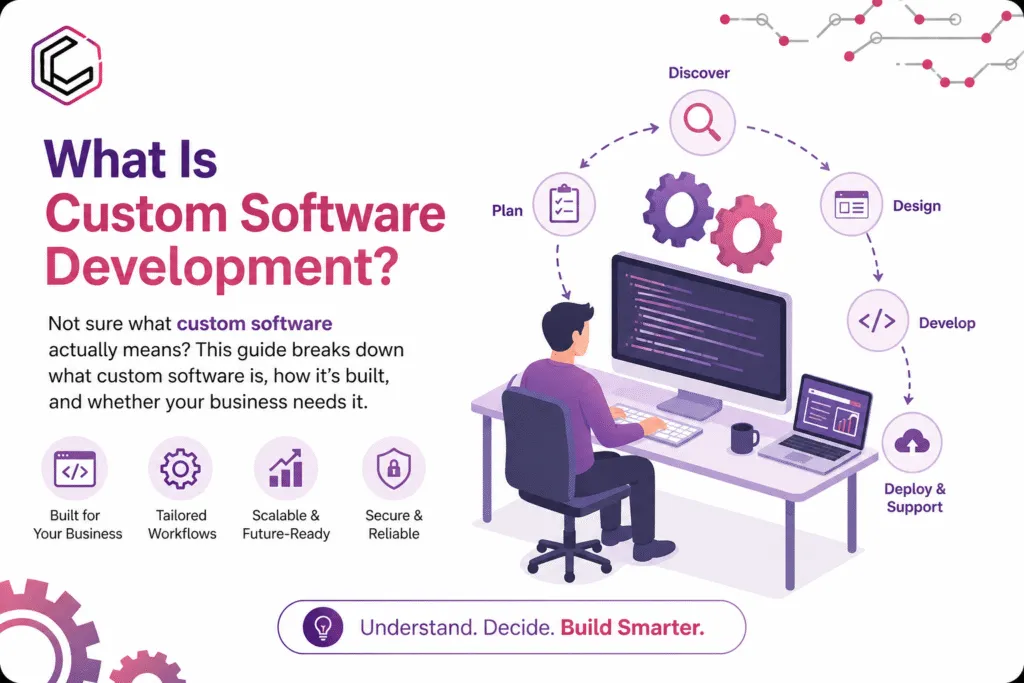
Custom software development is the end-to-end process of creating that bespoke software — from the initial brief and discovery phase through to design, build, testing, and deployment.
It typically involves:
- A discovery and requirements phase where your business needs are translated into a technical specification
- A design phase where user interfaces and system architecture are mapped out
- A development phase where the software is actually built by engineers
- A testing phase ensuring the software performs correctly, securely, and at scale
- A deployment and maintenance phase covering launch, staff training, and ongoing support
The people who carry out this work might be an in-house engineering team, a UK-based software development agency, a specialist freelancer, or an offshore development partner. Each arrangement has different implications for cost, communication, quality, and accountability — something we cover in detail in our guide to the custom software development process.
The output can take many forms: a web application, a mobile app, an internal business tool, an API connecting two existing systems, or a large-scale enterprise platform. What they all share is that they were built for one specific purpose, for one specific organisation.
The Main Types of Custom Software
Custom software is not a single category. Depending on what your business needs, a bespoke solution might take one of several forms.
Business Process Automation Tools Software that eliminates repetitive manual tasks — for example, automatically generating and sending client reports, routing incoming enquiries to the right team member, or syncing data between systems that do not natively communicate with each other.
Customer-Facing Applications Web or mobile applications that your customers or clients interact with directly — booking portals, client dashboards, e-commerce platforms with complex bespoke logic, or self-service account management tools.
Internal Dashboards and Reporting Systems Tools that bring together data from multiple sources — sales figures, operational metrics, finance data — into a single interface tailored to how your leadership team actually wants to view performance.
Industry-Specific Platforms Software built around the specific demands of a regulated or specialist sector. Healthcare providers might need patient management tools that integrate with NHS systems. Legal firms might need matter management software built around their fee structures. Logistics businesses might need route optimisation tools integrated with their existing fleet systems.
Custom Software vs Off-the-Shelf: The Core Difference
| Factor | Custom Software | Off-the-Shelf |
|---|---|---|
| Built for you | Yes — designed around your exact processes | No — designed for a broad market |
| Ownership | You own the codebase | You licence the software |
| Time to deploy | Weeks to months | Days to weeks |
| Upfront cost | Higher | Lower |
| Long-term cost | Often lower (no per-user fees) | Ongoing subscription costs |
| Flexibility | Unlimited — you set the roadmap | Limited to vendor’s feature updates |
| Vendor dependency | None | High |
| Data control | Full | Dependent on vendor’s policies |
Neither option is inherently superior. Off-the-shelf software is the right choice for many businesses, particularly those with standard operational needs and limited technical resources. Custom software earns its place when your processes are genuinely complex, proprietary, or strategically important enough to warrant the investment.
Who Uses Custom Software?
Custom software is not exclusive to large corporations. Here are the kinds of UK businesses that commission bespoke solutions regularly:
A Yorkshire-based manufacturing firm builds a custom production scheduling tool that integrates with their legacy ERP system. The integration alone saves their operations team 12 hours of manual reconciliation every week.
A London fintech startup builds a custom compliance monitoring platform rather than adapting an existing tool, because their regulatory workflow is different enough from standard offerings that off-the-shelf products would require costly manual workarounds.
A Scottish NHS primary care network commissions a bespoke patient triage and appointment system that integrates directly with their existing clinical records software and meets NHS Digital data standards — something no commercial product could satisfy out of the box.
A South East e-commerce retailer outgrows Shopify’s native capabilities and builds a custom order management system that handles their complex multi-warehouse, multi-currency fulfilment logic.
These are not outliers. As UK businesses become more operationally sophisticated and data-driven, the mismatch between generic software and real-world business needs becomes more apparent — and more costly.
Three Common Misconceptions About Custom Software
“It’s only for large enterprises.” This was more true a decade ago. Today, a well-scoped custom tool addressing a specific operational problem can be built for £15,000–£40,000 — a realistic investment for many UK SMEs, particularly when the alternative is years of subscription fees and staff time lost to manual workarounds.
“It takes years to build.” Poorly managed projects without clear specifications can drag on, but a professional development team working with well-defined requirements can deliver a focused custom tool in 8–16 weeks. Scope drives timeline more than any other factor.
“It always costs more in the long run.” This is frequently untrue. Per-user SaaS licensing, add-on modules, forced upgrades, and the hidden cost of adapting your business processes to fit the software — when totalled over five years — often exceed what a bespoke system would have cost to build and maintain. The maths deserves careful scrutiny before assuming off-the-shelf is the economical choice.
Is Custom Software Right for Your Business?
Ask yourself these five questions honestly:
- Are your core business processes genuinely different from those of your direct competitors?
- Are you spending significant staff time on manual workarounds because your current software cannot do what you need?
- Do you handle sensitive or regulated data where you need precise control over where it is stored and how it is accessed?
- Are your per-user licensing costs growing faster than your headcount, making SaaS increasingly expensive?
- Has a vendor ever changed pricing, discontinued a feature, or altered a product in ways that disrupted your operations?
If you answered yes to three or more of these, a conversation with a reputable UK software development agency is worth your time.
Related Reading: Explore the Full Picture
Understanding what custom software is represents the first step. Before commissioning any development work, it is worth building a complete picture across three areas:
- The benefits in depth — not just a generic list, but which advantages actually apply to your specific business context. Our guide, 10 Key Benefits of Custom Software Development (And When They Actually Matter), walks through each one with an honest “when it matters” qualifier.
- The development process — what actually happens between the initial brief and go-live, what your role is at each stage, and where projects commonly go wrong. See The Custom Software Development Process Explained: Every Stage, Simply for a full breakdown.
- The broader comparison — if you are still weighing up the decision between bespoke and off-the-shelf, our detailed guide Custom Software vs Off-the-Shelf Software: Which Is Right for UK Businesses in 2026? covers costs, compliance, UK GDPR considerations, and a practical decision framework.
Together, these four articles give you everything you need to make a well-informed technology investment decision.