Search for “benefits of custom software development” and you will find dozens of lists that read almost identically: flexibility, scalability, security, integration, ROI. Ticked off one after another, as though every benefit applies equally to every business in every situation.
They do not.
The honest truth is that custom software development offers significant, genuine advantages — but which benefits actually matter depends entirely on the nature of your business, the complexity of your operations, and the strategic problems you are trying to solve. A benefit that is transformational for a regulated financial services firm in Edinburgh might be largely irrelevant to a ten-person marketing agency in Bristol.
This guide takes a different approach. We examine ten real benefits of custom software development — and for each one, we are direct about the circumstances in which it genuinely applies, and those in which it does not. Because making the right technology decision for your business requires honesty, not a sales brochure.
Why Generic Benefits Lists Often Miss the Point
Most articles about custom software are written to persuade rather than inform. They present every benefit as universally applicable, omit the genuine trade-offs, and leave readers no better equipped to make an actual decision.
The question worth asking is not “does custom software have these benefits?” — it does. The question is: do these benefits apply to my specific situation, at a level that justifies the investment?
Keep that question in mind as you read through the ten benefits below.
The 10 Benefits of Custom Software Development
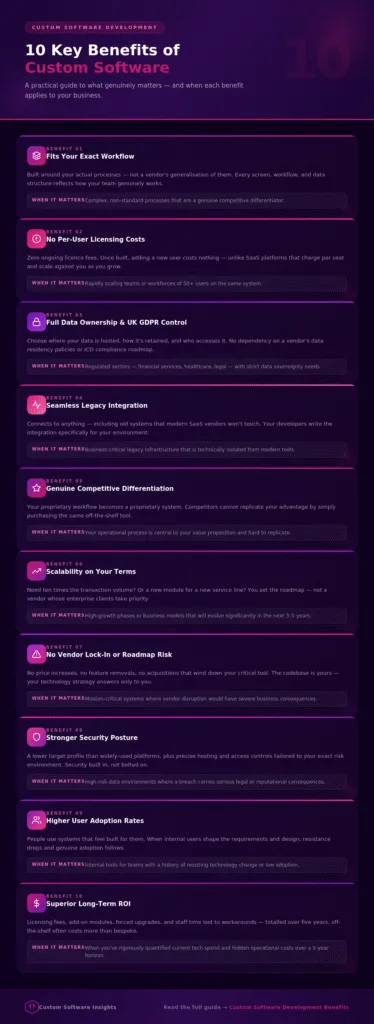
Benefit 1 — Software That Fits Your Exact Workflow
Off-the-shelf software is built around assumptions about how businesses in your category operate. If your operations align with those assumptions, it works well. If they do not, you face a choice between adapting your processes to fit the software — which carries real operational cost — or living with persistent friction.
Custom software is built around your actual processes, not a vendor’s generalisation of them. Every screen, workflow, and data structure is designed to reflect how your team genuinely works.
When it matters most: Your business processes are complex, non-standard, or represent a genuine competitive differentiator. If your processes are largely standard — basic invoicing, contact management, task assignment — off-the-shelf almost certainly serves you well enough.
Benefit 2 — No Per-User Licensing Costs
Most SaaS platforms charge per seat. At five users, that cost is negligible. At fifty, it is material. At five hundred, it is a significant operational expense that scales with every hire — often faster than the value the software delivers per additional user.
Custom software carries a higher upfront development cost, but zero ongoing licensing fees. Once built, adding a new user costs nothing.
When it matters most: You are scaling your team rapidly, or you already have a large workforce using the same system. A business with 200 staff paying £50 per user per month is spending £120,000 per year on a single SaaS licence. At that scale, the economics of custom development become compelling within two or three years.
Benefit 3 — Full Data Ownership and UK GDPR Compliance
When you use off-the-shelf software, your data sits on the vendor’s infrastructure. You are dependent on their data residency policies, their security practices, their breach notification processes, and their interpretation of data processing obligations under UK GDPR.
Custom software gives you complete control. You choose where data is hosted — whether that is a UK-based cloud provider, AWS London region, or on-premises servers. You define data retention policies, access controls, and audit logging. You are not waiting for a vendor to implement a compliance feature on their roadmap.
When it matters most: You handle sensitive personal data, operate in a regulated sector (financial services, healthcare, legal), or have specific data residency requirements under UK GDPR or sector-specific regulation. For businesses processing straightforward, non-sensitive operational data, vendor-managed compliance from a reputable SaaS provider may be entirely sufficient.
Benefit 4 — Seamless Integration with Your Existing Systems
One of the most persistent pain points in business technology is integration — or the lack of it. Off-the-shelf platforms offer standard integrations with other popular platforms, but if you rely on legacy systems, proprietary databases, or industry-specific software that pre-dates modern APIs, you will often find those integrations do not exist.
Custom software can be built to connect with anything — including old systems that no modern SaaS vendor would prioritise. Your developers write the integration specifically for your environment.
When it matters most: You have legacy infrastructure that is business-critical but technically isolated. Manufacturing firms, NHS-adjacent healthcare providers, and long-established professional services businesses frequently face this challenge. If your systems are modern and well-connected, native integrations between popular SaaS tools may serve you equally well.
Benefit 5 — A Genuine Competitive Differentiator
In some businesses, the way you deliver your service is your competitive advantage. Your operational process, your client experience, your data model — these are the things that set you apart. When that is the case, forcing those differentiators into a generic platform can erode them.
Custom software lets you build your competitive advantage directly into the technology. Your proprietary workflow becomes a proprietary system that competitors cannot simply replicate by purchasing the same tool.
When it matters most: Your operational process is genuinely distinctive and central to your value proposition. For businesses where software is purely a supporting function and the competitive advantage lies elsewhere — in relationships, expertise, or brand — this benefit carries less weight.
Benefit 6 — Scalability Entirely on Your Terms
Off-the-shelf software scales within the constraints of the vendor’s architecture and pricing model. When you outgrow a tier, you move to a more expensive one. When you need a feature the vendor has not built, you wait for their roadmap — or you do without.
Custom software scales according to your requirements. Need to handle ten times the transaction volume? Your development team can build for that. Need to add a new module for a new service line? It gets added to your roadmap, on your timeline.
When it matters most: You are in a high-growth phase, operate in an unpredictable market where demand can spike significantly, or have a business model that will evolve substantially over the next three to five years. If your business is stable and mature with predictable needs, the scalability of most established SaaS platforms is likely adequate.
Benefit 7 — No Vendor Lock-In or Roadmap Risk
Vendor lock-in is one of the most underestimated risks in business technology. When a critical piece of software is owned by someone else, you are exposed to their decisions: price increases, feature removals, acquisitions, and, at the extreme end, product discontinuation.
UK businesses have experienced all of these. Products acquired and subsequently wound down. Pricing models restructured with little notice. Features that were core to your workflow deprioritised in favour of the vendor’s larger enterprise customers.
With custom software, there is no vendor. The codebase is yours. Your technology roadmap is determined by your business strategy, not by a product team in San Francisco or Amsterdam.
When it matters most: The software underpins a genuinely critical business function, and the consequences of vendor disruption would be severe. For lower-stakes tools, vendor risk is manageable — particularly if your data can be exported and migrated without excessive friction.
Benefit 8 — A Stronger Security Posture
Widely-used off-the-shelf platforms are high-value targets for attackers. Because vulnerabilities in popular software can be exploited across thousands of organisations simultaneously, these platforms attract disproportionate attention from malicious actors.
Custom software, by contrast, is an unknown quantity to automated scanning tools and opportunistic attackers. It is not immune to security vulnerabilities — every codebase requires rigorous security testing — but it does not carry the same target profile as a platform used by 100,000 businesses worldwide.
Additionally, because you control the hosting environment, you can implement security controls precisely tailored to your risk profile.
When it matters most: You handle high-value, sensitive, or regulated data where a breach would have serious legal, financial, or reputational consequences. Security must still be actively built and tested — it is not a passive benefit of going custom.
Benefit 9 — Higher User Adoption Rates
Resistance to new software is a real and costly problem for many businesses. When staff feel that a system was chosen without regard for how they work, adoption is grudging at best and actively hostile at worst. Workarounds proliferate. The intended efficiency gains never materialise.
Custom software, particularly when internal users are involved in the requirements and design process, tends to see higher adoption. People use systems that feel built for them.
When it matters most: You are building internal tools for teams who have historically resisted technology change, or where low adoption of existing systems has already cost you significant efficiency. For customer-facing software where users are external, the UX investment matters more than the custom vs. off-the-shelf distinction.
Benefit 10 — Superior Long-Term ROI
This is the benefit that surprises most people who approach the analysis carefully. Custom software has a higher upfront cost — that is simply true. But when you account for the full five-year picture — licensing fees, per-user costs, add-on modules, forced upgrades, staff time lost to workarounds, and the opportunity cost of software that does not quite fit — the total cost of ownership for off-the-shelf often exceeds a custom alternative.
A business paying £80,000 per year in SaaS licensing across multiple platforms, with two full-time staff managing integrations and manual processes, has spent £400,000 over five years. A £120,000 custom platform that consolidates those needs and eliminates those overheads can represent significant net savings — and that is before accounting for the operational improvements.
When it matters most: You have a clear picture of your current technology spend across all tools, and you have quantified the hidden costs of your current setup. Do the maths rigorously. If the numbers do not support the investment over a realistic time horizon, they do not support it.
The Trade-Offs You Should Know
An honest guide acknowledges the other side of the ledger.
Custom software development requires a meaningful upfront investment — typically £15,000 at the low end for a simple tool, and considerably more for complex systems. You will also wait longer before going live — weeks to months rather than days. And once the software is built, ongoing maintenance responsibility sits with you (or your development partner) rather than a vendor with dedicated infrastructure teams.
These are real costs. They do not make custom development a bad decision — but they do make it a consequential one that deserves careful evaluation rather than enthusiasm alone.
How to Know If the Benefits Apply to You
Work through these six questions:
- Are your business processes materially different from industry norms?
- Is your current software creating measurable inefficiency that your team has flagged repeatedly?
- Do you have genuine data sovereignty or compliance requirements that your current vendor cannot satisfy?
- Are you spending more than £3,000 per month across SaaS platforms — with that cost set to grow?
- Has vendor behaviour (pricing changes, feature removals, downtime) disrupted your operations in the past 24 months?
- Is there a process or capability you simply cannot build on top of your current tools?
If you answered yes to three or more, the benefits of custom software development are likely to apply in ways that justify a serious feasibility assessment.
Related Reading: Build Your Full Understanding
This article focuses on the why of custom software. To make a fully informed decision, we recommend reading across our complete series:
- Start with the fundamentals — if you want a clear, jargon-free explanation of what custom software actually is before evaluating the benefits, begin with What Is Custom Software Development? A Plain-English Guide for Businesses in 2026.
- Understand the process — knowing what happens when you commission custom software, and what your involvement looks like at each stage, is essential before engaging any development partner. Our detailed walkthrough, The Custom Software Development Process Explained: Every Stage, Simply, covers every phase from brief to go-live.
- Compare your options side by side — if you are still weighing custom against off-the-shelf, our full comparison guide, Custom Software vs Off-the-Shelf Software: Which Is Right for UK Businesses in 2026?, brings together costs, UK GDPR considerations, scalability, and a practical decision framework in one place.