A Decision That Can Define Your Business Trajectory
In 2026, software is no longer a back-office concern — it is the engine of how British businesses operate, compete, and grow. Whether you run an independent accountancy firm in Leeds, a manufacturing business in the Midlands, or a fast-scaling e-commerce brand out of London, the software choices you make today will shape your productivity, compliance posture, and customer experience for years to come.
The question of custom software versus off-the-shelf software has never been more nuanced. The rise of AI-augmented SaaS platforms, the continued rollout of Making Tax Digital (MTD), increased scrutiny under UK GDPR, and a tightening economic environment have all changed the calculus. What was once a simple cost comparison has become a strategic decision rooted in long-term business vision.
This guide cuts through the noise to help UK business owners, directors, and IT decision-makers make the right call — with clear-eyed analysis of both options, realistic cost expectations, and honest advice on when each approach genuinely makes sense.
What Is Off-the-Shelf Software?
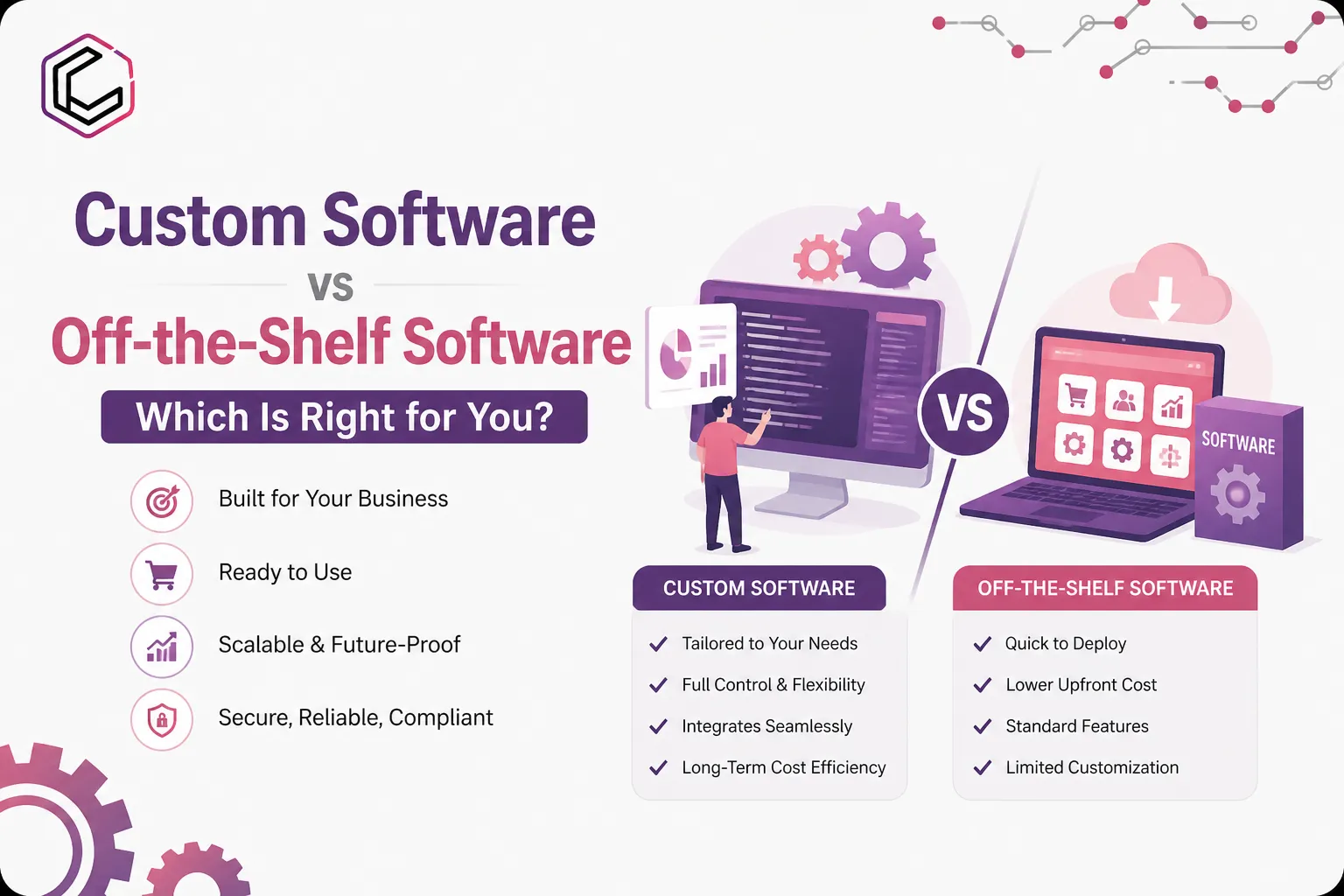
Off-the-shelf (OTS) software — also known as commercial off-the-shelf (COTS) software — refers to pre-built applications designed for a broad range of users and sold as a standardised product. Think of tools like Sage 50, Microsoft 365, Xero, Salesforce, Shopify, or HubSpot.
These products are built to serve the majority of use cases within a given industry or function. You subscribe or purchase, configure the settings available, and begin using the system with minimal lead time.
Typical characteristics:
- Available immediately or within days
- Subscription-based or one-time licence fees
- Regular updates managed by the vendor
- Community support, documentation, and third-party integrations
- Limited ability to alter core functionality
For many UK SMEs with standard operational needs, off-the-shelf software works exceptionally well and represents outstanding value. The challenge arises when your business processes are complex, proprietary, or simply don’t fit neatly into the vendor’s assumptions about how you should work.
What Is Custom Software Development?
Custom software is built specifically for your organisation — designed around your exact workflows, data structures, user roles, and business logic. It can be developed by an in-house engineering team, a UK-based software development agency, or an offshore partner.
Custom software ranges from relatively modest bespoke tools — such as an internal dashboard or an automated reporting system — to large-scale enterprise platforms managing complex multi-site operations.
Typical characteristics:
- Developed to your precise specifications
- Longer lead time (weeks to months depending on scope)
- Higher upfront investment
- Full ownership of the codebase (depending on your contract)
- Ongoing maintenance responsibility falls to you or your developer
- Can be built to integrate with your existing systems natively
Custom development is not exclusively the domain of large enterprises. A growing number of UK SMEs are commissioning bespoke tools to solve specific pain points that off-the-shelf products simply cannot address cost-effectively.
Key Decision Factors
1. Cost and Total Cost of Ownership
Off-the-shelf software typically has a lower initial cost. A Xero subscription for a small business might cost £30–£60 per month, while a Salesforce CRM licence could run to several hundred pounds per user annually. These costs are predictable and can be budgeted easily.
Custom software, by contrast, requires a meaningful upfront investment. A bespoke web application built by a UK agency might cost anywhere from £15,000 for a modest tool to £150,000 or more for a complex platform. However, the total cost of ownership over five or more years often tells a different story. Persistent subscription fees, per-user pricing, costly add-on modules, and the price of working around software limitations (in staff time and workarounds) can make off-the-shelf far more expensive in the long run.
2. Time to Deployment
Off-the-shelf wins here, decisively. You can be operational within days. If speed to market is critical — for instance, launching a new service or onboarding a client — this is a significant advantage.
Custom software takes time. Expect a minimum of 8–16 weeks for a well-scoped medium-complexity project with an experienced UK development team, and considerably longer for enterprise-grade systems.
3. Scalability and Flexibility
Off-the-shelf software scales within the constraints of the vendor’s roadmap. If the vendor deprioritises a feature you depend on, or discontinues a pricing tier, your business is affected. Integration flexibility is also limited to whatever APIs or connectors the vendor makes available.
Custom software scales precisely as your business needs demand. You own the roadmap. You can add features, restructure data models, and build integrations with any system — including legacy systems that off-the-shelf products typically refuse to support.
4. Maintenance and Support
Off-the-shelf vendors handle security patches, infrastructure, and bug fixes. This is a genuine burden lifted from your team. Custom software requires that you or your development partner actively maintains the codebase, manages hosting, and applies updates — particularly important for security.
UK-Specific Considerations in 2026
UK GDPR and Data Residency
Following the UK’s post-Brexit divergence from EU GDPR, UK businesses must comply with the UK GDPR framework administered by the ICO (Information Commissioner’s Office). A critical consideration when evaluating software is where your data is stored and processed. Many US-headquartered SaaS vendors store data in EU or US data centres by default. Depending on the nature of your data and your contracts, this can create compliance complexity.
Custom software gives you precise control over data residency — you choose the hosting environment, whether that is a UK-based cloud provider, AWS London region, or an on-premises server. For businesses handling sensitive personal data, financial records, or healthcare information, this level of control can be essential.
Making Tax Digital (MTD)
HMRC’s Making Tax Digital initiative continues its phased rollout, with MTD for Income Tax (MTD ITSA) now applying to a broader range of self-employed individuals and landlords. Businesses need software that either natively supports MTD-compliant submissions or can integrate with HMRC’s APIs.
Off-the-shelf accounting tools like Xero, QuickBooks, and Sage are fully MTD-compatible. If you commission custom software with financial functionality, ensure your development team builds HMRC API integration from the outset — it is not an afterthought.
Sector-Specific Regulation
UK businesses in financial services, healthcare, legal, and construction face sector-specific software standards. FCA-regulated firms, for example, must ensure their systems meet specific record-keeping and reporting requirements. Custom software can be built to satisfy these requirements precisely; off-the-shelf software may need careful vetting to confirm compliance.
Who Should Choose Off-the-Shelf Software?
Off-the-shelf is the right choice if:
- You are an SME with standard operational needs — payroll, invoicing, CRM, project management — that broadly match what established vendors offer
- Speed of deployment is your top priority and you cannot afford a development timeline
- Your budget is constrained and upfront custom development is not feasible
- You lack the internal technical capacity to specify, oversee, and maintain a custom build
- The software category is mature and well-served (e.g., HR and payroll, email marketing, basic accounting)
- You need reliable vendor-managed compliance — particularly for rapidly-evolving regulations where vendor teams track changes as part of their service
Businesses like independent retailers, professional services firms, and hospitality operators often find that thoughtfully chosen off-the-shelf tools — properly configured and integrated — serve them excellently for years.
Who Should Choose Custom Software?
Custom development makes sense when:
- Your business processes are genuinely unique and represent a competitive differentiator — forcing them into a generic tool would mean losing that advantage
- You have complex integration requirements with legacy systems, bespoke databases, or third-party platforms that standard software cannot connect to
- You are operating at scale where per-user SaaS licensing becomes prohibitively expensive
- You handle sensitive or regulated data requiring specific data residency, audit trails, or access controls that off-the-shelf products cannot guarantee
- You have identified a market gap — many of the UK’s most successful software businesses began as internal tools built to solve problems no vendor had addressed
- You need full ownership and long-term independence from a vendor’s pricing decisions or product roadmap
Manufacturing firms, specialist financial services businesses, logistics operators, and healthcare providers are among those who frequently find that custom-built systems provide measurable competitive advantage.
The Hybrid Middle Ground: Low-Code, Customisable Platforms
It would be a disservice to frame this as a binary choice. In 2026, the space between pure off-the-shelf and fully bespoke has matured considerably.
Low-code platforms such as Microsoft Power Apps, OutSystems, and Mendix allow businesses to build tailored applications on managed infrastructure — reducing development time while still producing highly customised outputs. Customisable SaaS platforms like Salesforce (with heavy configuration and AppExchange extensions) or Shopify Plus (with custom Liquid templating and APIs) can bend considerably to your requirements without a full custom build.
For many UK businesses, this middle path — often called “composable architecture” — offers the best of both worlds: vendor-managed infrastructure with meaningful bespoke functionality layered on top. It is worth exploring seriously before committing to either extreme.
Seven Questions to Ask Before You Decide
- What does this software need to do that generic tools cannot? Be specific. Vague dissatisfaction rarely justifies custom development costs.
- What is our realistic five-year total cost of ownership for each option, including staff time lost to workarounds?
- Where will our data be stored, and does that satisfy UK GDPR and any sector-specific obligations?
- Do we have the internal capacity to manage a custom build — including specifying requirements, managing a development partner, and overseeing ongoing maintenance?
- Is the software category we need well-served by the market? If six established vendors offer exactly what you need, custom development is hard to justify.
- What happens if our software vendor is acquired or discontinues the product? Vendor risk is real and often underweighted in software decisions.
- Are there low-code or highly configurable platforms we haven’t fully explored?
Conclusion: Strategy First, Software Second
The most costly mistake UK businesses make is letting software drive strategy rather than the other way around. The right software — whether custom or off-the-shelf — is the one that faithfully serves your business model, protects your data, supports your compliance obligations, and positions you to grow.
Off-the-shelf software is not a compromise — for the majority of UK businesses, it is the smart, efficient, and cost-effective choice. Custom software is not a luxury — for businesses with genuinely unique needs, real complexity, or ambitions to build a proprietary advantage, it is an investment with significant return.
Start with clarity about your processes, your constraints, and your five-year ambitions. The right software choice will follow naturally.