If you’ve been researching software development options, you’ve almost certainly seen “bespoke software” and “custom software” used as if they mean exactly the same thing.
Sometimes they do. But there is a real, practical distinction between the two and choosing the wrong approach could cost you significantly in time, money, and technical debt down the line.
This guide cuts through the confusion, covers the advantages and disadvantages of both, and helps you make the right call for your business.
What Is Bespoke Software? (Bespoke Software Meaning Explained)
The word bespoke comes from English tailoring. It referred to cloth that had been “spoken for” cut and sewn entirely around one person’s measurements, from raw material, with no existing pattern as a starting point. Nothing off the rack. Fully yours.
Bespoke software meaning follows the same principle. It is software designed and engineered entirely from scratch, built exclusively around your business, your processes, your data model, your users, your integrations. No pre-existing platform is used as a base. No compromises are made to fit a template someone else designed.
The result is a product that belongs entirely to your business and cannot be replicated by a competitor purchasing the same tool.
What Is Custom Software?
Custom software starts from an existing foundation. A development team takes a pre-built platform, an open-source CMS, a commercial CRM, a cloud-based SaaS product, and modifies it to better fit your needs. This broader idea of custom software is commonly used to describe software created or adapted for a specific organisation or user group. New features are added, workflows are adjusted, integrations are built, and the interface is reshaped.
The core of the product already exists. You are tailoring it, not building it from raw materials.
Think of it as buying a well-cut suit and having a tailor adjust the sleeves, take in the waist, and add a custom lining. It fits far better than off-the-rack. But it is still, fundamentally, someone else’s pattern, and you are working within the limits of that original cut.
If you want to understand this topic in more detail, you can also read our guide on what custom software development is and how it helps businesses build solutions around their specific workflows.
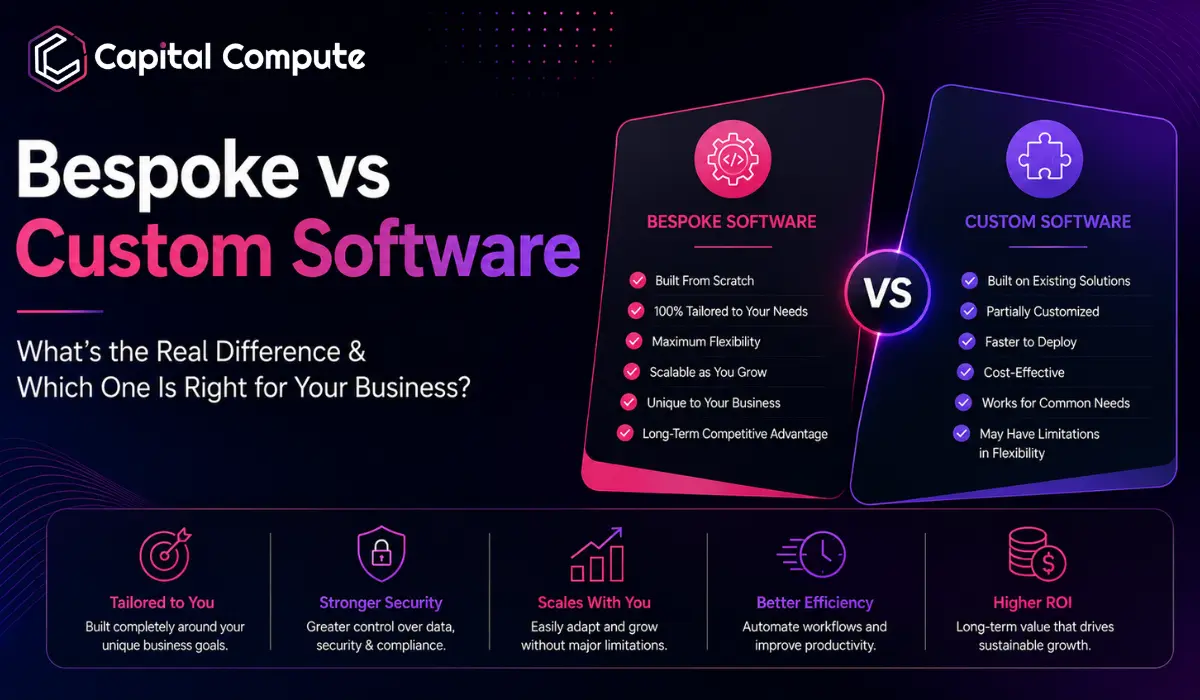
Bespoke vs Custom Software: The Key Differences Side by Side
| Factor | Bespoke Software | Custom Software |
|---|---|---|
| Starting point | Built entirely from scratch | Built on an existing platform |
| Level of customisation | Total, every feature is yours | Partial, limited by the base platform |
| Development time | Longer | Faster |
| Initial cost | Higher | Lower |
| Scalability | Unlimited, you own the architecture | Limited by the original platform's ceiling |
| Ownership | Full, including all source code | Shared, core platform may be third-party |
| Maintenance | Fully in your control | Dependent on base platform updates |
| Best for | Complex, unique, or regulated processes | Standard needs with specific adjustments |
Both approaches can support business growth when planned correctly. At Capital Compute, we help businesses choose the right software development approach based on their goals, processes, budget, and long-term scalability needs.
Key Benefits of Bespoke and Custom Software Solutions
Bespoke Software Advantages
- Perfect Operational Fit Because bespoke software is designed entirely around your workflows, there is no workaround layer. Your team does not adapt to the software, the software is built to match your team. This alone eliminates the hidden inefficiencies that quietly accumulate over years of using tools that almost work.
- Full IP Ownership You own everything: the codebase, the architecture, the logic. No vendor lock-in. No dependency on a third-party platform staying in business. No licensing fees that compound as you scale. For businesses in regulated or high-growth sectors, this level of control is often non-negotiable.
- Competitive Advantage That Cannot Be Purchased A competitor cannot go to the same marketplace and buy your exact software. Bespoke systems embed your institutional knowledge and operational edge directly into your technology. The product becomes a moat, not just an operational tool.
- Unlimited Scalability Because you own the architecture from the ground up, a skilled engineering team can scale it in any direction, more users, more data, new markets, new feature sets, without hitting the ceiling of someone else’s platform or paying per-seat fees that multiply as you grow.
- Security Built to Your Threat Model Off-the-shelf and custom platforms are known products with documented vulnerabilities. Bespoke systems have a smaller attack surface and can be engineered to meet your specific compliance and security requirements from day one, not retrofitted later.
Custom Software Advantages
- Faster Time to Market Because custom software is built on a tested, existing platform, development time is significantly shorter. You are filling gaps and adding functionality, not building everything from raw materials. For businesses that need a working product quickly, this is a meaningful advantage.
- Lower Initial Cost The base system already exists and has already been paid for — usually by thousands of other users sharing the development cost. This makes custom software far more accessible for teams working within tighter budgets or validating a concept before committing to full investment.
- Proven Reliability You are building on a platform that has already been tested in production environments, often at significant scale. The core system has known behaviour, documented bugs, and an established community. That baseline stability reduces early-stage risk.
- Easier Onboarding Teams are often already familiar with widely-used platforms. Reduced learning curves mean faster adoption, lower training costs, and quicker productivity gains when the product goes live.
When to Choose Bespoke Software
Bespoke software is the right choice when:
- Your business processes are genuinely unique and no existing platform fits them properly
- You are in a regulated industry where compliance must be built in, not added on
- Long-term scale is a priority and you need architecture that won’t accumulate technical debt
- IP ownership is strategically important, for investment rounds, acquisition, or competitive positioning
- You have already tried customising an off-the-shelf tool and hit its ceiling
When to Choose Custom Software
Custom software makes more sense when:
- An existing platform covers 70–80% of your needs and specific gaps remain
- You are working within a tight timeline or limited initial budget
- You are validating a product concept before committing to a full bespoke build
- Requirements are relatively standard, CRM adjustments, CMS modifications, integration work
For businesses that want to understand how a software project moves from idea to launch, our guide on the custom software development process explains each stage in a simple way.
The bespoke vs custom software question comes down to one core decision: does your business need a product built entirely around your requirements, or can an existing platform be modified to get close enough?
Bespoke software delivers total ownership, unlimited scalability, and a genuine competitive edge but requires a higher upfront investment and the right engineering partner. Custom software is faster and more affordable, but you will always be working within the constraints of someone else’s architecture, and those constraints compound over time.
Understanding both the advantages and disadvantages of each approach is what separates businesses that make a smart technology investment from those that end up rebuilding two years later.
Ready to Build the Right Thing?
Whether you need a fully bespoke product engineered from the ground up or a custom solution adapted to your specific requirements, the right starting point is a straight conversation with an engineering team that prioritises your outcome over their preferred approach.
At Capital Compute, we help businesses choose the right software development approach based on their workflows, growth plans, budget, and technical requirements. Whether bespoke or custom software is the better fit, our goal is to help you build a scalable, secure, and future-ready solution.
Get in touch with Capital Compute to discuss the right software solution for your business.