JavaScript has been the foundation of modern web development for nearly three decades. From interactive websites and mobile applications to server-side development with Node.js, it powers millions of applications used by businesses worldwide.
However, as software projects have become larger and more complex, development teams have faced new challenges. Maintaining thousands of lines of code, onboarding new developers, preventing runtime errors, and scaling applications across multiple teams requires more than just a flexible programming language.
This is where TypeScript has gained significant popularity.
Developed by Microsoft, TypeScript extends JavaScript by adding static typing and modern development features that help teams build more reliable, maintainable, and scalable software. Today, many enterprise applications, SaaS platforms, and large-scale digital products use TypeScript to improve code quality and simplify long-term development.
But does that mean TypeScript is always the better choice?
Not necessarily.
The right language depends on several factors, including your project size, business objectives, development team, and future growth plans. Working with an experienced custom software development company UK can help you select the right technology stack from the outset.
In this guide, we’ll compare TypeScript vs JavaScript from both a technical and business perspective. Rather than focusing solely on syntax differences, we’ll explore how each language impacts scalability, maintainability, development speed, and long-term software success helping business owners, CTOs, and engineering leaders choose the right technology for their next project.
TypeScript vs JavaScript at a Glance
Although TypeScript and JavaScript are closely related, they serve different purposes.
JavaScript is the language browsers understand natively, while TypeScript builds on JavaScript by introducing additional features that improve developer productivity and code reliability. Before deployment, TypeScript is compiled into standard JavaScript, making it compatible with all modern browsers and JavaScript environments.
The following comparison highlights the key differences.
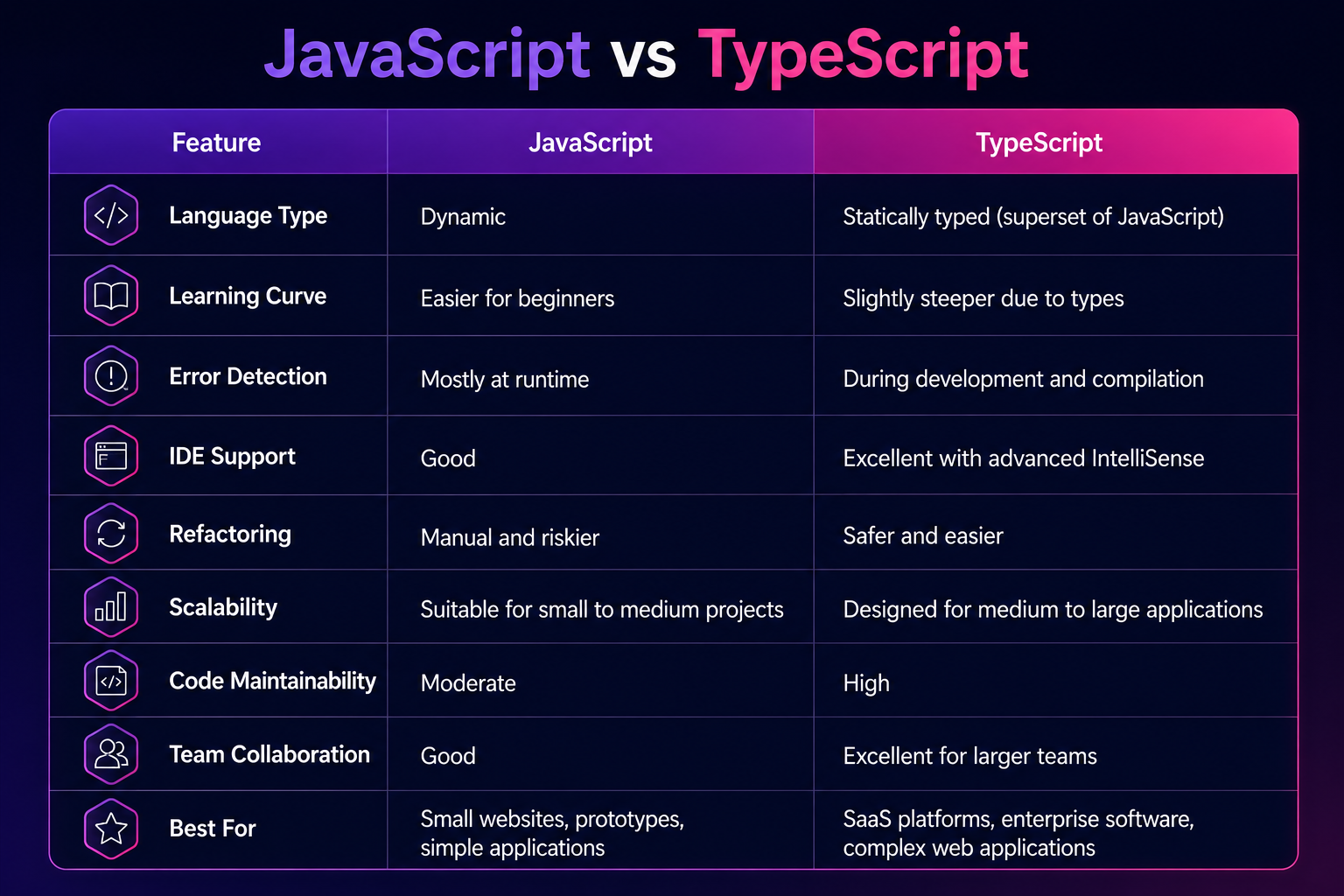
Quick Comparison
Choose JavaScript if you need:
- A simple website or web application
- Rapid prototyping
- Small development projects
- Lightweight scripts or automation
- A lower learning curve
Choose TypeScript if you need:
- Enterprise software
- Large SaaS platforms
- Long-term product development
- Better code maintainability
- Multiple developers working on the same codebase
- Easier scaling as the application grows
For many modern software projects, the decision is less about replacing JavaScript and more about determining whether the additional structure provided by TypeScript will benefit the project over its lifetime.
What Is JavaScript?
JavaScript is one of the world’s most widely used programming languages and remains a core technology of modern web development.
Originally created to add interactivity to web pages, JavaScript has evolved into a versatile language capable of powering websites, mobile applications, desktop software, APIs, and cloud-based services.
Today, developers use JavaScript across the entire technology stack. Combined with frameworks such as React, Angular, or Vue.js on the frontend and Node.js on the backend, it enables businesses to build complete web applications using a single programming language.
Key Advantages of JavaScript
JavaScript continues to be popular because it offers several practical benefits:
- Easy to learn and widely supported.
- Runs natively in all modern web browsers.
- Large developer community and ecosystem.
- Thousands of open-source libraries and frameworks.
- Ideal for rapid application development.
- Excellent support for APIs and third-party integrations.
For startups, proof-of-concepts, and smaller web applications, JavaScript often provides everything needed to build and launch products quickly.
Businesses looking to build interactive web applications, APIs, or modern frontend experiences often choose JavaScript because of its flexibility and extensive ecosystem. If you’re planning your next project, explore our Hire JavaScript Developers service to work with experienced engineers.
Where JavaScript Can Become Challenging
As applications grow, JavaScript’s flexibility can also introduce complexity.
Common challenges include:
- Runtime errors that may not be discovered until execution.
- Reduced code consistency across larger teams.
- More difficult refactoring as projects expand.
- Greater reliance on testing to identify type-related issues.
- Increased maintenance effort for long-lived applications.
These limitations don’t make JavaScript a poor choice they simply highlight why many engineering teams adopt additional tooling, such as TypeScript, for larger software projects.
What Is TypeScript?
TypeScript is an open-source programming language developed by Microsoft that builds directly on JavaScript.
Rather than replacing JavaScript, it enhances it by introducing features such as static typing, interfaces, generics, and advanced tooling. Developers write TypeScript during development, and it is then compiled into standard JavaScript before being deployed.
Because every valid JavaScript application can gradually adopt TypeScript, businesses don’t need to rebuild existing software from scratch. Teams can migrate incrementally while continuing to use familiar JavaScript frameworks and libraries.
TypeScript has become the preferred choice for many enterprise development teams because it improves software quality without changing how applications run. If you’re planning a scalable application, our Hire TypeScript Developers service gives you access to engineers experienced in building enterprise-grade software.
Key Advantages of TypeScript
TypeScript has become the preferred choice for many enterprise development teams because it improves software quality without changing how applications run.
Some of its biggest advantages include:
- Detects many coding errors before deployment.
- Improves code readability and consistency.
- Makes large codebases easier to maintain.
- Simplifies refactoring and feature development.
Enhances IDE features such as autocomplete and intelligent navigation.
Supports better collaboration across distributed engineering teams.
These capabilities help reduce development risk and improve long-term maintainability, making TypeScript particularly well suited to software products expected to evolve over several years.
JavaScript vs TypeScript: It’s Not About Competition
A common misconception is that TypeScript replaces JavaScript.
In reality, TypeScript works alongside JavaScript.
Every TypeScript application ultimately becomes JavaScript before it runs in a browser or server environment. Think of TypeScript as an additional layer that helps developers write safer, cleaner, and more maintainable code before deployment.
For businesses planning a long-term software investment, this additional structure often translates into fewer defects, easier maintenance, and a more scalable foundation for future growth.
Why TypeScript Has Become the Preferred Choice for Large-Scale Software Development
As software products grow, so does their complexity. What starts as a small application with a few hundred lines of code can quickly evolve into a platform with thousands of files, multiple integrations, and several developers contributing simultaneously.
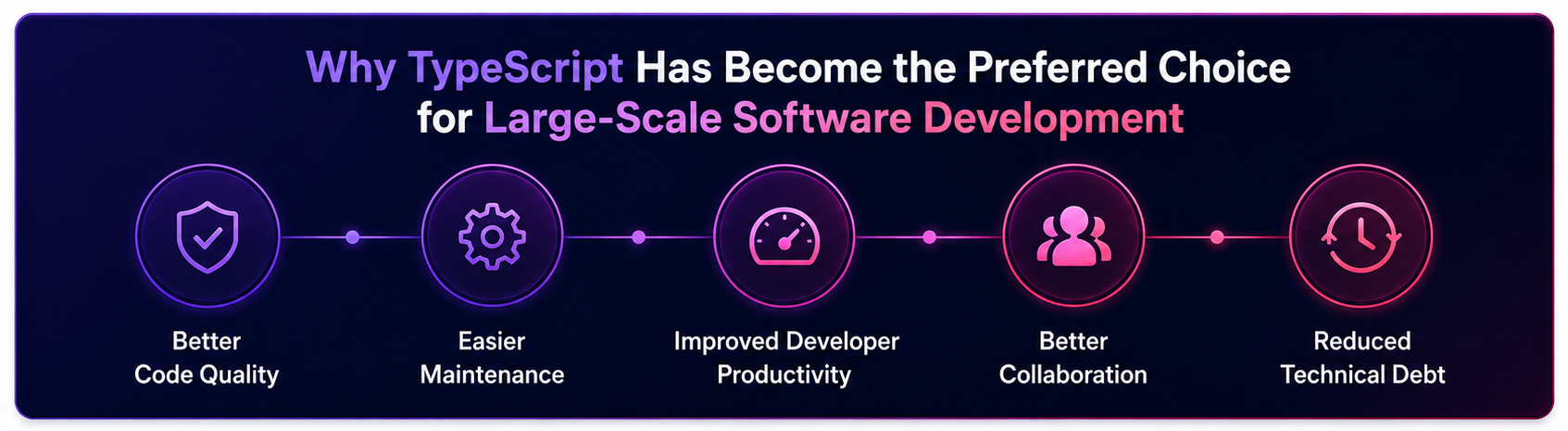
While JavaScript is highly flexible, managing large codebases becomes increasingly difficult without additional structure. This is one of the main reasons why many organisations choose TypeScript for enterprise applications, SaaS platforms, and long-term software projects.
Here are the key reasons why.
1. Better Code Quality
One of TypeScript’s biggest advantages is its ability to identify errors during development rather than after the application has been deployed.
With JavaScript, many issues only become visible when the code is executed. TypeScript performs type checking during compilation, helping developers identify potential problems much earlier.
Benefits include:
- Fewer runtime errors
- More reliable code
- Improved application stability
- Easier debugging
- Better overall software quality
For businesses, this means less time spent fixing unexpected issues after release and more confidence in production deployments.
2. Easier Maintenance
Large software projects continue evolving long after the initial launch. New features are added, existing functionality changes, and different developers contribute to the same codebase over time.
TypeScript makes this ongoing maintenance much easier by creating a more structured and predictable development environment.
Key advantages include:
- Easier code navigation
- Safer code refactoring
- Better documentation through type definitions
- Reduced risk when updating existing features
- Faster onboarding for new developers
This is particularly valuable for software expected to be maintained for several years.
3. Improved Developer Productivity
TypeScript doesn’t just improve code quality, it also helps developers work more efficiently.
Modern IDEs such as Visual Studio Code provide advanced support for TypeScript, making everyday development faster and more accurate.
Developers benefit from:
- Intelligent autocomplete
- Real-time error detection
- Improved code navigation
- Better documentation suggestions
- Faster debugging
- Simplified refactoring
These features reduce repetitive tasks and allow developers to spend more time building features instead of resolving avoidable coding issues.
4. Better Collaboration Across Engineering Teams
As development teams grow, maintaining coding standards becomes increasingly important.
Without clear structure, different developers may implement similar functionality in different ways, making the application harder to understand and maintain.
TypeScript introduces consistency by encouraging well-defined data structures and interfaces.
This helps teams:
- Maintain consistent coding standards
- Reduce misunderstandings between developers
- Improve code reviews
- Share reusable components more effectively
- Collaborate across multiple development teams
For organisations working with distributed or outsourced engineering teams, this consistency helps improve communication and reduce development risk.
5. Reduced Technical Debt
Technical debt often builds up when software evolves without consistent standards or documentation.
Small shortcuts that seem harmless during early development can become expensive problems as the application grows.
TypeScript helps minimise technical debt by encouraging developers to write cleaner, more maintainable code from the beginning.
Some long-term benefits include:
- Better organised codebases
- Fewer unexpected bugs
- Easier feature enhancements
- Lower maintenance costs
- Improved software reliability
Although TypeScript may require a little more effort during the early stages of development, it often reduces the time and cost of maintaining software over its lifecycle.
6. Enhanced Scalability for Enterprise Applications
Scalability isn’t only about supporting more users, it’s also about ensuring your software can continue evolving without becoming difficult to maintain.
Enterprise applications often include:
- Multiple development teams
- Thousands of source files
- Third-party integrations
- APIs and microservices
- Frequent feature releases
- Ongoing maintenance and optimisation
In these environments, TypeScript provides the structure needed to manage complexity more effectively.
Its strong typing, better tooling, and improved code organisation make it easier to introduce new features, scale engineering teams, and maintain consistent quality as the application grows.
Why Many Modern Frameworks Favour TypeScript
Many of today’s leading frontend and backend frameworks offer excellent support for TypeScript or recommend it for larger applications.
Examples include:
- Angular
- React
- Next.js
- NestJS
- Vue.js
- Node.js applications
This widespread adoption reflects a broader industry shift towards building software that is easier to maintain, scale, and collaborate on over the long term.
Key Takeaway
For small projects, JavaScript remains a fast and effective choice.
However, when building software expected to support business growth, multiple developers, and continuous feature development, TypeScript often provides a stronger long-term foundation. Its focus on code quality, maintainability, and collaboration makes it the preferred choice for many enterprise software development teams.
When JavaScript Is Still the Better Choice
Although TypeScript offers significant advantages for large-scale software development, it isn’t the right solution for every project. In many cases, JavaScript remains the more practical and efficient option, particularly when speed, simplicity, and rapid development are the priorities.
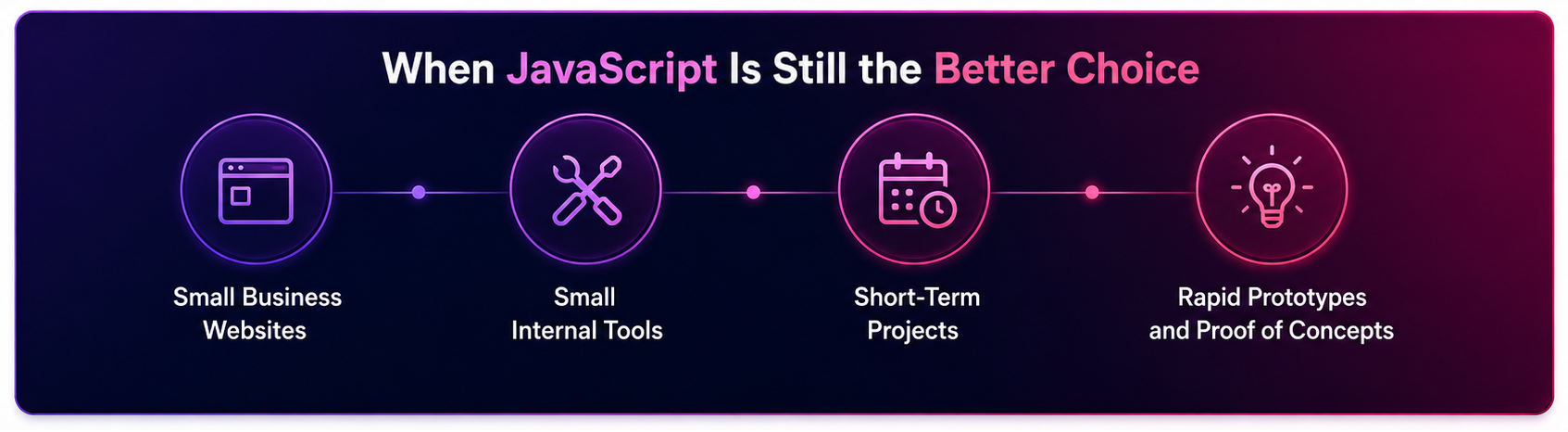
Here are some scenarios where JavaScript is still an excellent choice.
1. Small Business Websites
Not every website requires the additional structure that TypeScript provides.
If you’re building:
- A marketing website
- A company portfolio
- A landing page
- A blog
- A brochure website
JavaScript is usually more than capable of handling the required functionality while keeping development simple.
2. Rapid Prototypes and Proof of Concepts
When validating a new product idea, businesses often need to launch quickly rather than build a highly structured application.
JavaScript allows development teams to:
- Build prototypes faster
- Test ideas quickly
- Validate user feedback
- Make rapid changes during early development
Once the product gains traction, it can be migrated to TypeScript if needed.
3. Small Internal Tools
Simple internal applications often don’t require enterprise-level architecture.
Examples include:
- Admin dashboards
- Internal calculators
- Reporting tools
- Workflow automation
- Small business utilities
For these projects, JavaScript can reduce development time while keeping maintenance straightforward.
4. Short-Term Projects
Some applications are built to solve immediate business needs rather than support years of continuous development.
Examples include:
- Event websites
- Campaign microsites
- Temporary customer portals
- Product launch pages
In these situations, JavaScript often provides the fastest route from idea to deployment.
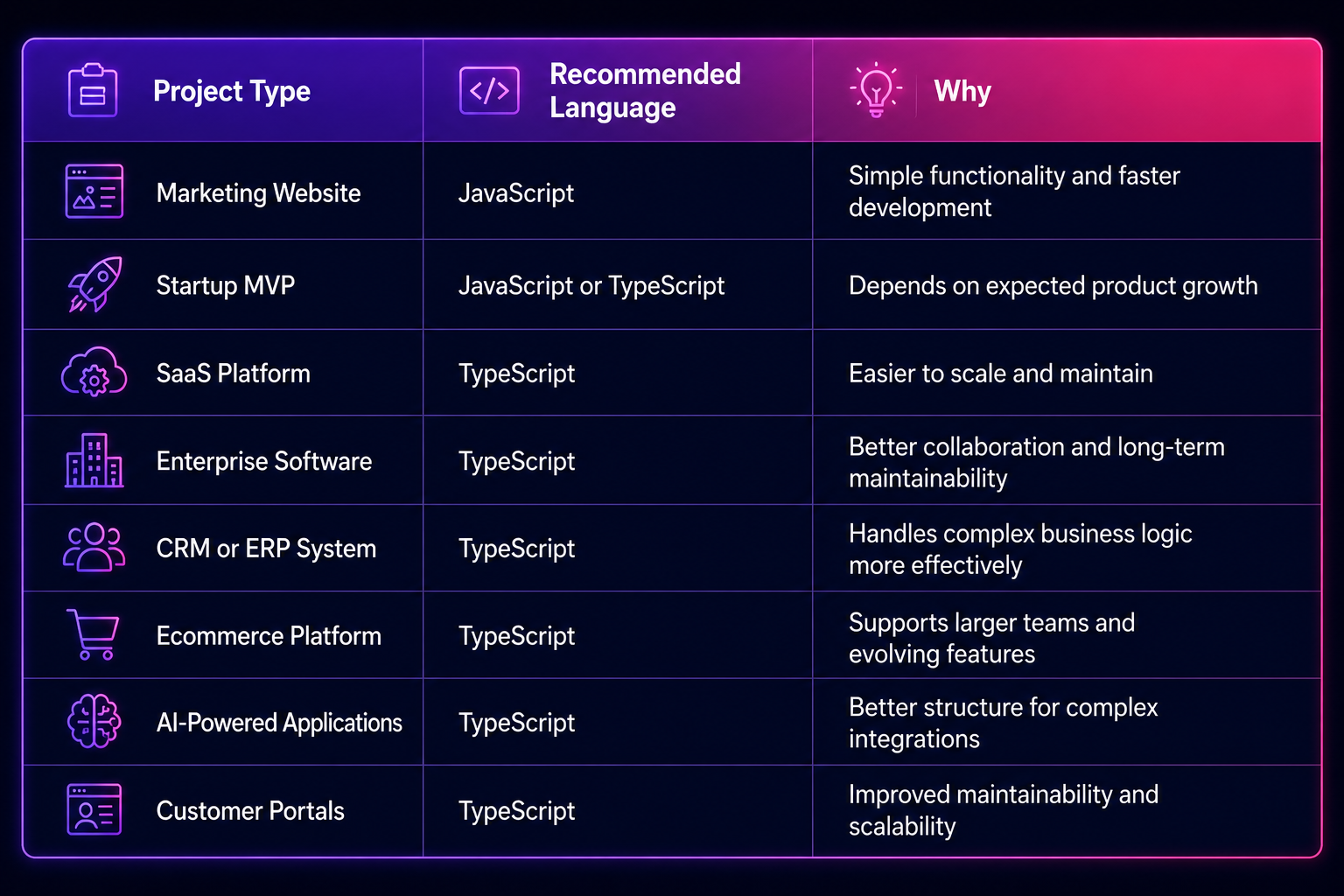
Choosing the Right Language Based on Your Project
Instead of asking which language is better, consider which one best supports your business objectives.
The table below provides a practical guide.
A Simple Rule of Thumb
Choose JavaScript when:
- Your project is relatively small.
- You need to launch quickly.
- The application has limited complexity.
- Long-term maintenance isn’t a major concern.
Choose TypeScript when:
- You’re building custom software expected to grow.
- Multiple developers will contribute to the project.
- The application includes complex business logic.
- Long-term scalability and maintainability are priorities.
TypeScript vs JavaScript for Large Development Teams
As software teams grow, maintaining consistency becomes increasingly challenging. Different developers contribute code, new features are introduced regularly, and the application evolves over many years.
Without clear standards, projects can quickly become difficult to manage.
This is one of the key reasons why many engineering teams prefer TypeScript for enterprise software development.
TypeScript helps large teams by:
- Creating consistent coding standards.
- Reducing misunderstandings between developers.
- Making code reviews faster and more effective.
- Simplifying onboarding for new team members.
- Improving documentation through type definitions.
- Supporting safer code refactoring.
For organisations working across multiple departments or distributed development teams, these advantages contribute to faster delivery and improved software quality.
Common Misconceptions About TypeScript
Despite its growing popularity, several misconceptions continue to influence technology decisions.
“TypeScript replaces JavaScript.”
Not true.
TypeScript is a superset of JavaScript and compiles into standard JavaScript before running in browsers or server environments.
“TypeScript is only for enterprise companies.”
While enterprise organisations widely adopt TypeScript, startups and growing SaaS businesses also benefit from its improved maintainability and developer productivity.
“TypeScript slows development.”
There may be a slight learning curve initially, but many development teams find that TypeScript speeds up projects over time by reducing bugs, simplifying debugging, and making refactoring safer.
“Migrating from JavaScript is too difficult.”
Many businesses adopt TypeScript gradually. Existing JavaScript projects can be migrated incrementally, allowing teams to introduce TypeScript without rebuilding the application from scratch.
Key Takeaway
JavaScript and TypeScript are not competing technologies, they complement each other.
For smaller projects, JavaScript often provides the speed and flexibility needed to deliver results quickly.
For custom software, SaaS platforms, and enterprise applications expected to evolve over several years, TypeScript offers a more structured foundation that supports scalability, maintainability, and long-term business growth.
How Capital Compute Chooses the Right Technology Stack
At Capital Compute, we believe the best technology stack is the one that supports your business goals, not the latest trend. Every recommendation is based on your product vision, scalability requirements, budget, and long-term roadmap.
Why Businesses Choose Capital Compute
Engineering-first approach – Senior engineers and architects lead every project.
- Free discovery session – Validate your idea and define the right technical approach before development begins.
- Fixed-price estimate in two working days – Clear pricing with no unnecessary delays.
- No subcontracting – Your project is delivered by our dedicated in-house engineering team.
- Outcome-based delivery – We focus on business results, not just development hours.
- AI-assisted engineering workflows – Accelerate delivery while maintaining code quality.
- 90-day post-launch support – Ongoing assistance after your software goes live.
- Flexible engagement models – Start with outsourcing and transition to dedicated engineering teams as your product grows.
- Whether you’re building an MVP or scaling an enterprise platform, we help you choose technologies that support long-term growth and maintainability.
Conclusion
Choosing between TypeScript and JavaScript isn’t about selecting the more popular language, it’s about choosing the right tool for your project’s goals.
JavaScript remains a great option for smaller applications, prototypes, and projects that need to launch quickly. However, for large-scale software, SaaS platforms, and enterprise applications, TypeScript provides stronger foundations for scalability, maintainability, and long-term development.
Before making a decision, consider your application’s complexity, expected growth, team size, and future maintenance requirements. The right technology choice today can reduce technical debt and support your software for years to come.
Build Scalable Software with Confidence
Whether you’re planning a new product, modernising an existing application, or scaling enterprise software, choosing the right technology stack is critical to long-term success.
Capital Compute helps UK businesses design, develop, and scale custom software using technologies that align with their business goals, not just the latest trends.
Ready to build your next software project?
Book a Free Discovery Call and speak with our engineering team.