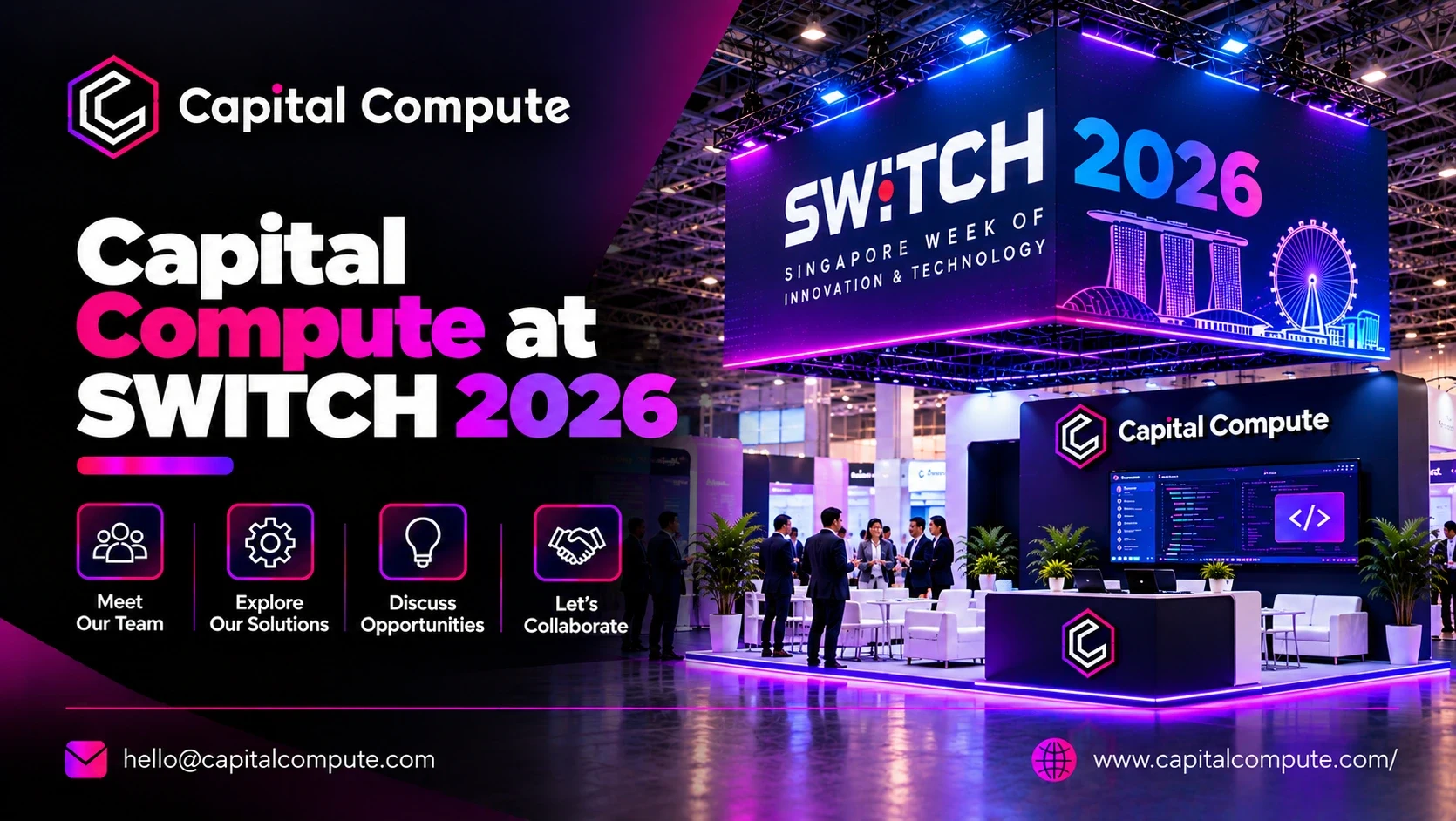
Capital Compute is attending SWITCH 2026 in Singapore, where Mansi Shah, Founder, and Udit Sharma, Partner, will connect with founders and product teams about AI and product development. The Singapore Week of Innovation and Technology takes place from 27 to 29 October 2026 at Marina Bay Sands Expo & Convention Centre.
A useful product conversation starts with the decision your team needs to make: what to build, which problem AI can address and how to deliver software that people will use. That is the focus we are bringing to SWITCH 2026.
If you are attending, bring a product idea, an engineering bottleneck or a workflow you want to improve. Request a conversation with Capital Compute and tell us the topic and day that work for you.
Key takeaways
- SWITCH 2026 runs from 27 to 29 October at Marina Bay Sands in Singapore.
- Mansi Shah and Udit Sharma are representing Capital Compute.
- The programme combines emerging technology, startup growth, market access, exhibitions and the SLINGSHOT startup finals.
- Our discussion focus is practical AI adoption, software product development and engineering collaboration.
What is SWITCH 2026 and where does it take place
SWITCH stands for Singapore Week of Innovation and Technology. It connects founders, investors, researchers, business leaders and technology partners through conference sessions, exhibitions and networking. Enterprise Singapore lists SWITCH 2026 as its innovation festival.
| Event detail | Information |
|---|---|
| Dates | Tuesday 27 to Thursday 29 October 2026 |
| Venue | Marina Bay Sands Expo & Convention Centre, Singapore |
| Event spaces | Halls A–C on Level 1 and Ballrooms on Level 3 |
| Organiser | Enterprise Singapore |
| Capital Compute representatives | Mansi Shah, Founder; Udit Sharma, Partner |
| General registration | Complimentary attendee registration; separate tickets apply to SWITCH Beyond |
The official SWITCH website confirms the dates, venue and attendee-pass registration. Check the organiser’s latest programme and access conditions when planning your visit, as individual sessions and ticket entitlements can differ.
What can founders explore across the SWITCH 2026 programme
The programme connects technology discussions with the decisions involved in building a business. For a founder, that can mean assessing an AI application, finding a partner or understanding what a product needs before it can scale.
Main Stage brings technology and startup ideas together
The Main Stage programme covers AI, quantum technology and sustainable solutions through keynotes and panel discussions. It also hosts the SLINGSHOT deep-tech grand finals, linking technology ideas with the challenge of building a viable company.
SWITCH Beyond examines practical technology applications
SWITCH Beyond offers focused sessions and hands-on workshops. Its published half-day tracks cover five domains across the three event days:
| Day and session | Published Beyond track |
|---|---|
| 27 October morning | Healthcare and Biomedical |
| 27 October afternoon | Embodied AI and Robotics |
| 28 October morning | Semiconductor |
| 28 October afternoon | Quantum |
| 29 October morning | Climate Tech |
The organiser also describes workshops with cross-industry applications, including AI. Beyond requires a separate pass, so a complimentary general attendee registration should not be treated as access to every workshop or track.
SWITCH Global and Converge address business growth
SWITCH Global focuses on international market access and connections with innovation ecosystems. SWITCH Converge addresses founder decisions around capabilities, capital and talent. Together, these programmes put product decisions alongside the commercial and team requirements needed to deliver them.
The exhibition and SLINGSHOT create further opportunities to connect
The organiser promotes a trade and exhibition floor with more than 400 startups and exhibitors and over 30 global pavilions. These are the event’s advertised scale indicators, rather than a final attendance count. The floor offers another setting to discover products and discuss potential collaboration.
SLINGSHOT 2026 marks the competition’s tenth edition, with a Top 50 Global Startups cohort and more than S$2 million in grant prizes advertised. Its five domains span advanced computing and intelligence, manufacturing and industrial systems, digital technologies and security, environmental technologies, and health and biomedical innovation.
Who can you meet from Capital Compute
Mansi Shah, Founder, and Udit Sharma, Partner, will represent Capital Compute at SWITCH 2026. Together, they bring experience in product engineering, SaaS development and the business decisions behind software delivery.
Mansi Shah brings an engineering and SaaS product perspective
Mansi Shah, Founder of Capital Compute, is an engineer with more than ten years of experience building and scaling SaaS products. She founded Capital Compute to help founders build products and support companies with JavaScript and mobile engineering talent.
At SWITCH 2026, Mansi will connect with founders about product direction, MVP scope and the engineering capacity needed to take their products forward.
Udit Sharma connects software requirements with delivery expectations
Udit Sharma, Partner at Capital Compute, brings more than ten years of experience in software sales, business development and project management. He has worked with clients across different industries and geographies, helping connect business requirements with software delivery.
His experience brings a practical perspective to discussions about project scope, delivery expectations and collaboration. Founders can connect with Udit at SWITCH to talk through their product plans and engineering requirements.
What will our conversations about AI and product development focus on
Our starting point is the outcome you need. Adding an AI capability to a product and using AI within software engineering are related decisions, but they need different success measures and review processes.
AI within the product
A product feature might help users find information, process documents or complete a repetitive task. Start with a defined workflow and ask how you will measure its usefulness, check its output and handle an incorrect result. Our generative AI development services explain how AI capability can fit around business information and existing systems.
AI within engineering
AI-assisted engineering uses AI during implementation, review or documentation. Capital Compute’s proprietary workflow combines technology- and domain-specific markdown rule files, cross-model pull-request review, and automatic documentation with tribal-knowledge capture. Engineers remain responsible for requirements, decisions and release quality.
The rules supply project context; a different model provides another review perspective; documentation keeps decisions and common pitfalls available for future work. The purpose is to reduce avoidable rework and make software easier to maintain, without turning an AI suggestion into an unchecked production change.
For the wider delivery picture, our custom software development process explains how requirements, implementation, testing and release fit together.
Request a conversation with Capital Compute. Share the result you want and the constraint your team is facing; meeting arrangements depend on availability.
What should you bring to a product discussion
A short, specific brief is enough to start. You do not need a complete specification to explain the problem, but a clear decision helps the discussion move beyond a list of technologies.
- The user or team you want to help and the task they find difficult.
- The result you want from the next release, such as completing a core workflow or reducing manual handling.
- The systems, data or integrations the product must work with.
- The constraint that matters most, including scope, timing, budget or engineering capacity.
If you are at the idea stage, our guide to what an MVP means in software development can help frame the first release. For an existing application, consider the usage and delivery evidence you already have, then use our post-launch tracking guide to prepare questions about what should happen next.
How does Capital Compute approach product delivery
Capital Compute builds custom software through its own engineering team, without subcontracting, with client code ownership from day one. Our Singapore custom software development services describe the delivery model for businesses evaluating an engineering partner.
- Outcome-based billing ties payment to successful delivery of agreed outputs within a scoped two- or four-week sprint.
- A one-week free trial sprint lets the team work on a real backlog before a commercial commitment.
- The same team provides 90 days of post-launch support, fixing defects in Capital Compute-written code at no development charge.
- The named AI engineering workflow adds project rules, cross-model review and knowledge capture to delivery.
One example of our product work is Boom, a desktop screen-recording application. Its published case study describes a focused recording, editing and sharing journey across Windows, macOS and Linux, with an average open-to-share time of under one minute. This is desktop product evidence, separate from AI-feature or AI-workflow performance claims.