Every growing UK business reaches the same inflection point. You have a software idea, a digital transformation roadmap, or a product backlog that is getting longer by the week, and a board or leadership team asking how you plan to build it. The first instinct is often to hire. The second is to ask whether hiring is actually the right call.
That question deserves a better answer than most resources provide. The majority of comparisons online line up salary against day rates, list generic pros and cons, then tell you it depends. That is not useful to a decision-maker under pressure to deploy capital wisely.
This article takes a different approach. Instead of comparing cost alone, it answers the question that actually matters to UK businesses in 2026: which development model produces the highest return on investment, at which stage of growth, and for which type of project? ROI in software development is not just about saving on salaries. It is the combined output of speed to market, quality of delivery, revenue generated, technical debt avoided, and how well your engineering capacity scales with your business.
By the time you finish reading, you will have a clear framework for making this decision, know exactly where Capital Compute sits in the picture, and understand why the cheapest option is rarely the highest-returning one.
What Is In-House Software Development?
In-house software development means building and managing a team of developers as direct employees of your company. They operate under your HR processes, your management structure, and your tooling. Everything from sprint planning to code review happens internally.
- Typical structure: A technical lead or CTO, several developers, a QA engineer, and often a product manager. Hiring happens sequentially, and the team builds domain knowledge over time.
- Best suited for: Businesses where software is the core product, where continuous iteration is part of the business model, and where long-term IP ownership and deep institutional knowledge are strategic requirements.
- Advantages: Full control over priorities, direct communication with stakeholders, natural alignment with company culture, and accumulated product knowledge that grows over time.
- Limitations: Slow to assemble (UK tech hiring typically takes 45 to 60 days per role), expensive when true costs are accounted for, difficult to scale quickly in either direction, and high exposure to attrition risk in a competitive UK developer market.
What Is Software Development Outsourcing?
Outsourcing is frequently conflated with hiring a freelancer on Upwork or Fiverr. That is not the same thing. Managed software outsourcing means engaging a professional software development partner, a firm with structured engineering teams, a defined delivery methodology, and end-to-end accountability for outcomes.
This covers three distinct models.
- Managed delivery means the outsourcing partner takes a defined scope, assembles the right team, and delivers it against agreed milestones and quality standards. If you are evaluating this model for the first time, it is worth understanding the full range of Custom Software Development Outsourcing models, costs, and benefits before committing to any structure.
- Dedicated engineering teams means the partner provides a permanent, exclusive team embedded in your processes, effectively an extension of your company without the HR overhead.
- End-to-end product responsibility means the partner acts as your CTO, architecture lead, and delivery team combined, guiding technical strategy from discovery through launch.
The distinction matters because it changes what you should expect. A freelancer offers labour. A professional outsource software development company in the UK like Capital Compute offers outcomes.
It is also worth understanding that outsourcing and outstaffing are not the same thing. If you are unsure which model fits your situation, our guide on outsourcing vs outstaffing breaks down the structural and commercial differences in plain terms.
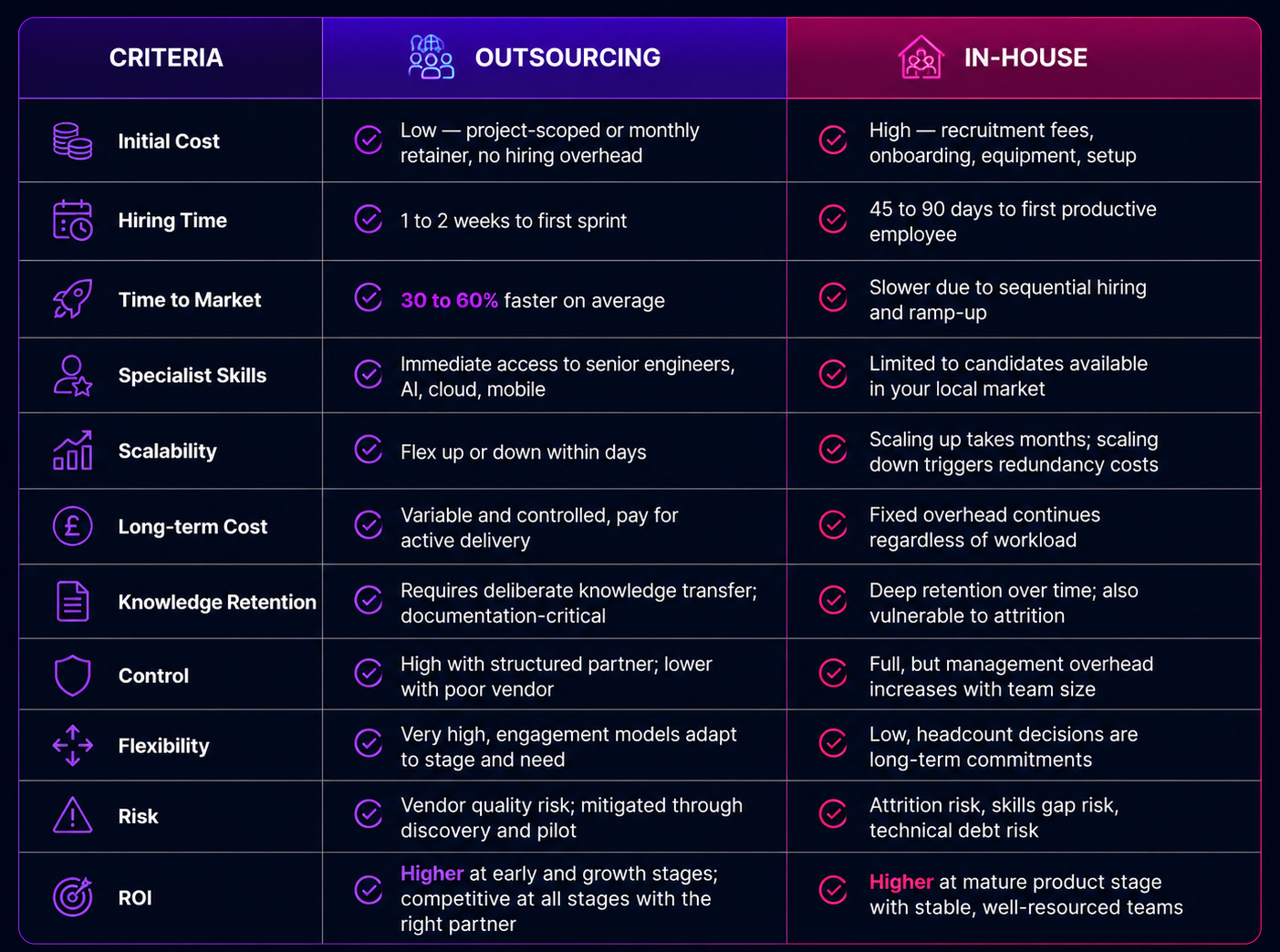
Outsourcing vs In-House Development at a Glance
What an In-House Developer Actually Costs a UK Business
Take a mid-level software developer in London or Manchester. Advertised salary benchmarks sit between £55,000 and £75,000 in 2026. But salary is only the starting point.
- Recruitment: Agency fees typically run 15 to 20% of first-year salary, or 8 to 12 weeks of internal recruiter time. For a £65,000 role, external recruitment alone costs £9,750 to £13,000.
- Employer’s National Insurance: 13.8% of salary above the secondary threshold, adding roughly £7,800 to £9,800 per developer per year.
- Pension contributions: Minimum 3% employer contribution, typically 5 to 6% for competitive packages, adding £3,300 to £4,500 per developer.
- Equipment and tooling: Laptop, licences, cloud access, collaboration tools, typically £2,500 to £4,000 in year one, with annual software costs of £1,500 to £3,000 thereafter.
- Office space: London commercial office space runs £800 to £1,400 per desk per month. Even a hybrid arrangement at two days per week carries a real cost.
- Training and upskilling: Technologies move fast. Keeping an in-house team current in AI tools, cloud infrastructure, and modern frameworks costs £1,500 to £4,000 per developer per year. Staying across the latest custom software development trends is itself a time and budget commitment for any internal team.
- Management overhead: A team of five developers typically requires a technical lead or engineering manager, adding another full salary and the time of your CTO or head of engineering.
- Employee turnover: The UK tech sector sees attrition of 15 to 20% annually. When a developer leaves, you pay recruitment costs again, absorb productivity loss during handover, and typically run 6 to 8 weeks with a gap in output.
- Total true cost of a UK developer: For a £65,000 salary, the realistic all-in annual cost is £95,000 to £120,000. That is before factoring in the cost of a bad hire. Industry estimates put this at 30% of first-year total cost, or roughly £30,000 to £36,000 in recruitment, management time, and rework.
What Outsourcing Actually Costs
A structured outsourcing engagement with a firm like Capital Compute involves a defined project cost or monthly delivery rate, with no employer NI, no pension, no recruitment cost, no equipment, and no management overhead beyond your internal product owner.
Hidden costs to account for on the outsourcing side:
- Vendor selection time (mitigated by free discovery calls and structured pilots)
- Internal product owner time (typically 20 to 25% of a product manager’s capacity)
- Knowledge transfer at engagement close (accounted for in good contract structures)
- Scope creep if discovery is skipped (which is why Capital Compute provides a fixed-price estimate within two business days)
The net position: for most UK growing businesses, outsourcing a senior engineer delivers equivalent or better output at 40 to 60% lower total cost, when the full in-house cost stack is counted honestly.
Which Model Delivers Better ROI?
- Speed to market drives revenue earlier: A product that launches three months sooner than it would have under an in-house hiring model captures three extra months of revenue, user feedback, and competitive positioning. For a SaaS product with £50,000 monthly recurring revenue at maturity, three months is £150,000 of income that simply does not exist if you spend those months recruiting.
- Productivity is not proportional to headcount: Research consistently shows that a small team of senior engineers outperforms a larger team of mid-level ones. Outsourcing partners who specialise in matched, experienced team assembly rather than bulk hiring deliver disproportionate output per pound spent.
- Access to expertise reduces technical debt: When a business hires developers available in the current market rather than the ones ideally suited to the project, corners get cut. Architecture decisions made by the wrong people at the founding of a codebase create technical debt that compounds over years. The right team from the start, even if it costs more upfront, eliminates debt that would otherwise consume 20 to 40% of future development capacity.
- Opportunity cost is invisible but real: When your leadership team spends three months hiring, onboarding, and managing a new engineering function, those are three months they are not spending on product strategy, customer acquisition, or fundraising. Outsourcing that function does not just save money, it frees your most valuable people to work on the highest-return activities.
- Maintenance and post-launch support: In-house teams carry overhead costs indefinitely, including the weeks between product launches when they are in maintenance mode. Outsourcing partners like Capital Compute structure 90-day post-launch support into the engagement, with delivery billing that reflects active work rather than idle headcount.
Outsourcing vs In-House by Business Stage
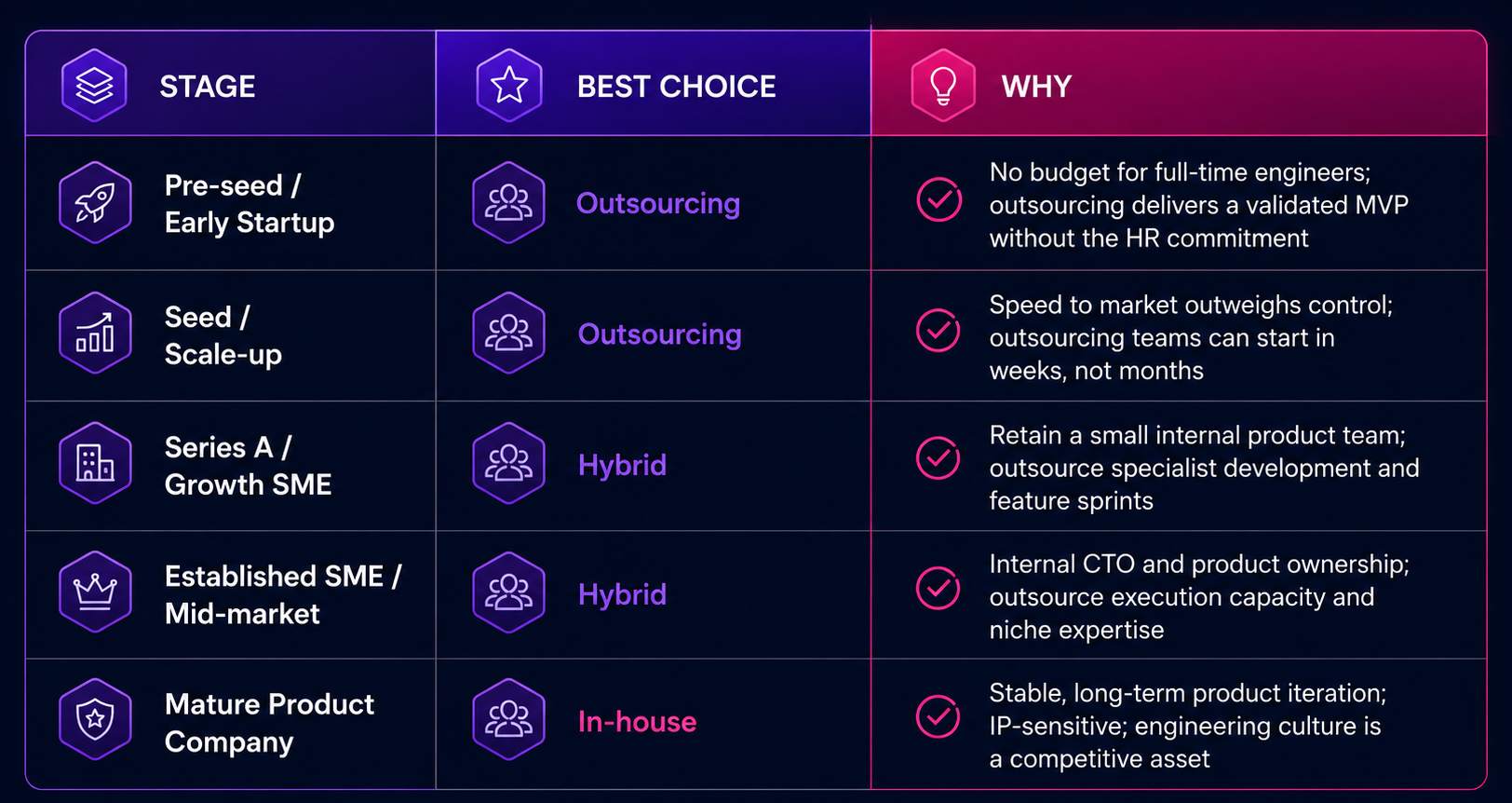
The key insight that competitors miss: the optimal model is not static. The right answer at £500k ARR is different from the right answer at £5m ARR. A common and expensive mistake is to hire in-house prematurely, before the product has validated its architecture and revenue model, and then spend months unwinding those decisions when circumstances change.
Outsourcing vs In-House by Project Type
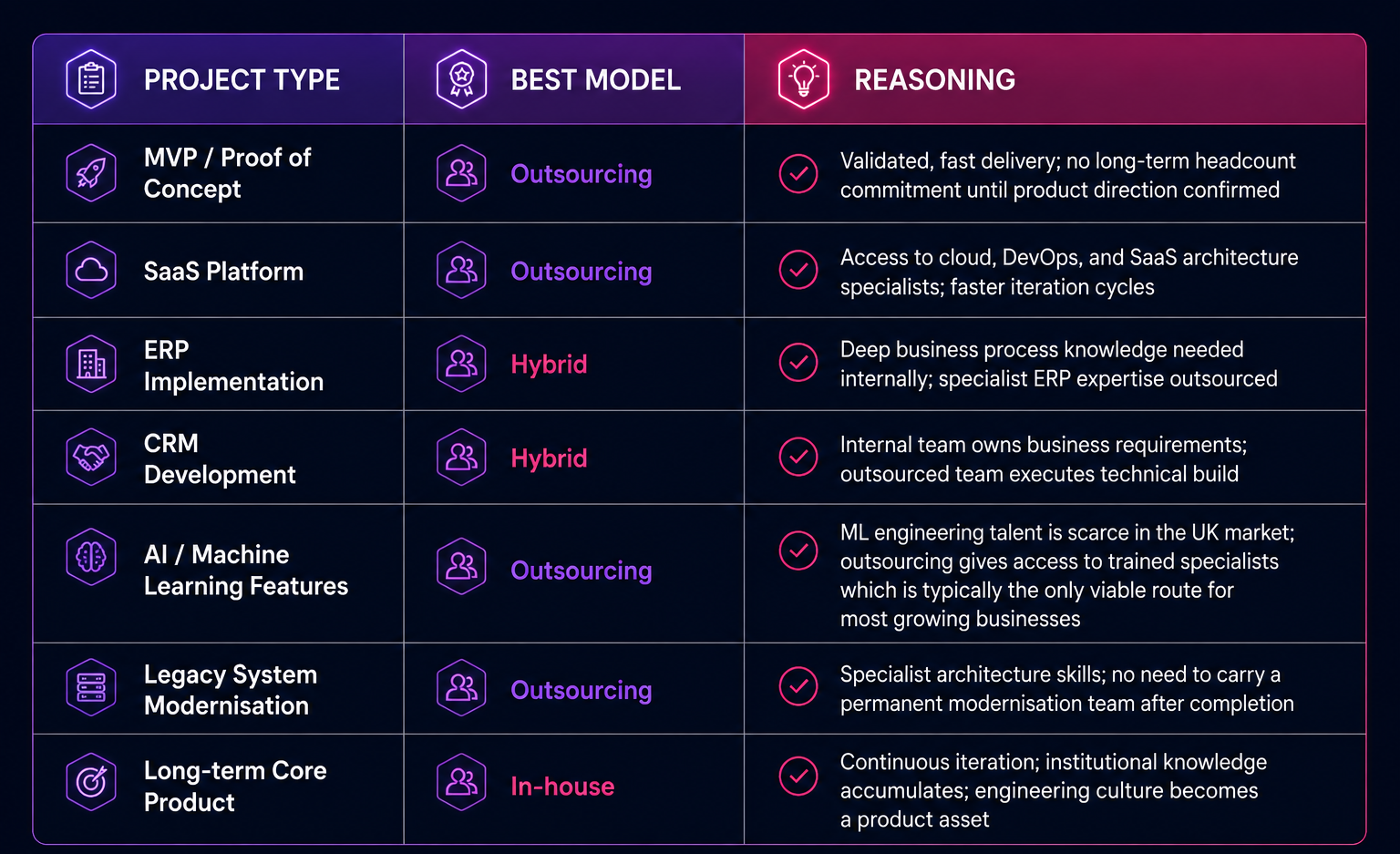
When In-House Development Makes More Sense
There are scenarios where building a permanent internal team delivers a better return than outsourcing. Knowing these conditions matters as much as understanding when outsourcing wins.
Build in-house when your software is the product and requires continuous, daily iteration rather than episodic delivery. If your engineering team is shipping changes every day and the feedback loop between business and code needs to be near-instant, an embedded team that lives inside your company structure delivers value that is difficult to replicate externally.
Build in-house when you are operating in a highly regulated environment, such as financial services, healthcare, or defence, where data handling, compliance audit trails, and security clearance requirements make third-party access to systems genuinely complex.
Build in-house when your IP is the product’s entire commercial value. If your competitive moat is the algorithm, the data model, or the proprietary workflow baked into the software, keeping development inside your walls reduces exposure.
Build in-house when you are at a stage of maturity where engineering culture is a talent magnet. The best engineers in the UK want to work on interesting problems with great colleagues. A strong in-house team attracts more strong engineers in a virtuous cycle that is difficult to replicate through outsourcing.
Build in-house when daily, face-to-face collaboration between product, design, engineering, and commercial teams is a genuine functional requirement, not simply a preference.
When Outsourcing Delivers Higher ROI
Outsourcing wins, and wins clearly, in the following situations.
When your runway does not support the full in-house cost stack. If you are working with a budget that makes the full-time hiring model feel uncomfortably stretched, outsourcing is not the compromise choice. It is the strategically correct one. Fixed overhead at early stage is one of the most common causes of runway compression.
When you need to move faster than hiring allows. In a competitive market, being six weeks faster to launch than a competitor is worth far more than whatever you save by avoiding an outsourcing fee. Speed to revenue is a financial return, and partnering with a custom software development company in the UK that can start delivery within days rather than months is a material commercial advantage.
When you need specialist skills you cannot find locally. The UK developer market is deep but not unlimited. AI engineers, cloud architects, mobile specialists with specific platform expertise, and senior engineers who have built at scale are scarce. Outsourcing gives you access to talent pools that your location or employer brand cannot reach.
When the project has a defined end point. Legacy migration, platform rebuild, third-party integration work, these are finite projects. Hiring permanent headcount to deliver a time-bounded scope means you will carry that cost long after the work is done.
When you are validating before committing. Outsourcing lets you build the first version of something, test it with real users, and decide whether to invest in building an internal team, informed by what the product actually needs rather than what you assumed it would need at the planning stage.
Common Mistakes UK Businesses Make
The mistakes that produce the worst ROI outcomes are predictable and avoidable.
-
Hiring in-house before the product direction is confirmed
Building an engineering team around an architecture that later proves incorrect costs months of time and tens of thousands of pounds to unwind.
-
Choosing the cheapest outsourcing vendor
Low-cost vendors tend to have high rework rates, poor documentation, and weak discovery processes. A vendor who charges 30% less but requires 40% more iterations to reach production-quality code is not cheaper, it is more expensive.
-
Ignoring hidden costs on both sides
Businesses that budget only salary for in-house and only day rate for outsourcing systematically underestimate total cost of ownership. The true cost comparison requires accounting for every line item.
-
Treating outsourcing as staff augmentation
Bringing in individual contractors and managing them yourself is not outsourcing, it is distributed hiring. It carries all the management overhead of in-house without the institutional knowledge benefits. The ROI case for outsourcing depends on engaging a partner who takes end-to-end responsibility for delivery, not just developers who follow your instructions.
-
Skipping discovery
Starting development without a proper scoping and discovery phase is one of the fastest ways to burn budget. Without a clear technical specification, outsourcing projects run over scope, over time, and under quality expectations.
-
Scaling too fast before the model is proven
Whether in-house or outsourced, expanding engineering capacity before the product has validated its core value proposition means you are paying to build features on an unproven foundation.
How Capital Compute Helps UK Businesses Maximise ROI
Capital Compute is built for growing UK businesses that want engineering outcomes, not just engineering resources. Every aspect of how we work is designed to reduce the risk and increase the return on your software investment.
- Engineer-led from day one
- Free discovery, fixed-price estimate in 48 hours
- No subcontracting
- Outcome-based billing
- One-week free trial sprint
- No charges for post-launch bugs
- Proprietary AI-assisted development workflow
- Agentic AI deployments already live
- Code ownership from day one
- Flexible engagement models
Conclusion
ROI in software development is not the same as cost reduction. The model that costs less to start is not always the model that returns more.
For most UK businesses at early and growth stages, outsourcing to a structured engineering partner produces better returns than in-house hiring. It compresses time to market, gives access to senior expertise that the local hiring market cannot match, eliminates fixed overhead that drains runway, and lets leadership focus on the highest-value activities rather than managing a growing internal function.
For mature product businesses with stable roadmaps, strong engineering cultures, and IP at the core of their competitive position, in-house development is often the right long-term model.
For most businesses in between, which is most businesses, a hybrid approach works best: internal product ownership and strategic direction, with outsourced delivery capacity for features, specialist skills, and sprint execution.
The question is not outsourcing or in-house. The question is which model, at this stage, for this project, produces the highest return on the capital you are investing in software. That is the question Capital Compute is built to help you answer.
Ready to find out which model fits your business? Book a free discovery call with Capital Compute and receive a fixed-price estimate within 48 hours.